Wednesday, November 14, 2018
Front Porch Books: November 2018 edition
Front Porch Books is a monthly tally of new and forthcoming books—mainly advance review copies (aka “uncorrected proofs” and “galleys”)—I’ve received from publishers. Cover art and opening lines may change before the book is finally released. I should also mention that, in nearly every case, I haven’t had a chance to read these books, but they’re definitely going in the to-be-read pile.
Veterans Crisis Hotline
by Jon Chopan
(University of Massachusetts Press)
Jacket Copy: The twelve stories of Veterans Crisis Hotline offer a meditation on the relationship between war and righteousness and consider the impossible distance between who men are and who they want to be. A veteran working at the hotline listens to the stories men tell when they need someone to hear their voices, when they need to access a language for their pain. Two men search for the head of a decapitated Iraqi civilian so that they might absolve themselves of the atrocities of war, a Marine hunts for the man who raped his girlfriend, and a teenage son replaces his dead father on the battlefield. With a quick wit and offbeat humor, Jon Chopan takes us from the banks of the Euphrates to the bars and VFW halls of the Rust Belt, providing insight into the Iraq War and its enduring impact on those who volunteered to fight in it.
Opening Lines: Sometimes, when they call the hotline, they want to talk to another vet. They ask for us specifically. They have this perception that only those who’ve seen war can understand the suffering born of it. As far as I can tell, this is a myth. It is, to my mind, like asking the criminally insane to cure one another.
Blurbworthiness: “These twelve stories, each narrated by a different veteran of the Iraq war, divide evenly between the often near-hallucinatory events of that war and the accounts of life back home in its aftermath. Sometimes sad, sometimes horrifying, often hilarious―occasionally all three simultaneously―each story bears down on moments of such searing honesty that it lingers in the reader’s memory as urgently as it lives on the page. This is an unsparing, vital, and completely engaging work of art.” (Sue Miller, author of The Arsonist)
The Nocilla Trilogy
by Agustin Fernandez Mallo
(Farrar, Straus and Giroux)
Jacket Copy: A landmark in contemporary Spanish literature, Agustin Fernandez Mallo’s Nocilla Trilogy—Nocilla Dream, Nocilla Lab, and Nocilla Experience—presents multiple narratives of people and places that reflect America and the world in the digital age of the twenty-first century. In the middle of the Nevada desert stands a solitary poplar tree covered in hundreds of pairs of shoes. Farther along Route 50, a lonely prostitute falls in love with a collector of found photographs. In Las Vegas, an Argentine man builds a peculiar monument to Jorge Luis Borges. On the run from the authorities, Kenny takes up permanent residence in the legal non-place of Singapore International Airport, while the novelists Enrique Vila-Matas and Agustín Fernández Mallo encounter each other on an oil rig. These are just a few of the narrative strands that make up Fernández Mallo’s Nocilla Trilogy. Greeted as a landmark in contemporary Spanish literature, the entire trilogy has not been available in English until now.
Opening Lines: Digital computers are superb number crunchers. Ask them to predict a rocket’s trajectory or calculate the financial figures for a large multinational corporation, and they can churn out the answers in seconds. Bet seemingly simple actions that people routinely perform, such as recognizing a face or reading handwriting, have been devilishly tricky to program. Perhaps the networks of neurons that make up the brain have a natural facility for such tasks that standard computers lack. Scientists have thus been investigating computers modelled more closely on the human brain.
Blurbworthiness: “An encyclopedia, a survey, a deranged anthropology: Nocilla Dream is just the coldhearted poetics that might see America for what it really is. There is something deeply strange and finally unknowable about this book, in the very best way.” (Ben Marcus, author of The Flame Alphabet)
The Gulf
by Belle Boggs
(Graywolf Press)
Jacket Copy: Marianne is in a slump: barely able to support herself by teaching, not making progress on her poetry, about to lose her Brooklyn apartment. When her novelist ex-fiancé, Eric, and his venture capitalist brother, Mark, offer her a job directing a low-residency school for Christian writers at a motel they’ve inherited on Florida’s Gulf Coast, she can’t come up with a reason to say no. The Genesis Inspirational Writing Ranch is born, and liberal, atheist Marianne is soon knee-deep in applications from writers whose political and religious beliefs she has always opposed but whose money she’s glad to take. Janine is a schoolteacher whose heartfelt poems explore the final days of Terri Schiavo’s life. Davonte is a former R&B superstar who hopes to reboot his career with a bestselling tale of excess and redemption. Lorraine and Tom, eccentric writers in need of paying jobs, join the Ranch as instructors. Mark finds an investor in God’s Word God’s World, a business that develops for-profit schools for the Christian market, but the conditions that come along with their support become increasingly problematic, especially as Marianne grows closer to the students. As unsavory allegations mount, a hurricane bears down on the Ranch, and Marianne is faced with the consequences of her decisions. With sharp humor and deep empathy, The Gulf is a memorable debut novel in which Belle Boggs plumbs the troubled waters dividing America.
Opening Lines: The applications arrived, first in a trickle that Marianne could have read in an afternoon, then all at once, in alarming, mailbox-stuffing sheaves. She spent all day avoiding them, swimming in the Gulf of Mexico instead, or reading the stubby, water-damaged Judith Krantz and Stephen King novels she borrowed from the paneled-wood study. The applications covered every horizontal surface in her room: the oak-veneer bureau, the top of the boxy, old-fashioned television, the round Formica dinette table. They splayed across the second double bed’s glossy navy-and-orange bedspread, and blocked the heating and air vents that jutted out below the heavy floral curtains.
Blurbworthiness: “The Gulf is a hilarious and healing novel for these polarized times. Reading it consumed my nights, and gave me hope.” (Tania James, author of The Tusk That Did the Damage)
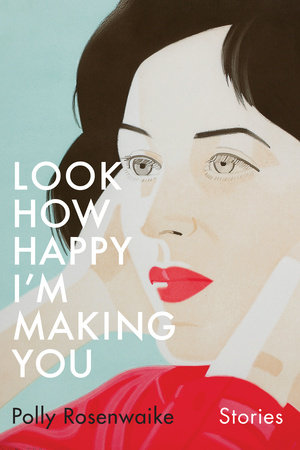
Look How Happy I’m Making You
by Polly Rosenwaike
(Doubleday)
Jacket Copy: The women in Polly Rosenwaike’s Look How Happy I’m Making You want to be mothers, or aren’t sure they want to be mothers, or―having recently given birth―are overwhelmed by what they’ve wrought. Sharp and unsettling, wry and moving in its portrayal of love, friendship, and family, this collection expands the conversation about some of women’s most intimate experiences. One woman struggling with infertility deals with the news that her sister is pregnant. Another woman nervous about her biological clock “forgets” to take her birth control and confronts the reality of becoming a single parent. A new mother with postpartum depression finds comfort with a much younger man. A psychologist who studies infant laughter faces her best friend’s tragedy. Together, these twelve empathetic stories reveal pregnancy and new motherhood in all its anxiety and absurdity, darkness and wonder.
Opening Lines: We are all in love with the baby. We, meaning the #4 bus community, weekdays at the seven o’clock hour, on our way to work and school and early morning errands. The baby wears a royal blue puffy jacket and a striped knit hat. He tracks our shopworn, overly articulated faces. Despite how we caper―tilting and bouncing our heads, scrunching our lips and wriggling our noses, working our hands into frantic waves―the baby gazes at us with his grave baby face. He is chary with his baby gift of a grin, a palm in the air, a mimic, obliging just often enough to lend hope to our campaigns.
Blurbworthiness: “The world wants one story: pregnant glow, new mother tired but ever-grateful, ever-in-love. Without shying away from any of the transcendent and true beauty, Look How Happy I’m Making You shows us the many shadowed layers of pregnancy, miscarriage, birth and motherhood with an insistent bravery and searing honesty.” (Ramona Ausubel, author of Awayland)
The Patch
by John McPhee
(Farrar, Straus and Giroux)
Jacket Copy: The Patch is the seventh collection of essays by the nonfiction master, all published by Farrar, Straus and Giroux. It is divided into two parts. Part 1, “The Sporting Scene,” consists of pieces on fishing, football, golf, and lacrosse―from fly casting for chain pickerel in fall in New Hampshire to walking the linksland of St. Andrews at an Open Championship. Part 2, called “An Album Quilt,” is a montage of fragments of varying length from pieces done across the years that have never appeared in book form―occasional pieces, memorial pieces, reflections, reminiscences, and short items in various magazines including The New Yorker. They range from a visit to the Hershey chocolate factory to encounters with Oscar Hammerstein, Joan Baez, and Mount Denali. Emphatically, the author’s purpose was not merely to preserve things but to choose passages that might entertain contemporary readers. Starting with 250,000 words, he gradually threw out 75 percent of them, and randomly assembled the remaining fragments into “an album quilt.” Among other things, The Patch is a covert memoir.
Opening Lines: You move your canoe through open water a fly cast away from a patch of lily pads. You cast just shy of the edge of the pads—inches off the edge of the pads. A chain pickerel is a lone ambush hunter. Its body resembles a barracuda’s and has evolved to similar purpose. Territorial, concealed in the vegetation, it hovers; and not much but its pectoral fins are in motion. Endlessly patient, it waits for prey to come by—frogs, crayfish, newts, turtles, and smaller fish, including its own young. Long, tubular, with its pelvic fins set far back like the wings of some jets, it can accelerate like a bullet.
Blurbworthiness: “McPhee delights in cracking open subjects, both ordinary and esoteric, and making them accessible to the layperson in works that testify to his virtuosity as one of the greatest living American essayists.” (Publishers Weekly)
Floyd Harbor
by Joel Mowdy
(Catapult)
Jacket Copy: The twelve linked stories in Joel Mowdy’s first book take place in and around Mastic Beach, a community on New York’s Long Island that’s close to the wealthy Hamptons but long afflicted by widespread poverty. Mostly in their teens and early twenties, the characters struggle to become independent in various ways, ranging from taking typical low-paying jobs—hotel laundry, janitorial, restaurant, and landscaping work—to highly ingenious schemes, to exchanging sexual favors for a place to stay. A few make it to local community colleges; others end up in rehab or juvenile detention centers. However loving, their parents can offer little help. Those who are Vietnam veterans may suffer from PTSD; others from the addictions that often come with stressful lives. Neighborhoods of small bungalows—formerly vacation homes—with dilapidated boats in the driveways hint at the waterways that open up close by. The beauty of the ocean beach offers further consolation, as does the often high-spirited temperament of youth. Joel Mowdy brings to his affecting collection both personal experience and a gift for discerning and lingering on the essential moments in his characters’ stories. He intimately and vividly illuminates American lives that too seldom see the light.
Opening Lines: The bungalows on Neighborhood Road, Mastic Beach, had been summer homes, Fire Island a short drive from there via the Smith Point Bridge. Now bicycles built from parts huddled under lock and chain along the concrete stoop of Paul’s Bicycle & Shoe Repair. Their wheels caught clumps of dead leaves in the wind. Baskets of doll heads collected dust among spools of thread and balls of yarn in the neighboring unmarked craft stores, where bundles of cotton had been stacked like sandbags in the window display.
Blurbworthiness: “Of course there’s no harbor in Floyd Harbor, a town untouched by Long Island’s affluence, and these intricately linked stories’ protagonists are dishwashers and salad boys and line cooks, and in rehab and awaiting court appearances; they’re kids from broken homes who left high school to start broken homes. They feel like they’ve never been anywhere, and striving for a little of the comfortable life they’ve glimpsed, they’re the kind of small-time schemers who do most of their thinking in the woods behind the Handy Pantry. But they’ve never given up on hope, and especially love, since it might stop them from rolling blindly through the rest of their lives, and they’re determined to hold out for some acknowledgment of their presence. Joel Mowdy writes beautifully about one part of America left behind in the great heartless scramble that constitutes our society.” (Jim Shepard, author of The World to Come)
Funny Man
by Patrick McGilligan
(Harper)
Jacket Copy: Funny Man is a deeply textured and compelling biography of comedy giant Mel Brooks, covering his rags-to-riches life and triumphant career in television, films, and theater, from Patrick McGilligan, the acclaimed author of Young Orson: The Years of Luck and Genius on the Path to Citizen Kane and Alfred Hitchcock: A Life in Darkness and Light. Oscar, Emmy, Tony, and Grammy award–winner Mel Brooks was behind (and sometimes in front the camera too) of some of the most influential comedy hits of our time, including The 2,000 Year Old Man, Get Smart, The Producers, Blazing Saddles, and Young Frankenstein. But before this actor, writer, director, comedian, and composer entertained the world, his first audience was his family. The fourth and last child of Max and Kitty Kaminsky, Mel Brooks was born on his family’s kitchen table in Brooklyn, New York, in 1926, and was not quite three-years-old when his father died of tuberculosis. Growing up in a household too poor to own a radio, Mel was short and homely, a mischievous child whose birth role was to make the family laugh. Beyond boyhood, after transforming himself into Mel Brooks, the laughs that came easily inside the Kaminsky family proved more elusive. His lifelong crusade to transform himself into a brand name of popular humor is at the center of master biographer Patrick McGilligan’s Funny Man. In this exhaustively researched and wonderfully novelistic look at Brooks’ personal and professional life, McGilligan lays bare the strengths and drawbacks that shaped Brooks’ psychology, his willpower, his persona, and his comedy. McGilligan insightfully navigates the epic ride that has been the famous funnyman’s life story, from Brooks’ childhood in Williamsburg tenements and breakthrough in early television—working alongside Sid Caesar and Carl Reiner—to Hollywood and Broadway peaks (and valleys). His book offers a meditation on the Jewish immigrant culture that influenced Brooks, snapshots of the golden age of comedy, behind the scenes revelations about the celebrated shows and films, and a telling look at the four-decade romantic partnership with actress Anne Bancroft that superseded Brooks’ troubled first marriage. Engrossing, nuanced and ultimately poignant, Funny Man delivers a great man’s unforgettable life story and an anatomy of the American dream of success.
Opening Lines: What made Melvin, the youngest of the Kaminsky kids, so darn funny? Later people said—he himself said—it was Brooklyn, the Depression, being Jewish and growing up in the shadow of Hitler. But there was also something about birth order and the family genes that contributed to “the strange amalgam, the marvelous pastiche that is me.”
Before there was Mel Brooks there were the Kaminskys. The Kaminsky family formed their own little world in Brooklyn, the mother and four brothers living in humble circumstances, the brothers sharing the same bed and crawling over one another like a litter of adorable puppies in a cardboard box, as Brooks often said in interviews.
The Behavior of Love
by Virginia Reeves
(Scribner)
Jacket Copy: Doctor Ed Malinowski believes he has realized most of his dreams. A passionate, ambitious behavioral psychiatrist, he is now the superintendent of a mental institution and finally turning the previously crumbling hospital around. He also has a home he can be proud of, and a fiercely independent, artistic wife Laura, whom he hopes will soon be pregnant. But into this perfect vision of his life comes Penelope, a beautiful, young epileptic who should never have been placed in his institution and whose only chance at getting out is Ed. She is intelligent, charming, and slowly falling in love with her charismatic, compassionate doctor. As their relationship grows more complicated, and Laura stubbornly starts working at his hospital, Ed must weigh his professional responsibilities against his personal ones, and find a way to save both his job and his family. A love triangle set in one of the most chaotic, combustible settings imaginable, The Behavior of Love is wise, riveting, and deeply resonant.
Opening Lines: Ed’s work keeps him late. Yesterday’s pile of incomplete tasks awaits him in his office, and today’s begins the moment he steps from his car. He never knows what the first thing will be, but it always meets him here in the dirt parking lot. Yesterday, it was Margaret wandering toward the Boulder River, whose waters have already drowned one patient. The day before, it was a six-year-old named Devin eating gravel. Today, it’s a young man bursting out the front doors of Griffin Hall, a white plastic chair over his head, a denim-clad orderly close behind. The orderly’s rubber club is raised. The boy drops to the ground and curls himself into a ball. The chair topples down the stairs and scatters a group of patients.
Recent Studies Indicate
by Sarah Bird
(University of Texas Press)
Jacket Copy: When Sarah Bird arrived in Austin in 1973 in pursuit of a boyfriend who was “hotter than lava,” she found an abundance of inspiration for storytelling (her sweetheart left her for Scientology, but she got to taste a morsel of Lynda Bird Johnson’s poorly preserved wedding cake as a temp worker at the LBJ Library). Sarah Bird went on to write ten acclaimed novels and contribute hundreds of articles to publications coast to coast, developing a signature voice that combines laser-sharp insight with irreverent, wickedly funny prose in the tradition of Molly Ivins and Nora Ephron. Now collecting forty of Bird’s best nonfiction pieces, from publications that range from Texas Monthly to the New York Times and others, Recent Studies Indicate presents some of Bird’s earliest work, including a prescient 1976 profile of a transgender woman, along with recent calls to political action, such as her 2017 speech at a benefit for Annie’s List. Whether Bird is hanging out with socialites and sanitation workers or paying homage to her army-nurse mom, her collection brings a poignant perspective to the experience of being a woman, a feminist, a mother, and a Texan—and a writer with countless, spectacular true tales to tell us.
(On a personal and purely egotistical note, I’m especially interested in reading this essay collection because I get a little cameo at one point when Sarah relates the story of the time she passed out just before going on stage to interview Ben Fountain and me at the Texas Book Festival—a scary and embarrassing episode that she somehow turns into high wit.)
Opening Lines: As a pathologically shy child driven by an insatiable curiosity about the world and the fascinating human creatures who inhabit it, I was simultaneously compelled by two deeply opposing forces: (a) I desperately desired to never have to speak to anyone outside of my immediate family and (b) I yearned to quiz every stranger who crossed my path.
Only one profession had the power to grant both of these contradictory wishes. Writing.
Blurbworthiness: “What sets Sarah Bird apart from other writers is the pure joy she gets out of her characters. And she laughs at herself—a lot. You can’t help but grin when you read her, no matter the topic.” (Skip Hollandsworth, author of The Midnight Assassin: The Hunt for America’s First Serial Killer)
Figuring
by Maria Popova
(Pantheon)
Jacket Copy: Figuring explores the complexities of love and the human search for truth and meaning through the interconnected lives of several historical figures across four centuries—beginning with the astronomer Johannes Kepler, who discovered the laws of planetary motion, and ending with the marine biologist and author Rachel Carson, who catalyzed the environmental movement. Stretching between these figures is a cast of artists, writers, and scientists—mostly women, mostly queer—whose public contribution has risen out of their unclassifiable and often heartbreaking private relationships to change the way we understand, experience, and appreciate the universe. Among them are the astronomer Maria Mitchell, who paved the way for women in science; the sculptor Harriet Hosmer, who did the same in art; the journalist and literary critic Margaret Fuller, who sparked the feminist movement; and the poet Emily Dickinson. Emanating from these lives are larger questions about the measure of a good life and what it means to leave a lasting mark of betterment on an imperfect world: Are achievement and acclaim enough for happiness? Is genius? Is love? Weaving through the narrative is a set of peripheral figures—Ralph Waldo Emerson, Charles Darwin, Elizabeth Barrett Browning, Herman Melville, Frederick Douglass, Nathaniel Hawthorne, and Walt Whitman—and a tapestry of themes spanning music, feminism, the history of science, the rise and decline of religion, and how the intersection of astronomy, poetry, and Transcendentalist philosophy fomented the environmental movement.
Opening Lines: All of it—the rings of Saturn and my father’s wedding band, the underbelly of the clouds pinked by the rising sun, Einstein’s brain bathing in a jar of formaldehyde, every grain of sand that made the glass that made the jar and each idea Einstein ever had, the shepherdess singing in the Rila mountains of my native Bulgaria and each one of her sheep, every hair on Chance’s velveteen dog ears and Marianne Moore’s red braid and the whiskers of Montaigne’s cat, every translucent fingernail on my friend Amanda’s newborn son, every stone with which Virginia Woolf filled her coat pockets before wading into the River Ouse to drown, every copper atom composing the disc that carried arias aboard the first human-made object to enter interstellar space and every oak splinter of the floor-boards onto which Beethoven collapsed in the fit of fury that cost him his hearing, the wetness of every tear that has ever been wept over a grave and the yellow of the beak of every raven that has ever watched the weepers, every cell in Galileo’s fleshy finger and every molecule of gas and dust that made the moons of Jupiter to which it pointed, the Dipper of freckles constellating the olive firmament of a certain forearm I love and every axonal flutter of the tenderness with which I love her, all the facts and figments by which we are perpetually figuring and reconfiguring reality—it all banged into being 13.8 billion years ago from a single source, no louder than the opening note of Beethoven’s Fifth Symphony, no larger than the dot levitating over the small i, the I lowered from the pedestal of ego.
Labels:
Ben Fountain,
Fresh Ink,
Front Porch Books,
short stories
Friday, November 9, 2018
Friday Freebie: Shelf Life of Happiness by Virginia Pye
Congratulations to Paul Weidknecht, winner of last week’s Friday Freebie: Catch, Release by Adrianne Harun.
This week’s giveaway is for Shelf Life of Happiness by Virginia Pye, a new short story collection now out from Press 53. Here’s what Jim Shepard, author of The World to Come, had to say about the book: “The characters in Virginia Pye’s Shelf Life of Happiness experience their lives as a tangle they urgently need to understand before it’s too late. These are deft and moving stories.” Three lucky readers will each win a copy of the collection. Keep scrolling for more information on the book and how to enter the contest.
In these bittersweet, compelling stories, Virginia Pye’s characters in Shelf Life of Happiness long for that most-elusive of states: happiness. A young skateboarder reaches across an awesome gap to reconnect with his disapproving father; an elderly painter executes one final, violent gesture to memorialize his work; a newly married writer battles the urge to implode his happy marriage; and a confused young man falls for his best friend's bride and finally learns to love. In each case, Pye’s characters aim to be better people as they strive for happiness--and some even reap the sweet reward of achieving it.
If you’d like a chance at winning Shelf Life of Happiness, simply email your name and mailing address to
Put FRIDAY FREEBIE in the e-mail subject line. Please include your mailing address in the body of the e-mail. One entry per person, please. This contest is open to U.S. addresses only. Despite its name, the Friday Freebie remains open to entries until midnight on Nov. 15, at which time I’ll draw the winning name. I’ll announce the lucky reader on Nov. 16. If you’d like to join the mailing list for the once-a-week newsletter, simply add the words “Sign me up for the newsletter” in the body of your email. Your email address and other personal information will never be sold or given to a third party (except in those instances where the publisher requires a mailing address for sending Friday Freebie winners copies of the book).
Want to double your odds of winning? Get an extra entry in the contest by posting a link to this webpage on your blog, your Facebook wall or by tweeting it on Twitter. Once you’ve done any of those things, send me an additional e-mail saying “I’ve shared” and I’ll put your name in the hat twice.
Thursday, November 8, 2018
When Books Go MIH (Missing in House): One Writer’s Library
Reader: Lisa Romeo
Location: Cedar Grove, NJ
Collection Size: About 1,400
The one book I’d run back into a burning building to rescue: A fill-in-yourself cookbook of my recipes—because it carries an inscription: “To my daughter, who turned out to be a terrific cook!” This surprised Mom because as she always admitted, she was not a good cook.
Favorite book from childhood: Every single one that featured a horse. I’ll have to go with National Velvet.
Guilty pleasure book: Books I only discover after falling in love with the film or TV series the books inspired. Currently, the Call the Midwife memoir trilogy.
I ordered more bookcases last week when I caught myself doing what I vowed I’d never do: piling books on the wing chair I’d confiscated from the living room, claiming I needed a reading chair in my home office. The chair now resembles the basement treadmill—sturdy and parked in a fine spot but rendered useless by its transformation into a holder of stuff. In the chair’s case, it’s books purchased in the past few weeks or those I’d pulled from the shelf for some worthy reason, but when I went to return them to their rightful spot, the spot was gone, overtaken by other books.
I looked around. The chair wasn’t the only warning sign that my home library needed attention.
Piled on a card table were books about fathers and daughters, grief, and death rituals— books I’d read or skimmed last year while writing and revising my recently published memoir, Starting With Goodbye, and/or while writing more about those topics for book publicity months ago. Huh. Thought I’d re-shelved them. The card table itself had been hastily erected as a place to stash other books I’d assigned my online MFA students months ago and needed handy, then promptly forgotten I’d pulled from shelves. Later, I’d go to the appropriate spot, move my index finger along to find one, alphabetically, where it should have been.
Then our son called from college during his first week—as instructed because surely most of the books assigned in his 20th Century American Literature class were on my shelves, saving us both a wad of cash. Instead, I discovered the stash of classics I absolutely know I had somewhere, were apparently elsewhere.
Books are often MIH. Missing, but In the House. Somewhere.
For someone with nearly 100 linear feet of book shelf space, it probably shouldn’t be this way.
Six years ago, the home office/library of my dreams took shape. I did the imagining, my dear husband did the work: painting the walls red, the window trim and door white; measuring, then assembling eight black bookcases; moving a white-and-butcher-block glass-fronted cabinet up from the kitchen. I dislike desks so we floated a black wood dining table in the center of the room so every bit of wall space could be given over to books.
I drafted one son and for two days we organized, alphabetized, and shelved some 1,000 books. All the novels together, followed by short story collections. Then the narrative nonfiction, memoirs, and essay collections by a single author. A separate slim bookcase was devoted to essay anthologies. In the white cabinet: two shelves for poetry, three for books on writing craft, one for language and style reference. Finally, there were two shelves for stuff I’d written myself (before my book), that appeared between physical covers, plus books by editing clients.
Back then, there were empty spaces at the end of many shelves which I filled with mementos, travel trinkets, photos, and Mom’s Waterford candy jars filled with shells and pretty rocks.
It seemed like enough space. So much space, after 23 years working in that same home office with drab hand-me-down, beige office shelving designed to hold anything but books.
It wasn’t enough space.
Slowly, the bits of art and ephemera gave way to newly-acquired books. When all the linear space was full, I began laying books horizontally on top of standing books, then eventually, sadly, stacking books in front of other books. Mind you, each time I get to the end of a 10-week writing class I teach four times a year, I cull the collection, yanking out a dozen books to give away to students. It doesn’t help much.
From where I sit writing in my home office, I watch the light traffic on my suburban street. Recently I tried to think of a week when the UPS van didn’t stop to drop off books, or I didn’t arrive home from a conference, bookstore appearance, or book festival without an armful. No such week existed in my memory. (Some weeks, no such day exists.)
I haven’t even mentioned the bookcases in the breakfast nook holding cookbooks, the one in the living room stacked with travel and local history. Or the baskets in two bathrooms holding trivia and joke books. Or the shelves in the basement where my sons stack books they want to be rid of, awaiting my sorting into bags for the hospice shop, friends with younger children, and book drives.
My fiction shelves are mostly well-behaved; novels rarely go MIH. I read only one novel at a time and return it to its place according to the author’s last name within days. Poetry books and writing craft books don’t generally go missing either but if they did, I wouldn’t realize it right away since I don’t impose alphabetical shelving there. When I want to read a particular poem again, I likely have a vivid memory of the book’s cover and search that way. Craft and writing reference books seem to self-sort into most-consulted at one end of the shelf, and infrequently-thumbed at the other.
What I’m challenged by are the 27 shelves, always full, overflowing, haphazard, holding nonfiction prose, shelves that begin alphabetically but devolve into chaos. I tend to read—or skim, study, search through—about six different nonfiction books at a time. They could be anywhere—in the pool bag, on my night table, in the car, under a pillow on the family room couch. Shelved in the wrong place. I blame not having my glasses handy, ever. Or if I’m tired, I might re-shelve P after R. Put a single-author essay collection on the anthology shelf, drop a memoir by a multi-genre author alongside her novels.
The nonfiction shelves are where at 3:00 a.m. I once decided to reposition some physical shelves, pulled out about 300 books, judged wrong about shelf height, and so now some books are (horrors!) shelved horizontally. It’s where gaps might mean the book is in a pile meant for research or teaching. The nonfiction shelves are also where I’m perplexed by a “missing” title until I realize I meant to buy it, thought I bought it, but didn’t (yet) buy it.
I did find all the classic novels that my college son called about (okay, two weeks too late), neatly stacked (though behind several trophies) in a bookcase in the elder son’s room, where of course I’d suggested he keep them until his brother needed them. Shouldn’t they be back in my office? Of course. Alas, where to put them and the 50-odd other currently shelf-less books?
First, I consult my husband, whose regular job demands he organize a sizable wholesale warehouse for maximum storage and efficiency. How, dear, can we cram in more shelves, more books? He pulls out the measuring tape and yes, we can squeeze one of the narrowest, tallest bookshelves between the window and the closet door, and another next to the wing chair.
But honey, he said ever so gently, you don’t really have a bookshelf problem. You have a book-buying problem.
How could I explain? I don’t have a book-buying problem. I have a library.
Lisa Romeo is the author of Starting with Goodbye: A Daughter’s Memoir of Love after Loss (University of Nevada Press). Her short work is listed in Best American Essays 2018 and 2016, and has appeared in the New York Times, O The Oprah Magazine, Longreads, Brevity, Under the Gum Tree, and many other places. Lisa teaches with the Bay Path University MFA program and earned her MFA from Stonecoast. Connect on Twitter, Facebook, Instagram, or at her website.
My Library is an intimate look at personal book collections. Readers are encouraged to send high-resolution photos of their home libraries or bookshelves, along with a description of particular shelving challenges, quirks in sorting (alphabetically? by color?), number of books in the collection, and particular titles which are in the To-Be-Read pile. Email thequiveringpen@gmail.com for more information.
Tuesday, November 6, 2018
America, You Know What to do Today
Government by the people is, in the end, an “affair of calculation,” a math problem: Who votes? How much does each vote count?
Jill Lepore, These Truths
(Not sure where to go to mark your ballot? The #BooktheVote website will help point you in the right direction.)
Sunday, November 4, 2018
Sunday Sentence: Beautiful Country Burn Again by Ben Fountain
Simply put, the best sentence(s) I’ve read this past week, presented out of context and without commentary.
Trump is good, so good that I half expect myself to be taken with him, to feel some glimmer of inclination toward the optimistic view, but the prevailing mood is dread, dread bordering on depression. Then the thought arrives fully formed, without effort, without joy or pleasure either, just this final, crude certainty like a hammer coming down: Donald Trump, plainly and simply, is full of shit.
Beautiful Country Burn Again by Ben Fountain
Saturday, November 3, 2018
Scenes From a Marriage: First Sight
![]() |
| Shutterstock |
It was a perfect late May morning: the air was crisp and cool as the other side of the pillow, clouds were a garden of white blooms, and birds were soundtracking the day with every ounce of air in their tiny lungs. Everywhere you looked in Jackson that day, the molecules of the air sang This day will be bright as a Colgate smile. The town felt ripe with possibility.
I couldn’t wait to get out of there.
I’d returned to my hometown after my sophomore year at the University of Wyoming—nine months during which I got a girlfriend, lost a girlfriend, longed for a girlfriend, stared too hard and creepily at certain girls in my psychology class, snaked my fingers into one girl’s pants and under the bra of another, and then—finally, finally—lost my virginity in my dim dorm room….only to have that girl, Becky, drift away with disinterest in a matter of less than two weeks.
Becky was the one who finally undid me. She burned my heart until it tasted bitter and angry. Romance was now nothing but a charred piece of meat on a plate in front of me.
After being dumped by what I thought was my first true and committed lover, my eyes stopped wandering and I clenched tight inside myself. I vowed to have nothing to do with women. Ever again.
“I’m through,” I told my friend Randy. “I’m done, done, done with girls. From now on, I focus inward, taking care of myself, looking out for Number One and all that crap.”
Randy slid his gold-rimmed glasses back up the bridge of his nose and did his best to hold in a knowing smile. “Sure,” he said. “Whatever you say.”
This was near the end of the spring semester in Laramie and to Band-Aid my heart, I plunged headfirst into my classwork. I roused myself from a spiritual torpor that had seemed to spread like cancer in me for the past eighteen months of collegiate life. It’s like I’d broken out of a fever that had held me in a sweaty dream, demanding my attention at the cost of everything else. I felt renewed in my fresh determination to forge ahead as a single person moving through life unencumbered and free from distraction. Girls were the disease I no longer wanted to catch.
* * *
When the semester ended, I returned home to Jackson, reluctant and dragging my feet. Moving back in with my parents was contrary to my new life plan as a footloose and fancy-free single man (determinedly single). I didn’t want to return to living in my bedroom with its childsize bed and all its humid teen love agonies.
But I had to go back. It was strictly a financial decision. I had $200 to my name and couldn’t afford to pay rent anywhere in Laramie, so I prodigaled my way back to Jackson. My father, the Baptist minister, gave me one of his trademark one-armed sidehugs and grunted against the top of my head, “Good to have you back.”
I consoled myself with the thought that it would only be for a short time. I’d already laid my escape plans. As a theater major, I had Hollywood dreams (what theater major doesn’t?). My friend Tupper Cullum, a fellow actor from the previous summer when we’d both appeared on stage at Dirty Jack’s Wild West Theater in Jackson, had found work in Denver and invited me to come along on this budding-thespian adventure.
Tupper, a tall, muscular fellow with a smooth-as-cream-cheese Southern accent, was fun to be around. He had a soft manner, but was always quick with a dry-wit joke and wry grin. I looked up to him as a big brother, a potential mentor who might bring me along with him on whatever breaks in the acting profession were to be had in Denver. This could be the start of something big, I told myself. That’s how I thought in those days, in wide-eyed naiveté like I was a backstage ingénue in a 1930s movie about a small-town girl longing for a big-city break. In my crazed young mind, I seriously thought of Denver as a stepping stone paving my way to H-wood. It was a tiny paving stone, but a stone nonetheless.
Press the Pause button, buddy. Tupper couldn’t go to Denver until the end of June. He’d already planned to be in Alaska for a theater repertory workshop and wouldn’t be traveling back through Wyoming before the end of the month.
“That’s okay,” I told him on the phone. “I’ll just hang out at my parents’ place in Jackson until you’re ready.”
All the time, I wondered what I would do with myself for the next month and a half.
How’s that saying go? Life is what happens when you’re busy making other plans…
* * *
As I walked into my father’s church that perfect May morning, the lawn sparkled with diamonds of dew. I’d cut the grass the day before as a favor to my father and I could still smell the slightly sour earthiness rising from under my feet. The morning felt like it could turn out to be beautiful with birdsong, moist grass blades, and crystalline skies.
As I walked up the steps and entered the church, I noticed none of that beauty.
I was thinking of charred and smoking hearts.
I was thinking of girls betraying me with flamethrowers, scorching my earth.
I was thinking of avenues of escape.
I was thinking of doors and windows, how when God closes one He opens another.
What I wasn’t thinking about was destiny and fate and the random intersection of lives.
I’d celebrated my 20th birthday two days earlier by going to see Monty Python’s The Meaning of Life at the Jackson Hole Cinema. But right at this moment, I felt like my own life had no meaning. Two weeks earlier, I wrote, inscrutably, in my diary, “Someday soon, I’ll just step into the elevator of blackness and hit the button for the ground floor.”
I was handed a church bulletin by an avuncular usher who greeted me with a too-cheery, “Welcome home! Glad to see you’re back for the summer.”
I nodded and thought to myself, This is only a whistle stop, buddy. I’m just pulling into the station to catch my breath before I head on down the tracks to my destination.
I took my place in my usual pew—halfway back on the right hand side—so that I could be inconspicuous but not appear to my father that I was looking for a hasty exit after the service. Which, truth be told, I was.
By this point in my life, I treated church attendance as an obligatory, check-the-box chore I performed for the pleasure of my parents. They suspected I had spent my college years wandering away from the flock, a black sheep exploring a different meadow on his own. What they didn’t know, and never would, was that I’d lost my virginity a couple of months earlier—desecrated the holy temple of my body without the sanctity of marriage. I’d also started going out to bars and smoking cigarettes—habits I tried to keep hidden from them, but deep down knew it was futile. I mean, my clothes reeked of nicotine. And it was impossible not to hug my mother. She’s just that kind of person.
When I returned home that summer, I was different—and proud of it. I’d seen James Dean on screen for the first time earlier that year, when the tiny arthouse theater in Laramie, Trout Cinema, showed all three of his movies in a mini-filmfest. He was the coolest, the ab-so-lute coolest dude I’d ever seen. I started modeling my behavior on his: I cupped my cigarettes in the palm of my hand like he did; when I wore my winter jacket, I flipped up my collar and smirked at the world over its edge like he did; I squinted my eyes and adopted a tortured look like he did. I was a rebel with a cause: I was no longer the polite, sissy preacher’s kid. I was the new cool kid on the block.
I was too blind to see my tough James Dean persona was just a thin veneer over my ongoing insecurity.
As I sat there in the church pew waiting for the service to begin, I squinted my eyes and hardened my face against the rest of the congregation: kind old ladies I’d grown up with were now smiling in happy recognition of my homecoming; and their husbands with thinning hair and once-a-week fancy church clothes were likewise grinning and winking in my direction. I nodded back coolly and then pretended to have a sudden interest in reading the church bulletin.
The log-built church smelled of lemon-scented furniture polish, dusty hymnals, and once-a-week wardrobes. Its thick timbers creaked and groaned as they expanded with the day’s growing warmth. All around me came the rustle of bodies and the crinkle of wrappers from hard candies older ladies gave to their grandchildren quiet them during the service.
My father entered and mounted the steps to the pulpit. He looked out across the congregation, found me in my usual spot, and gave a curt nod of recognition. I was where he wanted me to be.
But I was far from wanting to be where I was at that moment.
I sighed. Only another fifty-five minutes to go and then I was out of there.
The organist struck the first notes of the Prelude and, on cue, the choir members started filtering in to the room. My father had a showy tradition of having the robed choir members enter the area behind the pulpit from entrances at the front of the church, one on each side of the pulpit area. As the organist and pianist started playing the first hymn, the choir would climb from their backstage waiting area in the basement, two lines of amateur singers who forced the notes from their throats with all the lusty fervor of the birds outside. They filtered in single-file from each side like a line of ants, then took their places in the choir loft.
I glanced up from my bulletin and saw they were the same old crowd of the usual suspects: the heavily-permed ladies, the tall thin men, the altos, the sopranos, the baritones, the thickset men of the bass section. I’d grown up watching them week after week, leading us in the hymns and performing the once-weekly “special music” when the offering plates were being circulated by the deacons halfway through the service.
The line of familiar ants marched into the choir loft and I started to yawn.
But then, but then, but THEN!!
My mouth froze mid-yawn.
There was a new choir member.
A girl, a woman, a beauty.
Thunder clapped across my heart, my brain went blank, my eyes melted.
She was in the back row, half-hidden behind Steve C., a county surveyor, and Barb T., an elementary school teacher. I shifted in my pew, straining for a better look.
Holy crap! There was a new girl in town—someone close to my age—and my parents hadn’t bothered to mention her to me in the week I’d been back? What the hell?! I’d have to have a serious talk with them when I got home.
I suddenly hated the fact that “love at first sight” was a cliché because it had just come true and I knew that no one in all the years to come would ever believe me when I say it happened to me on that gorgeous dewy day in June in the Year of Our Lord 1983.
Her eyes, her eyes, her eyes. Even from halfway back in the congregation, a distance of fifty yards, I could see them, rounded and darkly-lashed with mascara. I could tell right away they were eyes that engaged with the world, peering into life and drawing unsuspecting souls (like mine!) into their orbit.
That mouth, that mouth, that mouth. It was full-lipped, but not too wide, not too tight. It was the kind of shapely mouth that, I suspected, held back a deep and wondrous voice.
Her hair, her hair, her hair. Dark blonde curls cascaded and tumbled and rolled down to her shoulders. Those strands beckoned my hands and I knew, if given the chance, my fingers would romp with delight in the soft folds and ringlets they found there.
By this point, my James Dean coolness lay in smoking ruins at my feet.
I realized my mouth still hung open in the unfinished yawn and I snapped my jaws shut. The bulletin was a soggy sweat-mess in my hands.
Oh my Lord, I whispered—and not in a reverent churchy way.
Needless to say, I heard nothing of my father’s sermon that day. The only part of the service which had my full attention was the special music during the offertory when the choir stood—when she rose!—and delivered the day’s song, adding her voice to the choir’s overall off-key-ness, which to me at that moment sounded as perfectly tuned as an angel’s harp. My heart kept beat with the one-two-three, one-two-three syncopation of the choir director’s arms. For me, church was over when the choir sat down and my father took the pulpit for his sermon.
My life had just ended and begun afresh at the same time. It’s like God took a pen and pressed it against that tiny red reset button at the back of my head.
I had no idea who this mystery girl was, but I would employ every skill I’d learned from Nancy Drew, Encyclopedia Brown, and Hercule Poirot to find out.
Little did I know that six months later—almost to the day—I would walk out of that church with that woman beside me. She’d be wearing white and I would be the happiest man alive.
Excerpted from the early draft of my current work-in-progress, a memoir about my marriage to Jean. Spoiler: we celebrate 35 years of marriage exactly one month from today.
Friday, November 2, 2018
Friday Freebie: Catch, Release by Adrianne Harun
Congratulations to Carl Scott, winner of last week’s Friday Freebie: Evergreen Tidings From the Baumgartners by Gretchen Anthony.
This week’s giveaway is for Catch, Release, the new short-story collection by Adrianne Harun, author of A Man Came Out of a Door in the Mountain. Tim O’Brien had this to say about the new story collection: “Catch, Release is brilliant. Masterly brilliant. Tour de force brilliant―the crystalline prose, the characters who dive off the page and splash down into the reader’s heart, the islands and water and sunlight and sand and trees that are as astonishingly real as last night’s dreamscape, the moral complexities and contradictions of human beings in contest with the devil, the pitch-perfect sounds of desperation and joy and terror and triumph and unspeakable loss, the smells of fish and salt and sand and musty old farmhouses. As a whole―and these wonderful stories demand to be read as a whole―Catch, Release will break your heart and then mend it and then break it again. This book will endure.” Keep scrolling for more information on the book and how to enter the contest. And be sure to check Adrianne’s account of her “first time.”
In Catch, Release, Adrianne Harun’s second story collection, loss is the driver. But it’s less the usual somber shadow-figure of grieving than an erratically interesting cousin, unmoored, even exhilarated, by the sudden flight into emptiness, the freedom of being neither here nor there. In this suspended state, anything might happen―and it does. Harun’s most realistic stories are suffused with mystery, while her more fantastic tales reveal startling truths within the commonplace. In diverse settings that include, among other places, a British Columbian island, a haunted Midwestern farmhouse, a London townhome, and a dementia care facility overpopulated with dangerously idle guardian angels, characters reconfigure whole worlds as they navigate states defined by absence. In “The Farmhouse Wife,” a young couple, struggling financially, takes up residence in a near-abandoned farmhouse, only to be joined by an inconvenient roommate, a woman whose own bereft state proves perilously seductive. A kleptomaniac father gets caught in one of his petty thefts in “Pearl Diving,” propelling his two sons out of one life into another, perhaps more appropriate, one. In “Madame Ida,” a family of little girls steadily invades a woman’s life as she puzzles out the mysteries of a missing sheriff-turned-cult-leader and the absence of her own son. And in the title story, two teenagers face off against the hurtful lies of an ancient con woman who is mining a widow’s grief for her own ends. Adrianne Harun has been described as an exacting and attentive stylist whose stories are rendered in vivid language. The Los Angeles Review of Books wrote of her work: “Harun finds beauty in pitch black; she makes poetry out of brutality and grace out of terror. She is an alchemist, turning the worst aspects of life into gold.” With Catch, Release, Harun upends the world once more.
If you’d like a chance at winning Catch, Release, simply email your name and mailing address to
Put FRIDAY FREEBIE in the e-mail subject line. Please include your mailing address in the body of the e-mail. One entry per person, please. This contest is open to U.S. addresses only. Despite its name, the Friday Freebie remains open to entries until midnight on Nov. 8, at which time I’ll draw the winning name. I’ll announce the lucky reader on Nov. 9. If you’d like to join the mailing list for the once-a-week newsletter, simply add the words “Sign me up for the newsletter” in the body of your email. Your email address and other personal information will never be sold or given to a third party (except in those instances where the publisher requires a mailing address for sending Friday Freebie winners copies of the book).
Want to double your odds of winning? Get an extra entry in the contest by posting a link to this webpage on your blog, your Facebook wall or by tweeting it on Twitter. Once you’ve done any of those things, send me an additional e-mail saying “I’ve shared” and I’ll put your name in the hat twice.
Wednesday, October 31, 2018
Scary as Sheet: Ghost Stories For My Halloween
I live in a house that has good potential to breed ghosts. Built in 1920, the Craftsman home on a quiet tree-lined street in Butte, Montana, is a jigsaw puzzle of dark corners, cobwebbed crawlspaces, drafty closets, an obsolete coal chute, and narrow, twisting staircases that send one’s mind reeling with vertigo. In the basement lurks a big-bellied, multi-armed and asbestos-lined furnace that, when it gleams with inner fire, looks like a mechanical beast out of Jules Verne. And one hears things. At night, the radiators tick like approaching high heels. The blowsy curtains shift from side to side, in a breezeless room. There are creaks, there are hums, there are papery whispers behind one’s back.
The house has seen its share of stories, passing through several different Butte families before us, including one owner, a well-known married ophthalmologist, who met a scandalous end when he was killed in a car accident, along with an 18-year-old female passenger. In an unofficial history left by previous owners, there’s a winking little addendum to the story: He was known for his wandering eye and partying ways.
Like I said, stories have attached themselves to this house. And I believe some characters from those stories still live here.
During one visit, my daughter tripped near the top of one of those spiral staircases, barely catching herself in time from falling. She swears she was nudged from behind. A distinct push against the middle of my back. She was alone in the house at the time.
Houses contain us, we live our lives in them, and it is not surprising that they might continue to shelter us after we die. We are attached to our homes, perhaps so much that we cannot leave, even though we are dead. A haunted house has an emptiness that is filled by the inappropriate or unnatural. A house can lose its soul, a house can go bad. Houses can be monuments to personality, we inflict our tastes upon them, but they can afflict us with their perversity in return. Ghosts can be like vermin–pests to be driven away or exterminated. We are anxious about our houses. Even the most conciliatory, helpful house can become supernaturally burdensome.I don’t know if I’m supernaturally burdened in my house or if those noises in the other room are just noises, but I do know I suck a lot of pleasure out of that paragraph from Audrey Niffenegger’s introduction to her excellent collection, Ghostly, which is one of the books I’ve been reading this past month to get me in the mood for Halloween.
Ghostly begins with “The Black Cat.” It has been years–decades–since I read Edgar Alan Poe’s classic, and Niffenegger was smart to open her roster with this one because I felt those spinal chills all afresh as if for the first time when I read these words from the narrator (murderer and terrible pet owner) when he overconfidently bangs against his cellar wall as a show of bravado in front of the investigating policemen:
“Gentlemen,” I said at last, as the party ascended the steps,” I delight to have allayed your suspicions. I wish you all health, and a little more courtesy. By the bye, gentlemen, this–this is a very well constructed house.” ( In the rabid desire to say something easily, I scarcely knew what I uttered are all.)–“I may say an excellently well constructed house. These walls–are you going, gentlemen?–these wall are solidly put together,” and here, through the mere frenzy of bravado, I rapped heavily, with a cane which I held in my hand, upon that very portion of the brick-work behind which stood the corpse of the wife of my bosom.
But may God shield and deliver me from the fangs of the Arch-Fiend! No sooner had the reverberation of my blows sunk into silence, than I was answered by a voice from within the tombs!–by a cry, at first muffed and broken, like the sobbing of a child, and then quickly swelling into one long, loud, and continuous scream, utterly anomalous and inhuman–a howl–a wailing shriek, half of horror and half of triumph, such as might have arisen only out of hell, conjointly from the throats of the dammed in their agony and of the demons that exult in the damnation.
The book only gets better from there. Shivery standouts include short stories by Edith Wharton, Oliver Onions (funny name, creepy story), A. M. Burrage, A. S. Byatt, and Neil Gaiman, whose “Click-Clack the Rattlebag” is an icy stab to the heart. I don’t want to spoil anything for the virgin reader, but these lines near the end really sent me over the edge:
He pushed open the door to the attic room. It was perfectly dark, now, but the opening door disturbed the air, and I heard things rattle gently, like dry bones in thin bags, in the slight wind. Click. Clack. Click. Clack. Like that.
Ghostly also briskly re-introduced me to Saki and his equally-brisk pleasures. “Laura” and “The Open Window” are both delights in narrative wordplay, trickery, and compression. Especially the latter. Saki gets the job done in the time it takes some writers (present company included) to merely warm up the pen.
Niffenegger closes Ghostly with Ray Bradbury’s “There Will Come Soft Rains” (updated here to “August 2026”). As she writes in her introductory note: “Perhaps this is not a ghost story at all, but I like to think it is. It is a story of the ghost of a house and the ghost of a civilization. It is a warning and a parable. Of all the stories in this book, it is the most possible.”
The story moves like a roving camera, in one take, through a day in the life (and death) of a house which has miraculously survived a nuclear attack. The house lived, but nothing else did:
The house stood alone in a city of rubble and ashes. This was the one house left standing. At night the ruined city gave off a radioactive glow which could be seen for miles.
Ten-fifteen. The garden sprinklers whirled up in golden founts, filling the soft morning air with scatterings of brightness. The water pelted windowpanes, running down the charred west side where the house had been burned evenly free of its white paint. The entire west face of the house was black, save for five places. Here the silhouette in paint of a man mowing a lawn. Here, as in a photograph, a woman bent to pick flowers. Still farther over, their images burned on wood in one titanic instant, a small boy, hands flung into the air; higher up, the image of a thrown ball, and opposite him a girl, hands raised to catch a ball which never came down.
The five spots of paint—the man, the woman, the children, the ball—remained. The rest was a thin charcoaled layer.
The gentle sprinkler rain filled the garden with falling light.
A house also featured prominently in my TV watching in October. The Haunting of Hill House was only nominally, tangentially related to the novel by Shirley Jackson, and it took my wife and I a couple of episodes to really get into the Netflix series, but when we did, we were sucked in, as helpless as poor little Carol Anne splaying her fingers across the television screen in Poltergeist. There were plenty of legitimate jump scares that had me choking on my candy corn, but more than anything The Haunting of Hill House succeeded as–get this–a tender story about the bonds of family and how to deal with grief and guilt. The scares melt to schmaltz in the final episode as the denouement swerves like a car on an icy road toward a tree called This is Us, but even that isn’t enough to dampen the series’ well-earned sentiment of family first, even unto death.
I also appreciate how the Netflix series was kind enough to include a few patches of text lifted directly from Jackson’s famous opening/closing lines:
Hill House, not sane, stood by itself against its hills, holding darkness within; it has stood for eighty years and might stand eighty more. Within, walls continued upright, bricks met neatly, floors were firm, and doors were sensibly shut; silence lay steadily against the wood and stone of Hill House, and whatever walked there, walked alone.
I concluded my Halloween reading jag with Dolly by Susan Hill. While I wouldn’t rate it as highly as I would her previously ghost story novella, The Man in the Picture, Dolly does have its moments. Hill creates a soupy, chilly atmosphere of an isolated house out on the fens in Britain. She writes: “Empty houses breed fantasies, bleak landscapes lend themselves to fearful imaginings.” There are some superb, evocative descriptions which all combine to create some tense scenes surrounding temperamental children, a too-large mansion, and an unappreciated gift, a doll. And don’t even get me started on the rustling of tissue paper.
Speaking of odd noises, I just heard something strange coming from the other room. I’m gonna go check it out and then I’ll be right back.
Labels:
Butte,
Edith Wharton,
Ray Bradbury,
reviews,
short stories
Monday, October 29, 2018
My First Time: Jenn Stroud Rossmann
The First Time I Took Myself Seriously
The first time I went to a weeklong writers’ workshop I was still in grad school, before jobs and kids and various responsibilities kicked in. Since I was working toward my PhD in mechanical engineering, a week at Squaw Valley felt like a glorious moment of finding my people while visiting a land where words were the currency. I felt instantly at home. There’s a reason they call it the Squaw Valley “Community of Writers.” But, because I was still in the suspended half-reality of grad school, I didn’t yet know how special, wondrous, and rare this experience was. Also, there were hot tubs and mountains and wine. It was late-90s northern California, in the middle of another gold rush (several of my lab-mates had side hustles daytrading), and we were invincible.
After Squaw Valley, I buckled down and finished my thesis; I got a job teaching engineering with the marvelously clever students at Harvey Mudd College. I had wonderful colleagues and a little bungalow in Pasadena, and I was trying to get tenure. I wrote on the weekends, or late at night after finishing my grading. But I was very much an engineering professor whose “hobby” was writing fiction. (And reading it: I subscribed to several litmags, and read a few novels a month.) In the meantime, the veins of gold dried up, and several California universities froze hiring. So my husband’s faculty job, when it came, was across the country, in New Jersey. We moved, I found a new position, and I was back at the starting line of the tenure track. Then, we had children.
This is how some novels get written: after the “real work” is done; at naptime; in the car while you’re waiting for ballet class to get out; when your husband sees you getting twitchy and takes the kids to the park for a canoe. I wrote stories and novels this way, on the side and in the margins, and I sent them out. I got some useful feedback, and some not-so-useful. I slid a lot of manuscripts into the drawer. My children grew, and I started to feel more confident about my odds of earning tenure.
I had been automatically deleting those emails from Squaw Valley about each summer’s re-convening of the Community of Writers, and—after a wistful sigh, and a little wave of ennui, those about other conferences and residencies. (I never took the step of unsubscribing. I may be a bit of a masochist when it comes to ennui.)
Then, twelve years after Squaw Valley, I decided to apply to Tin House’s summer workshop. It would be in July, in Portland, Oregon; in August, I would compile and submit my tenure file. I made a pro-and-con list. I shopped for daycamps that my young daughters could attend while I was gone. Here’s what cinched it: my capable husband said, We got this. My best friend back in California said, I’ll meet you there. My mother said, Use my frequent flier miles. My in-laws said, What took you so long.
The week of workshops with the legendary Jim Shepard was transformative. The craft talks and readings were edge-of-seat, can’t-take-notes-fast-enough terrific. (This must be what it feels like to get an MFA, I thought.) My fellow writers were generous, subversive, hilarious. And not all of them were shockingly young, with jetpacks strapped to their backs as they counted down to career rocket-launches. Some, like me, had other lives, other jobs. (I called home each night to hear my daughters’ sweet, vulnerable voices, usually during happy hour.) We called it wordcamp, recognizing the ephemerality of our time together.
All of us recognized each other as fellow citizens of this world of words. The work of both workshoppers and faculty was dauntingly excellent, so the week didn’t exactly build my confidence in my own writing. But it was a homecoming. The week reminded me how alive I felt in this world: performing a close reading of a story; discussing stories and novels; hearing lyrical poetry read aloud; watching as Luis Alberto Urrea dropped his new novel to the ground and performed the first chapter from memory, in character(s).
I soaked it all in, sat marinating on the plane ride home, then faced a week of agonizing detox on re-entry to Real Life. I resolved to figure out how to bring writing out of the margins. A slow learner, I realized only gradually that if I could visit this country of Wordland again—whether it was in Oregon, or Brooklyn, or California, or Chicago—I could reconnect with my people, practice my conjugations in the native language, cobble together something like a DIY MFA, and eventually learn how to conjure this feeling at my very own desk: I belong here, I’ve knit something of words, and I believe I may be able to strengthen it, today.
Jenn Stroud Rossmann is the author of the new novel The Place You’re Supposed to Laugh, set in Silicon Valley in 2002. Kate Racculia, author of Bellweather Rhapsody, says it is “acutely observed, full of wit, keen insight, and compassion.” Rossmann writes the essay series “An Engineer Reads a Novel” for Public Books. Her stories have appeared in Hobart, Jellyfish Review, Tahoma Literary Review, failbetter, and other magazines. Her work has been a finalist for honors including the BOA Editions Short Fiction Prize, the Disquiet Literary Prize, and Sarabande Books’ Mary McCarthy Prize. She earned her BS and PhD at the University of California, Berkeley, and is a professor of mechanical engineering at Lafayette College. You can find her online at www.jennstroudrossmann.com
My First Time is a regular feature in which writers talk about virgin experiences in their writing and publishing careers, ranging from their first rejection to the moment of holding their first published book in their hands. For information on how to contribute, contact David Abrams.
Sunday, October 28, 2018
Sunday Sentence: American Radiance by Luisa Muradyan
Simply put, the best sentence(s) I’ve read this past week, presented out of context and without commentary.
If sadness were a fruit
It would be a sadberry
which is related to the blueberry
but sadder.
“Clams” from American Radiance by Luisa Muradyan
Subscribe to:
Posts (Atom)