Showing posts with label poetry. Show all posts

Sunday, August 2, 2020

Sunday Sentence: Homie by Danez Smith


Simply put, the best sentence(s) I’ve read this past week, presented out of context and without commentary.


       someone dragged the screaming boy
       so deep into the woods he sounds like the trees now.


Homie by Danez Smith

Sunday, June 14, 2020

Sunday Sentence: Blood Ties & Brown Liquor by Sean Hill


Simply put, the best sentence(s) I’ve read this past week, presented out of context and without commentary.

       A flock of starlings alights in a tree and chatters,
       each a night of twinkling stars on its back, then
       the hush and inexplicable lighting out en masse,

       black whirlwind wheeling against blue, rippling
       like breeze-ruffled trees, the path of prayers,
       searching before coming down to light again.


Sunday, June 7, 2020

Sunday Sentence: Blood Ties & Brown Liquor by Sean Hill


Simply put, the best sentence(s) I’ve read this past week, presented out of context and without commentary.

       Lord, I wish I knew what ails me. If I was good
       enough to be a dog I’d lose my bark.


Sunday, May 3, 2020

Sunday Sentence: Nebraska by Kwame Dawes


Simply put, the best sentence(s) I’ve read this past week, presented out of context and without commentary.


       It grows dark quickly here,
       and God no longer strolls
       the gardens, calling out
       the name of things with delight;
       not even the damp clump
       of a name.


“Transplant” in Nebraska by Kwame Dawes


Thursday, April 30, 2020

Here’s to Blithesome May (and e. e. cummings)


It’s the last day of National Poetry Month and I’ve been celebrating with poetry old (nineteenth-century poets) and new (Kwame Dawes, Eileen Myles, and M. L. Smoker to name a few). I’m also still thinking about the sometimes-tangled prosody of e. e. cummings whose Collected Poems dominated most of my 2019 in Verse. Today, I thought I’d say goodbye to April (you cruellest of months) and bid Hello to what the poet calls “blithesome May” in an excerpt from one of his earlier, more-accessible poems.

How’s the weather in your neck of the woods? Here in Montana, there were snowflakes swirling outside my fourth-floor apartment window a mere two weeks ago. So I’m more than ready for sun-showers and the burst of buds on the flowering trees in my neighborhood. For those of you, like me, who have been restlessly pacing the confines of quarantine, here’s a glimmer of meteorological hope from Mr. cummings, first published in The Cambridge Review in 1910 (in the month of May, naturally).


The Coming of May

We have wintered the death of the old, cold year,
We have left our tracks in the melting snow,
We have braved harsh March’s biting jeer,
And April’s gusty overflow.
And now, when Nature begins to grow,
And the buds are out, and the birds are gay
And all is well–above and below,–
Here’s to the coming of blithesome May.

Winter was good when he met us here,
With his sharp, clear days, and his flashing snow,
Bur we carried Winter out on his bier,
And buried him, many a month ago.
March was not hard with all his blow,
With April, Spring seemed on her way,
But we’ve reached the best at last, and so
Here’s to the coming of blithesome May.

Winter has ended his cold career,–
No more death, and no more woe,–
We’ve come at last to a different sphere,
With no more freezing, and–mistletoe.
Spring in coming was very slow,–
Altogether too much delay,–
But we’ve cheered her on from foe to foe:
Here’s to the coming of blithesome May.


Sunday, April 26, 2020

Sunday Sentence: Nebraska by Kwame Dawes


Simply put, the best sentence(s) I’ve read this past week, presented out of context and without commentary.


In truth, I have been reprimanded by my own guilt / for how easily have I silenced the noises of a world entering the terror of a dictatorship, / how I have pretended that in time it will pass—how I have carried in me the hope in / a constitution that says in another five years, the terrible order will change— / a kind of jubilee and yet I know that I am ignoring the bones scattered in the wake / of this horror, the deaths, the losses, the wounds, the debilitating wounds that will not heal; / how a generation of infants will have learned that the adults are allowed to sulk and scowl / in tantrums and no one is bold enough to do much about it—how the secret of the adult / is that we live in compromise each day, we seek our pleasures at the expense of others, / and this is enough for us as long as we remain silent.

from “Bones” in Nebraska by Kwame Dawes


Sunday, April 19, 2020

Sunday Sentence: Nebraska by Kwame Dawes


Simply put, the best sentence(s) I’ve read this past week, presented out of context and without commentary.


       This is a ritual of sin: after clearing a long
       path, behind me the pox of snow returns.


from “How I Became an Apostle” in Nebraska by Kwame Dawes


Sunday, February 2, 2020

Sunday Sentence: The War Makes Everyone Lonely by Graham Barnhart


Simply put, the best sentence(s) I’ve read this past week, presented out of context and without commentary.


There was gunfire, and it painted the wind red.

“Goat in the Cleared Village” from The War Makes Everyone Lonely by Graham Barnhart


Sunday, January 26, 2020

Sunday Sentence: Essays After Eighty by Donald Hall


Simply put, the best sentence(s) I’ve read this past week, presented out of context and without commentary.


Poems are image-bursts from brain-depths, words flavored by buttery long vowels.

Essays After Eighty by Donald Hall


Sunday, January 19, 2020

Sunday Sentence: The Best Poems of Jane Kenyon


Simply put, the best sentence(s) I’ve read this past week, presented out of context and without commentary.


       God does not leave us
       comfortless, so let evening come.


from “Let Evening Come” in The Best Poems of Jane Kenyon


Friday, January 3, 2020

My Year of Reading: Every Book I Read in 2019


111.

Three slashes, like a prisoner scratching the number of days in his prison cell; in my case, however, I was liberated by the one-hundred-and-eleven books I read in 2019. Not all of them were great, or even good; but the vast majority of the classic and contemporary literature I read was enough to tip the scales on the side of brilliant rather than blasé.

And how do I know exactly how many books I read over the course of the past year? Like many diehard readers, I obsessively track everything in a book log which I have kept since 2005, noting author, title, the number of pages, and—lately—indicating if it’s a library book or an audiobook. I also log everything into my Library Thing account as a way of keeping my shelves sane and orderly (though, with the Great Book Purge of 2019, I no longer own the bulk of that list; nonetheless, I’m not deleting anything on my LT page, partly out of sentimental reasons).

For the statisticians in the group, here’s a breakdown, by the numbers, of my decade of reading (with links back to some previous by-the-numbers blog posts:

2010:  54
2011:  55
2012:  56
2013:  81
2014:  105
2015:  114
2016:  130
2017:  119
2018:  93
2019:  111

The longest book on my 2019 reading log clocked in at 1,144 pages (The Complete Poems of e. e. cummings); the shortest were two children’s books by Margaret Wise Brown (Goodnight, Moon and Little Fur Family) at 30 pages each. I didn’t read as many classic books as I’d hoped: only two on the list (three short novels by Gustave Flaubert and one long novel by Anthony Trollope) were published prior to 1900. Most of my reading this year was released in the twenty-first century. As someone who is especially fond of older books, that surprised me somewhat. I hope to do more literary time traveling in 2020.

You can see the picks for my favorite books published in 2019 here, but that only represents a small slice of the whole pie of my reading year.

[A Personal Interlude with some Big Breaking News: Things got kuh-razy busy for my wife Jean and me, starting in mid-summer and continuing until this very minute. After living in Butte, Montana for eleven years, we decided this 4,000-square-foot Craftsman house was just too big for these empty-nesters, so we put it on the market. I’ll spare you the details of all the ups and downs we suffered while riding the real estate rollercoaster—and I eventually stopped sharing the blow-by-blow account on Facebook because things never turned out the way we’d hoped—but at last I can pull the sheet off the Big Reveal: at 11 a.m. yesterday in the Year of Our Lord 2020 we signed the documents (for the fifth offer on the house!) at the title company, thus ending our mostly-happy era of living on Argyle Street. That afternoon, we signed a lease on an apartment (considerably less than 4,000-square feet, yo!) in Helena, an hour north along the interstate. One U-Haul, two days, and many sore muscles later, we are settling in to our fresh new life in a fresh new city.  I’ll still keep my day job with the federal government since my boss has graciously allowed me to telecommute, so little will change in that regard. As for the three cats...? Well, I’m sure they’ll be stressed at first, but Jean and I are pretty sure they’ll love the new place on the fourth floor of the apartment building since it has plenty of windows where they can watch “Bird TV.”]

Back to the books and my year of reading: Until I sold the bulk of my 10,000-volume collection this year (which you can read about here), I was keeping steady pace in 1,000 Books to Read Before You Die, James Mustich’s excellent list of must-reads. Once I no longer had the physical books in my hands, I stopped posting “1,000 Books photos” to social media; and, regrettably, I halted on my journey through Mr. Mustich’s book. I plan (resolve!) to re-embark on that voyage in this new year, starting with the E section of the book. I hope to make 1,000 Books posts a regular feature of this blog in the coming days. You can see me reading the Jennifer Egan entry (A Visit From the Goon Squad) in the photo above; Goon Squad was the last of the 1,000 Books books I read this year. That photo, taken yesterday morning, is also the last time I’ll be sitting in that breakfast nook in the Argyle Street house, seated at the table my son-in-law built for us many years ago. I will miss that table, that lamp, that cushioned bench seat. I have spent so many happy reading hours there, drenched in lamplight and sunlight. I’ll miss it, but I look forward to finding a new reading space in the Helena apartment.

Looking back over the list below, I note a number of good books I read for the first time, based on Mustich’s 1,000 Books recommendations, among them: Watership Down, Fun Home, The Outermost House, How Buildings Learn (perhaps the most delightfully-surprising one on the list because I didn’t expect to love a book about architecture as much as I did), The Worst Journey in the World, and Rebecca.

Were there disappointments along the way? Of course. No big, eclectic list like this could be all-perfect all-the-time. The ones that let me down included the following: Flaubert’s Parrot (just meh-kay for me), The Decline and Fall of Practically Everybody (probably knee-slapping funny when it was published in 1950, but not so much today), and My Family and Other Animals (maybe I wasn’t in the right frame of mind at the time, but I found it less endearing and more tedious to get through).

I made it through a good chunk of my unread Stephen King shelf this year, prompted by the downsizing of the collection which brought these previously-unread early books of his bubbling to the surface. I read all the ones published under his Richard Bachman pseudonym (save for The Running Man, which I’ll get to soon in 2020), as well as the collection of short stories The Bazaar of Bad Dreams. I also, regrettably, read Cycle of the Werewolf. It was terrible and I should have shot my copy with a silver bullet to put it out of our collective misery.

I also read a few really good books about dying, starting with Cory Taylor’s beautiful, intimate account of her last days on earth. Near the end of the year, I picked up Atul Gawande’s Being Mortal which gives good insight into how we treat the elderly and the dying. And, finally, I want to make special note of a book—a chapbook, really—which none of you have heard of: The Comfort Pathway by O. Alan Weltzien, which describes the final days of his mother and how the family gathered in her hospital room handles their individual and collective grief. I strongly urge you, in the loudest and most insistent of voices, to get a copy of The Comfort Pathway. It’s very short—less than 40 pages—but it will stay with you forever. As Weltzien writes in the opening pages: “I’ve always believed, and often taught, that when we try and write about the dead whom we loved, they come back in some ways and leave lasting traces. They don’t stay as far away.”

Other random highlights of the reading year:
*  Mary & Lou & Rhoda & Ted by Jennifer Keishin Armstrong took me back to the nights I sat in front of the TV in the 1970s watching Mary Tyler Moore and the WJM-TV crew;
*  several of Alan Bradley’s Falvia de Luce mysteries put an infectious smile on my face as I drove the highways and byways of Montana listening to the audiobooks narrated by Jayne Entwistle;
*  I finally got around to reading one of Ann Patchett’s novels, State of Wonder, and boy was I blown away by her storytelling prowess;
*  ditto with Elizabeth Gilbert (City of Girls);
*  a dreamy week spent on the crew of Wim Wenders’ short film about Edward Hopper, shot here in Butte, led me to explore more books about the American artist (Wenders’ film was for a museum installation of Hopper’s works opening this month in Switzerland);
*  I did a deep dive into the works of Adam Braver and re-confirmed my opinion that he is simply one of our greatest contemporary writers who doesn’t get as much attention as he deserves; if you have never read one of his novels, I highly recommend you start with Misfit or November 22, 1963;
*  I don’t normally read self-help books, but You Are a Badass by Jen Sincero filled me with superpowers and helped give me confidence for this life-changing move to Helena;
*  and, finally, I ventured back into the works of Virginia Woolf and found she wasn’t as dreadful as I’d thought during my grad school days.

And now on to the list, which I’ve arranged in alphabetical by author’s last name, rather than in chronological reading order:

Adams, Richard: Watership Down
Alexievich, Svetlana: Voices From Chernobyl
Armstrong, Jennifer Keishin: Mary & Lou & Rhoda & Ted
Atwood, Margaret: Cat’s Eye
Atwood, Margaret: The Handmaid’s Tale
Baldwin, James: Notes of a Native Son
Barnes, Julian: Flaubert’s Parrot
Barnes, Kate: Where the Deer Were
Barrett, William E.: Lilies of the Field
Bashaw, Molly: The Whole Field Still Moving Inside It
Bechdel, Alison: Fun Home
Beckerman, Ilene: Love, Loss and What I Wore
Beston, Henry: The Outermost House
Blake, Sarah: The Guest Book
Bradley, Alan: A Red Herring Without Mustard
Bradley, Alan: The Sweetness at the Bottom of the Pie
Bradley, Alan: The Weed That Strings the Hangman’s Bag
Bradley, Ryan W.: The Memory of Planets
Brand, Stewart: How Buildings Learn
Braver, Adam: Crows Over the Wheatfield
Braver, Adam: Divine Sarah
Braver, Adam: November 22, 1963
Braver, Adam: The Disappeared
Braver, Adam: What the Women Do
Brown, Margaret Wise: Goodnight Moon
Brown, Margaret Wise: Little Fur Family
Brunhoff, Jean de: Babar and His Children
Burns, Charles: Sugar Skull
Carey, John: Eyewitness to History
Carr, J. L.: A Month in the Country
Chast, Roz: Can’t We Talk About Something More Pleasant?
Chauvet, Jean-Marie: Dawn of Art: The Chauvet Cave
Cherry-Garrard, Aspley: The Worst Journey in the World
Christie, Agatha: Ordeal by Innocence
Christie, Agatha: Thirteen at Dinner
Clarke, Brock: Who Are You, Calvin Bledsoe?
Collins, Billy: Sailing Alone Around the Room
cummings, e. e.: Complete Poems
Cunningham, Michael: The Hours
Cuppy, Will: The Decline and Fall of Practically Everybody
Dahl, Roald: Matilda
Delaney, Edward J.: The Big Impossible
Denby, David: Great Books
Desai, Anita: Clear Light of Day
Du Maurier, Daphne: Rebecca
Du Maurier, Daphne: The Apple Tree
Durrell, Gerald: My Family and Other Animals
Egan, Jennifer: A Visit From the Goon Squad
Farres, Ernest: Edward Hopper
Fish, Kathy: Wild Life: Collected Works
Flaubert, Gustave: Three Short Works
Fox, Wendy J.: If the Ice Had Held
French, Tana: The Witch Elm
Gaskell, Elizabeth: The Old Nurse’s Story
Gawande, Atul: Being Mortal
Gilbert, Elizabeth: City of Girls
Hall, Donald, editor: New Poets of England and America
Healy, Luke: How to Survive in the North
Hernandez, Gilbert: The Troublemakers
Hughes, Anita: Christmas in Vermont
Hughes, Dorothy B.: In a Lonely Place
Jason: Low Moon
Jason: What I Did
Kaminsky, Ilya: Deaf Republic
King, Stephen: Cycle of the Werewolf
King, Stephen: Rage
King, Stephen: Roadwork
King, Stephen: The Bazaar of Bad Dreams
King, Stephen: The Long Walk
Klinger, Leslie S. and Lisa Morton, editors: Ghost Stories
Kusnetz, Ilyse: Angel Bones
MacLeod, Charlotte: Rest You Merry
Maizes, R. L.: We Love Anderson Cooper
Malden, R. H.: The Sundial
McCullough, David: The Pioneers
McMahon, Tyler: Kilometer 99
Michener, James: Hawaii
Nicolson, Nigel: Virginia Woolf
O’Brien, Tim: Dad’s Maybe Book
Obama, Barack: Dreams From My Father
Obama, Michelle: Becoming
Obreht, Tea: Inland
Olivas, Daniel: Crossing the Border
Oliver, Mary: Felicity
Olsen, Tillie: Tell Me a Riddle, Requa I, and Other Works
Olson, Justin: Earth to Charlie
Patchett, Ann: State of Wonder
Ray, Shann: Sweetclover
Reid, Taylor Jenkins: Daisy Jones and the Six
Rowland, Russell: Cold Country
Seth: Clyde Fans
Shapiro, Dani: Devotion
Shapiro, Dani: Inheritance
Sincero, Jen: You Are a Badass
Singleton, George: Staff Picks
Spawforth, Tony: Versailles: A Biography of a Palace
Strand, Mark: Hopper
Taylor, Cory: Dying
Taylor, Patrick: An Irish Country Christmas
Telgemeier, Raina: Guts
Tesdell, Diana Secker, editor: Christmas Stories
Trollope, Anthony: The Small House at Allington
Urza, Gabriel: The White Death: An Illusion
Weltzien, O. Alan: The Comfort Pathway
Wharton, Edith: The Age of Innocence
Wilder, Thornton: The Bridge of San Luis Rey
Williams, Diane: The Collected Stories of Diane Williams
Woolf, Virginia: Jacob’s Room
Woolf, Virginia: Mrs. Dalloway
Zalkow, Yuvi: A Brilliant Novel in the Works
Zindell, Deborah T.: National Parks History of the WPA Poster Art


Wednesday, January 1, 2020

My Year of Reading: Best Books of 2019


In the final year of this decade, I read my ass off. It’s true; I model a new pair of jeans for my wife (who is also named Jean, go figure) and she goes, “I don’t know....they look kinda baggy on you. What happened to that cute, tight ass I’ve come to know and love?”

“The books ate it,” I say.

Reader, it was all pleasure, little pain. Well, save for that overlong bildungsroman about a tribe of lemmings struggling for survival in nineteenth-century Lapland. That one was pure Spanish Inquisition pain. That one I tore in two and flung the various pieces across the room in disgust, after reaching page 450 and realizing I had many more lemming-cliffs to go; I returned the book, patched with duct tape, to the library with a grimace and a warning. That novel will never make any lists in any year.

In the coming days, I’ll have more to report about my big, butt-chomping 2019 reading list, but to start things off, I want to say a few words about the crème de la crème. Here then, is a list, in no particular order, of the best books published in 2019 which passed before my ever-hungry eyes. (Though, by saying “in no particular order” I will admit that the first two on the list could be considered the Best Fiction and Best Non-Fiction of my reading year, thus they get a little more ink here.) This is a very personal, particular, and possibly peculiar list with many books you might not find on other Best of 2019 lists now making their way onto the web; you’ll note some of the usual suspects aren’t on here (books like The Testaments by Margaret Atwood, or Ducks, Newburyport by Lucy Ellmann, or On Earth, We’re Briefly Gorgeous by Ocean Vuong): in those three cases, and in many others, it’s because they’re still waiting to be read by yours truly, the always-overbooked gentleman who is constantly seeking ways to make his reading days longer.

But yeah, back to the 2019 books. These are the best ones to bite my ass (in a good way) this year:

Inland
by Tea Obreht

I can unequivocally state that Inland was my most anticipated book of 2019. As a fever-addled fan of Obreht’s first novel, The Tiger’s Wife, I had built skyscraper-high expectations that this new novel, eight years after that brilliant debut, would be lyrical and engaging and as beautifully-structured as a perfect snowflake. I was not disappointed. In fact, I loved Inland so much, I went through it twice: once in hardback and once in audiobook (I’m a little less than halfway through the narration by Anna Chlumsky and Edoardo Ballerini right now and am discovering fresh gems along the way). Obreht weaves together two story strands in the novel set in the late 1800s in the Southwestern United States: that of ghost-haunted Lurie and his camel Burke (also an erstwhile member of the famed, real-life Camel Corps); and Nora, a scrappy pioneer wife and mother trying to make it through one day on her drought-dry homestead. To say more about the plot would be to destroy the joy of discovery that abounds in these pages. Rest assured, everything comes together marvelously in the end. What most impressed me about Inland was Obreht’s fine-tuned ear for dialogue and writing style of late nineteenth-century American literature. If I didn’t know any better, I could swear Obreht owned a time machine and traveled back to 1883 armed with a tape recorder. A couple of fine examples of her style from two different places in the book:
Two breads, left to rise overnight, had burst out of their pans like dancehall girls leaning over the rail. 
It struck her at some point that all life must necessarily feed on willful delusion. What else could explain the existence―and still more surprisingly, the persistence―of a place like Morton Hole, this huddle of journeyed lives strung along a thoroughfare obdurately referred to as Main Street? Would it not have been more earnest to call it Only Street?
Inland bursts its binding with great writing: the dough overflows its pan in this, my favorite fiction of 2019.


Dad’s Maybe Book
by Tim O’Brien

I hated the first Tim O’Brien book I ever read. In a review, I called his 2002 novel July, July “banal, banal.” At the time, O’Brien’s other work―most particularly The Things They Carried and Going After Cacciato―still waited for me in the near-distant future, and I did look forward to reading them despite my disappointment with July, July. None of us knew that novel about a class reunion would be the last book O’Brien would publish for 17 years. Seventeen years! In the publishing world, that even out-Tartts Donna Tartt who has spaced her three novels with “only” a decade in between publication dates. So what was Tim O’Brien doing all this time he was on hiatus from his legion of fans (myself included once I got to the Vietnam fiction)? He was busy being a father. And he was noodling around on his computer, dashing off paternal words of advice to his firstborn Timmy and then his second son Tad, neither of whom he thought he’d have much time to spend with here on earth. You see, he was 56 in 2003 when Timmy was born―right around the time I was dipping my pen in poison ink to write my review of July, July. Tad, came two years later. And so, facing the ticking clock of mortality, O’Brien set out to write a book not for us but for his sons. Maybe it will be a book, maybe it won’t, he muses. His wife Meredith assures him, “You don’t have to commit to an actual book. Just a maybe book.” And aren’t we all glad he did? The nearly two-decade wait was well worth it. Dad’s Maybe Book is one of the most delightful, inspiring, and entertaining books I read all year. At first, this new book feels like a bit of a departure for the man who wrote, in The Things They Carried, of a soldier who ties a puppy to a Claymore antipersonnel mine and squeezes the firing device. There are some of those gruesome echoes of war here, yes, but O’Brien leaves most of the grim stuff off the page and concentrates on the messages of love he wants to leave his two sons. “There was no literary impulse involved,” he writes. “There were no thoughts about making a book. My audience―if there would ever be an audience―was two little boys and no one else.” The depth of feeling in Dad’s Maybe Book is intensely intimate and we should count ourselves blessed to be able to read these notes between father and sons:
We are all locked up on death row, to be sure, but now, at age sixty-five, I've found myself trying to squeeze all I can into a rapidly shrinking allotment of days and hours. Where a younger father might tell his children he loves them sixty thousand times over a lifetime, I feel the pressure to cram those sixty thousand I-love-yous into a decade or so, just to reach my quota.
There are equally poignant observations about O’Brien’s lifelong admiration of Hemingway’s writing, coming to grips with the immorality of war, the homemade fun of family magic shows (Tim and his wife are both amateur prestidigitators) and, especially, lessons on writing....of which I’ll leave you one last gem from this book: “I write so slowly—how can I tell my kids all I want to tell them? Each of the scraps of paper on my desk seems to whisper, Tell me, put me in, don’t forget me, and yet this is only a maybe book, and I am only a maybe-writer, just as every writer was once a maybe-writer and just as every book was once a maybe book.”


Sun River
by Ben Nickol

This collection of short stories set in Idaho and Montana unfairly slipped off the radar after it was released in May of this year. I was lucky to read an advance copy of Sun River and provided the following words of praise to the publisher: Sun River is an impressive debut, driven by Nickol’s earnest concern for his characters and their well-being. It’s a good thing, too, because the people in these stories are often on the knife-edge of peril: they’re in transition, embarking on journeys, at breaking points, on icy marital roads careening toward divorce. Everywhere you turn in Sun River, hearts have skidmarks. As a reader, I found myself leaning forward in the seat, peering ahead, pressing down on the accelerator, whisking me through the pages. As the very last line of the very last story tells us, Nickol’s unforgettable characters are always “racing ahead of the storm.” I loved these stories and their heartbreaking lives.


We Love Anderson Cooper
by R. L. Maizes

Here’s another fresh collection of short stories that gripped me, hard, with its opening titular story and never let go. We Love Anderson Cooper begins with young Markus sitting on his bed thinking about his boyfriend Gavin and their first kiss (“behind the 7-Eleven six months ago, Gavin’s lips cold and tasting like raspberry Slurpee”) as he prepares for his bar mitzvah. The ensuing ceremony will be a disaster for middle-schooler Markus as he melts down in front of his family and friends, but it sets the tone for the rest Maizes’ terrific stories full of characters torn between the pangs of longing and the strictures of society.


Guts
by Raina Telgemeier

This is the fourth graphic memoir of Telgemeier’s I’ve read (after Drama, Smile and Sisters) and I once again find myself asking, “How in the world did Raina get ahold of the diary I kept in junior high and bring it to life with all its acne-riddled, headgear-binding pain and glory?” Like the author, I was a brace-faced, pathologically-shy teenager and here, in Guts, she taps into another little-discussed feature of my adolescence: my like-clockwork stomachaches (later diagnosed as a migraine stomach) which plagued me with puke for years. As I read, I was taken back to all those late nights when I hunched over the cold porcelain of the bathroom in our family home in Jackson, Wyoming. It was like I was reading my own fate and fortune in the swirl of the toilet. Telgemeier’s colorful illustrations (including Vomit Yellow-Green) perfectly complement the equally-vibrant lives of teenagers at a time when they’re so desperately trying to find their niche at school, with family, and in society at large. I can relate.


Inheritance
by Dani Shapiro

Already a fan of Shapiro’s previous books Still Writing and Hourglass, I started listening to her latest memoir, Inheritance, on audiobook soon after its release earlier this year. I was expecting a beautifully-written and intimately-personal account of the latest chapter of her life. I got that, yes, but what I wasn’t expecting was a trip full of shock and awe as Shapiro, almost on a whim, sends away for a DNA test to explore her genealogy. To say the results come as a surprise would be like saying someone shined a flashlight in the apostle Paul’s face on the road to Damascus. That one DNA test completely rocks Shapiro’s life down to its very foundation, making her question everything she knows about herself, including what she’s written in previous memoirs like Devotion and Slow Motion. Inheritance unfolds almost in real-time as we follow one of our best contemporary writers into a forensic investigation of the self.


Staff Picks
by George Singleton

That booming, crashing sound you heard coming from western Montana last February? That was me, laughing (once again) at the riotously-funny words of George Singleton. Humor on the page is a tough trick to pull off―unless the rabbit has pooped inside the hat before you pull him out; now, that is funny―but Singleton, like his spiritual god Lewis Nordan before him, knows the magic of laughter. Staff Picks is further proof that George Singleton needs to be enshrined in the National Comedy Hall of Fame...or, at the very least, given a statue in a town square somewhere, one where pigeons can alight and chuckle at all they’re planning to do to his embronzed image. All the stories in this collection are terrific, but if you only read one (and if you stop at just one story, I’ll be so mad I’ll personally come to your house and pull out your dog’s toenails with pliers) then make it the first, titular one about a “hands-on” contest to win an RV. Your laughter will echo off the hills.


Deaf Republic
by Ilya Kaminsky

The majority of my poetry reading in 2019 was devoted to the Complete Poems of e. e. cummings (begun in July and finished on the second-to-last day of the year), so I didn’t have a chance to explore many new releases. But I’m glad I made time to discover Deaf Republic, easily one of the best books of any genre to come out this year. As described at the publisher’s (Graywolf) website: “Deaf Republic opens in an occupied country in a time of political unrest. When soldiers breaking up a protest kill a deaf boy, Petya, the gunshot becomes the last thing the citizens hear—all have gone deaf, and their dissent becomes coordinated by sign language.” What follows is a remarkable fable of repression and resistance. Here are a few lines that showcase Kaminsky’s incredible talent:
In the sixth month
of a disastrous reign in the house of money

in the street of money in the city of money in the country of money,
our great country of money, we (forgive us)

lived happily during the war.
Deaf Republic is one of the most unforgettable and important books I read all year.


Daisy Jones and the Six
by Taylor Jenkins Reid

Here’s what I posted to Facebook in March:
Only 30 min into Daisy Jones and the Six and I can already tell this is going to be THE audiobook of the year. Admittedly, the novel by Taylor Jenkins Reid is clickbait for me, a boy who grew up bedroom-singing to Stevie Nicks, Linda Ronstadt, Rickie Lee Jones, Carole King, Thelma Houston, Nicolette Larson, Joan Jett, Blondie, and-and―should I go on for another two single-spaced pages? You get the idea: 70s and 80s female pop/rock/folk singers were my major jam (still are). So a novel about a rock band, led by the eponymous Daisy, told like an oral history from those who knew the once-great-now-flamed-out rockers is tailor-made for me....But the audiobook! My God, the audiobook! It has a cast of more than 20 readers (much like George Saunders’ Lincoln in the Bardo), and so far, they’re all great. But the real standout is Jennifer Beals who reads the part of Daisy. No, scratch that―she doesn’t just read the words, she BECOMES Daisy, with her burnt-out voice that sounds like she just went around licking all the ashtrays in a bar at closing time. And that’s a compliment.
I’m happy to report the remaining eight-and-a-half hours of the audiobook more than fulfilled this early promise of greatness.


The Big Impossible
by Edward J. Delaney

The Big Impossible, a collection of short stories and one novella, showcases all the qualities that make Edward J. Delaney’s writing so great: depth of feeling, a sneaky punch of wit, and beautiful sentences that soar to great heights. Delaney had me in his spell throughout the pages of this book, which took me from the chilly interior of a school shooter’s mind, to a man reviewing past lives via Google Street View, to a family in 1968 torn apart by, among other things, the sartorial choice of bellbottom pants. And if you’re someone who likes to puncture pretentious behavior at cocktail parties―especially those literary in nature―you’ll want to read the scathing and witty “Writer Party” (sample lines: Billy Collins’s success confounds them. “Billy Collins!” one shrieks, as one might shriek, “aerosol meatloaf!”).


Who Are You, Calvin Bledsoe?
by Brock Clarke

This latest novel by Brock Clarke (An Arsonist’s Guide to Writers’ Homes in New England, Exley, et al) unspools in crazy, happy fashion like a great Wes Anderson movie. It’s funny, it’s quirky, it’s laced with poignancy, and it put me under a spell for the space of 300 delicious pages. Here are the opening lines:
My mother, Nola Bledsoe, was a minister, and she named me Calvin after her favorite theologian, John Calvin. She was very serious about John Calvin, had written a famous book about him―his enduring relevance, his misunderstood legacy. My mother was highly thought of by a lot of people who thought a lot about John Calvin.
It just gets even better from there as we follow Calvin B. and his aunt Beatrice (who could also very well be named Mame) on their rollicking adventures around the globe in search of, as the title indicates, their very selves.


City of Girls
by Elizabeth Gilbert

Just as Daisy Jones and the Six transported me to the sunny vibes of the 1970s California music scene, City of Girls took me time traveling back to World War Two-era New York City and the marquee-lit theater scene. The novel follows nineteen-year-old Vivian Morris who, after being kicked out of Vassar College, is sent by her parents to Manhattan to live with her Aunt Peg (another flamboyant auntie character who brightened my reading year) who owns a midtown theater called the Lily Playhouse. Gilbert’s canvas is large (but not too large) and full of colorful character-types who feel like they tap-danced directly off the screen from movies like Stage Door and Gold Diggers of 1937 and right into our laps. I listened to the audiobook, narrated by the pitch-perfect Blair Brown, a smile on my face the whole time.


Sunday, December 22, 2019

Sunday Sentence: The Complete Poems of e. e. cummings


Simply put, the best sentence(s) I’ve read this past week, presented out of context and without commentary. Note: This week, I’m bending my own rules and posting not one, but three sentences I loved from the poetry of e. e. cummings I read this week, from three different poems. Consider them my Christmas gift to you.


The moon-lit snow is falling like strange candy into the big eyes of the
little people with smiling bodies and wooden feet

hard thick feet full of toes

*     *     *


The little moon
pinks into insignificance:a grouch of sun gobbles the east

*     *     *


       Do you believe in always,the wind
said to the rain
I am too busy with
my flowers to believe,the rain answered


from The Complete Poems, 1904-1962 by e. e. cummings


Friday, December 6, 2019

Friday Freebie: Big Holiday Giveaway


Congratulations to Carl Scott, winner of last week’s Friday Freebie contest: The Current by Tim Johnston.


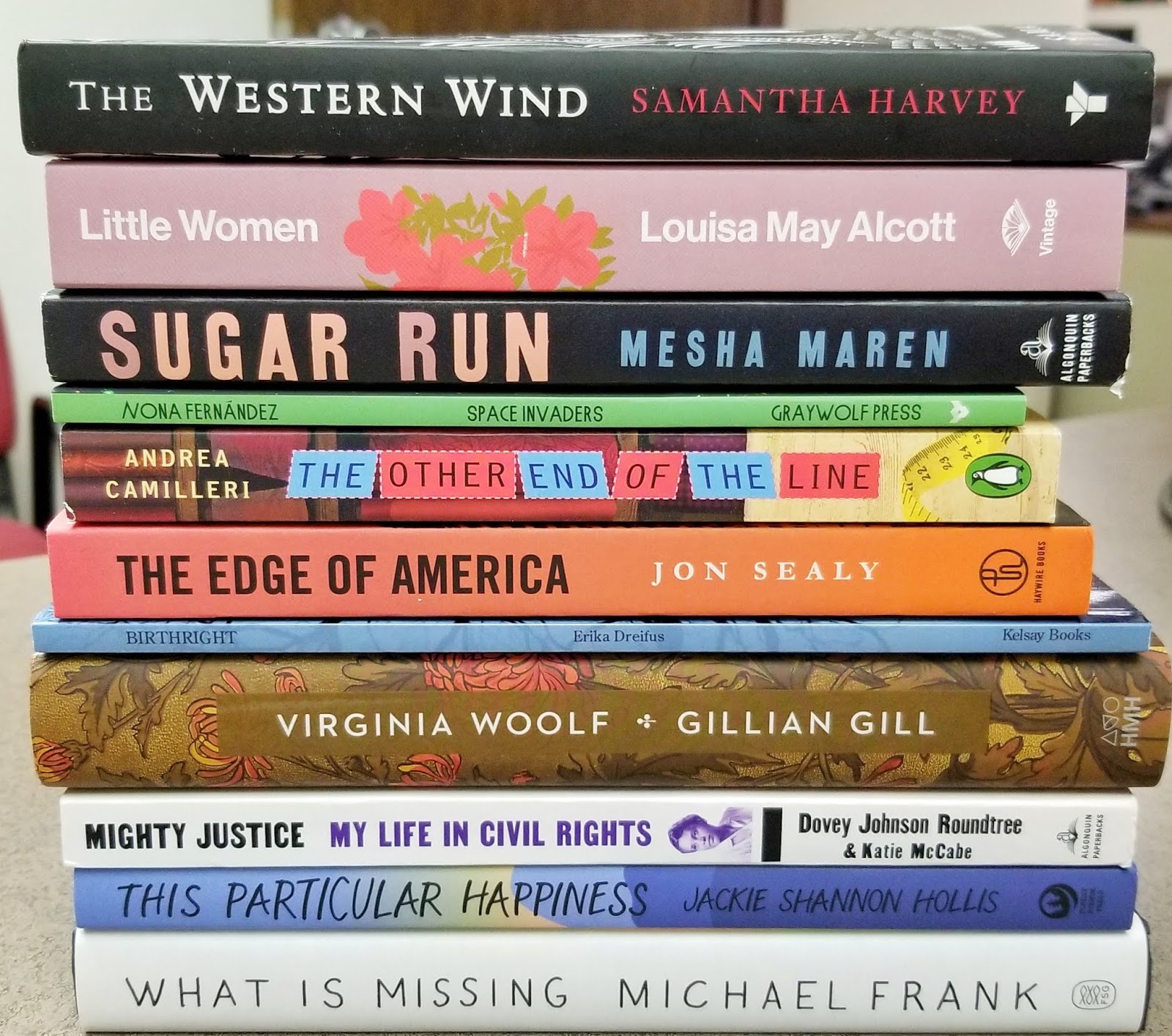
This week, I’ve donned a Santa Claus suit and put together a big, multi-book giveaway, just in time for the holidays. I have a stack of eleven books up for grabs. One lucky reader will win them all. Will it be you? Keep scrolling for more information on the book and how to enter the contest...


The Western Wind by Samantha Harvey: It’s 1491. In the small village of Oakham, its wealthiest and most industrious resident, Tom Newman, is swept away by the river during the early hours of Shrove Saturday. Was it murder, suicide, or an accident? Narrated from the perspective of local priest John Reve—patient shepherd to his wayward flock—a shadowy portrait of the community comes to light through its residents’ tortured revelations. As some of their darkest secrets are revealed, the intrigue of the unexplained death ripples through the congregation. But will Reve, a man with secrets of his own, discover what happened to Newman? And what will happen if he can’t?

Little Women by Louisa May Alcott: A Vintage Classics edition of Louisa May Alcott’s beloved and influential story of the March sisters, which is once again a major motion picture. First published in 1868, and based on Louisa May Alcott’s own unusual family, the novel brought to life some of American literature’s most spirited female characters—and this edition has a fresh new cover to match the vibrancy of these heroines. Little Women has long been one of the most enduringly beloved classics of children’s literature, as popular with adults as it is with young readers. Generations have been entranced by the adventures of the four March sisters, each with their distinct and realistic virtues and flaws: tomboyish, ambitious Jo; frail and sweet Beth; beautiful, confident Meg; and artistic, willful Amy. With their patient mother, Marmee, they survive the hardships of the Civil War and the dramas and tragedies of family life.

Sugar Run by Mesha Maren: In 1989, Jodi McCarty is seventeen years old when she’s sentenced to life in prison. When she’s released eighteen years later, she finds herself at a Greyhound bus stop, reeling from the shock of unexpected freedom but determined to chart a better course for herself. Not yet able to return to her lost home in the Appalachian Mountains, she heads south in search of someone she left behind, as a way of finally making amends. There, she meets and falls in love with Miranda, a troubled young mother living in a motel room with her children. Together they head toward what they hope will be a fresh start. But what do you do with your past—and with a town and a family that refuses to forget, or to change?

Space Invaders by Nona Fernandez: Space Invaders is the story of a group of childhood friends who, in adulthood, are preoccupied by uneasy memories and visions of their classmate Estrella González Jepsen. In their dreams, they catch glimpses of Estrella’s braids, hear echoes of her voice, and read old letters that eventually, mysteriously, stopped arriving. They recall regimented school assemblies, nationalistic class performances, and a trip to the beach. Soon it becomes clear that Estrella’s father was a ranking government officer implicated in the violent crimes of the Pinochet regime, and the question of what became of her after she left school haunts her erstwhile friends. Growing up, these friends―from her pen pal, Maldonado, to her crush, Riquelme―were old enough to sense the danger and tension that surrounded them, but were powerless in the face of it. They could control only the stories they told one another and the “ghostly green bullets” they fired in the video game they played obsessively.

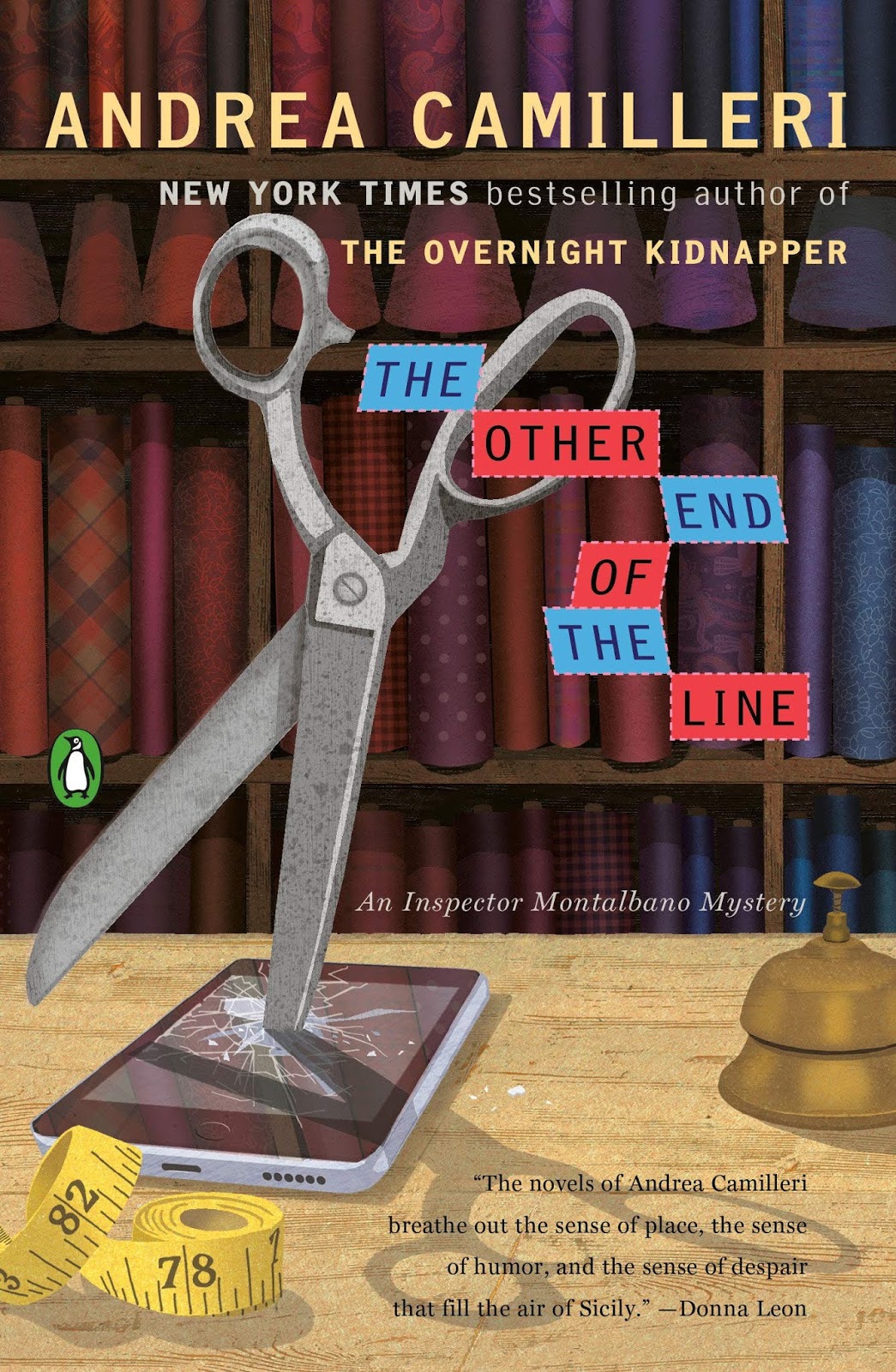
The Other End of the Line by Andrea Camilleri: A wave of refugees has arrived on the Sicilian coast, and Inspector Montalbano and his team have been stationed at port, alongside countless volunteers, to receive and assist the newcomers. Meanwhile, Livia has promised their presence at a friend’s wedding, and the inspector, agreeing to get a new suit tailored, meets the charming master seamstress Elena Biasini. But while on duty at the dock one late night, tragedy strikes, and a woman is found gruesomely murdered. Between managing the growing crowds at the landing, Montalbano delves into the world of garments, in the company of an orphaned cat, where he works to weave together the loose threads of the unsolved crimes and close the case.

The Edge of America by Jon Sealy: Bobby West is on the edge. As chief financial officer for a Miami holding company and a CIA front, he has overleveraged his business in the go-go 1980s financial culture. He turns to a deal-with-the-devil money laundering operation with a local gangster, Alexander French--a deal which quickly goes south when $3 million goes missing. Now Mr. French, a group of Cuban exiles, and an Israeli smuggler named Adriana Chekhov are all after Bobby West to pay up. With echoes of Iran-Contra and the Orwellian surveillance state, The Edge of America is a stunning thriller about greed, power, and the limits of the American dream.

Birthright (Poems) by Erika Dreifus: The poems in Birthright embody multiple legacies: genetic, historical, religious, and literary. Through the lens of one person’s experience of inheritance, the poems suggest ways in which all of us may be influenced by how we perceive and process our lives and times. Here, a poet claims what is hers as a child of her particular parents; as a grandchild of refugees from Nazi Germany; as a Jew, a woman, a Gen Xer, and a New Yorker; as a reader of the Bible and Shakespeare and Flaubert and Lucille Clifton. This poet’s birthright is as unique as her DNA. But it resonates far beyond herself.

Virginia Woolf by Gillian Gill: How did Adeline Virginia Stephen become the great writer Virginia Woolf? Acclaimed biographer Gillian Gill tells the stories of the women whose legacies—of strength, style, and creativity—shaped Woolf’s path to the radical writing that inspires so many today. Gill casts back to Woolf’s French-Anglo-Indian maternal great-grandmother Thérèse de L’Etang, an outsider to English culture whose beauty passed powerfully down the female line; and to Woolf’s aunt Anne Thackeray Ritchie, who gave Woolf her first vision of a successful female writer. Yet it was the women in her own family circle who had the most complex and lasting effect on Woolf. Her mother, Julia, and sisters Stella, Laura, and Vanessa were all, like Woolf herself, but in markedly different ways, warped by the male-dominated household they lived in. Finally, Gill shifts the lens onto the famous Bloomsbury group. This, Gill convinces, is where Woolf called upon the legacy of the women who shaped her to transform a group of men--united in their love for one another and their disregard for women--into a society in which Woolf ultimately found her freedom and her voice.

Mighty Justice: My Life in Civil Rights by Dorothy Johnson Roundtree and Katie McCabe: In Mighty Justice, trailblazing African American civil rights attorney Dovey Johnson Roundtree recounts her inspiring life story that speaks movingly and urgently to our racially troubled times. From the streets of Charlotte, North Carolina, to the segregated courtrooms of the nation’s capital; from the male stronghold of the army where she broke gender and color barriers to the pulpits of churches where women had waited for years for the right to minister—in all these places, Roundtree sought justice. At a time when African American attorneys had to leave the courthouses to use the bathroom, Roundtree took on Washington’s white legal establishment and prevailed, winning a 1955 landmark bus desegregation case that would help to dismantle the practice of “separate but equal” and shatter Jim Crow laws. Later, she led the vanguard of women ordained to the ministry in the AME Church in 1961, merging her law practice with her ministry to fight for families and children being destroyed by urban violence. Dovey Roundtree passed away in 2018 at the age of 104. Though her achievements were significant and influential, she remains largely unknown to the American public. Mighty Justice corrects the historical record.

This Particular Happiness by Jackie Shannon Hollis: Knowing where your scars come from doesn’t make them go away. When Jackie Shannon Hollis marries Bill, a man who does not want children, she joyfully commits to a childless life. But soon after the wedding, she returns to the family ranch in rural Oregon and holds her newborn niece. Jackie falls deep into baby love and longing and begins to question her decision. As she navigates the overlapping roles of wife, daughter, aunt, sister, survivor, counselor, and friend, she explores what it really means to choose a different path. This Particular Happiness delves into the messy and beautiful territory of what we keep and what we abandon to make the space for love.

What is Missing by Michael Frank: Costanza Ansaldo, a half-Italian and half-American translator, is convinced that she has made peace with her childlessness. A year after the death of her husband, an eminent writer, she returns to the pensione in Florence where she spent many happy times in her youth, and there she meets, first, Andrew Weissman, an acutely sensitive seventeen-year-old, and, soon afterward, his father, Henry Weissman, a charismatic New York physician who specializes in—as it happens—reproductive medicine. With three lives each marked by heartbreak and absence—of a child, a parent, a partner, or a clear sense of identity—What is Missing offers Costanza, Andrew, and Henry the opportunity to make themselves whole when the triangle resumes three months later in New York, where the relationships among them turn and tighten with combustive effects that cut to the core of what it means to be a father, a son, and—for Costanza—a potential mother.

If you’d like a chance at winning ALL THE BOOKS, simply e-mail your name and mailing address to


Put FRIDAY FREEBIE in the e-mail subject line. Please include your mailing address in the body of the e-mail. One entry per person, please (or, two if you share the postsee below). Despite its name, the Friday Freebie remains open to entries until midnight on Dec. 19, at which time I’ll draw the winning names. I’ll announce the lucky reader on Dec. 20. If you’d like to join the mailing list for the once-a-week newsletter, simply add the words “Sign me up for the newsletter” in the body of your email. Your e-mail address and other personal information will never be sold or given to a third party (except in those instances where the publisher requires a mailing address for sending Friday Freebie winners copies of the book). P.S. Since I’m downsizing my own book collection, I’ll occasionally toss an extra book into package. If you aren’t interested in reading the extra “Freebie,” please consider donating it to your local little free library.

Want to double your odds of winning? Get an extra entry in the contest by posting a link to this webpage on your blog, your Facebook wall or by tweeting it on Twitter. Once you’ve done any of those things, send me an additional e-mail saying “I’ve shared” and I’ll put your name in the hat twice.