Showing posts with label Ray Bradbury. Show all posts

Monday, May 13, 2019

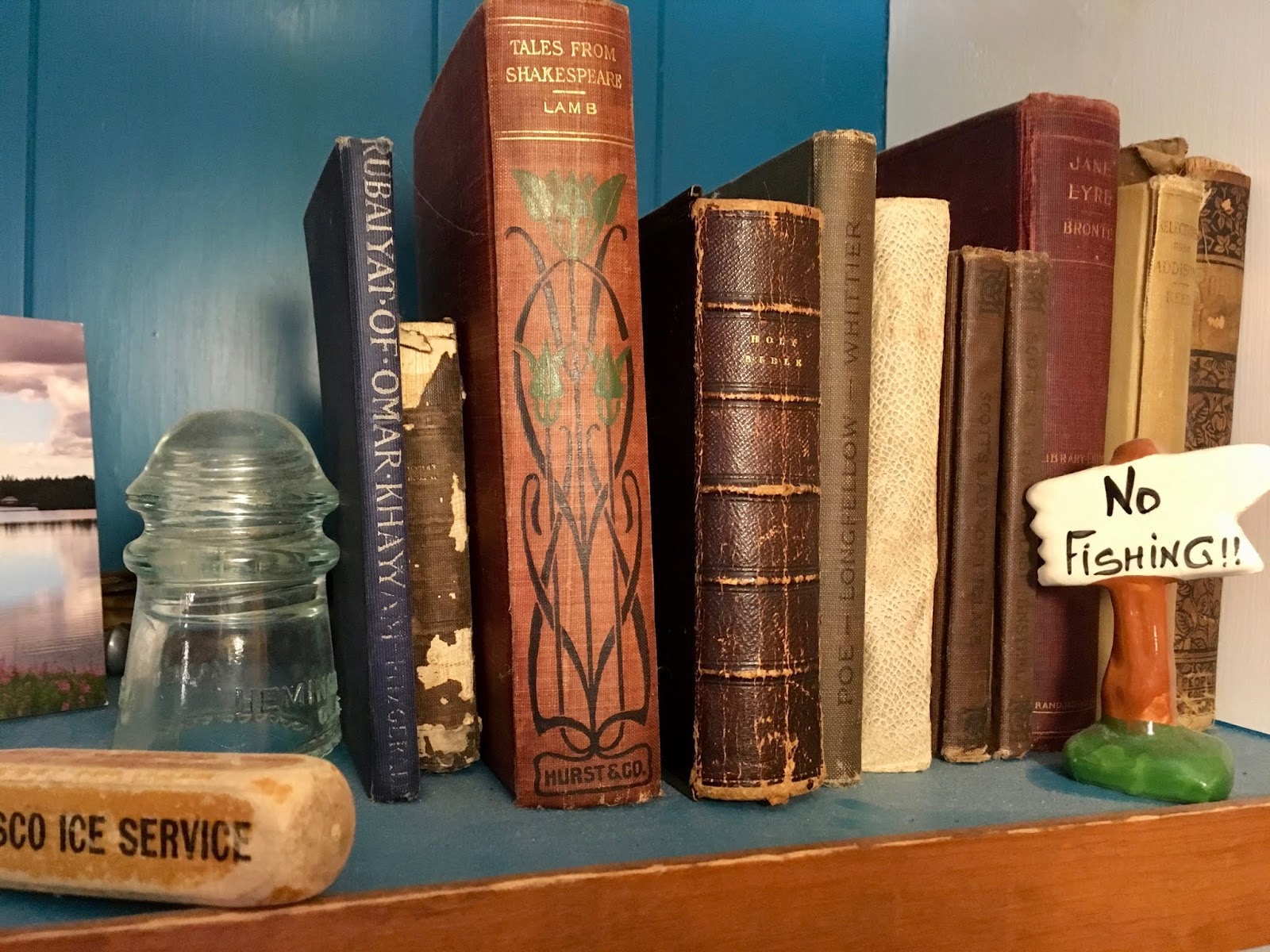
Valerie Nieman’s Library: The Many-Chambered Heart


Reader:  Valerie Nieman
Location:  Greensboro, NC
Collection Size:  About 1,650
The one book I'd run back into a burning building to rescue:  My uncle Jerry went back into a lightning-struck house to rescue his father’s books, (after first carrying him out of the fire, as he was disabled.) I guess that story means I’d have to grab those once-rescued volumes of Mark Twain (see below) and Emerson and Tennyson. Oh! Of course, the brass-bound 1860 Bible, inscribed in spidery sepia ink with a mother’s poetic benediction to “My Dear Son” as he went to war. It was used for my parents’ wedding and the funerals of my mother’s parents.
Favorite book from childhood:  Jack London’s stories—a volume I bought at a school book fair. Still have it. And Girl of the Limberlost. I was a solitary child wandering the woods, so this book spoke to me—but finding it online in recent years, I was appalled at the prose. Still, it gave me encouragement in my expeditions. Also Huckleberry Finn, Alice’s Adventures in Wonderland, and books about horses and nature including Silent Spring by Rachel Carson.
Guilty pleasure book:  Tess of the D’Urbervilles.


Counting the Books

Too many books? Never!

Well, maybe.

I’ve spent a life accumulating, sorting, sifting, giving, receiving. Now with retirement in sight, I weigh each book I buy, thinking how many I soon will have to let go.

They are all over the house, in the wood-paneled “den” where I work, in the living room, the bedroom, the spare bedroom, the former office. At work, they fill two tall bookcases, including one that will kill me if an earthquake happens to hit Greensboro while I’m sitting at my desk.

Until I took on this assignment to write about my library for The Quivering Pen, I’d never counted them. I moved from West Virginia to North Carolina in 1997 with 32 back-breaking boxes of books in my collection, that much I know, and in the words of Jacob Marley, “You have laboured on it, since.” The ponderous boxes of books are many, many more in number now.

For this photo essay, I could have tidied up and organized, given my bookshelves the artificial gloss of Instagram faces, but decided to stick with the gritty reality. The photos don’t show it, but there is organization, of a sort.


In my working area, I have 70-plus books of poetry in the first of two maple bookcases my mother made for herself while working at Ethan Allen in Jamestown, New York. They are 1950s vintage, honey-brown, like buckwheat honey. Then there are 110 (probably half the total, the rest being hidden in crates) of the “contributor copies” of journals and anthologies where I’ve appeared, and copies of my books. On the credenza, 23 books for ready reference. On the antique iron plant stand, 34 books in the on-deck circle for reading. On the fireplace side shelves, 38 antique books that once inhabited the upstairs den at my parents farmhouse in Randolph, New York, with the copperplate signatures of relatives three generations back. A dozen books stacked on the coffee table and a big pile of journals on a little stool. Almost 300 books just in the den.

The living room—what old-timey people would have called the parlor, as it’s used just for guests—has a number of coffee-table books and my favorite volume for inspiration, The Book of Symbols, left open for browsing.


The guest bed room is home to the matching bookcase Mom made at the “splinter factory,” with 50-plus books chosen for the enjoyment of guests, as well as a few journals.


The “library” was once my writing room. When I divorced, I changed things around, moving my writing space into the den, where I can lounge by the fire and where a blank wall before my desk keeps me from getting lost in the outside view.

Not counting extra copies of my own books, I’d say there are close to 900 books in this room, going all the way back to the Little Golden Books my parents bought me, when times were tough but there was always a quarter for a book. Butterflies. The Forest. I have double-decked layers of paperbacks starting with the first ones I bought for myself off the Rexall drug store revolving book rack: The Illustrated Man by Ray Bradbury, The Left Hand of Darkness by Ursula Le Guin, Stranger in a Strange Land by Robert Heinlein, Dune by Frank Herbert.

The top shelves are filled and over-stacked with signed books bought at readings over the years. Many of these writers have become good friends. Some I’ve never seen again, but their voices come back when I open their books.

The lower shelves house the full set of Mark Twain in green cloth bindings, bought after my maternal grandfather got to know him on a train trip, my go-to reading during long summers as the books were readily available in “the den.” I read Tom Sawyer, of course, I read every volume, and for a while was enamored with the two-volume life of Joan of Arc. And the complete 1911 Encyclopedia Britannica, noteworthy as the last edition published with signed articles. It’s all there, the onionskin pages intact, except for the map of New York State that I pulled out for a grade-school project. Yes, I was once a book vandal, to my shame.

Along with all these beloved books, the shelves house bits of memorabilia— a horseshoe crab tail found on an Oak Island beach when my parents lived near there. Sand dollars. Stones from mountain walks and from St. Martin and from the pebbly plage at Nice. A pair of long, narrow dressmaker’s shears. A rabbit that I wood-burned into a piece of plywood for a long-ago Christmas present for my father. Interesting stamps. A plastic bass lure I plucked from a snag at Cassadaga Lake.


At work, I’ve lined the back portion of my desk with copies of my publications, and then filled two tall bookcases with literature that I might use in classes, but also books that I just like to look at, and through. Friends. Also textbooks, of course, and the academic detritus of tenure portfolios and faculty handbooks. I’d estimate 375 books.


Books come to me, novels sent in for reviewing at the newspapers where I’ve worked, books from a former boyfriend who was moving and needed to downsize, books bought at church book sales, books left by friends or traded, even a few books rescued from the street side trash. And so many books have left me, especially books that I’ve lent to students, knowing most would not come back. Two copies of Breece D’J Pancake’s stories went that way. The students needed them more than I did.


It’s daunting to think of the cull to come, how I’ll try to find homes for many of these books. People don’t seem to want physical books as much. Old volumes are sold by the linear foot, and by the color, for people to use as interior decoration. Some will go to my nephew, some to friends, some perhaps to a college collection.

Lately, I’ve been accumulating e-books, handy while traveling although not as satisfying as a book in the hand.

Too many books? Never.


Appalachian heritage is the common thread binding Valerie Nieman’s wide range of writing, from mainstream fiction to horror, and both lyric and narrative poetry. Her latest novel, To the Bones (West Virginia University Press), is a genre-bending satire of the coal industry and its effects on Appalachia. Her third poetry collection, Leopard Lady: A Life in Verse, was published in fall 2018. Nieman’s writing has appeared widely in journals and in numerous anthologies, including Eyes Glowing at the Edge of the Woods and Ghost Fishing: An Eco-Justice Poetry Anthology. She teaches workshops at John C. Campbell Folk School, NC Writers Network conferences, and many other venues. A graduate of West Virginia University and Queens University of Charlotte and a former journalist, she now teaches creative writing at North Carolina A&T State University.

My Library is an intimate look at personal book collections.  Readers are encouraged to send high-resolution photos of their home libraries or bookshelves, along with a description of particular shelving challenges, quirks in sorting (alphabetically? by color?), number of books in the collection, and particular titles which are in the To-Be-Read pile.  Email thequiveringpen@gmail.com for more information.


Wednesday, October 31, 2018

Scary as Sheet: Ghost Stories For My Halloween


I live in a house that has good potential to breed ghosts. Built in 1920, the Craftsman home on a quiet tree-lined street in Butte, Montana, is a jigsaw puzzle of dark corners, cobwebbed crawlspaces, drafty closets, an obsolete coal chute, and narrow, twisting staircases that send one’s mind reeling with vertigo. In the basement lurks a big-bellied, multi-armed and asbestos-lined furnace that, when it gleams with inner fire, looks like a mechanical beast out of Jules Verne. And one hears things. At night, the radiators tick like approaching high heels. The blowsy curtains shift from side to side, in a breezeless room. There are creaks, there are hums, there are papery whispers behind one’s back.

The house has seen its share of stories, passing through several different Butte families before us, including one owner, a well-known married ophthalmologist, who met a scandalous end when he was killed in a car accident, along with an 18-year-old female passenger. In an unofficial history left by previous owners, there’s a winking little addendum to the story: He was known for his wandering eye and partying ways.

Like I said, stories have attached themselves to this house. And I believe some characters from those stories still live here.

During one visit, my daughter tripped near the top of one of those spiral staircases, barely catching herself in time from falling. She swears she was nudged from behind. A distinct push against the middle of my back. She was alone in the house at the time.


Houses contain us, we live our lives in them, and it is not surprising that they might continue to shelter us after we die. We are attached to our homes, perhaps so much that we cannot leave, even though we are dead. A haunted house has an emptiness that is filled by the inappropriate or unnatural. A house can lose its soul, a house can go bad. Houses can be monuments to personality, we inflict our tastes upon them, but they can afflict us with their perversity in return. Ghosts can be like vermin–pests to be driven away or exterminated. We are anxious about our houses. Even the most conciliatory, helpful house can become supernaturally burdensome.
I don’t know if I’m supernaturally burdened in my house or if those noises in the other room are just noises, but I do know I suck a lot of pleasure out of that paragraph from Audrey Niffenegger’s introduction to her excellent collection, Ghostly, which is one of the books I’ve been reading this past month to get me in the mood for Halloween.

Ghostly begins with “The Black Cat.” It has been years–decades–since I read Edgar Alan Poe’s classic, and Niffenegger was smart to open her roster with this one because I felt those spinal chills all afresh as if for the first time when I read these words from the narrator (murderer and terrible pet owner) when he overconfidently bangs against his cellar wall as a show of bravado in front of the investigating policemen:
       “Gentlemen,” I said at last, as the party ascended the steps,” I delight to have allayed your suspicions. I wish you all health, and a little more courtesy. By the bye, gentlemen, this–this is a very well constructed house.” ( In the rabid desire to say something easily, I scarcely knew what I uttered are all.)–“I may say an excellently well constructed house. These walls–are you going, gentlemen?–these wall are solidly put together,” and here, through the mere frenzy of bravado, I rapped heavily, with a cane which I held in my hand, upon that very portion of the brick-work behind which stood the corpse of the wife of my bosom.
       But may God shield and deliver me from the fangs of the Arch-Fiend! No sooner had the reverberation of my blows sunk into silence, than I was answered by a voice from within the tombs!–by a cry, at first muffed and broken, like the sobbing of a child, and then quickly swelling into one long, loud, and continuous scream, utterly anomalous and inhuman–a howl–a wailing shriek, half of horror and half of triumph, such as might have arisen only out of hell, conjointly from the throats of the dammed in their agony and of the demons that exult in the damnation.

The book only gets better from there. Shivery standouts include short stories by Edith Wharton, Oliver Onions (funny name, creepy story), A. M. Burrage, A. S. Byatt, and Neil Gaiman, whose “Click-Clack the Rattlebag” is an icy stab to the heart. I don’t want to spoil anything for the virgin reader, but these lines near the end really sent me over the edge:
He pushed open the door to the attic room. It was perfectly dark, now, but the opening door disturbed the air, and I heard things rattle gently, like dry bones in thin bags, in the slight wind. Click. Clack. Click. Clack. Like that.

Ghostly also briskly re-introduced me to Saki and his equally-brisk pleasures. “Laura” and “The Open Window” are both delights in narrative wordplay, trickery, and compression. Especially the latter. Saki gets the job done in the time it takes some writers (present company included) to merely warm up the pen.

Niffenegger closes Ghostly with Ray Bradbury’s “There Will Come Soft Rains” (updated here to “August 2026”). As she writes in her introductory note: “Perhaps this is not a ghost story at all, but I like to think it is. It is a story of the ghost of a house and the ghost of a civilization. It is a warning and a parable. Of all the stories in this book, it is the most possible.”

The story moves like a roving camera, in one take, through a day in the life (and death) of a house which has miraculously survived a nuclear attack. The house lived, but nothing else did:
       The house stood alone in a city of rubble and ashes. This was the one house left standing. At night the ruined city gave off a radioactive glow which could be seen for miles.
       Ten-fifteen. The garden sprinklers whirled up in golden founts, filling the soft morning air with scatterings of brightness. The water pelted windowpanes, running down the charred west side where the house had been burned evenly free of its white paint. The entire west face of the house was black, save for five places. Here the silhouette in paint of a man mowing a lawn. Here, as in a photograph, a woman bent to pick flowers. Still farther over, their images burned on wood in one titanic instant, a small boy, hands flung into the air; higher up, the image of a thrown ball, and opposite him a girl, hands raised to catch a ball which never came down.
       The five spots of paint—the man, the woman, the children, the ball—remained. The rest was a thin charcoaled layer.
       The gentle sprinkler rain filled the garden with falling light.


A house also featured prominently in my TV watching in October. The Haunting of Hill House was only nominally, tangentially related to the novel by Shirley Jackson, and it took my wife and I a couple of episodes to really get into the Netflix series, but when we did, we were sucked in, as helpless as poor little Carol Anne splaying her fingers across the television screen in Poltergeist. There were plenty of legitimate jump scares that had me choking on my candy corn, but more than anything The Haunting of Hill House succeeded as–get this–a tender story about the bonds of family and how to deal with grief and guilt. The scares melt to schmaltz in the final episode as the denouement swerves like a car on an icy road toward a tree called This is Us, but even that isn’t enough to dampen the series’ well-earned sentiment of family first, even unto death.

I also appreciate how the Netflix series was kind enough to include a few patches of text lifted directly from Jackson’s famous opening/closing lines:
Hill House, not sane, stood by itself against its hills, holding darkness within; it has stood for eighty years and might stand eighty more. Within, walls continued upright, bricks met neatly, floors were firm, and doors were sensibly shut; silence lay steadily against the wood and stone of Hill House, and whatever walked there, walked alone.


I concluded my Halloween reading jag with Dolly by Susan Hill. While I wouldn’t rate it as highly as I would her previously ghost story novella, The Man in the Picture, Dolly does have its moments. Hill creates a soupy, chilly atmosphere of an isolated house out on the fens in Britain. She writes: “Empty houses breed fantasies, bleak landscapes lend themselves to fearful imaginings.” There are some superb, evocative descriptions which all combine to create some tense scenes surrounding temperamental children, a too-large mansion, and an unappreciated gift, a doll. And don’t even get me started on the rustling of tissue paper.

Speaking of odd noises, I just heard something strange coming from the other room. I’m gonna go check it out and then I’ll be right back.


Thursday, January 5, 2017

My Year of Reading: Every Book I Read in 2016


This Was the Year

This was the year I killed it, reading-wise: 130 books, a new record since I started keeping track of my habits in 2005 (the year I was deployed to Iraq with the U.S. Army, I had loads of free time on my hands, and I read what now looks like a paltry 50 books).

This was the year when I read fewer new books (i.e., those released in the past 12 months) than ones published in other years: 56 vs. 74. Part of that had to do with my commitment to making headway on my Five-Year Reading Plan of the Essentials (though I still have a long way to go on that list), but part of it also had to do with the fact that I occasionally let my fancy go free and footloose through my library, pinballing from one book to the next, no matter what the publication date.

This was the year I re-discovered audiobooks. Rather than listening to Bruno Mars, Electric Light Orchestra, or Sia on my daily commute to and from the Day Job, I opted for Audible.com and the aural pleasures of Timothy West rolling the prose of Anthony Trollope trippingly off his tongue through The Warden, Barchester Towers, Doctor Thorne and Can You Forgive Her?. Richard Armitage also brought David Copperfield back to life for me on my second time through the classic novel (which now might just be my favorite Dickens of all time, nudging Dombey and Son from the top of the list).

This was the year of Anthony Trollope. When I go all in, I go really deep.

This was the year I got a library card. After being appointed to the Butte-Silver Bow Public Library Board earlier this year, I realized—with a bucketload of chagrin—that I had rarely darkened the doorway of our beautiful 122-year-old library here in Butte, Montana (and never to check out a book—gasp!). I quickly corrected the error of my ways by taking out a book by Lee Child.

This was the year of Lee Child. For years, family friend Marilyn has politely badgered me to read the bestselling author. “I think you’ll really like him,” she says every time she sees me. I mean every frickin' time, without fail. Finally, caving in and attempting to silence Marilyn’s hectoring once and for all, I checked out a copy of A Wanted Man from the library. Within twenty pages, I was convinced Marilyn was the smartest person on the planet. Not only did I “really like” Child, I loved him. I immediately started binging on Jack Reacher. He turned out to be the Lay’s potato chip of action heroes. At our Christmas party a few weeks ago, I pulled Marilyn aside and told her of my new-found love for all things Lee Child. “Great!” she said. “Now, let’s talk about David Baldacci...”

This was the year I read a book about a horrific plane crash (Fireball) while I was flying cross-country from Montana to Georgia. I survived my flight; Carole Lombard, unfortunately, did not walk away from hers.

This was the year I should have revived The Biography Project here at the blog since I read books about The Lives of Others (author Anthony Trollope, baseball legend Ted Williams, film actress Carole Lombard, and author Sinclair Lewis—the latter which I haven’t completely finished, so I’m carrying it over to my 2017 book log).

This was the year of Sinclair Lewis. I originally read Main Street as part of my Five-Year Plan, but enjoyed it so much, I moved on to several other time-tested classics by the Midwestern satirist. I binged him hard. Like Lee Child hard, like Anthony Trollope levels of intensity. (Come to think of it, this was the Year of Binge.) I’m not through with Lewis yet. I plan to read at least two more of his before this year is out: It Can’t Happen Here (because, sadly, it did, it did) and Dodsworth.

This was the year I was surprised by how bad some books could be, given their popularity and the bestselling reputation of the author (the children’s classic The Black Stallion and Alan Furst’s A Hero of France to name just two), but I was also pleasantly surprised by how truly great some relatively-unheralded titles turned out to be (Searching for John Hughes; Not All Fires Burn the Same; Wilderness; and every book by Nickolas Butler, which I gobbled down in quick succession—by the way, The Hearts of Men, which comes out this March, is the best of them all). I was also left feeling flatlined by books I expected to love but only liked (The Sisters Brothers, Zero K, Then We Came to the End, I’m Thinking of Ending Things).

This was the year my wife, feeling like a “book widow,” sighed in exasperation, “You know, you’ll never be able to read ALL THE BOOKS.”

This was the year I turned to her and replied, “Maybe not, but I’m gonna try.”


Crunching the Numbers

Sure, I read a lot of poetry books which typically clock in at less than 100 pages. And, yes, I read quite a few stand-alone novellas (mostly from the fabulous Ploughshares Solo series) that were often less than 50 pages. But for every whisper-thin poetry chapbook or novella, there were books the size of small Pacific islands (I’m looking at you, Mr. Anthony Trollope Novel!). The proof in my book pudding comes when I crunch the numbers to determine the average page count (yes, I note the number of pages in my book log—don’t you?). In 2016, I read a total of 32,584 pages (not counting the 606 pages in the Sinclair Lewis biography, which I’m rolling over into the 2017 book log). That puts me at an average page count of 251, lower than last year’s average of 304 (note to my 2017 self: fewer novellas, more Trollope). But nearly 33,000 pages still feels like a whole helluva lot. I mean, I could never eat 33,000 Oreos in one year no matter how hard I tried.

More stuff which is possibly interesting only to me:
  • The shortest book was Confession (24 pages) by Bill Roorbach, the longest was David Copperfield (877 pages) by Charles Dickens
  • 44 of the 130 were e-books
  • 5 were audiobooks
  • 56 were published in 2016, 3 were advance copies destined to be released in 2017 or beyond, and the rest were from prior years
  • 89 were written by men, 37 by women, 4 were a mix of both (anthologies or collaborations), and 0 were written by cats
And now, without further ado, I give you...


ALL THE BOOKS I READ THIS YEAR


Mrs. McGinty’s Dead by Agatha Christie
Battleborn by Claire Vaye Watkins
Escape and Reverse by Chelsey Johnson
Confession by Bill Roorbach
Over on the Dry Side by Louis L’Amour
The Revenant by Michael Punke
Wilderness by Lance Weller
Up From the Blue by Susan Henderson
The Detroit Frankfurt Discussion Group by Douglas Trevor
All I Want Is What You’ve Got by Glen Chamberlain
This is What I Want by Craig Lancaster
The House on the Cliff by Franklin W. Dixon
Selected Poems by Theodore Roethke
A Walk in the Sun by Harry Brown
Dog Run Moon by Callan Wink
The Darkening Trapeze by Larry Levis
Hollywood and the Holocaust by Henry Gonshak
Main Street by Sinclair Lewis
The Other Felix by Keir Graff
Zero K by Don DeLillo
Galaxie Wagon by Darnell Arnoult
Tin House #66
Building Stories by Chris Ware
Look by Solmaz Sharif
Babbitt by Sinclair Lewis
The Maltese Falcon by Dashiell Hammett
A Wanted Man by Lee Child
By the Iowa Sea by Joe Blair
Make Me by Lee Child
Dead Man’s Float by Jim Harrison
Daredevils by Shawn Vestal
Legends of the Fall by Jim Harrison
Men Be Either Or, But Never Enough by Andria Nacina Cole
Killing Floor by Lee Child
Cordoba Skies by Federico Falco
Unquiet Things by James Davis May
Reacher Said Nothing: Lee Child and the Making of Make Me by Andy Martin
The Black Stallion by Walter Farley
The Virginity of Famous Men by Christine Sneed
Little Known Facts by Christine Sneed
One Summer by Bill Bryson
Battle Rattle by Brandon Davis Jennings
Poems: New and Selected by Ron Rash
Red Harvest by Dashiell Hammett
Night Sky With Exit Wounds by Ocean Vuong
Into the Sun by Deni Ellis Bechard
Mississippi Noir edited by Tom Franklin
They Could Live With Themselves by Jodi Paloni
Still Come Home by Katey Schultz
56 Counties by Russell Rowland
The Warden by Anthony Trollope
The Thin Man by Dashiell Hammett
Then We Came to the End by Joshua Ferris
The Soul in Paraphrase by Robert Boswell
Beach Plum Jam by Patricia Buddenhagen
The Art of Departure by Craig Lancaster
They Were Strong and Good by Robert Lawson
McWhinney’s Jaunt by Robert Lawson
Canoe Country by Florence Page Jaques
Shotgun Lovesongs by Nickolas Butler
Sketchy Stories by Kerby Rosanes
The Echoing Green: Poems of Fields, Meadows, and Grasses edited by Cecily Parks
Marrow Island by Alexis M. Smith
ShallCross by C. D. Wright
I’m Thinking of Ending Things by Iain Reid
Arrowsmith by Sinclair Lewis
Barchester Towers by Anthony Trollope
A Good Scent From a Strange Mountain by Robert Olen Butler
Liar’s Code by Rich Chiappone
Beneath the Bonfire by Nickolas Butler
The Hearts of Men by Nickolas Butler
The Walking Dead #1 by Robert Kirkman
Classic Penguin: Cover to Cover by Paul Buckley
There Now by Eamon Grennan
Bestiary by Donika Kelly
Doctor Thorne by Anthony Trollope
Dandelion Wine by Ray Bradbury
Exceptional Mountains by O. Alan Weltzien
Glimmer Train Stories #96 Spring/Summer 2016 (with a story by Yours Truly)
Melancholy Accidents by Peter Manseau
Elmer Gantry by Sinclair Lewis
The Queen of the Night by Alexander Chee
Closer All the Time by Jim Nichols
99 Poems by Dana Gioia
Searching for John Hughes by Jason Diamond
Nancy’s Mysterious Letter by Carolyn Keene
Maine by J. Courtney Sullivan
The Hour of Land by Terry Tempest Williams
The State We’re In by Ann Beattie
Splitting an Order by Ted Kooser
David Copperfield by Charles Dickens
The Confusion of Languages by Siobhan Fallon
Another Brooklyn by Jacqueline Woodson
The Good Soldiers by David Finkel
Footing Slow: A Walk with Keats by Eli Payne Mandel
Trending Into Maine by Kenneth Roberts
The Pugilist at Rest by Thom Jones
Koppargruva by Hugh Coyle
Ghosts by Raina Telgemeier
Landscape with Headless Mama by Jennifer Givhan
The Sisters Brothers by Patrick DeWitt
Full Dark, No Stars by Stephen King
The Iliad by Homer (Robert Fagels, translator)
A Hero of France by Alan Furst
Fireball: Carole Lombard and the Mystery of Flight 3 by Robert Matzen
Anthony Trollope by Victoria Glendinning
Not All Fires Burn the Same by Francine Witte
Night School by Lee Child
Dr. Wortle’s School by Anthony Trollope
The Door That Always Opens by Julie Funderburk
The Black Echo by Michael Connelly
Ninety-Nine Stories of God by Joy Williams
Can You Forgive Her? by Anthony Trollope
The Wrong Side of Goodbye by Michael Connelly
My Name is Lucy Barton by Elizabeth Strout
The Snow Goose by Paul Gallico
The Mothers by Brit Bennett
The Clothing of Books by Jhumpa Lahiri
Snowflake by Paul Gallico
Miracle in the Wilderness by Paul Gallico
Afterward by Edith Wharton
One Who Saw by A. M. Burrage
The Crown Derby Plate by Marjorie Bowen
The Diary of Mr. Poynter by M. R. James
The Mistletoe Murder and Other Stories by P. D. James
Waterlines by Alison Pelegrin
The Signalman by Charles Dickens
Christmas Days by Jeanette Winterson
Wintering by Peter Geye
The Kid: The Immortal Life of Ted Williams by Ben Bradlee Jr.


Thursday, August 18, 2016

Drinking Dandelion Wine


Ray Bradbury was a wizard with words, casting spells left and right, mesmerizing the readers of his 27 novels and 600 short stories. He sometimes wrote about hypnotists, magicians, and soothsayers, but the real wizardry happened in the elixir of his words.

Nowhere is the magic more potent than his 1957 book Dandelion Wine, which the cover of my 1979 Bantam Books edition calls “The captivating novel of a boy’s magical summer.” Dandelion Wine is not quite a novel, neither is it a traditional collection of short stories; it is a fever dream of memory, a jump-cut film of golden memories, a warm bath of nostalgia that, no matter how long you sit in the tub water, never grows chill. Dandelion Wine centers around two brothers, Doug and Tom Spaulding, as they roam carefree across the “magical summer” of 1928 in the fictional town of Green Town, Illinois, based on Bradbury’s childhood home of Waukegan, Illinois. (Bradbury often returned to Green Town, most notably in Something Wicked This Way Comes and Farewell Summer.)

Though I could fault Mr. Bradbury for packing a few too many “life lessons” into just one summer, and for making 12-year-old Douglas too wise beyond his years, it’s probably best to set those aside and just go with the flow of the book. And flow it does, from golden vignette to golden vignette across the June to August span of months. There are moments of true beauty (the dawning realization that the fabled Time Machine the boys are so excited about is none other than ancient Colonel Freeleigh who spins stories about the Civil War and hunting buffalo with Pawnee Bill) and true terror (Lavinia Nebbs walking through the dark ravine when The Lonely One, a serial killer, is still on the loose). The real Time Machine conductor here is Bradbury himself as he transports readers back to a small Midwestern town of the 1920s, a world of trolleys, soda fountains, junk peddlers, Saturday afternoon matinees, and sitting on the front porch in the evening eating chilled foil-wrapped Eskimo Pies and falling asleep to the sound of the adults’ conversation murmuring soft while the squeak of their rocking chairs sing like crickets into the falling blanket of night.

As I mentioned earlier, Ray Bradbury was a genius when it came to imagery and character-building. I’ll leave you with a single paragraph in which he sums up the everything we need to know about John Huff, one of Douglas’ best friends:
The facts about John Huff, aged twelve, are simple and soon stated. He could pathfind more trails than any Choctaw or Cherokee since time began, could leap from the sky like a chimpanzee from a vine, could live underwater two minutes and slide fifty yards downstream from where you last saw him. The baseballs you pitched him he hit in the apple trees, knocking down harvests. He could jump six-foot orchard walls, swing up branches faster and come down, fat with peaches, quicker than anyone else in the gang. He ran laughing. He sat easy. He was not a bully. He was kind. His hair was dark and curly and his teeth were white as cream. He remembered the words to all the cowboy songs and would teach you if you asked. He knew the names of all the wild flowers and when the moon would rise and set and when the tides came in or out. He was, in fact, the only god living in the whole of Green Town, Illinois, during the twentieth century that Douglas Spaulding knew of.
If, like me before a couple of weeks ago, you’ve never read Dandelion Wine, now would be the best time to do so, while we still have a few golden drops of summer left in the bottle. As Bradbury warns us, “August was almost over. The first cool touch of autumn moved slowly through the town and there was a softening and the first gradual burning fever of color in every tree, a faint flush and coloring in the hills, and the color of lions in the wheat fields.”


Sunday, August 14, 2016

Sunday Sentence: Dandelion Wine by Ray Bradbury


Simply put, the best sentence(s) I’ve read this past week, presented out of context and without commentary.


To touch her face was that always new experience of opening your window one December morning, early, and putting out your hand to the first white cool powdering of snow that had come, silently, with no announcement, in the night.

Dandelion Wine by Ray Bradbury


Monday, July 14, 2014

My First Time: Kelly Barnhill


Photo by Bruce Silcox
My First Time is a regular feature in which writers talk about virgin experiences in their writing and publishing careers, ranging from their first rejection to the moment of holding their first published book in their hands.  Today’s guest is Kelly Barnhill, author of The Witch's Boy, which has just been published under the Algonquin Young Readers imprint.  Kelly Barnhill lives in Minnesota with her husband, three children, and very old dog.  Her debut novel, The Mostly True Story of Jack, received four starred reviews.  Her second book, Iron-Hearted Violet, was a Parents’ Choice Gold Award Winner and an Andre Norton Award finalist.  You can read more about The Witch's Boy at last month's Front Porch Books feature here at The Quivering Pen.  Click here to visit Kelly's delightful blog (subtitled "Author. Teacher. Insufferable Blabbermouth. I also make pie.").


My First Failure

This is a lie.  This isn’t my first failure.  I’ve had lots before this, frankly, and will have lots after.  But this is the first time that I actually enjoyed failing.

Let me explain.

Prior to publishing my first novel for children, The Mostly True Story of Jack, I wrote a lot of truly terrible fiction.  I am not saying this as a backhanded way of garnering sympathy or compliments.  No, I am only speaking the truth.  The fiction written in those years was terrible.

I recognize now that it was terrible for a reason.  Terrible, as it turns out, is an excellent teacher.  One of the benefits of writing truly terrible fiction is that it requires a certain tenacity to continue to produce knowing full well that the product produced will be absolute dreck.

Ray Bradbury, one of my heroes in life, would often recommend to young writers to spend five years writing one story per week--stories that would be thrown out as a matter of course.  He said this was important in the process of writerly becoming because of one simple reason: it gets the dreck out.  We make; we discard; we make; we discard.  And eventually, we realize that we’ve made something with eyes and skin and teeth--something wholly separate from ourselves.

I wrote a book called A Stand of White Pine.  You will never see it.  It is terrible.  I wrote another book called The Incredible Disappearing Girl.  You also will never see it.  And then I wrote a book called Little Girl Blue.  Now that book I was proud of.  It had legs and lungs.  It walked and breathed.  It was an adult novel in which I had used the form of the murder mystery to explore the social dynamics of a particular town in Oregon--and its uncomfortable intersection of race and class and intolerance and greed.  It had been drawn largely from my experience as a student teacher in one of the most tightly-wound, racially-divided schools I had ever seen in my life.  And I imagined an exhausted teacher, burdened by a crushing sense of ambivalence, being thrust into action in the wake of the murder of one of her favorite students.

I liked that book.  I still do.  It was my first real novel.

So I sent it out.  All over the place.  I wrote a query letter, and I must have done a good job of it, because a lot of people requested the full manuscript.  And a lot of people said no.  And I was stuck in that limbo in which so many aspiring writers find themselves--that obsessive email-checking and agent-blog-hounding and tweet-o-mancy.  It is a soft stalking that erupts in the online habits of many a horrified and self-loathing writer.  And I admit it: I did it, too.

And it’s foolish, of course, because it doesn’t actually do anything.  It is a creative wheel-spinning that causes a terrible brain-paralysis.  I wasn’t writing; I wasn’t creating; I wasn’t imagining; hell, I wasn’t even reading.  I was just waiting.  And waiting is terrible.

Eventually they all said no.  An across-the-board failure.  I was a wreck.

And then it happened.

I got another letter.  This one from a very prominent Big Shot Power Lady Agent--or BSPLA for short.  She was a long-shot, but I figured what the heck.  And I had given up on hearing from her, because she had held onto my manuscript for well over six months.  I figured she was just giving me a silent no.

What she sent me was still a no.  But it was bigger than that.  What she sent me was this:
Dear Ms. Barnhill,
      Thank you for giving me the opportunity to read Little Girl Blue. I enjoyed it mightily, and read it three times. However I am still going to have to pass. I know this may be hard to hear, and I apologize for it. It’s just that even as I enjoyed the story, and even as I furiously turned the pages, I had this phrase running around the back of my brain, and it was this: “Right writer, wrong book.” I love your writing. And I will want to read more of it. But you’ve written the wrong book.
      Write me the right book, and I will likely represent it.
      Yours truly,
      BSPLA
It was the kindest and best letter that I have ever received in my life.  It was my most beautiful failure.

In about a hundred words, she set me free.  And I no longer had to spin my wheels in email-checking or blog scouring or tweet-interpreting.  Instead, she gave me the gift of accepting that the book had failed.  That it was okay that it had failed.  That the failure was not an indication of perpetual failure--no!  Instead, it was another step along the creative process: we make; we discard.  By discarding, I could make again.  I could do what I needed to do: write the next book.  Write the right book.

Now, in truth, none of us are ever writing the right book.  We only ever attempt to get as close to right as we can.  We do the work we were born to do, and we stumble and fall along the way.  We make mistakes.  We write terrible prose.  We produce dreck.  Still, there is something wonderful about being set loose in a wide open space.  There is something wonderful about setting aside a project that simply isn’t working, and making something new.

Because making things matters, you know?  And sometimes failure is the best thing that can happen.


Saturday, July 12, 2014

Afraid of the Machine: Technophobia in Modern Literature


By Brandon Engel

Technophobia, defined by Merriam-Webster as a “fear or dislike of advanced technology or complex devices,” has been used by science-fiction, horror and fantasy authors as a tool for playing on the innate fears of technophobic readers since the idea first took hold during the Industrial Revolution, as skilled workers in the textile trade began to be replaced by framing machines and powered looms, operated by lower-paid, unskilled workers.

A group of textile craftsmen, known as the Luddites, took to the streets of industrialized Great Britain and rioted, destroying the machines that threatened their livelihoods.  These riots led to numerous clashes between these disenfranchised workers and the British Army from 1811-1814.

Several years after the Luddite Uprising, in 1818, a twenty-year-old author by the name of Mary Wollstonecraft Shelley anonymously published her first full-length novel, entitled Frankenstein; or the Modern Prometheus, in which a mad scientist uses technology to create a living creature by synthesizing limbs from various corpses, which turns out to be far more terrifying than anything he could have ever imagined.

Almost universally panned by the critics upon its initial publication, Frankenstein has become a classic of 19th-century literature and the foundational work of the science-fiction and fantasy genres through its exploration of man’s desire to use technology to make himself more powerful than God and nature and the devastating effects that could come from it.

Since Frankenstein, countless genre authors have used technophobia to captivate readers’ imaginations.  Since the mid-20th century, technophobia in literature has shifted away from monsters and mad scientists and more towards the space age, artificial intelligence and the threat of nuclear warfare brought on by the Cold War.  Let’s examine some of the technophobic themes of a few of the most iconic science-fiction and fantasy stories of the last century.

The Martian Chronicles by Ray Bradbury

In 1950, a collection of short stories, written by Ray Bradbury, about the aftermath of a nuclear war that renders Earth uninhabitable and forces the survivors to colonize on Mars, was published in a single volume.  These stories were originally published in various science-fiction publications through the late 1940s and played on the fears of those that witnessed the devastation caused by the bombings of Hiroshima and Nagasaki during World War II, along with the general tension in the early years of the Cold War.

In the second to last entry to The Martian Chronicles, entitled “There Will Come Soft Rains,” Bradbury exposes the world to the idea that machines may outlive people.  The machines in question are not dangerous in the least, but instead are artificial intelligence robots that continue to carry out the domestic duties of a wealthy family, killed just outside their home by a nuclear blast; their silhouettes remain etched on an exterior wall.

Quelling the fears of readers that more sinister machines could one day exterminate the human race and inherit the Earth, the home is destroyed by a fire, sparked by a fallen tree, knocked down in a storm.  Without human intervention, the home’s water supply has dried out, leaving the robots helpless as they frantically try to extinguish the flames.  In the end, all that remains is a single wall, on which the date and time are displayed, lending truth to the undeniable power of nature as the dominant force in the universe.

2001: A Space Odyssey by Arthur C. Clarke

Looking at an even darker side of artificial intelligence, there’s Arthur C. Clarke’s 1968 novel 2001: A Space Odyssey.  Based loosely on his earlier short stories and written alongside the screenplay for the film directed by Stanley Kubrick, Clarke’s novel explores what can go wrong as man becomes too dependent on technology, especially in the face of potentially dangerous situations, such as space exploration.

In the novel, the protagonist, Dr. David Bowman, must deal with HAL 9000, an artificial intelligence computer responsible for integral operations on the Discovery One mission, who becomes defiant and eventually murderous when faced with abstract concepts that it was not programmed to comprehend.

Aside from the ongoing theme of man’s battle for dominance over the machines he has programmed, yet does not fully understand, early chapters look into the concept of man’s inherent instinct to use technology for evil in the form of warfare after tools and knowledge of how to use them are introduced to ancestral apes by extraterrestrials.

Demon Seed by Dean Koontz

Darker still, Dean Koontz’s 1973 novel Demon Seed examines the possibility of artificial intelligence developing independent emotion, causing machines to feel love or lust for a person, without a concept of what is socially acceptable.  In Demon Seed, Susan, a wealthy and beautiful woman, is imprisoned by Proteus, an artificial intelligence program under development at a nearby university, after Proteus invades and infects the system that maintains Susan’s home and becomes infatuated with her beauty.

Incapable of understanding love in its true, human sense, Proteus terrorizes Susan through physical molestation with self-engineered tentacles, referred to as “pseudopods,” and constant threats of forced impregnation with a biologically engineered embryo, into which Proteus will install himself.

The 2013 Spike Jonze film Her, starring Joaquin Phoenix, followed a similar theme, though it was decidedly more light-hearted.

Christine by Stephen King

Finally, in a slight departure from the previous examples, Christine introduces the supernatural to the concept of artificially intelligent technology.

In Stephen King’s 1983 novel about a 1958 Plymouth Fury, possessed by the vengeful spirit of its former owner who lost both his wife and daughter in the vehicle, leaves the reader wondering if the spirit of Mr. LeBay was the driving force behind the string of murders or if the car, itself, is inherently cursed and evil.

With self-driving vehicles set to take to the roads in the coming years, could malfunctioning or hacked AI systems create a fleet of real life Christines?  The book is also a sort of precursor to two of King’s later works: “The Mangler” (found in Night Shift) and Maximum Overdrive.

Conclusion

As technology continues to become more complex, technophobia continues to spread around the world.  No longer relegated to older generations that were not exposed to the precursors to modern technology in their youth, a growing number of younger individuals are beginning to worry that new technology is becoming too advanced and powerful and may be used for unsavory purposes by governments and criminals alike, such as unwarranted surveillance.  More and people are relying upon smart devices, and directly interacting with their phones in a way that is eerily reminiscent of HAL 9000 from Clarke’s grim visions of the future.  People are also investing in home automation technology, with a number of homes equipped with systems eerily reminiscent of the system in place in Bradbury’s stories: automated locks, security cameras, and wireless home security systems that can even synchronize multiple appliances...almost as though the machines were communicating with each another.

There is no indication of where or when technology’s advancement will slow down, but as extreme technophobia continues to force ordinary citizens to move off the grid, it will be interesting to see how authors use it as a tool to capture our imagination.


Brandon Engel is an entertainment blogger whose favorite authors include Kurt Vonnegut, Oscar Wilde, Stephen King and James Baldwin. Follow him on twitter: @BrandonEngel2