Saturday, February 12, 2011

Soup and Salad: Hemingway in Wyoming, Hammett in Texas, In Franzen's Shadow, eBooks vs. Bookstores, Should We Have an American Writers Museum?

On today's menu:

1. From the Department of George Washington Slept Here: A hotel owner in Cody, Wyoming is cleaning up around the place and starts going through some of the old ledgers from the 1930s.  She screams when she comes across Ernest Hemingway's signature.  "We've got some history here."  The Montana Standard has the details.

2.  Meanwhile, way down in Texas, someone else was surely screaming when he found some "lost" Dashiell Hammett stories.  An editor discovered 15 unpublished stories from the author of The Maltese Falcon.  One of those stories, "So I Shot Him," will be published in an upcoming issue of The Strand.  Great moments in literary excavation like this don't come along all the time, you know.  Okay, I'll say it: "It's the stuff dreams are made of."

3.  At The Millions, Gabriel Brownstein (author of The Curious Case of Benjamin Button, Apt. 3W) considers two books which came out in 2010: Jonathan Franzen's Freedom and Allegra Goodman's The Cookbook Collector.  Brownstein ponders the authors' execution of similar plot structures and the degrees to which the public embraced each of the books.
Both are addictive reading. I couldn’t put either one down. And both books were well received. Reviewers really liked The Cookbook Collector. They marveled at its intelligence and grace. It was called “a feast of love;” critics said that Goodman “makes us care,” and that her book was “enchanting and sensuous,” and “flush with warmth and color.” Critics were somewhat more divided over Freedom, but those who liked it liked it a lot: “A masterpiece of American fiction,” said Sam Tanenhaus in the New York Times Sunday Book Review, “an indelible portrait of our times,” said Michiko Kakutani in the daily. And this difference in response mimicked the gap between the two books’ pre-publication hype. Franzen’s was sold as “The Great American Novel” (that’s what Esquire called it), while The Cookbook Collector was (I guess) just another good book by Allegra Goodman.
In the article's money quote, Brownstein further concludes: Goodman glides through her fiction, while with Franzen, it’s always a triple lutz with a camel.  Nice.

4.  USA Today looks at the adapt-or-die crossroads at which many brick-and-mortar independent bookstores are standing.  In one direction, the road leads down the tried and true path of handselling "real" books to loyal customers; in the other direction, booksellers are planning innovative ways to bring the e-book experience into their stores.  The article, "Is there hope for small bookstores in a digital age?," focuses on Oblong Books in New York's Hudson Valley where owner Suzanna Hermans has partnered with Google eBooks in order to sell "byte books" to her customers in the store.  Her customers include some "who don't even want me to mention e-books, and others who are trying out their Nooks. It's going to be one-on-one education, but it means our customers have a choice."  I've oftened wondered what survival strategies bookstores will need to employ in this Age of Kindle; I'm not sure I fully understand the Google partnership, but I'm happy to see someone is trying something new.

5.  Does this nation need a museum dedicated to its writers?  Dr. Malcolm O'Hagan seems to think so.  In his online column at Fine Books & Collections, Nicholas Basbanes writes about O'Hagan's ambition to raise money for an American Writers Museum.  O'Hagan says: “If you do it right—and I think literature deserves its own cathedral in this country—then it’s going to cost a lot of money. The whole idea is to honor literature in the history and culture of our nation. To realize the vision of a new building, and to establish a continuing endowment, then that’s the threshold. Our goal is to bring our writers and our literature into the public discourse of the nation.”  Hey, if we can have a Pez dispenser museum, then surely we can break ground somewhere in America for a place to honor writers (and, by extension, readers).

6.  And finally, here's something to keep in mind as you plunge into the weekend:


Photo of Hemingway typewriter by Martin Kidston
Illustration of suicide-book by Michael Kindt

Friday, February 11, 2011

Friday Freebie: Quiet Americans by Erika Dreifus


Congratulations to Alice Cullina, winner of last week's Friday Freebie: The Lover's Dictionary by David Levithan.

I'm happy to announce that this week's book giveaway is one of the best short-story collections I've read in a long time: Quiet Americans by Erika Dreifus.  I've already reviewed the collection (which you can read here) but let me just add a few more comments...

This debut collection is impressive not just for its strength, but also its restraint.  The stories in Quiet Americans are, directly or indirectly, about the Holocaust and its reverberating effects on survivors, but Dreifus wisely keeps the most horrific details ghosting in the background.  We all know what happened in Auschwitz, Treblinka and Dachau, and it is that soundtrack (solemn, sober, haunting) which plays in our heads as we read these stories.

Don't let the subject matter be an off-putting downer, however.  There is beautiful, smart writing to be found at every turn of these pages.  I especially like the way the story "Matrilineal Descent" opens:
Weave back through the decades. Back before the gastarbeiten, before East and West Berlin, before the Wall; back before the Bunker, before the Fuhrer, before Weimar. Keep weaving back, back, back; back before the railway car at Compiegne and before the Archduke was shot at Sarajevo, and you will find yourself in the time when the Kaiser still headed his empire. Then situate yourself more solidly in a small village of seven hundred souls, deep in a valley dotting the edge of the Black Forest. Altheim. And remind yourself that no one knew, then, about Zoloft.
I love how that repetition of "back, back, back" works as hypnosis to put us under the spell of literary time travel.  And that's what Quiet Americans does at nearly every turn: it takes us back to a place and a time which, try as we might*, we can never forget.

If you'd like the chance to win a *signed* copy of Quiet Americans, all you have to do is answer this ridiculously-easy question:

What beloved American novel has Dreifus read "at least once or twice a year" since she was a child, according to the Q & A at her website?

Email your answer to thequiveringpen@gmail.com

Put FRIDAY FREEBIE in the e-mail subject line.  One entry per person, please.  Please e-mail me the answer, rather than posting it in the comments section.  Despite its name, the Friday Freebie runs all week long and remains open to entries until the contest closes at midnight on Feb. 17--at which time I'll draw the winning name. I'll announce the lucky reader on Feb. 18.


*But, really, we should never forget.

Thursday, February 10, 2011

Mag Watch: Fugue, Winter-Spring 2010

There's something going on in the woods of Idaho's northern panhandle.  That's where you'll find a reliable cadre of writers producing meaningful, quality fiction, essays, and poetry in an often-overlooked region of the Pacific Northwest.  Seattle and Missoula may have (rightfully) earned reputations as literary epicenters in the West over the past three decades, but they had better watch their backs because Idaho is fast becoming a more visible contender.

In Boise, you've got Anthony Doerr (Memory Wall), Brady Udall (The Lonely Polygamist) and Alan Heathcock (Volt); in McCall, there's Brian Hart (Then Came the Evening); and in Moscow, you'll find Kim Barnes (A Country Called Home), Robert Wrigley (Beautiful Country), and Mary Clearman Blew (Jackalope Dreams).  I'm sure there are others, but those are the prominent writers who spring to mind.

In the bull's-eye of Idaho's literary surge is Fugue, a biannual produced by the University of Idaho in Moscow.  Though it's been around since the 1980s, I had never heard of Fugue until Benjamin Percy happened to Tweet about one of his essays appearing in a recent issue.  As I turned the pages of Issue 38--which also happens to be Fugue's 20th Anniversary Issue--I grew more and more impressed by what I read.

Not all of the writers in this issue were from Idaho, but each of them wrote from a Rocky Mountain sensibility, while maintaining the kind of universality that could embrace readers from Dallas to Bangladesh.  This is writing that's as steadfast as a century-old pine and refreshing as a cold splash of mountain water to the face.

Here are some of the highlights from the 20th Anniversary Issue:

Three poems by Richard Hugo ("High Grass Prairie," "Trout," and "The Towns We Know and Leave Behind, The Rivers We Carry With Us"): As I've said before, Hugo is perhaps one of our greatest chroniclers of landscape--whether it's Montana, Washington, or Italy.  You can find these three poems elsewhere, but it's always good to have a daily injection of Hugo for whatever ails you.  I especially love the opening of "High Grass Prairie."
Say something warm. Hello. The world
was full of harm until this wind
placated grass and put the fish to rest.
And wave hello. Someone may be out there
riding undulating light our way.
Wherever we live, we sleep here
where cattle sleep beside the full canal.
We slept here young in poems.

On Language: A Short Meditation by Kim Barnes: This delightful essay reminds me I really need to read more of Barnes' books (I've only read her memoir).  Here, she struggles with conflicted feelings between her role of an academic and someone who still longs for the lost vernacular from when she was growing up in logging camps:
I'm a tenured college professor with three degrees in English, the author of several books, but it feels as though in attaining my educations and career I've lost some essential part of who I am, some last connection to the forces that shaped me.  My people's language was crick and ain't and every g dropped from ing.  We went huntin and fishin and shootin.  We drug rather than dragged our deer out of the woods and said of new stomping grounds that we'd never went there before.

In Two Nights, Anthony Doerr goes on a solo camping trip in the mountains near Boise and reflects on an inglorious battle fought between the Tukudeka Indians and the U.S. Cavalry in 1879 on the very ground where he's pitched his tent.  He's overwhelmed not just by history, but by the literal weight of the world:
       For me nothing is more compelling in this country than the night skies: on winter nights the stars flicker white and red and blue, twisting and glittering in their places.  In the same moment they can seem both astonishingly close and impossibly far away.  This is not typically comforting: you feel the size of the Earth beneath your back, which is massive enough to hold all of its cities and oceans and creatures in the sway of its gravity, and on the far side of the Earth is the sun, 300,000 times more massive than the Earth, and slowly your thoughts begin to bump up against the enormity of the Milky Way, in which our entire solar system is merely a mote.
       I close my eyes; I think of the brook trout in the lake beside me, quick and sleek, little sleeves of muscle suspended in the black water, their fins and bellies fringed with orange, their backs aswarm with patterns.  The snowy peaks gleam in the moonlight.  In a few days this lake will be frozen over, and I wonder if the fish turn up their eyes, if they watch the lights traveling through the sky, if they sense that this could be the last time they will be able to see them.

The New Frontier by Jess Walter: The author of The Financial Lives of the Poets is in fine fettle here in this hilarious short story (is it even possible to write about Walter without at least once using the word "hilarious"?).  Nick, the narrator, is coerced into going to Las Vegas with best friend Bobby in search of Bobby's sister who may or may not have been kidnapped and turned into a sex slave.  Much gonzo hilarity ensues (see? there it is again).

In Invasion, Benjamin Percy laments how his hometown--Bend, Oregon--has been infested with Pandora moths.  And Californians.
       In the late 1980's, the population of Bend was 18,000.  There are now, in the metro area, more than 200,000 people.  Some of them come from places like Portland and Seattle--but most of them come from California.
       The men wear Izod golf shirts and Ecco leather shoes with no socks.  They part their hair and stink of cologne and smile white toothy smiles when talking about how fast the greens are at Widgi Creek golf course.  The women wear white pants and bright blouses and carry small black purses from which they are constantly withdrawing pink cell phones.  Their brightly blond hair appears flattened out of gold.  All of them drive Saabs, Audis, Volvos, BMWs, Land Rovers that have never left pavement.
       [....]
       Our parents didn't like the Californians, so we didn't either.  Our clothes and our cars didn't match theirs.  They brought with them wine shops, clothing boutiques, white-linen restaurants that served sushi and arugula salads that cost too much.  Golf courses spread into the desert like green oil slicks.

Kim Stafford could very well have been writing directly to those Californistas in his poem For My Friends, which begins:

When a river is a border on a map, and not a place to swim;
when a mountain is a postcard you could get;
when an otter is like music in a special on TV,
and not a whiskered stranger you have met;
when smoke from campfires is something known from books
and not a pungent remnant in your clothes;
when forests are but fables, and caves in fairy tales,
and deserts empty places no one knows;
when children learn from Mickey of the mouse,
and think they know the world but never leave the house;
when from busy cities the wilderness feels distant as a star--
then we have lost our treasure, and missed the means to measure
     who we are.


In Why I Stay, Brandon R. Schrand describes how as a young family man fueled by inspiration from Montana literary deity Rick Bass, he got a teaching job in Idaho and threw caution to the wind to move to a remote town nestled in "a verdant place of rolling hills and forest."  Schrand perfectly captures the feelings I once had as a young writer/father/husband:
       Becoming a writer...is a crackpot notion.  Something best left to madmen who are single, skinny, and who smoke a lot.  Sane people don't prod their families into the woods so they can become a writer.  Who was it that said, "I'm going to the woods with a typewriter and a gun, and it's going to be one or the other"?  So there ensued a war between the concerns and the daydreams.  The daydream itself would keep me from rooting around in parts of my head where logic took up residence and issued forth reprimands, reproaches, and recriminations.  Logic said that it would be easier to become a pilot, surgeon, or astronaut than it would to be a writer.  Logic said that I had a family to think about.  Logic said just getting one thing published would be next to impossible let alone a book, or many books.  Fools gold, pie in the sky, pipe-dreams, the lot of it.  Better to get a job and settle down.  Then if the fancy strikes, sharpen the pencil and amuse yourself with the little stories you'd like to tell.  Just don't make your family suffer while you chase rainbows.  That's what logic said.
      But the daydream arrives at night like a lover.  Like a drug.  Like hypnosis.  Before you know it, you're afloat in its crystal waters and you can see yourself.  Yes, you can see yourself writing in a studio tucked in a grove of ponderosa and throwing hunks of wood on the Bassian fire that fuels your wonder.

Perhaps Schrand should have cocked an ear toward Marilynne Robinson (Housekeeping) who dispenses this advice to writers in an interview with Mary Clearman Blew:
Ignore eveything you hear about what is publishable and write from the center of your imagination.  Discipline your prose to make it clear and strong.  Do research--it will get you out of the narrow corridor of what has been your knowledge and experience.  Expect difficulty, failure and rejection.  They're just part of the life.

In a literary magazine full of fine writing, I think the finest I encountered here was by a writer named Joshua Foster.  His short story Inside Out was a taut stretch of fiction reminiscent of Annie Proulx, Richard Ford, and Andre Dubus.  The story is narrated by the son of a rancher and devout Mormon who skips church to help a ranchhand--an older boy with a swaggering reputation--round up stray cattle during calving season.  One heifer in particular seems to be having difficulty giving birth.
       The cow thrashed through the moldy straw and crashed against the walls.  She seemed gigantic and desperate in that small space, panicked and ready to eat us whole.  At the head catch, I pulled the rope and snapped the gate shut behind the cow’s ears.  She yanked back hard, stressing the wooden joists, and then stepped forward to take the pressure from her throat.
       Jarrett had his coat off.  He’d sweated through his checkered shirt.
       “Get her tail,” Jarrett said.  He rolled up his sleeve.
       I grabbed the tail and pulled it out of the way.  When Jarrett buried his hand inside the cow, her tail went rigid as a tree branch.
I'm loath to quote any more out of context because the story works so well as a whole and looking at its individual parts doesn't give you a good sense of its harsh beauty.  Do yourself a favor, read the whole thing HERE.

Elsewhere in Fugue, you'll find fiction by Pete Fromm and Bryan Di Salvatore; poetry by Robert Wrigley, Joy Passanante, and Ripley Hugo; interviews with William Kittredge and Thom Jones; and essays by Rick Bass, Debra Gwartney, Annick Smith, and Susanna Sonnenberg.  There's even a eulogy for an Idaho sportsman written by Ernest Hemingway in 1939.

But really, there's not a bad page in the entire issue.  And how many publications can boast that kind of per-capita quality?  This Idaho literary magazine stands as one of the tallest pines in the forest.

To order a copy of Fugue, CLICK HERE.


Cover art by Catherine Chauvin.

Wednesday, February 9, 2011

More Than Just Three Little Words: "The Lover's Dictionary" by David Levithan

David Levithan has written a haiku of a novel.  I'm not even sure I could call The Lover's Dictionary a novel--at least not in the proper sense of cohesive plot and rising action.  The book, which is not much bigger or heavier than the average schoolboy's Valentine, is better described as a series of microfictions and meditations on relationships.

The Lover's Dictionary is loose, jumbled and broken into particles.  But isn't that how life beyond the boundaries of fiction unspools?  The answer to Foreigner's "I Want To Know What Love Is" has always been: it's half-finished sentences by candlelight dinner constantly interrupted by the waiter.  It's digressions and diversions.  It's encapsulated haiku moments you remember for years.

I couldn't think of a better way to tell this story.  Levithan (co-author of Nick & Norah's Infinite Playlist) has done something marvelous here; he's given us a fresh, creative approach to the standard meet-cute, fall-in-love, squabble-and-reconcile, music-montage romance which by now has worn the welcome mat threadbare.  Those elements are in there, but it's the way Levithan presents his material that makes all the difference.

As the title suggests, the entire book is a series of words and their definitions--from "aberrant" to"zenith."  Each word gets its own page and the length varies from one sentence to several paragraphs.  Levithan is literally trying to define love here as he charts the uneven course of two unnamed characters, a male narrator and a lover of indeterminate sex  known only as "you."  The only characters who get names are the best friends who lurk on the fringes after the couple starts dating.

The Lover's Dictionary moves in swift, non-linear fashion back and forth across the dating timeline, from their first meeting after an online dating service pairs them up ("I noticed on your profile that you said you loved Charlotte's Web") to the fights both petty (the cap on the toothpaste) and large (the slammed doors, the shoving, the scratching).  The plot, such as it is, revolves around one character's infidelity and the attempts to heal that rift.  But really, "what happens" on these pages is less interesting than how the story is told.  Like Ambrose Bierce and his Devil's Dictionary, Levithan's primer illustrates, word by word, what often cannot be defined by direct approach.  If we look askew at the subject through irony, then maybe it will make more sense.

The entries in The Lover's Dictionary range from the corny
brash, adj.
       "I want you to spend the night," you said.  And it was definitely your phrasing that ensured it.  If you had said, "Let's have sex" or, "Let's go to my place," or even "I really want you," I'm not sure we would have gone quite as far as we did.  But I loved the notion that the night was mine to spend, and I immediately decided to spend it on you.
to the sublime
paleontology, n.
       You couldn't believe the longest relationship I'd ever been in had only lasted for five months.
       "Ever?" you asked, as if I might have overlooked a marriage.
       I couldn't say, "I never found anyone who interested me all that much," because it was only our second date, and the jury was still hearing your case.
       I sat there as you excavated your boyfriends, laid the bones out on the table for me to see. I shifted them around, tried to reassemble them, if only to see if they bore any resemblance to me.
The Lover's Dictionary is often funny in the way it juxtaposes words with their fictional definitions:
bemoan, v.
       This is dedicated to your co-worker Marilynn.
       Marilynn, please stop talking about your sister's pregnancy.
       And please stop showing up late.
       And please stop asking my lover to drinks.
       And please stop humming while you type.
       I'm tired of hearing about it.

On the surface, The Lover's Dictionary may seem as slight and fleeting as a hasty lip-brushed kiss, but its impact is more like a deep, lingering hug.  This romantic lexicon has a lot to say about how we live and love in all those scattered haiku moments of our relationships.

Tuesday, February 8, 2011

Tuesday Tune: "When U Love Somebody" by The Fruit Bats

For a song with minimal lyrics, "When U Love Somebody" sure has a lot to say.

Baby, remember on the bus and my hand was on your knee?
When U love somebody,

it's hard to think about anything but to breathe.
Baby, I am the cub who was washed out in the flood.
When U love somebody,

bite your tongue, all you get is a mouthful of blood.

That's it.  That's what you get with The Fruit Bats on the single off their 2003 Mouthfuls album.  It may not be enough for everybody, but from where I sit, it's just the right amount of words.

Set against a sunny tune--which, with its handclaps and guitar-strum reminds me of "Stuck in the Middle With You" by Stealers Wheel--the lyrics speak to the kind of all-encompassing devotion to your lover that has you reluctant to say anything negative which will upset the balance.  So, you bite your tongue and flood your mouth with blood.

This amateur music vid, made by someone called "angrybeaver1248" on YouTube, is actually quite charming in its literal earnestness.

And yes, consider this your pre-game warm-up for Valentine's Day.


For a free download of "When U Love Somebody" from Amazon, CLICK HERE.

Monday, February 7, 2011

2011 Academy Awards Prediction Contest

Welcome to the first-ever Academy Awards Prediction Contest sponsored by the Quivering Pen blog.

First, the rules, then a bit of commentary....

1.  One entry per person.
2.  You must answer all the questions in the survey to compete (in other words, predict a winner in each of the Oscar categories, and provide your name and e-mail address*).
3.  The contest is open to anyone, though winners who reside outside the United States might have to wait a bit longer to receive the prize.
4.  Each correct guess is worth one point.  If more than one person ties for the number of most correct guesses, those names will go into a hat and the winner will be drawn from there.
5.  The contest closes on Feb. 26, the day before the Academy Awards presentation.
6.  The winner will be announced here on the website on Feb. 28.
7.  THE PRIZE:  From my personal DVD collection, a gently-used** boxed set of Criterion's Great Adaptations, which includes Oliver Twist, Great Expectations, The Most Dangerous Game and Lord of the Flies.  Since this is a blog about books, I tried to find an appropriate prize.

I am an Academy Awards fanatic.  Just as some people go crazy for Super Bowl Sunday, donning jerseys, lining up the Heart Attack Buffet of chips and dips, and wearing foam cheese wedges on their heads, so I too get a little crazy-eyed when the Oscars roll around.  I don't weave my hair in the shape of film canisters or paint my body Statuette Gold, but I do print out multiple checklists and impose the Rule of Silence on my household as the envelopes are being opened.  My wife, God bless her, has borne this behavior with minimal eye-rolls and snorts over the years.  But hey, was she complaining when I won a newspaper contest several years ago and earned us an all-expenses-paid trip to Hollywood?  Was she?  Huh?  Huh?  I thought not.

This year, the Academy Award lineup is, for us book-lovin' types, a pretty exciting one.  The Social Network, 127 Hours, True Grit, and Winter's Bone are all book adaptations up for the Oscar in Best Writing (Adapted Screenplay).  The latter two novels are especially loved by readers and have generally been praised for the way they've been brought from the page to the screen.  Both feature young girls on hard, determined quests--Mattie Ross tracking down her father's killer, and Ree Dolly tracking down her fugitive father--and both books open with unforgettable paragraphs:
People do not give it credence that a fourteen-year-old girl could leave home and go off in the wintertime to avenge her father's blood but it did not seem so strange then, although I will say it did not happen every day.  I was just fourteen years of age when a coward going by the name of Tom Chaney shot my father down in Fort Smith, Arkansas, and robbed him of his life and his horse and $150 in cash money plus two California gold pieces that he carried in his trouser band.
--True Grit by Charles Portis (1968)

Ree Dolly stood at break of day on her cold front steps and smelled coming flurries and saw meat.  Meat hung from trees across the creek.  The carcasses hung pale of flesh with a fatty gleam from low limbs of saplings in the side yards.  Three halt haggard houses formed a kneeling rank on the far creekside and each had two or more skinned torsos dangling by rope from sagged limbs, venison left to the weather for two nights and three days so the early blossoming of decay might round the flavor, sweeten that meat to the bone.
--Winter's Bone by Daniel Woodrell (2006)
I'll confess I haven't read either True Grit or Winter's Bone, but based on just those two opening paragraphs alone, they deserve a high spot near the top of my To-Be-Read pile of books.  Come Oscar night, I will be happy to see either of those novels get some recognition by Academy voters (and, indeed, it's been nice to see increased sales traffic for those books since the movies were released).

So, here's where I'll throw out my predictions for this year's Academy Award winners.  One caveat: as of this writing, the only nominees I've seen are The King's Speech, Black Swan, Animal Kingdom, The Kids are All Right, True Grit, The Social Network, Inception, Toy Story 3, The Town, Day and Night, Tron: Legacy (Lord, it pains me to mention that borefest in the same breath as "Oscar nominee"), Iron Man 2, The Wolfman, and Salt.  So, my predictions are based on a mixture of dice-throwing, hunches, and cynicism regarding Hollywood politics.

Best Picture:  The King's Speech
Best Actor:  Colin Firth for The King's Speech
Best Actress:  Natalie Portman for Black Swan
Best Supporting Actor:  Geoffrey Rush for The King's Speech
Best Supporting Actress:  Hailee Steinfeld for True Grit
Best Director:  Tom Hooper for The King's Speech
Best Original Screenplay:  The King's Speech
Best Adapted Screenplay:  The Social Network
Best Animated Feature:  Toy Story 3
Best Foreign Language Film:  Biutiful
Best Cinematography:  True Grit
Best Editing:  The Social Network
Best Art Direction:  The King's Speech
Best Costume Design:  The King's Speech
Best Makeup:  The Wolfman
Best Original Score:  The Social Network
Best Original Song:  "If I Rise" from 127 Hours
Best Sound Mixing:  The King's Speech
Best Sound Editing:  Inception
Best Visual Effects:  Inception
Best Feature Documentary:  Exit Through the Gift Shop
Best Short Subject Documentary:  Killing in the Name
Best Short Film, Live Action:  God of Love
Best Short Film, Animated:  Day and Night

Think you can beat my predictions?  Well, then....


*Rest assured, I will never sell or share your information with anyone else.  What happens at The Quivering Pen stays at The Quivering Pen.
**The boxed set has been opened but the discs have only been watched once and are in fine condition.

Sunday, February 6, 2011

Super Bowl Sunday with Chip Hilton


     William "Chip" Hilton felt as though all the scrubs and half the varsity were using him for a pillow. He could scarcely breathe, but in spite of his discomfort, he felt a glow of satisfaction. The football was safely cradled against his ribs.


As a boy, I never read any of the 24 Chip Hilton novels written in the 1940s and 1960s.  Partly because I was too deep into The Hardy Boys and Nancy Drew--the king and queen of adolescent series for my generation.  But also because I had no interest in sports, real or fictitious.  Still don't.  That's why on this Super Bowl Sunday, my wife and I will TiVo the Big Game, but will fast-forward through all the plays to watch only the commercials.

Chip Hilton certainly has his fans, and they are as devoted to the books as the mothers and fathers who still pack the high school stands long after their sons and daughters have graduated and gone off to play ball in college.  In the books, Chip was a triple threat--basketball, football, and baseball--and, as his Wikipedia entry notes, he "is often placed in the position of persuading his less-than-perfect teammates to play his way and share his values--with winning championships being the result."  Nancy always caught the ne'er-do-well criminal, Chip always won the game.  We read these books for the joy of the formula.

One devoted Chip fan, Jack McCallum, wrote a long, heartfelt piece for Sports Illustrated back in 1980 on his boyhood love for the Hilton books and then went on to describe how he sought out the 83-year-old author Clair Bee at his home in the Catskills.
Ah, Chip, where have you gone, you and your great natural talent?  And where's Speed Morris, your mercurial sidekick with the beat-up jalopy?  And Soapy Smith, your redheaded, joking-through-thick-and-thin comrade?  And Biggie Cohen, the first baseman with ham hocks for hands?   And where, oh where, is Hank Rockwell, that tough but warmhearted coach of football, basketball, baseball and life's lessons, a man who was equal parts Rockne, Landry, Shula and saint....The time has come to reveal who I am.  I think of myself as the world's greatest expert on Chip Hilton books, which might not get me a tumble in The New York Review of Books or a table at Elaine's, but at least it means something to people my age.  A college friend once challenged my supremacy during a late-night literary discussion that was fueled, as I recall, by a case of Colt .45.  The clincher was this: he could name the "touchdown twins" in Triple Threat Trouble (Book 18), but he didn't know which twin ran to the left (Eddie Aker) and which to the right (Jack Jacobs).  I did.  My title was secure.

You can read the rest of McCallum's excellent article HERE.


       "Who's that guy?  That 44?"
       "That's Hilton!  All-State!  Best quarterback in the country!"
       "You can say that again!  Kicks off, makes the tackle, recovers the fumble, and passes for a touchdown!"
       "And kicks the goal!  He's terrif!"

Enjoy the game.

Saturday, February 5, 2011

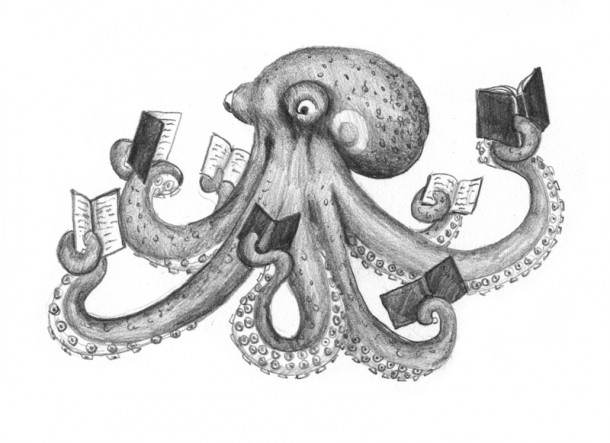
Reading With My Octopus Hands


The girl working in the coffee shop was having a good day and, in a voice that could cut through steel, she made sure the rest of us knew it.

"It's one of those mornings where everything just seems to go zippah-dee-doo-dah, y'know?" she said to her co-worker as she pulled a lever on the espresso machine and hissed steam into a waiting customer's cappuccino.  "Got a good night's sleep, had the leftover blintzes from yesterday my Mom put in the fridge, and didn't have any traffic on the way into work.  You ever have a day like that?" she asked the other girl.  Without waiting for an answer, she plunged into a further rundown of her morning; she was like a loud, living, breathing DayPlanner as she talked about what she was going to do with the rest of her day.  She chattered and babbled at a volume that was decidedly not an "inside voice."  The espressos hissed and steamed.  The rest of the customers talked among themselves at elevated pitches in order to be heard above the rising tide of noise.

I, for one, wished everyone would shut the fuck up.

I was sitting in a corner table with my Kindle and I was struggling to read David Mitchell's The Thousand Autumns of Jacob de Zoet.  Just when I was getting myself re-immersed in 18th-century samurai Japan, Little Miss Chirpy would pull me back out with her breathless description of the shade of black fingernail polish which, oh-em-gee, totally coordinated with her Ramones T-shirt that morning.

So she was having a good day.  Fine.  Big whoop.  I uncharitably wished she'd had a paper cut and fought with her boyfriend before coming to work so she would retreat into sullen, depressed silence.

Maybe it was just me.  Maybe I was having a hard time concentrating on Jacob's thousand autumns because there were already too many other narratives crowding my head.  At that moment, I was simultaneously reading three other books and it was driving me batshit.

*

I sank back into the bathtub, the warmth lapping over my shoulders and stomach and tried to focus on the book I was holding six inches above the water.  The Lover's Dictionary was a delightful little book about love and commitment.  It was easy to read, each page devoted to a single word and its micro-fiction definition.  The narrator and his girlfriend were funny, smart people and I really wanted to get to know them better.

It's just that I was distracted by thoughts of Jacob de Zoet and a certain "Radioactive Lady" in Tallahassee.


*     *

I sat at the desk in the hotel room with my copy of Elizabeth Stuckey-French's novel The Revenge of the Radioactive Lady propped in front of me.  The story revolves around an elderly woman named Marylou who, as a young mother, had been a guinea pig in a medical study of the 1950s where she drank radioactive cocktails which eventually caused the early death of her daughter.  Now she was in Florida, seeking retribution from the doctor who'd done her wrong all those decades ago.
Every morning when Marylou and her Welsh corgi, Buster, left their house at 22 Reeve's Court and set out on their walk toward Wilson Spriggs's house at 2208 Friar's Way, Marylou chanted to herself: Today's the day. Today's the day. Today's the day he'll suffer and die. Every morning she fully believed that by the time she'd walked the three blocks to Wilson's house she'd have figured out how to--

ThumpThumpThump!  What sounded like a herd of elephants (but turned out to be a high school wrestling team) ran across the floor of the room above me in the Hampton Inn.  I was pulled out of the book by the rumble from the ceiling.  So much for Marylou in Tallahassee....

Then, of course, I started thinking about the witty repartee those dictionary-lovers might toss back and forth in a situation like this.  And then my mind turned to Jacob and how he needed to defend himself against the Japanese feudal lords at that Dutch trading outpost.

*     *     *

I'm skimming low across a Montana wheat field with Richard Hugo.  For the past six months, I've gotten into the habit of reading at least one or two poems each day from Making Certain It Goes On.  Hugo's poetry folds me into the very page it's printed on and I go with him to the bar in Philipsburg, to the waters of Kicking Horse Reservoir, to the field where grass is placated by the wind and
         Someone may be out there
riding undulating light our way.
Wherever we live, we sleep here
where cattle sleep beside the full canal.
We slept here young in poems.
I linger over that last line, rolling it across the tongue, trying to fully absorb its beauty.

Then I make the mistake of looking up from the collection of Hugo's poetry.  Across my hotel room, I see the Radioactive Lady, The Lover's Dictionary, and my Kindle in a haphazard stack next to my computer.  They're all waiting for me.  They each in separate voices are calling to me, each trying to overshout the other, each vying for my increasingly crumbled attention.

I wish they'd shut the fuck up.


*     *     *     *

How did I get to this point?  When did I become a reader fragmented between narratives?  Why was I now sipping from my books when I should be gulping?

Some of it started when I took on the role of a book reviewer to multiple publications.  While I was reading one book for The Barnes and Noble Review, another assignment with a tighter deadline would come in from New West, and I'd feel forced to start working my way through that second book even as I was trying to finish the first book.

Then I started finding more and more books to add to my Must-Read list, taking recommendations from enthusiastic readers on Twitter and at BookBalloon, not to mention getting hooked by new books arriving daily from publishers who hoped I'd take a look at what they had to offer.  I called my To-Be-Read stack Mount Everest; then, as it grew and I realized what I was getting myself into, I renamed it Mount Never Rest.  The more I started to read new books, the farther away the finish line moved for each book.  At this rate, I would be a perpetual book starter but never a book finisher.

Make no mistake, you and I both live in a distracted society.  By now, the media has reported that story to death: video-game culture, attention-deficit, flashing billboards, micro-fiction, 140-character autobiographies, blah blah blah....In the competition for our attention, the once-interesting things in life have scattered into tiny atomic particles.  Deep thought has diluted and the short and shrill has become the momentary attention-getter.  In fact, since you started reading this, I'm willing to bet you had your eyes pulled off the screen at least three different times.

And now I was allowing myself to fall victim to turning books into wading pools.  Why, when there were so many TV shows to watch and news feeds to browse, was I making life hard for myself by reading four books at the same time, reading in the shallows with each one?

Overcommitment, for one thing.  Psychologically, I'm a "pleaser" and I hate to let anyone down--particularly editors who would like to have me review certain books by a certain date.  Before I knew it, my calendar bulged with assignments.

And then, in what seemed like mutual conspiracy, this year the publishing industry published a full roster of books which looked really, really interesting.  I was captivated by covers and hooked by plot summaries.  I started adding book after book to Mount Never Rest, trying to work out a reasonable schedule for myself--a schedule that quickly collapsed when I got books like The Instructions and Skippy Dies, thick volumes of daunting length.

I logged onto Twitter and tweeted at the #fridayreads group about how I was reading all these books at the same time "with octopus arms."  Funny, yeah, but nobody's laughing here.

I wasn't always like this.  There was a time when I was a monogamous reader, faithful to only one book at a time.  Ah, those were the days.  Back then, I could plow through War and Peace and keep the cast of characters straight in my head (well, almost).  Now, if I attempted that same thing, I would need a PowerPoint flow chart to help me navigate Napoleonic Russia.

The answer is, of course, to read faster.  Read faster, and live less.  Winnow down my time here on earth to the bare essentials of working my eyes across a page, line by line.  Take a speed-reading course, forsake responsibility, shirk my marriage, eat only peanut-butter sandwiches on whole-wheat bread.  That's unrealistic and (especially in the case of the shirked wife) completely undesirable.

Or, I could just stop taking on new books.  Finish these four, yes, but then pare it all back down to one book.  The way it used to be.  When all the pieces of my brain were in place and my reading was richer, deeper.

Yes, but....yes, but....I'm attracted to the next pretty book that comes along, clicking its high heels, swinging its hips, tossing its hair, pursing its lips.  I follow, I grab, I open to the first page, I start to read.  At this point, I have the image of my face getting too close to the nozzle of a vacuum cleaner.  I'm sucked in.

And inside the book is where I want to stay, at the peril of losing control of everything else that really matters in life.  Committed readers are much like meth addicts in this regard.

Here is what my factory-piston brain is trying to convince me I should do: lean closer to the book, assimilate into The Thousand Autumns of Jacob de Zoet, concentrate deeply on samurai Japan and let everything else slip to the background in a whisper: the chatty barista, the herd of high school athletes, the wind moving through Richard Hugo's grass.

Ah.  Hugo's grass.  That reminds me, I haven't read my "daily poem" this morning.  And after I'm through with that, I think I hear the Radioactive Lady tapping her foot.  She's waiting for me to come back to her...


Friday, February 4, 2011

Friday Freebie: "The Lover's Dictionary" by David Levithan

Congratulations to Cindy Naas Stapleton, winner of last week's Friday Freebie, The Janus Stone by Elly Griffiths.

This week's book giveaway is a Cupid arrow shot in your direction just in time for the holiday that, back in grade school, we used to call "VD Day."  Never mind that it was redundant (and that we had no earthly clue what "VD" stood for), it didn't stop our blushing fourth-grade snickers.

No matter how you celebrate Valentine's Day (or don't celebrate it, as is often the case), you'll want a copy of David Levithan's The Lover's Dictionary handy for that awkward moment between the presentation of the Godiva chocolates and the seeping recollection of her food allergies.  It's a compact palm-sized book, so you could hold it in one hand while writing your apology letter with the other.

Levithan, the author of several young-adult novels (including Nick & Norah's Infinite Playlist), has written a work of fiction which charts, in non-linear fashion, a relationship entirely through entries in a so-called Lover's Dictionary.  I'll have a full review of the book in the near future, but for now, I can tell you that it's clever, charming and, yeah, occasionally corny.  There are so many "definitions" I want to tell you about, but I'll limit myself to just two, chosen at random:
aberrant, adj.
       "I don't normally do this kind of thing," you said.
       "Neither do I," I assured you.
       Later it turned out we had both met people online before, and we had both slept with people on first dates before, and we had both found ourselves falling too fast before.  But we comforted ourselves with what we really meant to say, which was: "I don't normally feel this good about what I'm doing."
       Measure the hope of that moment, that feeling.
       Everything else will be measured against it.
buffoonery, n.
       You were drunk, and I made the mistake of mentioning Showgirls in a near-empty subway car.  The pole had no idea what it was about to endure.

Okay, one more...

candid, adj.
       "Most times, when I'm having sex, I'd rather be reading."
       This was, I admit, a strange thing to say on a second date.  I guess I was just giving you warning.
       "Most times when I'm reading," you said, "I'd rather be having sex."

If you'd like to learn the ABC's of love,* all you have to do is answer this question to be entered in the drawing for a copy of The Lover's Dictionary:

Which of Levithan's novels is "a Valentine's Day retelling of the Dickens classic, A Christmas Carol"?  (The answer can be found on the author's website)

Email your answer to thequiveringpen@gmail.com

Put FRIDAY FREEBIE in the e-mail subject line.  One entry per person, please.  Please e-mail me the answer, rather than posting it in the comments section.  Despite its name, the Friday Freebie runs all week long and remains open to entries until the contest closes at midnight on Feb. 10--at which time I'll draw the winning name.  I'll announce the lucky reader on Feb. 11.


*Cue the Jackson 5 jukebox in your head.

Thursday, February 3, 2011

Soup and Salad: Reading in Reptile Time, Kindle Singles Redux, Rummy Rumsfeld, Craig Loves Ernie, Roberto Bolano's Rules, LARB on the Launching Pad, Richard Ford vs. Cobra, The Bleak Dickens, yAWPfest, Penguins Redux

On today's menu:

1.  At Like Fire, Lisa Peet has some beautiful things to say about blogging and reading in what she* calls "reptile time."
       I think it’s a great term, myself, and the idea of blogging in reptile time is close to my heart.  Reading, too—it’s frustrating that the more new and current work I find myself plugged in to, the less time I have for the old stuff, the $2 paperbacks bought on the street and favorite books passed along by friends and things I read so long ago they’re probably entirely different stories now.  I make time for them, but it’s not as much as I would like.  Though I’m very happy where I am now, here in the middle of the soup, I look at my reading lists from ten years ago and feel a twinge of nostalgia for the way I read then, without the benefit of any hype or enthusiasm other than the most personal kind.  It’s been a while since I didn’t give a thought to what I was going to read next, or after that, unless I had a library due date looming.  A lot of what found me in those days, one way or another, was old.

2a.  Remember how I waxed enthusiastic about the new Amazon Kindle Singles?  Well, based on the strength of Darin Strauss' Long Island Shaolin and Brendan Koerner's Piano Demon, I continued my downloading spree with Evan Ratliff's Lifted.  Ratliff is editor of The Atavist, "a boutique publishing house" which is producing clean, tight narratives on several different digital devices for readers on the go, including a few of the offerings in the Kindle Store.  Lifted is a well-told, gripping story of a bank heist that doesn't go awry (at least not from the thieves' point of view).  Ratliff covers a lot of the ground we've already walked in the history of movies--from The Great Train Robbery to The Town--but in the way he shaves away all non-essentials and finds the rhythm of the minute-by-minute account of the robbery, he will have you white-knuckling your Kindle so hard, you might want to think about getting that Two-Year Extended Warranty before you start reading.  Screens could snap from the tension in Lifted.


2b.  What does the introduction of Kindle Singles (and like-minded short-form e-reading) bode for writers' wallets?  This article from The Big Picture may not have all the answers, but it has some of them.
What is new about Kindle Singles is the way that it circumvents publishers.  Amazon has gone to writers and asked them for these orphaned works or asked them to write such works to promote the idea.  For authors making 70% of a dollar or two, the proposition begins to make sense if they can sell a few thousand copies of their work.  With the narrowing of magazine writing opportunities, this should be a boon to authors.

3.  BREAKING NEWS: "Rummy" Rumsfeld coming to a bookstore near you; "remains largely unapologetic about his overall handling of the Iraq conflict."  Let the finger-pointing begin.


4.  At Three Guys One Book, Craig Lancaster (The Summer Son) recalls when he fell in love with Hemingway:
During the spring I turned 17 years old, I wasn’t nearly aware enough to realize just what A Farewell to Arms would mean to me.  All I knew was that the writing – so lean, so unadorned – was quite unlike anything I’d read before.  I recall some classmates chafing at the short, simple sentences, but I was enthralled.  I still am.

5.  Speaking of writing advice from the masters (and mistresses), This Recording rounds up a few pearls of wisdom from the likes of Flannery O'Connor, Charles Baxter, William Butler Yeats and Roberto Bolano, whose 12 Rules of Writing begin:
1.  Never approach short stories one at a time.  If one approaches short stories one at a time, one can quite honestly be writing the same short story until the day one dies.
2.  It is best to write short stories three or five at a time.  If one has the energy, write them nine or fifteen at a time.

6.  Consider this your drumroll: The Los Angeles Review of Books is nearing its launch date.  The somewhat lengthy Jerry Maguire-esque manifesto has been posted:
The LOS ANGELES REVIEW OF BOOKS will provide extensive commissioned reviews and essays and link to the finest, most enlightening of the blog entries, and provide a guide to the other literary resources on the web.   We will be using the power and promise of the web, in other words, to harness its own centrifugal force.
(Full Disclosure #1: I am a contributor to LARB)


7.  Richard Ford vs. cobra!  I have my doubts as to the veracity of this article, but figured you could use your daily dose of Richard Ford nonetheless.


8.  And for your Daily Dose of Dickens, I offer this essay at The Millions which extols the pleasures and pains of Bleak House.
       When I say, referring to Bleak House by Charles Dickens, “They don’t write books like that anymore,” I really mean it.  Reading it is like a guided tour of things serious authors aren’t allowed to do.  Exactly two of the characters are complicated and unpredictable, everyone else is either angelic or demonic.  Dozens of pages go by with nothing happening except amusing characters having silly conversation.  Halfway through the book an entire chapter is devoted to introducing a new character who never goes on to do anything integral to the story.  And a few of the characters start crying almost every time they have a conversation.
       Bleak House felt unlike the modern fiction I’m used to reading until I realized that the comparison is a disservice to Dickens.  You have to embrace Bleak House for what it is – a rambling, confusing, verbose, over-populated, vastly improbable story which substitutes caricatures for people and is full of puns.  In other words, an 800-page Dickens novel.

9.  Right now, thousands of writers are converging on our nation's capital for the Association of Writing Program's annual conference.  No word on whether or not Snooki will be dropping in from the Jersey Shore; but the legitimate lineup of presenters is like a frickin' Book World Super Bowl: Junot Diaz, Joyce Carol Oates, Richard Ford (your second daily sighting!), Mark Doty, Jennifer Egan, Elizabeth Strout, Ricky Moody, Benjamin Percy and at least two dozen others--enough to warrant security fears that one well-timed bomb could wipe out most of our current literary cash cows.  Fortunately, a few writers didn't make the annual trek to DC for pedagogy and cocktails.  Some, like Meg Pokrass, prefer to attend their own virtual AWP in their pajamas.  Pokrass is hosting the second annual yAWP, an on-line alternative to the national shindig.  You can drop in on the Barbaric yAWP Party on Facebook or on this page.  (Full Disclosure #2: Meg invited me to participate and so you can hear me reading a small slice of Fobbit, hastily recorded last night in my hotel room.)


10.  You voted, the Penguins listened.  Here are the results of the 10 Essential Penguin Classics reader poll.  The usual suspects are rounded up.  So, which books do you think should be included or dropped?  Discuss, debate, arm-wrestle in the comments section.


*Originally coined by Michael Chabon.