Front Porch Books is a monthly tally of books--mainly advance review copies (aka "uncorrected proofs" and "galleys")--I've received from publishers, but also sprinkled with packages from Book Mooch, Amazon and other sources. Because my dear friends, Mr. FedEx and Mrs. UPS, leave them with a doorbell-and-dash method of delivery, I call them my Front Porch Books. In this digital age, ARCs are also beamed to the doorstep of my Kindle via NetGalley and Edelweiss. Note: most of these books won't be released for another 2-6 months; I'm just here to pique your interest and stock your wish lists. Cover art and opening lines may change before the book is finally released.
 The Chaperone by Laura Moriarty (Riverhead Books): If you put a gun to my head and said I could only have one channel on television for the rest of my life, I would quickly blurt out: "TCM." The rest of the world can go away and if I can stay huddled in the dark in front of Turner Classic Movies, I'm a happy man. I love movies made between 1900 and 1950 with an unbridled passion. Cut me, I bleed black-and-white. That's why when I heard Laura Moriarty had written a novel featuring one of Hollywood's most alluring (and relatively unknown) actresses of the silent era, I knew I had to get my hands on it. The Chaperone follows future silver screen vamp Louise Brooks as she leaves her Midwestern town for a trip to the big city. The concept is ripe for Moriarty to explore the character of an irreverent spitfire of a girl before Hollywood gets its hands on her (or, more accurately, before she gets her hands on Hollywood). Here's the Jacket Copy to tell us why we should take this trip:
 Heading Out to Wonderful by Robert Goolrick (Algonquin Books): Goolrick follows up his immensely popular first novel, A Reliable Wife, with this book which looks just as reliably good. Once again setting a love story in the near-past (post World War Two, in this case), Goolrick delivers a tale about the dark side of passion. Here's the Jacket Copy:
 Suddenly, a Knock on the Door by Etgar Keret (Farrar, Straus, and Giroux): I've been a fan of Keret's short, quirky fiction from the day I first laid eyes on his collection The Girl on the Fridge. I began my review at The Barnes & Noble Review by saying, "The successful short-short story, also called 'flash fiction,' operates like an elite military commando team: get in, get out, take no prisoners. But how do you reduce a universe of meaning to something smaller than the size of a breadbox? Etgar Keret makes it look easy." His latest collection, Suddenly, a Knock on the Door, looks like it delivers more of the same flash-bang surprise of language. It was first published in Keret's native Israel in 2010 and is now being put in American readers' hands by Farrar, Straus and Giroux, which says in its Jacket Copy, "In his most playful and most mature work yet, the living and the dead, silent children and talking animals, dreams and waking life coexist in an uneasy world." Keret's universe is an odd one, indeed, but I guarantee you'll come back from your vacation there feeling smarter--like you're walking around with a secret the rest of humanity is yet to discover. Opening Lines:
 The Unfinished Work of Elizabeth D. by Nichole Bernier (Crown): Bernier's debut novel begins in the shattering aftermath of 9/11. Kate and her husband drive across the George Washington Bridge, purposefully not looking at the gaping hole left by the World Trade Center. But the absence is a presence, just as is the loss of Kate's friend Elizabeth who was killed in a plane crash shortly before the terrorist attacks. The first chapter sets up the novel quite well, promising a potent stew of emotions for the next 300 pages. Jacket Copy:
 The Sleepy Hollow Family Almanac by Kris D'Agostino (Algonquin Books): On the surface, this book fairly reeks of The Royal Tenenbaums or The Family Fang. And that's totally cool with me. I like a little quirk in my morning coffee. Here's the Jacket Copy:
 So Far Away by Meg Mitchell Moore (Little, Brown): Meg Mitchell Moore's second novel (after last year's The Arrivals) brings three disparate lives together: 13-year-old Natalie Gallagher who is dealing with her parents' ugly divorce as well as the vicious cyber-bullying of her former best friend; Kathleen Lynch, an archivist at the Massachusetts State Archives and a widow estranged from her only daughter; and an Irish immigrant domestic servant from the 1920s who harbored a secret. Those three worlds collide when Natalie finds the servant's diary in her family's basement and winds up at the archives where she'll do more research, and force Kathleen to confront her feelings about her own daughter. The Opening Lines hold great promise for what lies ahead in the next 330 pages:
 Hemlock Grove by Brian McGreevy (Farrar, Straus, and Giroux): Yes, it's true: monsters have invaded the normally staid-and-stuffy category we label "literary fiction." Fine by me. If books like Justin Cronin's The Passage and Colson Whitehead's Zone One are any indication, a little bloodied tooth-and-claw will be a welcome shake-up for readers who normally take their fiction on the heavy side. Not that the werewolves of fiction are about to disembowel Marilynne Robinson and eat her intestines, but there are some very inventive and sexy experiments being made with the cross-pollination of genres. Case in point, Brian McGreevy's debut novel Hemlock Grove which looks like it sets out to turn the classic monster story--from Mary Shelley to The Howling--on its furry, scaly ear. In addition to sporting a tasty neon-pink cover, Hemlock Grove has a mighty chewy storyline. Here's the Jacket Copy by way of explanation:
 Essayists on the Essay: Montaigne to Our Time by Carl H. Klaus and Ned Stuckey-French (University of Iowa Press): Shifting gears a little (okay, a lot), I turn my attention to a non-fiction anthology which landed on my front porch with a thunk two weeks ago. Calling itself "the first historically and internationally comprehensive collection of its kind," this book with its thick, rich stew of content will appeal to those who are interested in "the theory, practice, and art of the essay." There are plenty of books out there which collect essays on various subject matter--from whale songs to motherhood--but when was the last time you saw a group of essays whose subject matter was the essay itself? Klaus and Stuckey-French have assembled four centuries of commentary and theory on the art form. The line-up includes plenty of marquee names: Samuel Johnson, Francis Bacon, Charles Lamb, William Carlos Williams, Aldous Huxley, E. B. White, William H. Gass, Phillip Lopate, Susan Sontag, Ander Monson, John D'Agata and plenty of others. I think the spirit and value of the anthology is best summed up in this passage from Virginia Woolf's "The Modern Essay":
 The Coldest Night by Robert Olmstead (Algonquin Books): Olmstead is another name on my "Greatest Writers I've Never Read" list. Due to the unstoppable flood of books into my house, my S-L-O-W reading pace, and the unavailability of the 28-hour-day, I've somehow managed to not-read his novels Coal Black Horse and Far Bright Star. I hope that's about to change. Scratch that--I know that's about to change. Olmstead's newest book examines war and its impact on soldiers when they return to the United States. You should know by now, this is fiction tailor-made to my tastes. Here's the Jacket Copy for The Coldest Night:
 The Legend of Pradeep Mathew by Shehan Karunatilaka (Graywolf Press): To be honest, the cover design for this novel about a cricket player in Sri Lanka doesn't exactly raise my pulse. Neither does the somewhat daunting length (416 pages) for a book about a sport which has already been giving the literary fiction treatment in the critically-acclaimed Netherland by Joseph O'Neill. But I'm willing to set those petty prejudices aside because of two things: that trio of wolves on the spine which reassures me that I've never been disappointed by Graywolf's taste in fiction; and the first pages which set the stage for what looks like what Michael Ondaatje calls "a crazy ambidextrous delight." Here's the Jacket Copy:
And here are the Opening Lines:
 Fires of Our Choosing by Eugene Cross (Dzanc Books): Here's another new book from a trustworthy publisher. Dzanc Books is always scanning the literary horizon with high-powered binoculars to find fresh and exciting voices. Eugene Cross' debut collection of short stories could be one of the year's finest, solely based on these Opening Lines (to "Rosaleen, If You Know What I Mean"):
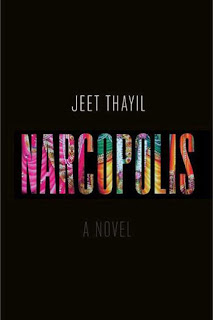 Narcopolis by Jeet Thayil (The Penguin Press): Here's a novel that puts its litmus test right at the beginning. Thayil's debut about Bombay's underbelly opens with a single sentence that unrolls like a bolt of cloth bouncing down a staircase across seven pages. I don't have the space to give you the entire mesmerizing prologue called "Something For the Mouth," but here is just a small narcotic taste of the Opening Lines:
 Evel Knievel Days by Pauls Toutonghi (Crown): Okay, here's the thing. I live in Butte, Montana, hometown of 1970s motorcycle daredevil Evel Knievel. Every year, for the past eleven years, the Mining City has held a mini Sturgis rally called Evel Knievel Days. Furthermore, I like baklava. So, how could I possibly resist Toutonghi's novel which not only features Butte front and center (for at least the first half of the book) but also Egyptian cooking? I can't and I won't--Evel Knievel Days is going straight to the summit of my To-Be-Read pile (aka Mt. NeverRest). Here's the Jacket Copy to explain more of its engine-revving appeal:
 Gilded Age by Claire McMillan (Simon & Schuster): In her debut novel, McMillan uses Edith Wharton's The House of Mirth as a high-dive from which to springboard into a story about "one woman's struggle for independence and love." Under McMillan's pen Wharton's Lily Bart becomes Ellie Hart and Cleveland substitutes for New York City. Here's the Jacket Copy:
 The Orphanmaster by Jean Zimmerman (Viking): Sometimes you just want to sink deep into an historical novel full of witches, spies, orphans and cannibals. Am I right? If that's the kind of book you'd pull from your shelf on a rainy afternoon, then Zimmerman's novel about Colonial America intrigue should be the first spine you crack as the rain pelts the window outside your reading nook. Though she shares the unfortunate coincidence of being released in the same year as Adam Johnson's highly-praised The Orphan Master's Son, Zimmerman has penned an entirely different novel. Exhibit A: the Jacket Copy:
 Windeye by Brian Evenson (Coffee House Press): Evenson's name has been circling around the periphery of my brain for a number of years, but somehow I've never crossed paths with his words until this collection of short stories landed on my doorstep. Evenson is well-known in certain circles as a master of modern literary horror. I'm excited/scared to take his tales for a test drive. Here are the Opening Lines to the collection's title story:
 Zombie by J. R. Angelella (Soho Press): Sticking with the unsettling things of this world, the next book atop Mt. NeverRest on my desk also holds a lot of potential to be a breakout hit of the summer. The back cover blurb says Angelella's debut novel will appeal to fans of Jonathan Safran Foer, Wes Anderson and Chuck Palahniuk. I've read the first chapter and I think Zombie will also appeal to fans of tight, snappy, funny fiction. Thanks to The Walking Dead and Zone One, zombies are hot right now. Angelella is about to make things even hotter for fans of the undead. Here's the Jacket Copy:

Only a few years before becoming a famous actress and an icon for her generation, a fifteen-year-old Louise Brooks leaves Wichita to make it big in New York. Much to her annoyance, she is accompanied by a thirty-six-year-old chaperone who is neither mother nor friend. Cora Carlisle is a complicated but traditional woman with her own reasons for making the trip. She has no idea what she’s in for: Young Louise, already stunningly beautiful and sporting her famous blunt bangs and black bob, is known for her arrogance and her lack of respect for convention. Ultimately, the five weeks they spend together will change their lives forever. For Cora, New York holds the promise of discovery that might prove an answer to the question at the center of her being, and even as she does her best to watch over Louise in a strange and bustling city, she embarks on her own mission. And while what she finds isn’t what she anticipated, it liberates her in a way she could not have imagined. Over the course of the summer, Cora’s eyes are opened to the promise of the twentieth century and a new understanding of the possibilities for being fully alive.

In Heading Out to Wonderful, an attractive and enigmatic stranger—Charlie Beale, a loner, recently home from the war in Europe—wanders into the town of Brownsburg, a sleepy village of only a few hundred people nestled in the Valley of Virginia. He brings with him two suitcases: one contains all his worldly possessions, including a set of butcher’s knives; the other is full of money. Charlie quickly finds a job at the local butcher shop and through his work there meets all the townspeople, most notably Sam Haislett, the five-year-old son of the shop’s owner, and Sylvan Glass, the beautiful, eccentric teenage bride of the town’s richest man. What no anticipates is how the interaction of these three people will alter the town forever, and how the passion that flares between Charlie and Sylvan will mark young Sam for life. Told through the eyes of Sam, now an older man looking back on that time, this much-anticipated follow-up to A Reliable Wife is an exciting, erotically charged, and altogether unforgettable story of love gone terribly wrong in a place where once upon a time such things could happen.Here are the novel's Opening Lines:
The thing is, all memory is fiction. You have to remember that. Of course, there are things that actually, certifiably happened, things where you can pinpoint the day, the hour, and the minute. When you think about it, though, those things mostly seem to happen to other people.
This story actually happened, and it happened pretty much the way I’m going to tell it to you. It’s a true story, as much as six decades of remembering and telling can allow it to be true. Time changes things, and you don’t always get everything right. You might remember a little thing clear as a bell, the weather, say, or the splash of light on the river’s ripples as the sun was going down into the black pines, things not even connected to anything in particular, while other things, big things even, come completely disconnected and no longer have any shape or sound. The little things seem more real than some of the big things.

"Tell me a story,” the bearded man sitting on my living-room sofa commands. The situation, I must say, is anything but pleasant. I’m someone who writes stories, not someone who tells them. And even that isn’t something I do on demand. The last time anyone asked me to tell him a story, it was my son. That was a year ago. I told him something about a fairy and a ferret—I don’t even remember what exactly—and within two minutes he was fast asleep. But the situation is fundamentally different. Because my son doesn’t have a beard, or a pistol. Because my son asked for the story nicely, and this man is simply trying to rob me of it.
I try to explain to the bearded man that if he puts his pistol away it will only work in his favor, in our favor. It’s hard to think up a story with the barrel of a loaded pistol pointed at your head.

Summer vacation on Great Rock Island was supposed to be a restorative time for Kate, who’d lost her close friend Elizabeth in a sudden accident. But when she inherits a trunk of Elizabeth's journals, they reveal a woman far different than the cheerful wife and mother Kate thought she knew. The complicated portrait of Elizabeth—her troubled upbringing, and her route to marriage and motherhood—makes Kate question not just their friendship, but her own deepest beliefs about loyalty and honesty at a period of uncertainty in her own marriage. The more Kate reads, the more she learns the complicated truth of who Elizabeth really was, and rethinks her own choices as a wife, mother, and professional, and the legacy she herself would want to leave behind. When an unfamiliar man’s name appears in the pages, Kate realizes the extent of what she didn’t know about her friend, including where she was really going on the day she died. Set in the anxious summer after the September 11th attacks, this story of two women—their friendship, their marriages, private ambitions and fears—considers the aspects of ourselves we show and those we conceal, and the repercussions of our choices.Blurbworthiness: "Women have secret lives—sometimes hidden in the corners of our minds, sometimes in dreams unrealized. One mark of friendship is when and whether these nightmares and ambitions can be revealed. This riveting novel fiercely captures this fulcrum of the public and private lives of American mothers." (Randy Susan Meyers, author of The Murderer’s Daughters)

Calvin Moretti can’t believe how much his life sucks. He’s a twenty-four-year-old film school dropout living at home again and working as an assistant teacher at a preschool for autistic kids. His insufferable go-getter older brother is also living at home, as is his kid sister, who’s still in high school and has just confided to Cal that she’s pregnant. What’s more, Calvin’s father, a career pilot, is temporarily grounded and obsessed with his own mortality. and his ever-stalwart mother is now crumbling under the pressure of mounting bills and the imminent loss of their Sleepy Hollow, New York, home: the only thing keeping the Morettis moored. Can things get worse? Oh, yes, they can. Which makes it all the more amazing that The Sleepy Hollow Family Almanac is not only buoyantly fun but often very, very funny. In this debut novel, Kris D’Agostino has crafted an engrossing contemporary tale of a loopy but loving family, and in Calvin Moretti, he’s created an oddball antihero who really wants to do the right thing—if he can just figure out what it is.I'm also drawn to The Sleepy Hollow Family Almanac because it seems like it will take politically-incorrect chances. I mean, you've gotta give props to a guy who is willing to start his debut novel with these Opening Lines:
I work with retards.
This is fact in more ways than one. It is fact because I am a teaching assistant at a preschool for autistic kids. It is fact because family, friends, and most of the people who populate my life are idiots.

It was a Friday when the girl came into the Archives for the first time, the first Friday after they'd changed the clocks. Spring ahead, fall back: Kathleen had once learned some rhyme about that when she was a school child, but she no longer remembered it. It had been some time since she'd been a school child. This was early November, the leaves mostly down, lying wet and slick all over Boston.
Not so long ago, a few days, maybe a week, Kathleen had been out walking the dog in short sleeves, but today the sky--dark, glowering low--seemed to be readying itself for some sort of inhospitable eruption. The planet appeared to be in a muddle, and she waited (they all waited) for something to happen.
Which it did. Not right away, but eventually.

The body of a young girl is found mangled and murdered in the woods of Hemlock Grove, Pennsylvania, in the shadow of the abandoned Godfrey Steel mill. A manhunt ensues—though the authorities aren’t sure if it’s a man they should be looking for. Some suspect an escapee from the White Tower, a foreboding biotech facility owned by the Godfrey family—their personal fortune and the local economy having moved on from Pittsburgh steel—where, if rumors are true, biological experiments of the most unethical kind take place. Others turn to Peter Rumancek, a Gypsy trailer-trash kid who has told impressionable high school classmates that he’s a werewolf. Or perhaps it’s Roman, the son of the late JR Godfrey, who rules the adolescent social scene with the casual arrogance of a cold-blooded aristocrat, his superior status unquestioned despite his decidedly freakish sister, Shelley, whose monstrous medical conditions belie a sweet intelligence, and his otherworldly control freak of a mother, Olivia.

The essay can be short or long, serious or trifling, about God and Spinoza, or about turtles and Cheapside. But as we turn over the pages of these five little volumes, containing essays written between 1870 and 1920, certain principles appear to control the chaos, and we detect in the short period under review something like the progress of history.
Of all forms of literature, however, the essay is the one which least calls for the use of long words. The principle which controls it is simply that it should give pleasure; the desire which impels us when we take it from the shelf is simply to receive pleasure. Everything in an essay must be subdued to that end. It should lay us under a spell with its first word, and we should only wake, refreshed, with its last. In the interval we may pass through the most various experiences of amusement, surprise, interest, indignation; we may soar to the heights of fantasy with Lamb or plunge to the depths of wisdom with Bacon, but we must never be roused. The essay must lap us about and draw its curtain across the world.

Henry Childs is just seventeen when he falls into a love affair so intense it nearly consumes him. But when young Mercy’s disapproving father threatens Henry’s life, Henry runs as far as he can—to the other side of the world. The time is 1950, and the Korean War hangs in the balance. Descended from a long line of soldiers, Henry enlists in the marines and arrives in Korea on the eve of the brutal seventeen-day battle of the Chosin Reservoir—the turning point of the war—completely unprepared for the forbidding Korean landscape and the unimaginable circumstances of a war well beyond the scope of anything his ancestors ever faced. But the challenges he meets upon his return home, scarred and haunted, are greater by far. Robert Olmstead’s riveting new novel is not only a passionate story of love and war, it is a timeless story of soldiers coming home to a country with little regard for, and even less knowledge of, what they’ve confronted. Through his hero, Olmstead reveals an unspoken truth about combat: that for many men, the experience of war is the most enlivening, electric, and extraordinary experience of their lives.It's not hard to figure out why this might just be the Olmstead novel to finally make it from the Not-Read column over to the Read column. Men, war and (pardon the pun) the Mercy of love. Sounds like a winner to me.

Aging sportswriter W.G. Karunasena's liver is shot. Years of drinking have seen to that. As his health fades, he embarks with his friend Ari on a madcap search for legendary cricket bowler Pradeep Mathew. En route they discover a mysterious six-fingered coach, a Tamil Tiger warlord, and startling truths about their beloved sport and country. A prizewinner in Sri Lanka, and a sensation in India and Britain, The Legend of Pradeep Mathew is a nimble and original debut that blends cricket and the history of modern Sri Lanka into a vivid and comedic swirl.
Begin with a question. An obvious one. So obvious it has already crossed your mind. Why have I not heard of this so-called Pradeep Mathew?Bonus appeal: a drunk and unreliable narrator. Okay, fine, maybe this is my cup of Earl Grey.
This subject has been researched lengthwise and breadthwise. I have analysed every match our man has played in. Why, you ask, has no one heard of our nation’s greatest cricketer?
Here, in no particular order. Wrong place, wrong time, money, and laziness. Politics, racism, powercuts, and plain bad luck. If you are unwilling to follow me on the next God-knows-how-many pages, re-read the last two sentences. They are as good a summary as I can give from this side of the bottle.

The day after his brother left the house for good, Marty Hanson picked out the smallest boy in his sixth grade class and waited until the boy was alone. He approached him, telling him that he’d found a dead dog decomposing in a far corner of the school’s courtyard. The boy, who was new at the school and whose name Marty could not remember, stuffed his hands deep into his pockets, nearly to the elbows, and said, “So?” He was looking at a dandelion near his sneaker’s toe.Blurbworthiness: "Eugene Cross's book of stories is beautifully made: eloquent and at times darkly comic, these stories are particularly alert to the ways that working people cope with what's been given to them. The stories also are wise and scary about American violence. I loved this book; it's a brilliant debut." (Charles Baxter)
“‘So?’” Marty said, staring at the boy. “So I dare you to come over and have a look.”
The boy kept his eyes trained on the ground, his head tilted forward. Marty saw the cowlick in the boy’s hair. Probably that morning his mother had tried to comb it down with a wet brush, Marty thought.
“I knew you were a pussy. Jimmy Dinuzio told me so.” Marty had seen the two hanging around.
“Jimmy didn’t say that.”
“Whatever,” Marty said. He began to turn away. Before he’d taken two full steps he heard the boy say, “Where is it?”
Marty led him to the southeast corner of the courtyard where two evergreens stood like sentries. He pointed to the base of one of the trees where the branches hung low and bare and darkened the ground. Dry pine needles were scattered everywhere.
“Over there,” Marty said. The boy walked slowly, waving his hand in front of him as though he was blind. Marty followed close behind, and by the time the boy realized there was no dog, it was too late, Marty already had him on the ground. He straddled his chest and pounded his head and torso with his fists. He had trapped one of the boy’s hands with his knee, and when the boy tried to shield his face with the other, Marty tore it away. He dropped his bony elbows onto the boy’s chest and ribs and he spit on him until his mouth went dry. The boy’s screams sounded to Marty like a car peeling out, like the high-pitched squeal of rubber on asphalt.

Bombay, which obliterated its own history by changing its name and surgically altering its face, is the hero or heroin of this story, and since I’m the one who’s telling it and you don’t know who I am, let me say that we’ll get to the who of it but not right now, because now there’s time enough not to hurry, to light the lamp and open the window to the moon and take a moment to dream of a great and broken city, because when the day starts its business I’ll have to stop, these are nighttime tales that vanish in sunlight, like vampire dust— wait now, light me up so we do this right, yes, hold me steady to the lamp, hold it, hold, good, a slow pull to start with, to draw the smoke low into the lungs, yes, oh my, and another for the nostrils, and a little something sweet for the mouth, and now we can begin at the beginning with the first time at Rashid’s when I stitched the blue smoke from pipe to blood to eye to I and out into the blue world— and now we’re getting to the who of it and I can tell you that I, the I you’re imagining at this moment, a thinking someone who’s writing these words, who’s arranging time in a logical chronological sequence, someone with an overall plan, an engineer-god in the machine, well, that isn’t the I who’s telling this story, that’s the I who’s being told, thinking of my first pipe at Rashid’s, trawling my head for images, a face, a bit of music, or the sound of someone’s voice, trying to remember what it was like, the past, recall it as I would the landscape and light of a foreign country, because that’s what it is, not fiction or dead history but a place you lived in once and cannot return to, which is why I’m trying to remember how it was that I got into trouble in New York and they sent me back to Bombay to get straight, how I found Rashid’s, and how, one afternoon, I took a taxi through roads mined with garbage, with human and animal debris, and the poor, everywhere the poor and deranged stumbled in their rags or stood and stared, and I saw nothing out of the ordinary in their bare feet and air of abandonment, I smoked a pipe and I was sick all day,Okay, you get the picture. By that point, you'll either bail or sail with Thayil across the rest of the novel's 288 pages (don't worry, he starts compartmentalizing language into manageable sentences in Chapter One). The publicity materials accompanying my copy of Narcopolis compared it to the writings of William S. Burroughs and Baudelaire. To me, it looks like a sweet curl of smoke going up the nostrils to blow the mind. Here's a taste of the plot from the Jacket Copy:
Narcopolis opens in Bombay in the late 1970s, as its narrator first arrives from New York to find himself entranced with the city’s underworld, in particular an opium den and attached brothel. A cast of unforgettably degenerate and magnetic characters works and patronizes the venue, including Dimple, the eunuch who makes pipes in the den; Rumi, the salaryman and husband whose addiction is violence; Newton Xavier, the celebrated painter who both rejects and craves adulation; Mr. Lee, the Chinese refugee and businessman; and a cast of poets, prostitutes, pimps, and gangsters.

Khosi Saqr has always felt a bit out of place. Butte, Montana, is a somewhat homogenous town, and Khosi--half Egyptian, full of nervous habits, raised by a single mother, owner of a name that no one can pronounce--sticks out dramatically. His only solace is his work at the Copper King Mansion Museum, the former home of his ancestor, copper baron William Andrews Clark, and his bond with (and unrequited love for) his best friend, Natasha. But after Natasha gets engaged to her longtime boyfriend and Khosi's mother announces that she has finally, after twenty years, divorced his father, Khosi decides that it is time to make the leap: he goes to Cairo to find his father and connect to his heritage in a way he's never been able to before.Blurbworthiness: "Evel Knievel Days is so good, I want to dress it up in a star-spangled jumpsuit, leap it over the pyramids of Giza on a Laverda American Eagle 750cc motorcycle, and watch it stick its landing before an audience of millions in downtown Butte, Montana. A funny, heart-warming, compulsively readable novel about the unbreakable bonds of family--and baklava. This is one you shouldn't miss. Terrific!" (Garth Stein, author of The Art of Racing in the Rain) "Evel Knievel--the great American daredevil whose spirit presides over Pauls Toutonghi's masterful coming-of-age novel--broke his shoulder, his arm, his collarbone, several ribs, his pelvis, and more: 433 bones in all. Toutonghi takes as many risks, but what he breaks, and puts back together, is the human heart.” (Ben Greenman, author of What He’s Poised to Do)

Eleanor Hart had made a brilliant marriage in New York, but it ended in a scandalous divorce and thirty days in Sierra Tucson rehab. Now she finds that, despite feminist lip service, she will still need a husband to be socially complete. A woman’s sexual reputation matters, and so does her family name. Ellie must navigate the treacherous social terrain where old money meets new: charitable benefits and tequila body shots, inherited diamonds and viper-bite lip piercings, country house weekends and sexting. She finds that her beauty is a powerful tool in this world, but it has its limitations, even liabilities. Through one misstep after another, Ellie mishandles her second act. Her options narrow, her future prospects contract, until she faces a desperate choice.And here are the very promising Opening Lines:
I’m a native Clevelander. I went east to school, as we do. And I married the loveliest man from Charleston, South Carolina, and convinced him to move back to Cleveland and start a family with me. Nothing is more usual than Clevelanders of a certain ilk leaving, seeing the world, and then dragging a spouse back to settle down. My husband, Jim, calls himself in jest an import—used to vary the breeding stock.
And variety is needed here. I've known most of my Cleveland friends since we were infants, since crawling around together on faded Oriental carpets and cartwheeling in the grass at country club picnics. My parents knew their parents, and my parents' parents knew their grandparents, and so it goes back to the very beginnings when Cleveland was considered the West, and nice families had to stick together. So imports are needed, as few things are less exciting than kissing someone you've known since kindergarten.
I tell you all this so that when I tell you that Eleanor Hart moved back to Cleveland without an import, you have a sense of the problem this presented.
It’s 1663 in the tiny, hardscrabble Dutch colony of New Amsterdam, now present-day southern Manhattan. Orphan children are going missing, and among those looking into the mysterious state of affairs are a quick-witted twenty-two-year-old trader, Blandine von Couvering, herself an orphan, and a dashing British spy named Edward Drummond. Suspects abound, including the governor’s wealthy nephew, a green-eyed aristocrat with decadent tastes; an Algonquin trapper who may be possessed by a demon that turns people into cannibals; and the colony’s own corrupt and conflicted orphanmaster. Both the search for the killer and Edward and Blandine’s newfound romance are endangered, however, when Blandine is accused of being a witch and Edward is sentenced to hang for espionage. Meanwhile, war looms as the English king plans to wrest control of the colony.

They lived, when he was growing up, in a simple house, an old bungalow with a converted attic and sides covered in cedar shake. In the back, where an oak thrust its branches over the roof, the shake was light brown, almost honey. In the front, where the sun struck it full, it had weathered to a pale gray, like a dirty bone. There, the shingles were brittle, thinned by sun and rain, and if you were careful you could slip your fingers up behind some of them. Or at least his sister could. He was older and his fingers were thicker, so he could not.Yowza! There's lots of skin-crawling promise in those three paragraphs. The other stories, according to the Jacket Copy, include "a woman falling out of sync with the world; a king's servant hypnotized by his murderous horse; and a transplanted ear with a mind of its own."
Looking back on it, many years later, he often thought it had started with that, with her carefully working her fingers up under a shingle as he waited and watched to see if it would crack. That was one of his earliest memories of his sister, if not the earliest.
His sister would turn around and smile, her hand gone to knuckles, and say, “I feel something. What am I feeling?” And then he would ask questions. Is it smooth? he might ask. Does it feel rough? Scaly? Is it cold-blooded or warm-blooded? Does it feel red? Does it feel like its claws are in or out? Can you feel its eye move? He would keep on, watching the expression on her face change as she tried to make his words into a living, breathing thing, until it started to feel too real for her and, half-giggling, half-screaming, she whipped her hand free.

Fourteen-year-old Jeremy Barker is obsessed with zombie movies. He attends an all-boys Catholic High School where roving gangs in plaid make his days a living hell. His mother is an absentee pillhead, his older brother a self-diagnosed sex-addict, and his father an ex-Marine realtor who disappears night after night without explanation. Jeremy navigates it all with a code cobbled together from Night of the Living Dead, 28 Days Later, Planet Terror, Zombieland and Dawn of the Dead:Sounds like a novel that has a lot of heart and (....wait for it....) braaains.
* Avoid Contact
* Keep Quiet
* Forget the Past
* Lock-and-load
* Fight to Survive
The code is put to the test when he discovers in his father's closet a bizarre homemade video of a man strapped to a bed, being prepped for some sort of surgical procedure. As Jeremy--troubled but ever-optimistic--attempts to trace the origin of the video, this remarkable debut moves from its sharp, precocious beginnings to a climax of almost unthinkable violence, testing him to the core.


