Friday, April 11, 2014

Friday Freebie: Lovers at the Chameleon Club, Paris 1932 by Francine Prose


Congratulations to Beverly Sizemore, winner of last week's Friday Freebie--a bundle of three novels: The Storied Life of A. J. Fikry by Gabrielle Zevin, The Impossible Lives of Greta Wells by Andrew Sean Greer, and The Road From Gap Creek by Robert Morgan.

This week's book contest prize is Lovers at the Chameleon Club, Paris 1932 by Francine Prose.  I have TWO brand-new hardback copies of the novel to give away to two lucky readers.  Here's more about the new prose from Prose:
A richly imagined and stunningly inventive literary masterpiece of love, art, and betrayal, exploring the genesis of evil, the unforeseen consequences of love, and the ultimate unreliability of storytelling itself. Paris in the 1920s. It is a city of intoxicating ambition, passion, art, and discontent, where louche jazz venues like the Chameleon Club draw expats, artists, libertines, and parvenus looking to indulge their true selves. It is at the Chameleon where the striking Lou Villars, an extraordinary athlete and scandalous cross-dressing lesbian, finds refuge among the club's loyal denizens, including the rising photographer Gabor Tsenyi, the socialite and art patron Baroness Lily de Rossignol, and the caustic American writer Lionel Maine. As the years pass, their fortunes--and the world itself--evolve. Lou falls in love and finds success as a race car driver. Gabor builds his reputation with vivid and imaginative photographs, including a haunting portrait of Lou and her lover, which will resonate through all their lives. As the exuberant twenties give way to darker times, Lou experiences another metamorphosis that will warp her earnest desire for love and approval into something far more sinister: collaboration with the Nazis. Told in a kaleidoscope of voices, Lovers at the Chameleon Club, Paris 1932 evokes this incandescent city with brio, humor, and intimacy.
Gary Shteyngart, never one for a bland blurb, had this to say about the novel: “Prose’s latest book goes further in destroying the concept of a single truth than Rashomon.  It’s also an uproarious portrait of Paris from the mid-twenties to the Second World War.  Prose has always been adept at slaying sacred cows; in this book, she pretty much machine-guns them.”

If you’d like a chance at winning a copy of Lovers at the Chameleon Club, Paris 1932, simply email your name and mailing address to

Put FRIDAY FREEBIE in the e-mail subject line.  One entry per person, please.  Despite its name, the Friday Freebie runs all week long and remains open to entries until midnight on April 17, at which time I’ll draw the winning name.  I’ll announce the lucky reader on April 18.  If you’d like to join the mailing list for the once-a-week newsletter, simply add the words “Sign me up for the newsletter” in the body of your email.  Your email address and other personal information will never be sold or given to a third party (except in those instances where the publisher requires a mailing address for sending Friday Freebie winners copies of the book).

Want to double your odds of winning?  Get an extra entry in the contest by posting a link to this webpage on your blog, your Facebook wall or by tweeting it on Twitter.  Once you’ve done any of those things, send me an additional e-mail saying “I’ve shared” and I’ll put your name in the hat twice.


Thursday, April 10, 2014

Front Porch Books: April 2014 edition


Front Porch Books is a monthly tally of books--mainly advance review copies (aka "uncorrected proofs" and "galleys")--I've received from publishers, but also sprinkled with packages from Book Mooch, Amazon and other sources.  Because my dear friends, Mr. FedEx and Mrs. UPS, leave them with a doorbell-and-dash method of delivery, I call them my Front Porch Books.  In this digital age, ARCs are also beamed to the doorstep of my Kindle via NetGalley and Edelweiss.  Note: most of these books won't be released for another 2-6 months; I'm just here to pique your interest and stock your wish lists. Cover art and opening lines may change before the book is finally released.


Fourth of July Creek by Smith Henderson (Ecco):  Henderson's debut novel has been on my book radar for more than six months--ever since I heard editor Lee Boudreaux mention it on Brad Listi's Other People podcast.  I can't remember exactly what Ms. Boudreaux said during that interview, but I believe the words "epic," "beautiful," and "Montana" were breathed into the microphone.  That's all I needed to hear.  Ping! went my radar.  And now I finally have an advance copy of this big, beautiful novel about Montana in my hands and I couldn't be more excited.  Let's begin with this bit of Blurbworthiness from Philipp Meyer (himself the author of the epic novel The Son): “This book left me awestruck; a stunning debut which reads like the work of a writer at the height of his power. Begins with the story of one struggling man and his family and soon seems to encompass and address all of modern America's problems.  Fourth of July Creek is a masterful achievement and Smith Henderson is certain to end up a household name.”  Here's the Jacket Copy:
After trying to help Benjamin Pearl, an undernourished, nearly feral eleven-year-old boy living in the Montana wilderness, social worker Pete Snow comes face-to-face with the boy's profoundly disturbed father, Jeremiah. With courage and caution, Pete slowly earns a measure of trust from this paranoid survivalist itching for a final conflict that will signal the coming End Times. But as Pete's own family spins out of control, Pearl's activities spark the full-blown interest of the FBI, putting Pete at the center of a massive manhunt from which no one will emerge unscathed. In this shattering and iconic American novel, Smith Henderson explores the complexities of freedom, community, grace, suspicion, and anarchy, brilliantly depicting our nation's disquieting and violent contradictions.
And the Opening Lines:
     The cop flicked his cigarette to the dirt and gravel road in front of the house, and touched back his hat over his hairline as the social worker drove up in a dusty Toyota Corolla. Through the dirty window, he spotted some blond hair falling, and he hiked in his gut, hoping that the woman in there would be something to have a look at. Which is to say he did not expect what got out: a guy in his late twenties, maybe thirty, pulling on a denim coat against the cold morning air blowing down the mountain, ducking back into the car for a moment, reemerging with paperwork. His brown corduroy pants faded out over his skinny ass, the knees too. He pulled that long hair behind his ears with his free hand and sauntered over.
     "Name's Pete," the social worker said, tucking the clipboard and manila folder under his arm, shaking the cop's hand. "We're usually women," he added, smiling with an openness that put the cop at ill ease.


We Were Flying to Chicago by Kevin Clouther (Black Balloon Publishing):  Kevin Clouther's collection of short stories is further evidence that some of the most interesting literary fiction is coming out of small presses like Black Balloon Publishing.  I've sampled paragraphs from several of the stories in this book--sort of like picking out pieces from a box of chocolates, taking one bite, then putting it back and moving on to the next caramel--and I can confidently report that this is writing that's unmistakably alive and feral.  Here, for example are the Opening Lines to the title story:
For no good reason, we were flying to Chicago. Our connecting flight had already left, and there was no hope of another that night. The flight attendant was a cruel sentinel. Stubbornly unattractive, she skulked in the corner, preemptively dismissing the complaints we all were thinking.
I just love that phrase "stubbornly unattractive."  Succinct and fresh, it paints a clear picture of this "cruel sentinel" in just two words.  Or consider this opening paragraph to the story "I Know Who You Are":
I was sitting at a desk in New York, an enormous desk with too many small things on it. The smallest thing was a paperclip. I mauled the paperclip. It was the only one. I turned it into an S and then a triangle. With my index finger, I launched the triangle into the door. The paperclip bounced cleanly onto the carpet.
Haven't we all mauled paperclips at one point in our lives?  I'm attracted to Clouther's writing by its blunt, simple style--which I know can be a turn-off to some readers.  Dare I say that I hear Raymond Carver and Ernest Hemingway echoing in my head?  Which, again, are high compliments in my book.  Blurbworthiness: "Kevin Clouther's remarkable collection illustrates, page by page, the unique joys of reading short fiction. By turns subversive and poignant, darkly humorous and deeply moving, these ten stories show us the author's expansive range and the heart that drives his imagination. Clouther's beautifully rendered characters will stay with you long after you've finished the book--you'll see them on the street, in the office, in your mirror."  (Bret Anthony Johnston, author of the forthcoming Remember Me Like This)


Crooked River by Valerie Geary (William Morrow):  I was impressed with Valerie Geary's way with words right from the Opening Lines of this novel:
We found the woman floating facedown in an eddy where Crooked River made a slow bend north, just a stone skip away from the best swimming hole this side of anywhere.  Her emerald-green blouse was torn half open and her dark, pleated skirt was bunched around her waist, revealing skin puckered and gray, legs bloated and bruised.  Her hair writhed like black snakes in the current. I poked her back with a stick. Not mean, but gentle, the way you might poke someone who's asleep.  She skimmed the surface, bumped against a half-submerged rock, and returned to where Ollie and I stood at the water's edge.  She bobbed there in the shallows in a tangle of brown leaves, her arms outstretched, fingers reaching, and it seemed like she was settling in to wait for someone else to come find her.  Like maybe we weren't good enough, Ollie and me, just two girls with skinny arms and skinny legs who didn't know the first thing about death.  We did, though.  We knew more than we wanted to anyway.
Apologies if you're eating breakfast while you read this; I should have warned you first.  A bloated body in a river is never a good way to start off the day.  However, a good book is always the best way to begin a morning, right?  Here's more about what you'll find along the banks of Crooked River, from the Jacket Copy:
With the inventiveness and emotional power of Promise Not to Tell, The Death of Bees, and After Her, a powerful literary debut about family and friendship, good and evil, grief and forgiveness. Still grieving the sudden death of their mother, Sam and her younger sister Ollie McAlister move from the comforts of Eugene to rural Oregon to live in a meadow in a teepee under the stars with Bear, their beekeeper father. But soon after they arrive, a young woman is found dead floating in Crooked River, and the police arrest their eccentric father for the murder. Fifteen-year-old Sam knows that Bear is not a killer, even though the evidence points to his guilt. Unwilling to accept that her father could have hurt anyone, Sam embarks on a desperate hunt to save him and keep her damaged family together. Ollie, too, knows that Bear is innocent. The Shimmering have told her so. One followed her home from her mom's funeral and refuses to leave. Now, another is following Sam. Both spirits warn Ollie: the real killer is out there, closer and more dangerous than either girl can imagine. Told in Sam and Ollie's vibrant voices, Crooked River is a family story, a coming of age story, a ghost story, and a psychological mystery that will touch reader's hearts and keep them gripped until the final thrilling page.
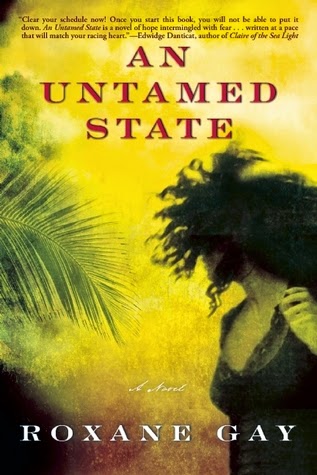

An Untamed State by Roxane Gay (Grove/Atlantic):  There are anticipated books, and then there are Anticipated Books.  You know, the ones which cause you to pull out your pocket calendars and scribble boxes around publication dates, pressing hard with the red ink pen until the paper tears.  Roxane Gay's debut novel is one of those books.  I've been in a restless state of impatience for what seems like years (though it's probably only been a matter of months), ever since I heard the news my publisher (Grove/Atlantic) would be releasing this novel about a rich Haitian-American woman who is kidnapped and held for ransom.  I myself feel like I've been tied to a chair in a dank basement, held at gunpoint while I wait for bags of money to be delivered to my kidnappers.  And now the day is here at last (or will be, for the rest of you, when An Untamed State is published in May).  The Opening Lines prove the payoff was worth the wait:
      Once upon a time, in a far off land, I was kidnapped by a gang of fearless yet terrified young men with so much impossible hope beating inside their bodies it burned their very skin and strengthened their will right through their bones.
      They held me captive for thirteen days.
      They wanted to break me.
      It was not personal.
      I was not broken.
      This is what I tell myself.
This is easily one of the best openings I've read this year; and the novel just gets better from there as we see the narrator, Mireille, attacked and ripped away from her husband and son while on their way to a beach outing.  Their car is surrounded by three black Land Cruisers: “The doors of all three trucks opened at the same time and men we did not know spilled out, all limbs and gunmetal.”  The men approach Mireille's car and bash out the windshield with the butts of their guns. “Their bodies glowed with anger,” Gay writes as she sends us into the heart of her novel, propulsive sentence by propulsive sentence. I have to agree with Tayari Jones (Silver Sparrow) when she says, “From the astonishing first line to the final scene, An Untamed State is magical and dangerous.  I could not put it down.  Pay attention to Roxane Gay; she's here to stay.”  Still not convinced?   Okay, what do I have to do--persuade you with the Jacket Copy?
Mireille Duval Jameson is living a fairy tale. The strong-willed youngest daughter of one of Haiti’s richest sons, she has an adoring husband, a precocious infant son, by all appearances a perfect life. The fairy tale ends one day when Mireille is kidnapped in broad daylight by a gang of heavily armed men, in front of her father’s Port au Prince estate. Held captive by a man who calls himself The Commander, Mireille waits for her father to pay her ransom. As it becomes clear her father intends to resist the kidnappers, Mireille must endure the torments of a man who resents everything she represents. An Untamed State is a novel of privilege in the face of crushing poverty, and of the lawless anger that corrupt governments produce. It is the story of a willful woman attempting to find her way back to the person she once was, and of how redemption is found in the most unexpected of places.


The Farm by Tom Rob Smith (Grand Central Publishing):  Though I'm not familiar with Tom Rob Smith's novels (his Child 44 still sits unread on my shelf), the premise of The Farm is one that seems guaranteed to send me into his pages.  Here's the Jacket Copy:
Until the moment he receives a frantic call from his father, Daniel believed his parents were headed into a peaceful, well-deserved retirement. They had sold their home and business in London and bid farewell to England, setting off to begin life anew on a remote, bucolic farm in rural Sweden. But with that phone call, everything changes. Your mother's not well, his father tells him. She's been imagining things--terrible, terrible things. She has had a psychotic breakdown and been committed to a mental hospital. Daniel prepares to rush to Sweden on the first available flight. Before he can board the plane, his father contacts him with even more frightening news: his mother has discharged herself from hospital and he doesn't know where she is. Then his mother calls: "I'm sure your father has spoken to you. Everything that man has told you is a lie. I'm not mad. I don't need a doctor. I need the police. I'm about to board a flight to London. Meet me at Heathrow." Caught between his parents, and unsure of who to believe or trust, Daniel becomes his mother's unwilling judge and jury as she tells him an urgent tale of secrets, of lies, of a horrible crime and a conspiracy that implicates his own father.
Here are the Opening Lines:
      Until that phone call it had been an ordinary day. Laden with groceries, I was walking home through a neighborhood of London, just south of the river. It was a stifling August evening and when the phone rang I considered ignoring it, keen to hurry home and shower. Curiosity got the better of me so I slowed, sliding the phone out of my pocket, pressing it against my ear–sweat pooling on the screen. It was my dad. He’d recently moved to Sweden and the call was unusual; he rarely used his mobile and it would’ve been expensive to call London. My dad was crying. I came to an abrupt stop, dropping the grocery bag. I’d never heard him cry before. My parents had always been careful not to argue or lose their temper in front of me. In our household there were no furious rows or tearful fights. I said:
      ‘Dad?’
      ‘Your mother...She’s not well.’
      ‘Mum’s sick?’
      ‘It’s so sad.’
      ‘Sad because she’s sick? Sick how? How’s Mum sick?’
      Dad was still crying. All I could do was dumbly wait until he said:
      ‘She’s been imagining things–terrible, terrible things.’

Orion's Daughters by Courtney Elizabeth Mauk (Engine Books):  Courtney Elizabeth Mauk's debut was aptly titled Spark, and, judging by this new novel, she has kindled the start of a solid career in storytelling.  Dan Chaon, author of Await Your Reply, apparently agrees with me: "It's clear to me that Courtney Elizabeth Mauk is going to be an important new voice of her generation." As described in Orion's Daughters' Jacket Copy, Mauk's new work is about how our past echoes into our present:
A postcard arrives straight out of her past, forcing Carrie to confront her commune upbringing alongside Amelia, the almost-sister she worshipped and lost. Desperate to keep her daughter close as her marriage disintegrates, Carrie must come to understand how the choices made by a well-meaning but misguided community have defined her life since, and threaten to forever.
We get a taste of Mauk's natural way with words in the Opening Lines:
From the time we were small, Amelia had a knack for storytelling. She could string words together like the pastel candies on the necklace she wore as a bracelet, twisted four times around her skinny wrist. Like those candies, her words never split or cracked, they never fell off into the grass and were lost. I did not have her skill. Two days after her grandfather gave us those necklaces mine had been destroyed by my sweet tooth and my carelessness.
Orion's Daughters is told in a series of brief chapters, some only a page long, which have the short, sweet crunch of beads on a candy necklace.  The novel officially publishes in May, but you can get a copy right now, through the publisher.  Click here to see the exclusive deal at the Engine Books website.


Scouting for the Reaper by Jacob M. Appel (Black Lawrence Press):  Jacob M. Appel, winner of the Hudson Prize, had me hooked with the penguins in his short story, "Hazardous Cargoes," whose Opening Lines go like this:
      Know your load.
      That’s rule numero uno in this business, which is why I make them count the penguins out in front of me one at a time. I’m not going to be the schmuck who shows up in Orlando two birds short of a dinner party. Or the screw-up who's got to explain to the highway patrol exactly how sixty kilos of coke ended up in his rig without his noticing. Short John Silver used to tell about one fellow who kept trying to turn his radio off, over and over again, but it just wouldn't shut off, and when he pulled into a rest stop for the night, he realized he'd got a ten-piece mariachi band camping out in his trailer. So I always insist on a comprehensive inventory. And the guys at the zoo grumble about it, giving me looks as icy as the day is hot, but they do it. So I know I’m pulling out of Houston with exactly forty-two Gentoo penguins, seventeen Jamaican land iguanas, four tuataras from New Zealand, and a pair of rare, civet-like mammals called linsangs. No more, no less.
Most of the other first lines in this collection of short stories are no less hook-y:
      Miss Stanley was new to the ninth grade that autumn, and we could all sense that she wasn't cut out for it.  ("Choose Your Own Genetics")
      The woman who was not my mother was named Sheila Stanton and at the age of nineteen she was held captive for ninety-one days by the Red Ribbon Strangler.  ("Creve Coeur")
      Nothing sells tombstones like a Girl Scout in uniform.  ("Scouting for the Reaper")
      George had handled their taxes. All year long, he tucked receipts and invoices into a battle-scarred manila envelope with a string-tie seal that he kept in his lower desk drawer alongside the church-warden pipes he hadn't smoked in two decades and the July 1958 copy of Playboy that he'd shoplifted as a teenager.  ("Ad Valorem")
      Another family crisis: The rabbit goes blind.  ("Rods and Cones")
I don't know about you, but when I see authors wield this much control and authority over their fiction from the first sentence, I just know the rest of the book will have a satisfying pay-off.  So, I'll just leave it at that and let Appel's sentences be the catalyst that compels you to buy the Reaper.


Savage Girl by Jean Zimmerman (Viking):  Jean Zimmerman follows up her debut novel, The Orphanmaster, with this enthralling story of a feral girl let loose in Gilded Age New York.  As I look back over this blog post, I realize I've used the word "feral" several times (along with "Untamed," of course).  This month, I must be drawn to dangerous stories and characters who need to be held at bay with whip and chair.  At any rate, here's the Jacket Copy to explain the wild roars of Savage Girl:
Jean Zimmerman’s new novel tells of the dramatic events that transpire when an alluring, blazingly smart eighteen-year-old girl named Bronwyn, reputedly raised by wolves in the wilds of Nevada, is adopted in 1875 by the Delegates, an outlandishly wealthy Manhattan couple, and taken back East to be civilized and introduced into high society. Bronwyn hits the highly mannered world of Edith Wharton–era Manhattan like a bomb. A series of suitors, both young and old, find her irresistible, but the willful girl’s illicit lovers begin to turn up murdered. Zimmerman’s tale is narrated by the Delegate’s son, a Harvard anatomy student. The tormented, self-dramatizing Hugo Delegate speaks from a prison cell where he is prepared to take the fall for his beloved Savage Girl. This narrative—a love story and a mystery with a powerful sense of fable—is his confession.
Here's how Hugo's confession begins in Savage Girl's Opening Lines:
Manhattan. May 19, 1876
      I wait for the police in the study overlooking Gramercy Park, the body prone on the floor a few feet away. Outside, rain has cooled the green spring evening. In here the heat is stifling.
      Midnight. I’ve been in this room before, many times in the course of my twenty-two years. The Turkish rug on the floor, the Empire chairs, the shelves of uncracked books, all familiar to me. A massive mahogany partners desk, from England, in the William IV style, installed as proof of the late victim’s diligence, a rich boy’s insistence that he is, after all, engaged in honest work.
      Of the dead man, a schoolmate of mine, I feature two possibilities. She killed him, in which case they will surely hang her. Either that or I killed him, in a fit of madness the specifics of which I have no memory.
Blurbworthiness: “A richly detailed 19th-century murder mystery and a fresh gloss on the Pygmalion fable, all in one. The story, narrated by a man who may or may not be a serial killer, compels you to keep turning the pages all the way to its shocking–and satisfying–end.”  (Christina Baker Kline, author of Orphan Train)


Wednesday, April 9, 2014

Making Poetry of Pain: an interview with Cara Hoffman


While women currently comprise about 14 percent of the U.S. military, war literature with central female protagonists in uniform is sorely lacking.  There’s Helen Benedict’s 2011 novel Sand Queen, a great short story by Mariette Kalinowski in the anthology Fire and Forget, and any number of memoirs, but comparatively little else (if I'm overlooking something, feel free to set me straight).  Cara Hoffman’s new novel Be Safe I Love You now joins those thin ranks and adds a compelling female character to the chorus of voices coming out of these two wars.

Lauren Clay has returned from a tour of duty in Iraq in time to spend Christmas holiday with her father and younger brother Danny.  All seems fine on the surface, but there are some rough seas building inside of Lauren.  The situation comes to a boil when Lauren takes Danny to an oil field in Canada that has become the focus of her anger over the war in Iraq.  There in the arctic landscape, she’s forced to confront the nightmares that have plagued her ever since a would-be suicide bomber attacked her checkpoint in the desert.

I first became a fan of Cara Hoffman’s fiction three years ago when I read her debut novel, So Much Pretty, whose plot revolves around the disappearance of Wendy White, a well-liked hometown girl in her early 20s.  In my review, I wrote: "For all its appearance of a mystery-thriller, (this is) really a novel of ideas.  So Much Pretty opens its arms to hug some pretty big themes--the depravity of mankind, the lost Utopia of rural living, the moral cost of single-handedly trying to cleanse society of sin, and the creeping rot of rumor in small towns--but at every turn Hoffman manages to turn social commentary into a gripping, white-knuckled read."  It’s a smart, multi-layered story that I’m still thinking about even now, three years later.

Be Safe I Love You is no less memorable for its engaging characters and urgent message about how we treat our veterans returning from war.  It's an especially potent treatment of how soldiers lose their sense of identity for the greater good and then must deal with a violent doppelganger who haunts them.  As Hoffman writes, Lauren "was stuck dragging around this ruined version of herself."

War is a chaos which goes against Lauren's nature.  She's a person who only wants to see things neatly resolved; she's a "fixer," most content when she's "getting things done."  It's one of the primary reasons she joined the Army in the first place--to build a better, financially-stable future for her father and brother after the three of them had been living for years in middle-class poverty.  Trouble is, Lauren has spent so many years taking care of everyone else around her that she's failed to minister to herself.  Now, upon her return to her hometown, she's quickly breaking apart.  Most everyone else has failed her: the Army, the Veterans Administration, her friends, even her father who blinds himself to the reality of Lauren's PTSD.

Be Safe I Love You is haunting and unforgettable and, best of all, burrows deep into the mind of a female warrior.  It's an important story readers should read and heed.

I recently had the privilege of interviewing Cara on a live phone-in event sponsored by Booktalk Nation.  Here's how our conversation began:

In its review of So Much Pretty, The New York Times Book Review had this to say about you: “Hoffman writes with a restraint that makes poetry of pain.”  That kind of description could easily apply to the pages of Be Safe I Love You, too.  Was this book painful for you to write?

Yeah, that's a good question.  I think that about many novels that writers write.  It seems like there's always a painful process that goes on in any writing that we do.  But certainly Be Safe I Love You deals with themes that are very painful because it's about poverty, and it's about family ties that become strained by poverty, and it's about war and homecoming.  People who've experienced those things, or understand those things--all of us, of course, have experienced the feelings of missing our loved ones or being taken away from our loved ones for any number of reasons.  So I would say, yeah, there were definitely painful parts to writing this novel.

The book does touch on a lot of different themes.  You really capture middle-class poverty--the working poor--and that's one of the motivations for Lauren joining the Army in the first place--to get the extra money so she can support her father and her brother.  You have some really vivid imagery in those scenes.

Well, thank you.

Was there any one incident, or maybe just an image or an idea, which was kind of the nugget behind writing the book?  Was there something which started it all for you?

I think so.  As in So Much Pretty, it really was beginning at the beginning.  So Much Pretty started with this image of someone searching for a woman.  And not necessarily searching for a woman because she'd been abducted, but searching for other reasons.  With Be Safe I Love You, I had this very stark image of a woman lying naked in the snow, alert and looking out at the stacks of this massive off-shore oil rig.  It was a very visual, visceral image that began the narrative--and still does.  That's how the prologue of the book begins.

That is a vivid image, and a little bit disorienting for readers, too, to start off there: "What is going on?"  And then, on the very next page, we get to her brother Danny's first "dispatch" to her, one of the emails and letters that he sends.  I found those to be really endearing and that's where we get the title "Be Safe I Love You," because that's how Danny signs off all of these missives to his sister, his "Sistopher," as he calls her.  I love the relationship between Lauren and Danny.  Does this mirror your own relationship with your siblings?

I have two brothers and, yeah, my older brother was a combat veteran who did two tours of duty in Afghanistan....Growing up, I did feel very close to my brothers.  They're great, funny guys who are very supportive.  I don't think I'm alone in adoring my siblings.  I think a lot of us can relate to what a nice relationship you can have....(Like Danny) I am one who's received a lot of letters and emails from my brother while he was in the Army.  He first enlisted when I was eleven years old.  So, I have a long history of sending and getting letters and, you know, putting silly things in them, and also being concerned about his safety and his life.  So (this part of the book) actually does come from something I have experience with.

Click here to listen to the entire 30-minute interview

Booktalk Nation's nationwide, phone-in and streaming video author talks connect readers with authors while supporting independent bookstores.  You can sign up for any event on the Booktalk Nation website and listen to your favorite authors discuss their latest book, buy signed personalized copies, and best of all you will be supporting your local independent bookstore with every purchase—all from the comfort of your own living room.  These talks are free and last no more than 30 minutes.  You can submit questions before the talk at the Booktalk Nation website or, for some calls, during the live talk.

Upcoming Booktalk Nation events include interviews with Debbie Macomber (April 17), Roxane Gay (May 12), Jim Butcher (May 15) and Diana Gabaldon (June 17).


Monday, April 7, 2014

My First Time: Heather Corbally Bryant


My First Time is a regular feature in which writers talk about virgin experiences in their writing and publishing careers, ranging from their first rejection to the moment of holding their first published book in their hands.  Today’s guest is Heather Corbally Bryant.  She's the author of How Will the Heart Endure: Elizabeth Bowen and the Landscape of War (non-fiction, University of Michigan Press), Through Your Hands (fiction, Rising Star), Cheap Grace (poems, Finishing Line Press), and most recently, Lottery Ticket (Parallel Press, University of Wisconsin).  Heather received her A.B. from Harvard, a PhD from the University of Michigan, and currently teaches writing at Penn State, University Park.  She has also taught at Harvard, Michigan, and Wellesley.  Click here to visit her website.


The Garden Party, or
How I Lost My Writing Virginity

It was May of my senior year in college and everything around me was sparkling, glittering.  Weeping cherry trees blossomed and the whole world appeared wide and open.  I put on a frilly dress and sauntered over to the nearby garden party.  My friends were laughing, dancing, and downing vodka and tonics.  It was hot for a May Cambridge evening.  We stayed up through the darkness, talking and drinking.  It was one of those nights that lives on forever in your mind and becomes longer and even more beautiful.

When I returned to my room, just before dawn, I sat down and wrote one of my first poems.  It was almost light outside and the tow trucks had already arrived, clanking, to remove the illegally parked cars outside my window.  I must have fallen asleep still in my tulle dress and awakened sometime around noon.  I looked at the onionskin sheet of paper I had placed next to my typewriter.  I barely remembered writing anything.  But there it was, a three-stanza poem, very loosely terza rima, but it was typed.  Usually I scribbled fragments of verse in my notebooks and squirreled them away.

Feeling brave, I slipped on my white stiletto sandals, grabbed my wallet, and walked several blocks to the post office.  I pulled open the Boston white pages and found the address for The Christian Science Monitor.  All I knew was that I was not a Christian Scientist, but that they published poems, sometimes.   I had once read one in a waiting room somewhere. I stood in line to buy an already-stamped envelope that was probably about ten cents, or some other similarly ridiculously small sum.  I wrote out the first line, “Attention Poetry Editor,” then the rest of the address, and before I could change my mind, I slipped the envelope in the mail slot.

A couple of weeks later, I received a handwritten note from the poetry editor saying she would be delighted to publish my poem the following week, and she had included a check for twenty dollars, my first official income from writing.  For a while, I didn’t want to turn the check into cash.  The whole experience had been magical.  After I graduated, I made a copy and took it to the bank.

Years later, I found the yellowed clipping during one of my many moves, probably just post-divorce.  I decided it was time to frame the poem for the red wall of my new room of my own.  As I looked up from my desk, I read the last line as if it had been written by someone else, my much younger self,
The end and the beginning of our tasks
Seem richly joined in the deserted
Cambridge streets.
I remembered then what I had forgotten.  I hadn’t told anyone about the poem.  A friend of my parents had seen it and sent them the clipping.  When my dad called me to congratulate me, I dared to say these words aloud for the first time: I want to be a poet.


Sunday, April 6, 2014

Sunday Sentence: Sleep Donation by Karen Russell


Simply put, the best sentence(s) I've read this past week, presented out of context and without commentary.


His handwriting is neat and evenly spaced; the only unusual thing about it is that Donor Y wrote in tiny all-capitals, like a scream shrunken down into a whisper.

Sleep Donation by Karen Russell


Saturday, April 5, 2014

Thinking Inside the (Status) Box, a guest essay by Jo Deurbrouck


The story goes: Ernest Hemingway once convinced a group of dinner companions to bet him $10 each that he couldn’t write a story short enough to fit on a bar napkin.  Hemingway collected their money—and, I’d like to think, stood a round—after scrawling these words: “For sale: Baby shoes, never worn.”

The bar napkin story is probably a fiction, but that doesn't seem to impact its popularity.  Just now I googled “for sale: baby shoes,” and was rewarded with seven pages of Hemingway hits before the first Zappo’s shoe ad snuck in.

And whether Hemingway authored those six words, or you agree with me that they comprise a valid short story, the fact is that somebody wrote a famous piece that could both fit comfortably on a bar napkin and break your heart.  And if it fits on a bar napkin, it could fit into every one of the status boxes that pepper our various electronic screens every day and whose typical contents are far less memorable.

The phrase “status box” almost never appears, for instance, in the same sentence with the word “literary,” but why not?  It’s true that we tend to privilege long forms over short, but it’s also true that writers and critics have for at least a century admired tautness and understatement.  And there’s no denying that filling a status box is an act of publishing, something writers should take seriously even if many of their Facebook friends don’t.

I joined the status box world in 2009 when my then-agent said I needed a “platform.”  Social networking sounded like a waste of time, but I was in year seven of shopping a manuscript I could neither abandon nor sell.  I seemed to do nothing but waste time.

Today I’m glad I began typing words into status boxes, but not because it led to hard-won success for that book.  This isn’t that kind of essay.  I’m glad because forcing myself to think inside the box, to treat clicking “Send” as an act of publishing, has fine-tuned my writing.

That fine-tuning started back in 2009.  I was on Twitter one day trying to figure out what good I could give or glean in 140 characters when I ran into a microessay contest organized under the hashtag #cnftweet.  This contest was hosted by a magazine called Creative Nonfiction, which has been championing literary nonfiction since the early 90s—in other words, since long before it was cool.


Creative Nonfiction’s tweets read like a dare: Could we Twitter users create a new form, as abbreviated as the baby shoes story and as powerful, but true?  Apparently the answer was “Yes.”  That #cnftweet contest is still running today.

Late last fall a group of writers, me included, wrote a roundtable essay about these microessays for Creative Nonfiction.  (You can read it here.)   While we worked, the theme that resonated for me and that I came away wanting to tell every writer I know was simply this: there is value in seeking value in status boxes.

Buddhists try to incorporate the practice of mindfulness into as many aspects of life as possible.  What status boxes allow writers to do is similar.  I can work while walking by the river, or grinding coffee in my predawn kitchen, or sitting at my desk trying to resist the invitation to offhandedness that is the Facebook prompt, “What’s on your mind?”


What do I work on in these rescued moments?  First and foremost, irreducibility.  Combing a long essay for its last ounce of fat is a Sisyphean task, but an intensely-focused hour can produce a Twitter essay without a single unnecessary word.

Which brings me to my final point.  Striving for irreducibility is an end in itself, but it also teaches valuable lessons, among them the knack of sensing what must be said and what must not.

I have learned to observe my own mind as it leaps across the gaps between words and to imagine my reader executing the same leaps.  They should feel challenging, those leaps, not irritating or confusing.  Alighting at the end of a leap should feel satisfying, or fun, or surprising yet inevitable, and above all, rewarding.

This imagination exercise has taught me most of what I know about the power of the unsaid.  I’ve never seen a useable rubric for it sketched out in a writing textbook, perhaps because it it can’t be.  Perhaps we can only learn about leaps by leaping.

Ernest Hemingway liked to talk about how good stories are like icebergs, with the told story equivalent to the iceberg’s visible tip.  I wish I could say this made sense to me the first time I read it, but it didn’t.  In an essay titled “The Art of the Short Story,” he tried to elaborate: “A few things I have found to be true.  If you leave out important things or events that you know about, the story is strengthened.  If you leave out or skip something because you do not know it, the story will be worthless.”

That didn’t make sense to me when I first read it either.  It does now.  I learned it in mid-leap, wasting time on Twitter.


Jo Deurbrouck is the author, most recently, of the 2012 National Outdoor Book Award winner Anything Worth Doing: A true story of friendship, adventure and tragedy on the last of the West's great rivers.  Her essays, microessays and book reviews have appeared in many publications, including the Washington Post, Christian Science Monitor, and Creative Nonfiction.  She is a former high school English teacher and river guide with an MA in English from Boise State University.  She speaks at conferences, bookstores, libraries and with book groups around the West.  Learn more about Jo at her website.


Friday, April 4, 2014

Friday Freebie: The Storied Life of A. J. Fikry by Gabrielle Zevin, The Impossible Lives of Greta Wells by Andrew Sean Greer, The Road From Gap Creek by Robert Morgan


Congratulations to Elaine Panneton, winner of last week's Friday Freebie: Up at Butternut Lake by Mary McNear and Golden State by Michelle Richmond.

This week's book giveaway is a trio of novels which will provide hours of bookish delights for all readers.  One lucky person will win a copy of all three novels: The Storied Life of A. J. Fikry by Gabrielle Zevin, The Impossible Lives of Greta Wells by Andrew Sean Greer, and The Road From Gap Creek by Robert Morgan.  The Storied Life of A. J. Fikry is a hardback, the other two are trade paperbacks.  And now a word about the books from the publishers...

In the spirit of The Guernsey Literary and Potato Peel Pie Society and The Unlikely Pilgrimage of Harold Fry, Gabrielle Zevin’s enchanting novel is a love letter to the world of books and booksellers.  On the faded Island Books sign hanging over the porch of the Victorian cottage is the motto "No Man Is an Island; Every Book Is a World."  A. J. Fikry, the irascible owner, is about to discover just what that truly means.  A. J. Fikry’s life is not at all what he expected it to be.  His wife has died, his bookstore is experiencing the worst sales in its history, and now his prized possession, a rare collection of Poe poems, has been stolen.  Slowly but surely, he is isolating himself from all the people of Alice Island--from Lambiase, the well-intentioned police officer who’s always felt kindly toward Fikry; from Ismay, his sister-in-law who is hell-bent on saving him from his dreary self; from Amelia, the lovely and idealistic (if eccentric) Knightley Press sales rep who keeps on taking the ferry over to Alice Island, refusing to be deterred by A.J.’s bad attitude.  Even the books in his store have stopped holding pleasure for him.  These days, A.J. can only see them as a sign of a world that is changing too rapidly.  And then a mysterious package appears at the bookstore.  It’s a small package, but large in weight.  It’s that unexpected arrival that gives A. J. Fikry the opportunity to make his life over, the ability to see everything anew.  It doesn’t take long for the locals to notice the change overcoming A.J.; or for that determined sales rep, Amelia, to see her curmudgeonly client in a new light; or for the wisdom of all those books to become again the lifeblood of A.J.’s world; or for everything to twist again into a version of his life that he didn’t see coming.  As surprising as it is moving, The Storied Life of A. J. Fikry is an unforgettable tale of transformation and second chances, an irresistible affirmation of why we read, and why we love.  For more about the book and to read the opening lines, check out last month's edition of Front Porch Books.

In Andrew Sean Greer's novel, readers can take a unforgettable trip through the many lives of one fascinating character.  After the death of her beloved twin brother, Felix, and the breakup with her longtime lover, Nathan, Greta Wells embarks on a radical psychiatric treatment to alleviate her suffocating depression.  But the treatment has unexpected effects, and the Greta of 1985 finds herself transported to remarkably similar lives in different eras--as a bohemian and adulteress in 1918, and a devoted wife and mother in 1941--fraught with familiar tensions and difficult choices.  Traveling through time, the modern Greta learns that each reality has its own losses and rewards, and that her alternate selves are unpredictable, driven by their own desires and needs.  And as the final treatment looms, one of these other selves could change everything.  Magically atmospheric, achingly romantic, The Impossible Lives of Greta Wells beautifully imagines "what if" and wondrously wrestles with the impossibility of what could be.  John Irving praised The Impossible Lives of Greta Wells by saying, “The premise of this novel isn’t that a woman travels through time: it’s that ‘the impossible happens once to each of us’....What this wonderful novel teaches us is how magic works.”  I previously featured the novel as one of my Sunday Sentences.

In The Road From Gap Creek, one of America's most acclaimed writers journeys to the land on which he has staked a literary claim to paint an indelible portrait of a family in a time of unprecedented change.  When Robert Morgan began the saga of the Richards family in his novel Gap Creek, the book became an Oprah Book Club Selection, attracting hundreds of thousands of readers to its beguiling story of a marriage begun with love and hope but beset by chaos at the turn of the twentieth century.  Now, in a masterful work of historical fiction, he introduces a new generation of this close-knit family in a captivating story that looks ahead to the uncertainties of the future, the struggle to define oneself, and the discovery of enduring love.  Daniel Woodrell (author of Winter’s Bone) had this to say about the book: “In The Road From Gap Creek [Morgan] delivers another powerhouse novel of his people, with their virtues and failings, wins and losses, loves and sorrows.”

If you’d like a chance at winning copies of The Storied Life of A. J. Fikry, The Impossible Lives of Greta Wells and The Road From Gap Creek, simply email your name and mailing address to

Put FRIDAY FREEBIE in the e-mail subject line.  One entry per person, please.  Despite its name, the Friday Freebie runs all week long and remains open to entries until midnight on April 10, at which time I’ll draw the winning name.  I’ll announce the lucky reader on April 11.  If you’d like to join the mailing list for the once-a-week newsletter, simply add the words “Sign me up for the newsletter” in the body of your email.  Your email address and other personal information will never be sold or given to a third party (except in those instances where the publisher requires a mailing address for sending Friday Freebie winners copies of the book).

Want to double your odds of winning?  Get an extra entry in the contest by posting a link to this webpage on your blog, your Facebook wall or by tweeting it on Twitter.  Once you’ve done any of those things, send me an additional e-mail saying “I’ve shared” and I’ll put your name in the hat twice.


Thursday, April 3, 2014

It's publication day for Fobbit! (Soft UK version)


Today marks the third official publication date for my little book about the Iraq War (following the U.S. debut in trade paperback from Grove/Atlantic in September 2012, and the hardback version which came out in the United Kingdom about a year ago).  I'm so very happy with this classy paperback of Fobbit from Harvill Secker (whose parent company is Penguin Random House) which hits British shelves starting today.  If you're in the U.K. (or know someone who is), your help in spreading the word about Fobbit would be most appreciated.  Thanks, luv!


Wednesday, April 2, 2014

On Literary Role Models by Cara Hoffman


When I was a child my favorite story was a piece by James Thurber that my mother used to read to me.  It was called “Something to Say,” about an alcoholic writer named Elliot Vereker.  Vereker was an eccentric whose genius was confirmed by the number of terrible things he did; freeloading on friends, crashing parties, breaking light bulbs on the ground because he liked the sound of shattering glass, wrenching plumbing away from the walls of other people's apartments and denouncing the achievements of those around him.  Despite this he was loved and respected—seen as a man of talent and substance.  To my eleven-year-old mind, Vereker seemed the perfect role model.

The same year I fell in love with Vereker, my mother read me The Sun Also Rises, Portrait of the Artist, Waiting for Godot and The Canterbury Tales.  It’s safe to say I came to envision a certain literary lifestyle as a child and set out to achieve it.  Bums, wanderers, drunks, and lunatics populated my internal landscape.  Mostly because they were to me, at nine or ten or eleven, incredibly funny, possessed of some great mystery.

I wrote every day as a kid, and every day as a teenager, and nearly every day as an adult.  Writing and reading were worlds without hierarchy.  Without rules.  Where the sneakers you wore or the place you lived, or later, the jobs you had to take, didn’t matter.  Writing was a place where experiences, euphoric, or mundane, or incredibly shitty, could be put to use.  Could be made into something, instead of just making you into something.

I carried this feeling with me everywhere.  It helped me leave home and leave school and leave the country.  It helped me have a baby.  It helped me work for a radical newspaper and leave work at a literary magazine for a bartending job that brought me to the setting of So Much Pretty.  And it helped me get through the days while working at a small town Daily—where people really do come into the newsroom to scream in your face when they’re pissed.  Scream at me, part of you thinks.  Now I know what it feels like to be bored and disgusted at the same time as worrying I’ll lose my job.

Thurber was satirizing the idea of genius with Eliot Vereker.  The well-worn concept that in order to write you have to be some kind of brilliant fuck up.  Some kind of suffering monster.  And this is probably what I loved about the story when I was young, how insufferable Vereker was—how he was an upfront loser, a cad with everyone but they insist he’s special, smart.  His eccentricity proof enough.

James Thurber
I have loved many eccentrics, and many drunks, all of them one kind of artist or another and I was for a time, in good company with them.  I love many of them still, but no longer buy the mystery, don’t believe the hype.  I think of these Vereker-esque personas a good deal these days while I'm preparing for another book tour and answering questions about myself.  What fable does the reader want about the writer?

For me the characters they create, the language they use and and stories they tell are more important than anything I could learn about their lives.

But he fact is this: You are what you do.  And there are few professions as exhaustively personal and revealing as writing— I can say many things about myself and already have in this short essay, but there is little I, or any other person you don’t really know, can say, especially to a mass audience, that would reveal with sufficient depth who they actually are.  If you really want to know who I am, you can read my novels.  I promise you'll find me there.


My thanks to Cara Hoffman for allowing me to reprint this essay from her blog.  Cara's new novel, Be Safe I Love You, is available now from Simon & Schuster.  Library Journal called it “A searing, unforgettable, and beautifully written tale about the corrosive effects of war on the psyche, a contemporary version of Tim O’Brien’s The Things They Carried with a female protagonist.”  Be sure to tune in to my conversation with Cara on Booktalk Nation tomorrow night (April 3) at 7 p.m. ET.  Click here to register for the free phone session.


Tuesday, April 1, 2014

Trailer Park Tuesday: All the Light We Cannot See by Anthony Doerr


Welcome to Trailer Park Tuesday, a showcase of new book trailers and, in a few cases, previews of book-related movies.


I love the story Anthony Doerr tells at the beginning of the trailer for his new novel:
In 2004, I came up to New York City, went into Penn Station, and the man in front of me started complaining about the reception on his cell phone. We're eighty feet underground, he's bashing on his little device, and I'm thinking, "What you're forgetting, mister, is that this is a beautiful miracle--you're talking to somebody very far away with this little transmitter and this little receiver in this device, and all around us this electromagnetic radiation is carrying messages. And that's kind of an amazing thing." So when I started this book, I wanted to capture the magic of hearing the voice of a stranger in a little device in your home. Because for the history of humanity, that was a strange thing. I started with a boy trapped somewhere and a girl reading a story to him over a radio.
That simple concept of the daily miracle we all take for granted eventually grew into this majestic novel we now hold in our hands: All the Light We Cannot See (I would also posit that taking words from a writer's head and transmogrifying them into ink on a page is also a kind of breathtaking miracle).  I've had an advance copy of the novel for several months now.  Though circumstances (always those damned circumstances) have so far prevented me from reading Doerr's novel, I will say that it is high on my To-Be-Read pile (aka Mt. NeveRest)--so high, it's at an altitude where I need an oxygen tank just to reach my copy.  Someday soon, I will get to it.  And yes, I'm stabbed with guilt and longing every time I read this priceless blurb from J. R. Moehringer (Sutton): “Doerr sees the world as a scientist, but feels it as a poet.  He knows about everything—radios, diamonds, mollusks, birds, flowers, locks, guns—but he also writes a line so beautiful, creates an image or scene so haunting, it makes you think forever differently about the big things—love, fear, cruelty, kindness, the countless facets of the human heart.  Wildly suspenseful, structurally daring, rich in detail and soul, Doerr’s new novel is that novel, the one you savor, and ponder, and happily lose sleep over, then go around urging all your friends to read—now.”  You can start losing sleep over All the Light We Cannot See when it publishes in early May.  Here's the plot synopsis of the novel:
      Marie Laure lives with her father in Paris near the Museum of Natural History, where he works as the master of its thousands of locks. When she is six, Marie-Laure goes blind and her father builds a perfect miniature of their neighborhood so she can memorize it by touch and navigate her way home. When she is twelve, the Nazis occupy Paris and father and daughter flee to the walled citadel of Saint-Malo, where Marie-Laure's reclusive great-uncle lives in a tall house by the sea. With them they carry what might be the museum's most valuable and dangerous jewel.
      In a mining town in Germany, the orphan Werner grows up with his younger sister, enchanted by a crude radio they find. Werner becomes an expert at building and fixing these crucial new instruments, a talent that wins him a place at a brutal academy for Hitler Youth, then a special assignment to track the resistance. More and more aware of the human cost of his intelligence, Werner travels through the heart of the war and, finally, into Saint-Malo, where his story and Marie- Laure's converge.
I also have to say that the cover design of All the Light We Cannot See is one of my absolute favorites of the year so far.  Though it's awash in blues and greens and grays, it feels like it glows with inner light.


Bookstore of the Month: Avid Bookshop


Avid Bookshop
493 Prince Ave.
Athens, GA  30601
(706) 352-2060
avid.athens@gmail.com
Avid Bookshop on Facebook
Avid Bookshop on Twitter
Avid Bookshop on Instagram

The first thing you should know about Avid Bookshop is that its booksellers like to talk about you behind your back.

“I have a confession to make,” owner Janet Geddis told me in an email.  “More often than not, when a customer leaves the store we say something about him or her the moment he/she has left.  You know what it is we say?  ‘I love her.’  ‘I love him.’  ‘I love them.’  ‘That kid is the best.’  I wholeheartedly believe our customers are the best in all the land, and I sure do hope that other bookstore owners feel the exact same way.”


Avid is relatively young in Bookstore Years (they opened in 2011), but that kind of customer-oriented attitude will carry them far in the business.  The store is located in Athens, Georgia, a picturesque town founded on the banks of the Oconee River.  Cotton was once king in this part of the state and Athens was called the “Manchester of the South” after the city in England known for its mills.  Today, it’s primarily known for manufacturing great rock bands like R.E.M. and the B-52’s.

“Athens, Georgia is a magical little town,” Geddis said.  “Nearly every person you encounter is an artist or creator of some kind.  You can’t throw a pebble without hitting a musician, and usually that musician is also a poet or a visual artist.  Folks are very supportive of one another’s creative ventures, and that extends to independent-spirited local businesses like Avid Bookshop.”

The Avid Bookshop credo goes something like this: “We are a customer-oriented shop that excels at having a well-curated selection and an excellent events series.  We love playing matchmaker and helping every customer find that perfect book.”  Geddis went on to say: “In short, we adore our customers and do our best to let them know how much we enjoy talking with them about books, about their lives, about their classes, about their vacations, you name it.  Our customers are really enthusiastic, smart, and utterly lovable.  I sound over the top here, but I assure you I am being 100% genuine.”

Likewise, the customers have responded, er, avidly to the care and feeding they get from Geddis and her staff.  The bookstore was recently voted Athens’ Favorite Local Business for the second year in a row in the Flagpole Favorites vote-based competition in the city’s alt-weekly publication.  “They like us,” Geddis said.  “They really like us.”


The most rewarding thing about being a bookseller?  “Having the amazing opportunity to connect to readers of all ages, being able to meet authors (they’re our personal rock stars), and getting to talk about books all day, every day.  In talking about books, you get the chance to know authors and readers in this incredibly intimate and really meaningful way.  That’s such a gift.”

Frank
The unofficial store mascot is Frank, the Fabulous Fiction Fan.   He was designed in 2012 by a then-12-year-old artist named Jeremy Kiran Fernandes, and now Frank’s image is all around the store and on every can of Avid Blend Coffee (a special java created by Athens coffee company Jittery Joe’s).

For those bookstore browsers who would like to see more of a fur-based mascot, rest assured there is an official store cat--he just doesn’t hang out in the stacks, that’s all, Geddis said.  “I work from my home office quite a lot, and my cat Satchel is the official Home Office Kitty.  He even has his own Instagram hashtag and special fans.  People have asked us to turn him into a bookstore cat, but we want to be sensitive to booksellers’ and customers’ allergies (plus we don’t want the cat to run into the street--he’s wily), so no store cat for us.  #SatchelCat shall remain a home office kitty.”

Here are more of Geddis’ responses to the questionnaire I sent to her:

Current staff picks:  Men We Reaped by Jesmyn Ward; Seven Stories Up by Laurel Snyder; The Way of Kings by Brandon Sanderson; The Scar Boys by Len Vlahos; Dept. of Speculation by Jenny Offill; Shotgun Lovesongs by Nickolas Butler; Plato at the Googleplex: Why Philosophy Won’t Go Away by Rebecca Goldstein; Red Doc> by Anne Carson; and anything by David Levithan or Rainbow Rowell.

Bestselling titles:  Our #1 bestseller by far is Top Chef’s Hugh Acheson’s A New Turn in the South.  Lately, we’ve been selling lots of Americanah by Chimamanda Ngozi Adichie, anything by Jennifer Holm, and Sparky! by Jenny Offill and Chris Appelhans.

Oddest/funniest request from a customer:  Perhaps the classic bookshop question from a customer: I am trying to find a book about _____.  I don’t know the title or author.  All I know is the cover is and I found out about it from _____.  Rather than being frustrated by the vagueness of these requests, we view them as missions and have a blast tracking down the clues until we find that exact right book.  The look on a customer’s face when we direct him to the precise book he’s looking for after only having received the sketchiest of clues is just priceless.

Rainbow Rowell and David Levithan read to a packed house
The best (or most memorable) author event at our store:
 The Rainbow Rowell and David Levithan YA Party was incredible.  The response from our customers and those who drove hours and hours to see Rainbow and David was overwhelming.  We’d pitched events for both with their respective publishers, but the authors weren’t touring in Georgia, so we figured all was lost.  After some Avid booksellers befriended David Levithan at the Decatur Book Festival, however, David took the helm, gave Rainbow a call, and they made a special trip to Athens.  It was a raucous and funny and tear-jerking and completely memorable evening.  Click here to see photos for this event at Facebook.


Avid Bookshop is the featured bookstore all this month at The Quivering Pen.  By clicking on the links to books mentioned in this month's blog posts, you'll be taken to the store's website where you can purchase the book (or, better yet, several books).  The Quivering Pen is dedicated to supporting independent bookstores.