Friday, June 7, 2013

Friday Freebie: The Son by Philipp Meyer


Congratulations to Jodi Paloni, winner of last week's Friday Freebie, the double-book prize package of Is This Tomorrow by Caroline Leavitt and The Glass Wives by Amy Sue Nathan.

This week's book giveaway is The Son, the new novel by Philipp Meyer that is earning scads of praise, including this from NPR: "One of the most solid, unsparing pieces of American historical fiction to come out this century...The Son is vast, brave and, finally, unstoppable."  It's a big book (561 pages), but in short here's the plot summary:
In 1859, Eli McCullough, the 13-year-old son of Texas pioneers, is captured in a brutal Comanche raid on his family's homestead. First taken as a slave along with his less intrepid brother, Eli assimilates himself into Comanche culture, learning their arts of riding, hunting, and total warfare. When the tribe succumbs to waves of disease and settlers, Eli's only option is a return to Texas, where his acquired thirsts for freedom and self-determination set a course for his family's inexorable rise through the industries of cattle and oil.
I haven't had the chance to whittle down Mt. NeverRest (aka my To-Be-Read pile), but The Son is firmly lodged near the summit of that mountain of books awaiting my eyes.  So, in the meantime, I'll refer you to the review by my friend Harvey Freedenberg (a fellow reader whose literary taste runs parallel to mine).  Here's how he begins his review at Bookreporter:
It’s not clear whether anyone is still trying to write the Great American Novel, but the ambition Philipp Meyer has displayed in the two he has produced so far suggests he might be aiming in that direction. His 2009 debut, American Rust, focused on the plight of two desperate young men in a dying Pennsylvania steel mill town. In its story of six generations of a Texas family that spans 175 years of history, The Son takes on nothing less than the founding myths of the American West. Taken together, they mark Meyer as a young author with the confidence and technical skill to assume an important place in the ranks of his generation’s best writers. There’s nothing tentative in Meyer’s robust account. The Son is the frank, often violent story of successive waves of deception, lawlessness and outright theft that marked the settlement of Texas’s Hill Country.
And here's how Harvey concludes his review:
Without compromising the novel’s pacing, Meyer, who now lives in Austin and reportedly read more than 250 books in preparation for writing The Son, tackles with a Melvillean zest a range of subjects that include the manufacture of bows and arrows and the butchering of buffalo. He deploys that local knowledge and research in a way that’s organic to the story, not intrusive. He’s especially adept at depicting the forbidding landscape, like the canyon “with fins and towers and hoodoos like observation posts, mesas and minor buttes, springs flowing brightly in the red rock,” so desperately fought over by the contesting parties. The Son is no potboiler “Cowboys and Indians” drama. That’s because, though he resists moralizing, Meyer takes pains to ensure that profound moral questions are never far from the surface of a story that's as big as its subject. The novel has antecedents (think of Thomas Berger’s Little Big Man and Larry McMurtry’s Lonesome Dove, to name two), but few equals in contemporary literature of this genre. Whether your tastes in entertainment run to Cormac McCarthy or Dallas, it’s a fair bet you will find this a sumptuous feast.
Click here to read the full review at Bookreporter.

If you'd like a chance at winning a copy of The Son, all you have to do is email your name and mailing address to thequiveringpen@gmail.com

Put FRIDAY FREEBIE in the e-mail subject line.  One entry per person, please.  Despite its name, the Friday Freebie runs all week long and remains open to entries until midnight on June 13, at which time I'll draw the winning name.  I'll announce the lucky reader on June 14.  If you'd like to join the mailing list for the once-a-week newsletter, simply add the words "Sign me up for the newsletter" in the body of your email.  Your email address and other personal information will never be sold or given to a third party (except in those instances where the publisher requires a mailing address for sending Friday Freebie winners copies of the book).

Want to double your odds of winning?  Get an extra entry in the contest by posting a link to this webpage on your blog, your Facebook wall or by tweeting it on Twitter.  Once you've done any of those things, send me an additional e-mail saying "I've shared" and I'll put your name in the hat twice.


Tuesday, June 4, 2013

Trailer Park Tuesday: Apology by Jon Pineda


Welcome to Trailer Park Tuesday, a showcase of new book trailers and, in a few cases, previews of book-related movies.


This, ladies and gentlemen, is what we call a perfect book trailer.  The video for Jon Pineda's debut novel Apology does everything right.  It's a perfect alignment of marketing elements: expertly filmed, long enough without being too long, loaded with blurbs (but not too many), and spiked with teasing hints of plot and character which reveal just enough to set the hook in our mouths. Confession: I received an advance copy of Apology months ago and though it looked promising, it soon started to drown in the flood of new titles coming through my front door on a daily basis.  In fact, I'd forgotten all about it until I saw this trailer.  Now, I'm plucking it out of the deluge and moving it closer to the top of my To-Be-Read pile.  The video begins with a young man taking an early-morning run along the docks in a seaside town.  As he jogs, a voice-over narration dictates a letter to a parole board in which he advocates on behalf of his imprisoned uncle.  The linchpin line of the video comes at the end: "What if this all started as a mistake that bloomed into where we are now?"  You don't need to know anything more about Apology other than what the trailer delivers, but if you were to know the book's plot, your interest would most likely go from "curious" to "gotta-get-that-book-now."  Here's what publisher Milkweed Editions tells us about Apology's story: "When nine-year-old Tom Serafino’s twin sister Teagan suffers a debilitating brain injury, a police investigation implicates his playmate Mario’s uncle—an immigrant, transient worker known as Shoe.  Innocent of the crime but burdened by his own childhood tragedy, Shoe takes the blame for what is in fact an accident caused by his young nephew, ensuring Mario’s chance at a future publicly unscarred." Apology hits bookstores today.  Run, don't walk, to get it.


Monday, June 3, 2013

My First Time: Jessica Anya Blau


My First Time is a regular feature in which writers talk about virgin experiences in their writing and publishing careers, ranging from their first rejection to the moment of holding their first published book in their hands.  Today’s guest is Jessica Anya Blau, author of the just-released novel The Wonder Bread Summer (which was previously featured at the blog here).  Her novel Drinking Closer to Home was called "unrelentingly side-splittingly funny."  It was featured in Target stores as a “Breakout Book” and made many Best Books of the Year lists for 2011.  Jessica’s first novel, The Summer of Naked Swim Parties, was picked as a Best Summer Book by the Today Show, the New York Post and New York Magazine.  The San Francisco Chronicle and other newspapers chose it as one of the Best Books of the Year.  Jessica co-wrote the screenplay for Franny, a film staring Frances Fisher and Steve Howey.  Franny is now in post-production in Los Angeles.  Jessica’s short stories have appeared in numerous magazines and have won or been nominated for many awards including The Pushcart Prize.  Her essays appear in The Huffington Post, Salon, Baltimore Style Magazine, the AOL homepage, The Nervous Breakdown and Red Room.  Several of Jessica’s stories and essays have been anthologized in books such as The Prose Reader: Essays for Thinking, Reading, and Writing; Dirty Words: a Literary Encyclopedia of Sex; and The Beautiful Anthology.


My First Naked Book Club Reading

There are ways in which I’m fearless (although I’m struggling to come up with them now) and there ways in which I’m a complete coward.  Reading my work aloud terrifies me, but I am always willing to do it as I don’t believe I can just silently write (in my mind, at my dining room table, in the cafĂ© down the street from my house) and expect my writing to take off and enter other people’s heads without me spewing it out into the world somehow.  Before my readings, I feel slightly nauseous and woozy.  I drink a lot of water, eat peanut butter sandwiches (they calm me down, I swear), and then I just go for it while reminding myself that no matter how bad it is, I’ll probably, A. Be alive at the end.  And, B. Still have all my limbs and the use of my hands so I can continue to write.  In spite of my fears, I usually end up feeling great after a reading—not because of what I’ve done, but because of the fact that any single person actually showed up to hear me.  Here’s a summary of three readings that were each my first time in one way or another.

1.  My First Naked Book Club Reading.  Each time I mentioned the upcoming Naked Book Club reading to one of my friends, they claimed they wanted to come with me.  By the time the night arrived, I had four girlfriends and two guy friends in tow.  When we walked into the Naked Book Club, which was being held at a health/swim center in Maryland, it was like a movie scene that you wouldn’t have believed had you seen it on the screen.  The main room, with gym equipment from wall to wall, was filled with naked men working out (not a woman in sight).  And they weren’t the men of CK underwear ads or gay porn, they were regular every day men: pot bellies, strangely-shaped and oddly-sized penises, patches of facial hair.  You know, human.  There I stood with my girlfriends, three blonds and a Venezuelan—perfumed, eyelashes fluttering like butterflies, heels that you have to train yourself to walk in—staring at the room full of sweaty, lumpy bodies.  The face-off was hilarious.  It was like the men had conjured up this group of women and suddenly we existed.  There was a strange bee-like commotion as they swarmed toward us, and then numerous offers to escort us to the ladies’ locker room so we could remove our clothes (we all declined).  Hilariously, not one person asked my guy friends if they wanted to remove their clothes.  The reading went well, I stared intently at my book and barely looked up.  The nudists were a generous and kind crowd.  Although, I found it interesting that of the twenty or so men there, only one of them had my book!

2.  My First Reading in Los Angeles.  I walked to the bookstore from my hotel early in the day just to make sure I knew where it was for that night’s reading.  There were event signs all over the place and giant posters of me where I looked far better than I look in real life.  There were also posters of David Sedaris who would be reading the night after me.  When the manager took me upstairs to the cavernous space where I’d read, I asked her if she really thought I would fill all those seats.  “This is a destination bookstore,” she said.  “It doesn’t matter who you are, we fill up every event.”  So when I showed up that night at five minutes to seven and saw one single person there (a man sitting in the center seat of the front row) I wasn’t sure what to do.  I approached the man, prepared to tell him that David Sedaris was reading the following night.  But then I saw he had my book in his hand.  “Did you come here to see me read?” I asked.  He nodded.  “Do you mind if we wait a minute in case some people I know in L.A. show up?”  He nodded again.  There was a podium and microphone set up on a small stage.  I wasn’t sure if I could actually stand up there and read to just one man in the center seat of the front row.  Eventually a handful of friends appeared (they were all late because of traffic) and took their seats in the near-empty room.  My friends lovingly heckled me during the reading, laughed uproariously as if my book were an inside joke, and then applauded so enthusiastically, I could have cried.  After the reading, I sat beside the man in the center seat of the front row.  “Do you want me to sign the book?” I asked.  And he nodded again.

3.  My First Reading at City Lights Bookstore in San Francisco.  I was thrilled to be there, and especially thrilled to be reading with my friend, Ron Tanner.  The room was packed and people were even lining the stairs that went down to the other floor.  I had eaten my peanut butter sandwich, guzzled water and done all the necessary anti-anxiety rituals but I was still shaky-nervous when I stepped up to the microphone.  I could barely look out at the crowd so kept my face toward my book, even though I’d almost memorized the pages.  Ron read after me, and then we both stood at the podium to answer questions.  Someone asked what I was working on and I said that I was in the middle of a book about a girl, a Berkeley student, who somewhat accidentally steals a bread bag full of cocaine.  I was no longer hiding my face behind my book and that was when I spotted him.  A guy I knew in college but hadn’t seen or spoken to since.  In fact, he was the guy who once showed up at my tiny, grubby apartment with a bread bag full of cocaine.  That strange afternoon, he had run into my place, panting, as if someone were chasing him.  He removed the wire twisty from the bag and then let it spin open to show me what was inside.  I didn’t do any of the coke (not my thing) and instead banished him from my apartment.  The bag had scared me.  It seemed too strange, too odd, too valuable.  I expected people with guns or switchblades to run in, slit both our throats, and then leave with the cocaine.  After the reading, I approached the old college friend.  “Do you remember when you brought the bread bag of cocaine to my apartment?” I asked.  “Of course,” he said.  “Was it almost full?” I asked.  “Because in my memory it was almost full.”  “More like three-quarters full,” he said.  “You refused to tell me where you got it,” I said.  “Yeah, I think I got it from a cousin,” he smiled and winked.  And I knew I was better off not knowing the real story, better off having turned it into fiction.


Sunday, June 2, 2013

Sunday Sentence: All That Is by James Salter


Simply put, the best sentence(s) I've read this past week, presented out of context and without commentary.


He liked to read with the silence and the golden color of whiskey as his companions.

All That Is by James Salter


Saturday, June 1, 2013

Franzengroin, Brad Garrett, and the Fate of Quality TV


I've come to the conclusion that my wife and I are series killers.

No, not serial killers, series killers--as in, TV series.  As soon as we start enjoying a show--really plunging into it, getting involved with the characters, looking forward to visiting the TiVo queue every night like it was a trip to Paris--as soon as we make a heavy emotional investment in a program, that's when the TV executives decide to cancel it.  It happened with Better Off Ted, Southland (though that was resuscitated on TNT), and Pushing Daisies.   All beloved shows, all beheaded by the studio axe.


And now it's happened again with one of the smartest, funniest sitcoms of this year: How to Live With Your Parents (For the Rest of Your Life).  Starring Sarah Chalke, Elizabeth Perkins and the totally-excellent Brad Garrett, the premise was simple: after breaking up with her husband (played by Jon Dore), Polly (Chalke) comes back to live with her parents (Perkins and Garrett), along with her adorable, precocious daughter (Rachel Eggleston).

Sure, it's a story that's been done before (Failure to Launch, anyone?), but the writing is zippy and zingy and the acting is first-rate--especially Garrett and Perkins as the laid-back, self-centered parents Max and Elaine.  I've had a man-crush on Elizabeth Perkins ever since 1988's Big, so that was sort a given in this case.  But Brad Garrett is a total surprise.  He was one of the best parts of Everybody Loves Raymond, playing the sad-sack brother to Ray Romano's neurotic, whiny husband/son/man-child.  Garrett used his towering height (6 feet, 8-1/2 inches) and bottomless-well voice to good effect in that long-running series.  In How to Live With Your Parents, he's something else entirely.  He emerges from his Sack of Sad to play Max, Polly's stepfather and once-promising actor who now runs a third-rate comedy club.  So much of this series' success lies in chemistry and timing and he and Perkins are a match made in Dialogue Heaven, feeding off one another with rapid-fire, interlocking, overlapping chatter--the kind of exchanges that make you hit the rewind button on your TiVo twice in order to catch All the Jokes.

A couple of months ago, I'd planned on coming here to the blog and posting this picture:


This, ladies and gentlemen is our introduction to Max and Elaine in the first episode when Polly shows up on their doorstep.  A session of middle-age afternoon delight is interrupted by the ringing of the doorbell and Max grabs the first thing he can find to cover himself: a copy of Jonathan Franzen's The Corrections--a hardback edition, no less (wink wink nudge nudge).  Surely this is one of the best examples of product placement in the literary world (though I doubt, Franzen being Franzen, that the author is very happy with it).  There's really no reason Max has to be semi-nude--he could have answered the door tying the sash on a bathrobe--but for those of us in the know, this is a terrific literary joke.  Just as The Corrections details the strained relationships in a dysfunctional family, Polly's re-entry to the parental nest hints at trouble ahead.

It's just too bad that the Trouble had to do with the future of the show itself and not the characters.  After the somewhat strained pilot, How to Live With Your Parents settled into a terrific ensemble piece with all of the actors finding their character-groove and the writers flinging jokes at us like sardines into a dolphin tank.  ABC apparently thought otherwise.

So there you have it, my love letter to a doomed television show.  If I thought it would do any good, I'd start a petition, campaigning the suits at ABC to give How to Live another life. Until then, my wife and I are going to choose our television shows very carefully.  I'd hate to see a good show go down in flames just because we loved it.


Friday, May 31, 2013

Friday Freebie: Is This Tomorrow by Caroline Leavitt and The Glass Wives by Amy Sue Nathan


Congratulations to Tisa Houck, winner of last week's Friday Freebie "Mega-Scary-Good Joe Hill Prize  Pack" which included all of Hill's published fiction: NOS4A2, Horns, Heart-Shaped Box and 20th Century Ghosts.

This week's book giveaway is another multi-book bundle.  I'm very excited to offer up copies of two new novels: Is This Tomorrow by Caroline Leavitt and The Glass Wives by Amy Sue Nathan.  One lucky reader will win both books.

Is This Tomorrow is Caroline Leavitt's tenth novel, following on the heels of her previous bestseller, Pictures of You.  As with all of her novels, the nuts and bolts of the plot are wrenched tight and the characters are deep and fascinating.  Here's a plot synopsis of Is This Tomorrow: In 1956, Ava Lark rents a house with her twelve-year-old son, Lewis, in a desirable Boston suburb.  Ava is beautiful, divorced, Jewish, and a working mom.  She finds her neighbors less than welcoming.  Lewis yearns for his absent father, befriending the only other fatherless kids: Jimmy and Rose.  One afternoon, Jimmy goes missing.  The neighborhood—in the throes of Cold War paranoia—seizes the opportunity to further ostracize Ava and her son.  Years later, when Lewis and Rose reunite to untangle the final pieces of the tragic puzzle, they must decide: Should you tell the truth even if it hurts those you love, or should some secrets remain buried?  Novelist Stewart O'Nan praised Is This Tomorrow by saying, "From the lockstep '50s into the do-your-own-thing '60s, Caroline Leavitt follows her cast of lonely characters as they grapple with the sorrowful mystery of a missing child.  'Are any of our children safe?' one asks, and of course the answer is no, no one is.  Like Mona Simpson's Off Keck Road, Is This Tomorrow is an intimate meditation on time, loss and destiny." For more about the book, check out the April edition of Front Porch Books here at The Quivering Pen.

In Amy Sue Nathan's debut novel, Evie and Nicole share a last name: Glass.  They also shared a husband.  Here's the plot synopsis of The Glass Wives: When a tragic car accident ends the life of Richard Glass, it also upends the lives of Evie and Nicole, and their children.  There’s no love lost between the widow and the ex.  In fact, Evie sees a silver lining in all this heartache—the chance to rid herself of Nicole once and for all.  But Evie wasn’t counting on her children’s bond with their baby half-brother, and she wasn’t counting on Nicole’s desperate need to hang on to the threads of family, no matter how frayed.  Strapped for cash, Evie cautiously agrees to share living expenses—and her home—with Nicole and the baby.  But when Evie suspects that Nicole is determined to rearrange more than her kitchen, Evie must decide who she can trust.  More than that, she must ask: what makes a family?  Since its publication, The Glass Wives has been racking up the praise.  Booklist declared: "Jodi Picoult fans will appreciate the surprising twists embedded in this thought-provoking narrative."  Julie Kibler (author of Calling Me Home) said: "In The Glass Wives, Amy Sue Nathan examines what it means to build an unconventional family when the original families shatter suddenly and irreparably into pieces.  Nathan's adept writing, wry humor, and authentic emotion carried me effortlessly from the beginning of this tender and hopeful debut novel to its satisfying end."

If you'd like a chance at winning a copy of both Is This Tomorrow and The Glass Wives, all you have to do is email your name and mailing address to thequiveringpen@gmail.com

Put FRIDAY FREEBIE in the e-mail subject line.  One entry per person, please.  Despite its name, the Friday Freebie runs all week long and remains open to entries until midnight on June 6, at which time I'll draw the winning name.  I'll announce the lucky reader on June 7.  If you'd like to join the mailing list for the once-a-week newsletter, simply add the words "Sign me up for the newsletter" in the body of your email.  Your email address and other personal information will never be sold or given to a third party (except in those instances where the publisher requires a mailing address for sending Friday Freebie winners copies of the book).

Want to double your odds of winning?  Get an extra entry in the contest by posting a link to this webpage on your blog, your Facebook wall or by tweeting it on Twitter.  Once you've done any of those things, send me an additional e-mail saying "I've shared" and I'll put your name in the hat twice.


Thursday, May 30, 2013

Look What I Found: Charles Dickens Globe editions ("won't injure the eyesight")


Look What I Found is an occasional series on books I've hunted-and-gathered at garage sales, used bookstores, estate sales, and the occasional pilfering from a friend's bookshelf when his back is turned. I have a particular fondness for U.S. novels written between 1896 and 1931. If I sniff a book and it makes me sneeze, I'm bound to fall in love.

It's not like I lack for any volumes of Charles Dickens' novels in my library.  I have Penguin, Modern Library and Signet paperbacks; a set of Nonesuch facsimiles I coveted three years ago; and at least three different versions of A Tale of Two Cities on my Kindle.  Why on earth would I want to add more book-poundage to my shelves already groaning under the weight of so many (too many!) dead-tree books?

Because I am a sick man (who's not in search of a cure).

When I saw these "Globe editions" of Dickens' works in an antique shop in Boise, Idaho two weeks ago, I knew I would walk out the store with them in the clutch of my covetous collector's hands.


Published by Houghton, Mifflin and Company in 1881, these squat, dark-green books immediately caught my attention with the illustrations (about four per volume) by F. O. C. Darley and John Gilbert:


Via Google, I found an ad in a 19th-century edition of Literary World which noted these books were "the best cheap edition on the globe....The paper is good, the print is clear, and the type of a size that won't injure the eyesight."  They sold for $1.50 a volume--which, as another ad in The American Naturalist declares, shall "be within the reach of all classes."

Though time has bent the books' spines to a slouch so that the pages have a charming C-shaped edge, the set is overall in very good condition.  In fact, I'd hazard to say that, with the exception of Our Mutual Friend, they are unread by any of the owners.  Each book has a nameplate inside the front cover: "Library of Minnie Washburne" and are numbered sequentially.  I'm missing a few of the numbers (between 102 and 114), so I'm wondering if there are other Globe editions, or if Miss Washburne was cataloging several new acquisitions that day and got some other books interspersed with her set of Dickens.  And did Minnie read Our Mutual Friend, then find Dickens wasn't to her taste and left the other volumes unread?  Or was she stricken by influenza and on her deathbed called for a book, any book, by that fellow she'd never read (but always meant to)?  Call me odd, but I fantasize about previous readers' lives like this.

In Googling "Minnie Washburne," I found several mentions of a woman by that name who was prominent in social activism--primarily the suffrage cause--around the turn of the 20th century.  What's more, she lived in Eugene, Oregon.  This is an especially sharp freak of coincidence because on the day I stopped in the Boise antique mall, I was en route to Oregon (which you might have read about in yesterday's blog post).  Was it the same Minnie Washburne?  I'd like to think it was.


Wednesday, May 29, 2013

The Fog-Shroud of Memory


We were lost.

We were driving through a foreign city.  Eugene, Oregon.  It was a city foreign to our present, but so familiar in our past.  Nearly 30 years ago, Jean and I had lived here, worked here, gone to school here, given birth to two children here.  Why did nothing look familiar?  Had the city changed, or was it us?  Our memories were blurred by the soft, unfocused fog-shroud of memory, as omnipresent as the clammy mist which blankets western Oregon.

We'd just driven two days from our home in Montana as part of a mini-book tour for Fobbit.  Coos County, Oregon was kind enough to select my debut novel as its annual county-wide Title Wave Read (a mind-blowing honor for a first-time novelist).  Over the next two days, I was scheduled to visit public libraries and speak to high school students about my dual life as a soldier and a writer.  Before we hit the coast, however, we had one stop to make.

We pulled into Eugene, trying to find our past.  Eugene is a college town fueled by its passion for track-and-field (it's where the legendary Steve Prefontaine lived and died).  It's a liberal city known for its eco-evangelism (ground zero for both tree huggers and loggers), but it's also a relatively quiet place.  People go about their business on the moist streets without too much pomp and circumstance.  It's a small enough community to be shaken to the core by a murder: seven months before Jean and I moved there, Diane Downs shot her three children in neighboring Springfield.

Eugene is where our marriage grew up, taking its first toddler steps.  I enrolled at the University of Oregon in the fall of 1984 and got my bachelor's degree in English three years later.  As I mentioned earlier, we were broke as a joke in those days, rationing our gas, riding our bikes wherever we could, pinching pennies, shopping the supermarket specials like they were a military campaign.  We were young, we were just a few inches above the poverty line, but we were happy.  Now, thirty years later, we were determined to find personal landmarks from those days.

We cruised the streets and nothing looked familiar.  "This is weird," we kept saying.  "This is so freakin' weird."

Finally, between the two of us, we managed to piece together the general location of our first house.

"I think it was on a street named for a president," Jean said.

"I know there was a convenience store on the corner just down the street--a Dairy-Mart or something like that," I said.  "I remember there was a huge cow on top of the sign which kept spinning around.  I always wanted to go in there and ask if the cow ever threw up.  Never worked up the nerve to do that, though."

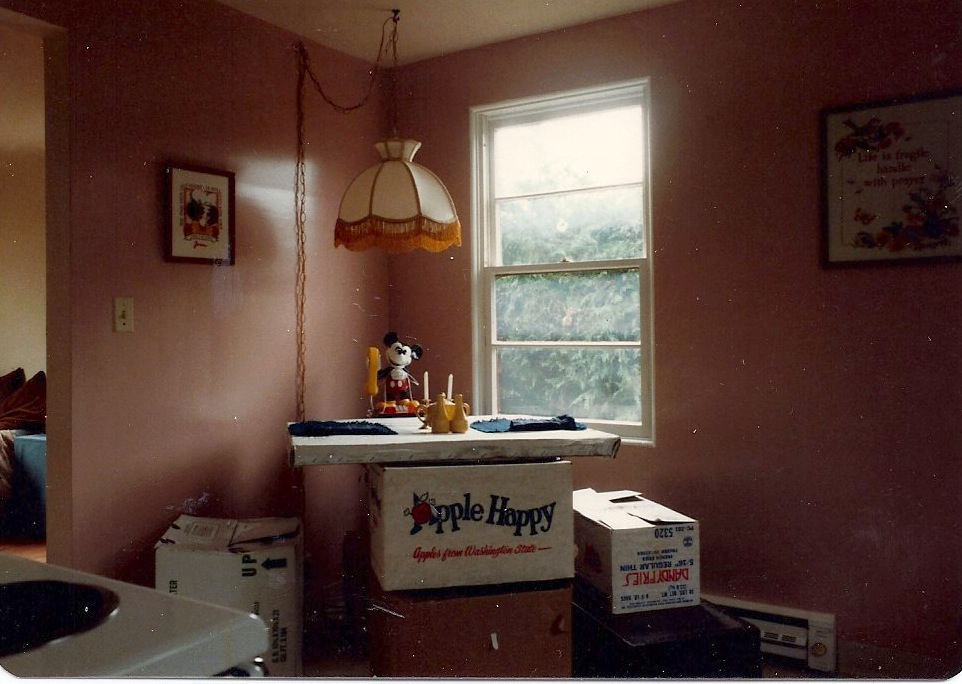
We moved to Eugene in January 1984, less than a month into our marriage.  We drove over Santiam Pass, bringing everything we owned with us in a U-Haul truck.  It was the smallest U-Haul available because at that time "everything we owned" consisted of a waterbed, a large hanging lamp with a fringed shade, a Mickey Mouse phone, a few boxes of clothes and the wedding gifts we'd just received.  We came over that pass in a wet snowstorm, descended into the city, and found a house to rent.  The landlord, a man only a few years older than us, looked at his new tenants with scorn and arrogance.  He saw us for what we were: two naifs with bottomless dreams, but a shallow bank account.  When he handed over the lease agreement, he did so reluctantly.  The security deposit and first month's rent almost completely wiped us out, leaving us $75 for groceries and gas.  (Jean just reminded me that I spent $60 of that on a necklace for a Valentine's Day gift.  What a romantic fool!)

Since we couldn't afford furniture, I "built" chairs, tables, and an elaborate sofa out of the packing boxes, stuffing one inside the other multiple times to strengthen them.  I spent an entire day making this cardboard furniture set and when I called Jean into the room, the look on her face was priceless.  I might be one of the only guys on this earth to win a girl's heart with cardboard furniture.

Our first kitchen, furnished with the finest in cardboard furniture

We smiled now, remembering those early days of ours.

I snapped my fingers.  "Hey, I just remembered--there was a Bi-Mart nearby.  Google that."

Jean punched "Bi-Mart" into her smartphone and gave me the address of the nearest store.  We pointed our car toward the eastern side of Eugene, then turned down 18th Street.  Gradually the fog started to burn off, landmarks became vaguely familiar.

"I remember this park," I said, pointing out the window to an expanse of grass, trees, swingsets, a running trail.

"Oh, yeah," Jean said.

"Remember how we started an exercise program?  We told ourselves we'd go jogging every night."

"I remember it didn't last," she said.

The reason it didn't last was because one month into our marriage Jean got pregnant.  One night after jogging once around the park's trail, Jean bent over at the waist, breathing hard.  "I can't do it," she panted.  "I feel like I have cement blocks tied to my feet."

Was that the same night we locked ourselves out of the house?  (The house we now couldn't find.)  My memory--or maybe it's just my imagination--tells me it was.  I remember going around to all the doors, twisting the unyielding knobs with my hand, and even tried prying up the bedroom window.  Then I started worrying someone would see me there in the dark, a sweat-suited figure trying to break in, and would call the cops.  Getting in trouble with the law, however innocently, was the last thing I wanted in this new relationship.  I was still in the Impress-Your-Lover phase of marriage.

"It won't budge," I told my still-breathless, sweating wife.  I dropped back to the ground.  We stared at each other in the dark, two frightened, unsure lovers who'd done a simple, careless thing--forgetting to put a key in their pocket before a nightly jog--and who now faced the embarrassment of calling up their landlord--a fussy, grade-A asshole--and asking him to come to their house and unlock the front door.  We'd only been living in the place for two weeks and now look, we'd barred ourselves from the few worldly possessions we'd brought with us from Wyoming.

We walked two blocks to Dairy-Mart and, because we didn't have any change for the pay phone, asked the night clerk if we could make a call.  Outside, above our heads, the cow spun itself into a dizzy vertigo.

Thirty years later, we crawled past 1920 Hayes Street at 5 miles per hour (Jean was right, though she never would have guessed Rutherford B. Hayes--who the hell ever remembers that President?).

You know that scene at the end of Planet of the Apes where Charlton Heston rounds the corner on the beach and sees the Statue of Liberty buried in the sand?  Or how Atlanta looks to the zombie-survivors of The Walking Dead?  It was the same effect on the two of us as we looked at our first house, three decades after we left it.

1984
2013
The front lawn was a wild overgrowth, the siding was dingy, there were cracks in the sidewalk.  It was as if a jungle had grown up around that house, the earth trying to swallow it in a clutch of dirty vegetation.  In fact, Jean and I weren't even sure this was the right house.  We snapped a photo on our smartphone anyway, then drove on.

We felt so old, so wealthy, so...superior to our younger selves.  Those two sweet, distant versions of us really had no clue what lay ahead of them.  Back then, we were so bound up in neuroses, financial anxieties, and just plain ignorance that we couldn't even feel life happening all around us--not even during what should have been a funny, rom-com moment of locking ourselves out of the house.  We drove on, clucking our tongues at 1984 Us.

We spent the rest of the day exploring the checkerboard of streets around downtown Eugene, desperately, stubbornly trying to find the birth home where our two sons came into the world.  We Googled "Lucinia Birth Home," but since it had closed years ago--probably pre-internet--we came up empty.  We called the OB-GYN department at Sacred Heart Medical Center: did anyone there remember Lucinia?  The twenty-something female voice on the other end acted as if we were asking to speak to George Washington.

Defeated, we drove out of the city toward our second home, confident we could at least find that place.

In February 1984, unemployed and down to our last couple of dollars with nothing to show for the second month's rent, we were forced to leave 1920 Hayes Street.  The smug landlord was disappointed but not surprised when we told him of our failure.  Through our church pastor, we'd heard of a boat-and-RV storage place out in Santa Clara which was looking for a couple to serve as caretakers for the yard.

We got the job, which required us to be on the property 24/7 (yes, that means seven days a week with no respite).  It provided a house with utilities and paid $400 a month.  It was manna from heaven and we gobbled it up.  We worked that job for two years (eventually, we successfully lobbied for one day off a week) and built our marriage on that financial stability.

($400?  Ha!  Three days ago, we spent $300 on a vacuum cleaner and went out to eat an $80 dinner at a local restaurant without batting an eyelash.  We would have been unrecognizable aliens from the future if those younger selves had seen that).

We made that house on Awbrey Lane our home.  That first hot summer, with Jean in her third trimester, we stripped all the paint off the kitchen cabinets, and even though we found a cheap wood bordering on plywood underneath we stained the cabinets and looked on our work with pride.  I set up a writing studio in the upstairs hallway, a short passageway with sloped ceilings which prevented me from standing up straight, and I wrote poetry, short stories, and half a draft of a really terrible novel.  We got to know our customers, the owners of boats and RVs, and always got a laugh after Mrs. Cobb came in to pay her monthly storage bill.  Mrs. Cobb was in her seventies and had a thin frizz of hair which stood up, as if the follicles were electrocuted, in an airy nimbus around her head.  Her hair was so thin, we could see her gleaming skull beneath the afro.  We might have laughed, but we felt sorry for Mrs. Cobb and always spoke more gently when she was in the office.  That house on Awbrey Lane was where Jean puked her way through a first pregnancy, where we adopted our first pet (a hypertensive mutt we named Caleb), where we decorated our first Christmas tree, where we brought our first child home from the birth home and lay in bed holding hands as we listened to our son suckle softly in the dark.

As we drove out of Eugene to Santa Clara two weeks ago, all of these memories rolled over us like a white-foamed wave striking rocks on the coastline.  We were more confident of this address, we were sure we could find this one page from our scrapbook waiting for us at the end of Awbrey Lane.  We drove with fear and curiosity.

If 1920 Hayes had been the vine-choked future of Logan's Run, then seeing the present-day Eugene Trailer and Boat Storage on Awbrey Lane was like walking across the atomic wasteland of Hiroshima.  Our memory of the place had been reduced to rubble--scorched earth--and something new had risen in its place.

The House on Awbrey Lane, 1985: our first garage sale
Awbrey Lane, 2013
Where once a house--built in the 1930s and weathered, sure, but still charming--had stood, there was now a double-wide trailer where the caretaker had her office and living quarters.  Where once tall trees had sheltered the house, there was now bare, too-sunny landscaping.  I remember once, back in 1985, hearing an odd noise outside in the trees at night.  I got dressed and, flashlight in hand, investigated.  I shined the beam up into the branches and nearly dropped the flashlight when a family of raccoons hissed at me.

Now it was all gone, our memories leveled by bomb-blast.  We got out of the car and introduced ourselves to the manager of the storage yard, a pleasant woman in her fifties. She'd been here for seven years, she said, and the place had always been like this.  I looked at the ground around the trailer, denuded of grass, and remember how I'd once seen a rat--large as a puppy--running across the lawn away from the house and how my heart had seized up because our infant son was sleeping in his crib at the time.  The garden bed we'd once tilled and planted--ambitiously too large for just the two of us, so large that watermelons rotted on the vine--was now paved over.

It was almost too sad and weird for us to see our first real home--the one where we'd lived for two years--erased like this.  We turned to go, exchanging pleasantries and names with the woman.  "Oh, Abrams?" she said.  "I've seen that name on some of the old invoices.  Every now and then I'll run across your signature."

Jean and I got in the car and pulled out of the driveway, smiling, marveling that the 30-year-old ink of our signatures was still on the books.  The past hadn't completely forgotten us, it seemed.


Tuesday, May 28, 2013

Trailer Park Tuesday: Girlchild by Tupelo Hassman


Welcome to Trailer Park Tuesday, a showcase of new book trailers and, in a few cases, previews of book-related movies.


As stark, offbeat, and cool as a Cannes Film Festival indie movie, the trailer for Tupelo Hassman's debut novel Girlchild is haunting and engaging.  The book, released in paperback earlier this year, centers around elementary school student Rory Hendrix, "a smart kid living in a poor town" which is "just north of Reno and just south of nowhere."  Out of loneliness, Rory decides to start her own Girl Scout troop.  So what if she's the only member?  As long as she is willing to sell cookies, we should ask no questions.  She also goes full-on GS as a way to cope with her single mother's behavior.  As a bartender at the local truck stop, Jo has poor taste in men.  Echoing William Faulkner's As I Lay Dying, Rory tells us in the video, "My mother is a hungry dog."  Lines like that should make you hungry to read this novel, which Aimee Bender has called an "amazing debut [that] spills over with love, but is still absolutely unflinching and real."  In case you missed it earlier here at the blog, Tupelo contributed a memorable story to the My First Time series about writing in closets.


Monday, May 27, 2013

Memorial Day Reading List: All That Is by James Salter


I began this Memorial Day weekend by reading the first chapter of All That Is, James Salter's first novel in 35 years, published last week by Knopf.  I bought the book on Saturday as an early birthday* gift to myself (today is, in fact, my birthday, and I baptized the morning by reading Chapter 2).  Even though I'm only 30 pages into it, I can already tell that this novel will be firmly stapled to my year-end "Best Books of 2013" list.

At the center of All That Is stands Phillip Bowman who, as the pages progress, we see as a young naval officer in World War Two, a Harvard student, then a book editor in mid-century Manhattan.  He lives, he loves, he advances toward death.  Nothing too remarkable plot-wise (at least so far), but the book's majestic magic is all in the telling.

James Salter is hardly a household name--even, sadly, in bookish households--but he's been quietly producing great works of literature since the late 1950s.  In his generous and spot-on review for the New York Times, Malcolm Jones writes:
Salter is 87, with a reputation so secure he has nothing left to prove. If there were a Mount Rushmore for writers, he’d be there already. He could have published nothing, and no one would have thought less of him.
And yet, here he is in the twilight of a career with what could arguably be his best book so far.  It is, I told my wife yesterday, full of language distilled down to pure, true sentences.

It is also a good book to start reading on Memorial Day, though All That Is is not, strictly speaking, a war book.  In fact, after the first chapter, the remainder of its pages are devoted to the post-war years, the time when America gathered her skirts in one hand and strode forth boldly into progress and optimism.  Salter's language is beautiful and breath-takingly confident.  How many writers do you know who can carry off describing the span and breadth of one person's life in the space of just one paragraph?  Seemingly minor character are given full, rich treatments in big, bold strokes--like this cameo portrait of Bowman's college roommate Malcolm Pearson:
After marriage, Malcolm did very little. Dressed like a bohemian of the 1920s in a loose overcoat, scarf, exercise pants, and an old fedora and carrying a thorn stick, he walked his collie on his place near Rhinebeck and pursued his own interests, largely confined to the history of the Middle Ages. He and Anthea had a daughter, Alix, to whom Bowman was godfather. She, too, was eccentric. She was silent as a child and later spoke with a kind of English accent. She lived at home with her parents, which they accepted as if it had always been intended, and never married. She wasn't even promiscuous, her father complained.
Chances are, we will never see Malcolm or his un-promiscuous daughter again in these pages, but Salter is like a strong, hard bell-clapper and the people described in this short paragraph toll, ring, resonate.

As does the novel's opening paragraphs--the real reason I'm bringing All That Is to you today.  I knew as soon as I read the first pages that I'd be posting these sentences here on Memorial Day.
      All night in darkness the water sped past.
      In tier on tier of iron bunks below deck, silent, six deep, lay hundreds of men, many face-up with their eyes still open though it was near morning. The lights were dimmed, the engines throbbing endlessly, the ventilators pulling in damp air, fifteen hundred men with their packs and weapons heavy enough to take them straight to the bottom, like an anvil dropped in the sea, part of a vast army sailing towards Okinawa, the great island that was just to the south of Japan. In truth, Okinawa was Japan, part of the homeland, strange and unknown. The war that had been going on for three and a half years was in its final act. In half an hour the first groups of men would file in for breakfast, standing as they ate, shoulder to shoulder, solemn, unspeaking. The ship was moving smoothly with faint sound. The steel of the hull creaked.
      The war in the Pacific was not like the rest of it. The distances alone were enormous. There was nothing but days on end of empty sea and strange names of places, a thousand miles between them. It had been a war of many islands, of prying them from the Japanese, one by one. Guadalcanal, which became a legend. The Solomons and the Slot. Tarawa, where the landing craft ran aground on reefs far from shore and the men were slaughtered in enemy fire dense as bees, the horror of the beaches, swollen bodies lolling in the surf, the nation’s sons, some of them beautiful.
"....some of them beautiful."  Wow.  I read that last sentence twice, thrice, four times just to savor the words and let them impact me.  They are, I think, completely apropos for this "holiday" weekend.

On this Memorial Day, it would be good and right for us to remember the battle-fallen, those shipped home in flag-blanketed coffins, those buried anonymously on foreign soil or in deep oceans, sunk like anvils.  Let us honor the brave ones, the timid ones, the privileged, the poor, the plain, the beautiful--all of them sacrificed in service to one cause or another.  Like many other writers who are also combat vets (Norman Mailer, Tim O'Brien, Karl Marlantes, among others), James Salter honors the war dead with his words.  Thank you, sir.

*50, in case anyone is sitting at home doing the math.


Sunday, May 26, 2013

Sunday Sentence: All That Is by James Salter


Simply put, the best sentence(s) I've read this past week, presented out of context and without commentary.


There comes a time when you realize that everything is a dream, and only those things preserved in writing have any possibility of being real.
Opening note to All That Is by James Salter