Front Porch Books is a
monthly tally of books—mainly advance review copies (aka “uncorrected proofs”
and “galleys”)—I’ve received from publishers, but also sprinkled with packages
from Book Mooch, independent bookstores, Amazon and other sources. Because my dear friends, Mr.
FedEx and Mrs. UPS, leave them with a doorbell-and-dash method of delivery, I
call them my Front Porch Books. In this digital age, ARCs are also beamed to
the doorstep of my Kindle via NetGalley and Edelweiss. Note: many of these books won’t
be released for another 2-6 months; I’m here to pique your interest and
stock your wish lists. Cover art and opening lines may change before the book is
finally released. I should also mention that, in nearly every case, I haven’t had a chance to read these books.
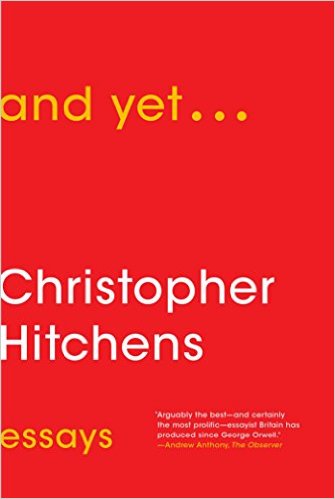
And Yet...: Essays
by Christopher Hitchens
(Simon and Schuster)
I have yet to hitch a ride on the Christopher Hitchens train. He’s an essayist I feel certain I should be reading, but I just haven’t gotten around to him. All shame and pity on me. Now, the good people at Simon and Schuster have considerately packaged a gallery of the late, great Hitch’s essays into one 560-page volume for my pleasure and edification. I’m adding
And Yet... to my
Five-Year Reading Plan of The Essentials.
Jacket Copy: The death of Christopher Hitchens in December 2011 prematurely silenced a voice that was among the most admired of contemporary writers. For more than forty years, Hitchens delivered to numerous publications on both sides of the Atlantic essays that were astonishingly wide-ranging and provocative. The judges for the PEN/Diamonstein-Spielvogel Award for the Art of the Essay, posthumously bestowed on Hitchens, praised him for the way he wrote “with fervor about the books and writers he loved and with unbridled venom about ideas and political figures he loathed.” He could write, the judges went on to say, with “undisguised brio, mining the resources of the language as if alert to every possibility of color and inflection.” He was, as Benjamin Schwarz, his editor at
The Atlantic magazine, recalled, “slashing and lively, biting and funny—and with a nuanced sensibility and a refined ear that he kept in tune with his encyclopedic knowledge and near photographic memory of English poetry.” And as Michael Dirda, writing in the
Times Literary Supplement, observed, Hitchens “was a flail and a scourge, but also a gift to readers everywhere.” The author of five previous volumes of selected writings, including the international bestseller
Arguably, Hitchens left at his death nearly 250,000 words of essays not yet published in book form.
And Yet… assembles a selection that usefully adds to Hitchens’s oeuvre. It ranges from the literary to the political and is, by turns, a banquet of entertaining and instructive delights, including essays on Orwell, Lermontov, Chesterton, Fleming, Naipaul, Rushdie, Pamuk, and Dickens, among others, as well as his laugh-out-loud self-mocking “makeover.” The range and quality of Hitchens’s essays transcend the particular occasions for which they were originally written. Often prescient, always pugnacious, and formidably learned, Hitchens was a polemicist for the ages. With this posthumous volume, his reputation and his readers will continue to grow.
Opening Lines: When, shortly after the triumph of the Castro revolution, Ernesto Guevara took over the direction of the Cuban National Bank, it became his duty to sign the newly minted ten- and twenty-peso notes. This he did with a contemptuous flourish, scrawling the bold
nom de guerre “Che” on both denominations. By that gesture, which made those bills a collectors’ item in some quarters of the left, he expressed an ambition to move beyond the money economy and what used to be termed “the cash nexus.” It was a stroke, at once Utopian and puritanical, that seemed to sum up his gift both for the improvised and the determined.
The Flood Girls
by Richard Fifield
(Gallery Books)
Two months ago, I sat in a hard plastic chair at the
Imagine Butte Resource Center here in Butte, Montana, a coffee mug full of cheap box-wine in my hands, listening spellbound as Richard Fifield read from his debut novel’s second chapter. It was a fierce, flamboyant, funny twenty minutes spent inside the current of his voice as he took us on a tour of the fictional Quinn, Montana (loosely based on his own hometown of Troy, Montana). Long before Richard’s voice stopped and he sat back down, I resolved to make
The Flood Girls one of my must-reads of 2015 (2016, if my well-laid plans go awry). The book will officially hit stores, libraries and e-readers in February. I suggest you all get in line for the
Flood right now.
Jacket Copy: This snappy, sassy redemption story set in small-town Montana is “a wild and crazy debut novel by a talented young writer” (Jackie Collins), filled with an uproarious and unforgettable cast of characters you won’t want to leave behind. Welcome to Quinn, Montana, population: 956. A town where nearly all of the volunteer firemen are named Jim, where The Dirty Shame—the only bar in town—refuses to serve mixed drinks (too much work), where the locals hate the newcomers (then again, they hate the locals, too), and where the town softball team has never even come close to having a winning season. Until now. Rachel Flood has snuck back into town after leaving behind a trail of chaos nine years prior. She’s here to make amends, but nobody wants to hear it, especially her mother, Laverna. But with the help of a local boy named Jake and a little soul-searching, she just might make things right. In the spirit of
Empire Falls and
A League of Their Own, with the caustic wit of
Where’d You Go, Bernadette thrown in for good measure, Richard Fifield’s hilarious and heartwarming debut will have you laughing through tears.
Opening Lines: Every night, Frank played harmonica for the cats.
Blurbworthiness: “Reading this novel is like unwrapping the wackiest birthday gift you’ve ever received:
The Flood Girls is a heart-shaped box filled with broads, softballs, drunks, Jackie Collins’ paperbacks, music, guns, and, most vibrantly of all, humanity. I started this book laughing out loud; I finished it grieving and grateful. Richard Fifield is the handsomest writer in North America, and perhaps its most compassionate.” (Sharma Shields, author of
The Sasquatch Hunter’s Almanac)
People Like You
by Margaret Malone
(Atelier26 Books)
Sometimes the biggest surprises come from the smallest places. Margaret Malone’s debut collection of short stories,
People Like You, arrived at my doorstep from
Atleier26 Books, a small press in Portland, Oregon, which has a tiny catalog (less than a dozen titles). Even the book itself is small (150 pages). But boy oh boy, the stories are big—large in all the best ways. I did a quick browse through some of the opening paragraphs and, within a matter of words, I was struck by the precision of details, the at-ease dialogue, the author’s depth of feeling for her characters. As Atelier26 founder
M. Allen Cunningham says at the press’ website: “Malone is the real thing, and her work is funny, unsettling, subtle, and moving.” Moving, indeed; I moved
People Like You to the summit of my ever-towering To-Be-Read pile (aka Mount NeveRest).
Jacket Copy: Malone’s people exist, like most of us, in the thick of everyday experience absent of epiphanies, and they are caught off-guard or cast adrift by personal impulses even while wide awake to their own imperfections. They win us over completely although we know they are bound to break our hearts with each confused and conflicted decision they make. Each of these stories is so beautifully controlled and alive to its own truth, readers will hardly know what hit them.
Opening Lines: The invitation is from a friend, though I use this term loosely: we have no friends. We have acquaintances from work, or old friends who live in other cities, or people who used to be our friends who we either borrowed money from and never repaid or who we just never bother to call anymore because we decided we either don’t like them or we’re too good for their company. We are not perfect.
Blurbworthiness: “This is the book I am personally going to put into peoples’ hands the moment it gets born. The stories in Margaret Malone’s collection
People Like You will blow your mind, steal your heart, and leave your DNA rearranged. Her writing is brilliantly urgent and alive. The biggest mouth-to-mouth resuscitation of storytelling I’ve seen in years.” (Lidia Yuknavitch, author of
The Small Backs of Children)
...AND: “There are moments in Margaret Malone’s collection
People Like You when it’s hard to breathe. Because
People Like You are people a lot like you, disturbingly so: awkward, petty, flawed, full of hope and monotony, yearning. Malone is a master of the minimal....Whether it’s a dying mother at a slot machine, a drinking pregnant mother stalking sex offenders, or a husband who’s having his prostate checked—every story is flawlessly told, the reader brought to the knees again and again by luxurious moments of intimacy and estrangement....And did I mention hilarious? Don’t let these wonderful stories pass you up. Margaret Malone is a name that will soon be up there with the best and brightest.” (Tom Spanbauer, author of
I Loved You More)
All Things Cease to Appear
by Elizabeth Brundage
(Knopf)
The chilly winter months beg for a page-turner of a book that invites me to lose myself in its plot and characters. This new creepy novel by Elizabeth Brundage looks like it will be the perfect way to spend a few hours curled up in my favorite reading chair. It opens with a father holding his pajama-clad daughter as they stand in the snow outside their neighbor’s house. I think it will just get even better from there.
Jacket Copy: Late one winter afternoon in upstate New York, George Clare comes home to find his wife murdered and their three-year-old daughter alone—for how many hours?—in her room down the hall. He had recently, begrudgingly, taken a position at the private college nearby teaching art history, and moved his family into this tight-knit, impoverished town. And he is the immediate suspect—the question of his guilt echoing in a story shot through with secrets both personal and professional. While his parents rescue him from suspicion, a persistent cop is stymied at every turn in proving Clare a heartless murderer. The pall of death is ongoing, and relentless; behind one crime are others, and more than twenty years will pass before a hard kind of justice is finally served. At once a classic “who-dun-it” that morphs into a “why-and-how-dun-it,” this is also a rich and complex portrait of a psychopath and a marriage, and an astute study of the various taints that can scar very different families, and even an entire community.
Opening Lines: This is the Hale Farm.
Here is the old milking barn, the dark opening that says,
Find me.
This is the weathervane, the woodpile.
Here is the house, noisy with stories.
The Mark and the Void
by Paul Murray
(Farrar, Straus and Giroux)
Paul Murray’s previous book
Skippy Dies might just be the best novel I never read. Oh sure, I talked a big game about being all excited to read it...
way back in 2010, but take a look at my pile of books marked
To Be Read—See it?—No, keep going a little farther down in the stack—
There it is. I’ll get to you soon, Skippy. I promise. Now along comes a new novel by the acclaimed Irish author, and this time it’s all about the money. I can’t say for certain, but I hope 2016 will be my Year of Murray.
Jacket Copy: What links the Investment Bank of Torabundo, www.myhotswaitress.com (yes, with an s, don’t ask), an art heist, a novel called For the Love of a Clown, a six-year-old boy with the unfortunate name of Remington Steele, a lonely French banker, a tiny Pacific island, and a pest control business run by an ex-KGB agent?
The Mark and the Void is Paul Murray’s madcap new novel of institutional folly, following the success of his wildly original breakout hit,
Skippy Dies. While marooned at his banking job in the bewilderingly damp and insular realm known as Ireland, Claude Martingale is approached by a down-on-his-luck author, Paul, looking for his next great subject. Claude finds that his life gets steadily more exciting under Paul’s fictionalizing influence; he even falls in love with a beautiful waitress. But Paul’s plan is not what it seems―and neither is Claude’s employer, the Investment Bank of Torabundo, which swells through dodgy takeovers and derivatives trading until―well, you can probably guess how that shakes out.
Opening Lines: Idea for a novel: we have a banker rob his own bank. He’s working alone; at first, it’ll look like a classic inside job. This man, however, is not what you’d call an insider. He’s French, not Irish, and although initially he might look like a typical Parisian—black suit, expensive shoes, hair neat but worn slightly long—as the story unfolds and his past comes to light, we find out he never quite fitted in over there either. He didn’t grow up in a leafy suburb, didn’t attend a fancy
grande école of the kind that bankers tend to come from; instead he spent his childhood in a run-down corner that the city prefers to disown, and his father’s something blue-collar—a welder maybe, a veteran of 1968, a tough nut.
Everyone Brave is Forgiven
by Chris Cleave
(Simon and Schuster)
World War Two. Three friends. A love triangle. Someone goes away into battle and comes home damaged. Sound familiar? Of course it does; it’s an old story, oft-told. Will Chris Cleave’s new novel be any different? Maybe, maybe not. But I’m swayed to believe it
will be better than the average Love in the Time of War story we’re used to reading—if nothing else, by the impassioned personal letter included at the front of my advance copy of
Everyone Brave is Forgiven in which Cleave explains the genesis of this book (his grandfather’s service on the island of Malta during World War Two) and his motives behind telling this story: “When I was beginning the project I might have said that by writing a small and personal story about the Second World War, I hoped to highlight the insincerity of the wars we fight now—to which the commitment of most of us is impersonal, and which finish not with victory or defeat but with a calendar draw-down date and a presumption that we shall never be reconciled with the enemy. I wanted the reader to come away wondering whether forgiveness is possible at a national level or whether it is only achievable between courageous individuals.”
Jacket Copy: It’s 1939 and Mary, a young socialite, is determined to shock her blueblood political family by volunteering for the war effort. She is assigned as a teacher to children who were evacuated from London and have been rejected by the countryside because they are infirm, mentally disabled, or—like Mary’s favorite student, Zachary—have colored skin. Tom, an education administrator, is distraught when his best friend, Alastair, enlists. Alastair, an art restorer, has always seemed far removed from the violent life to which he has now condemned himself. But Tom finds distraction in Mary, first as her employer and then as their relationship quickly develops in the emotionally charged times. When Mary meets Alastair, the three are drawn into a tragic love triangle and—while war escalates and bombs begin falling around them—further into a new world unlike any they’ve ever known. A sweeping epic with the kind of unforgettable characters, cultural insights, and indelible scenes that made
Little Bee so incredible, Chris Cleave’s latest novel explores the disenfranchised, the bereaved, the elite, the embattled.
Everyone Brave Is Forgiven is a heartbreakingly beautiful story of love, loss, and incredible courage.
Opening Lines: War was declared at eleven-fifteen and Mary North signed up at noon. She did it at lunch, before telegrams came, in case her mother said no. She left finishing school unfinished. Skiing down from Mont-Choisi, she ditched her equipment at the foot of the slope and telegraphed the War Office from Lausanne. Nineteen hours later she reached St. Pancras, in clouds of steam, still wearing her alpine sweater. The train’s whistle screamed. London, then. It was a city in love with beginnings.
The Quality of Silence
by Rosamund Lupton
(Crown)
Having lived in Alaska for nine years, courtesy of the U.S. Army, I have a special place in my reader’s heart for novels set in the Last Frontier. Rosamund Lupton’s latest novel pulled me in from the very first page when young Ruby and her mother land at the Fairbanks airport (a terminal with which I am all too familiar). At least from the opening lines, it's clear that Lupton gets the frigid-cold details just right. I look forward to going even deeper into
The Quality of Silence.
Jacket Copy: Thrillingly suspenseful and atmospheric,
The Quality of Silence is the story of Yasmin, a beautiful astrophysicist, and her precocious deaf daughter, Ruby, who arrive in a remote part of Alaska to be told that Ruby’s father, Matt, has been the victim of a catastrophic accident. Unable to accept his death as truth, Yasmin and Ruby set out into the hostile winter of the Alaskan tundra in search of answers. But as a storm closes in, Yasmin realizes that a very human danger may be keeping pace with them. And with no one else on the road to help, they must keep moving, alone and terrified, through an endless Alaskan night.
Opening Lines: It’s FREEZING cold; like the air is made of broken glass. Our English cold is all roly-poly snowmen and “woo-hoo! it’s a snow day!”—a hey-there friendly kind of cold. But this cold is mean. Dad said there were two main things about Alaska:
For one, it’s really really cold and
For two, it’s super-quiet because there’s thousands of miles of snow and hardly any people.
Blurbworthiness: “A forbidding Alaskan winter is the setting for this ambitious and imaginative novel…Narrated in part by Ruby, who is a delightfully realized character, (her deafness is treated with great sensitivity), the landscape, wildlife and bitter climate of Alaska are powerfully drawn. Chilling in every sense, you won’t want to step away from this story.” (
Sunday Mirror)
Numero Zero
by Umberto Eco
(Houghton Mifflin Harcourt)
I’m used to seeing big, chunky novels coming from Umberto Eco, so it was surprising (and refreshing) to open the mailing envelope from Houghton Mifflin Harcourt and find a knife-slim book by the renowned Italian writer, weighing in at 190 pages.
Numero Zero looks like an equally knife-sharp satire about contemporary media and gossip. It’s
numero uno on my To-Be-Read list.
Jacket Copy: 1945, Lake Como. Mussolini and his mistress are captured and shot by local partisans. The precise circumstances of Il Duce’s death remain shrouded in confusion and controversy.
1992, Milan. Colonna, a depressed hack writer, is offered a fee he can’t refuse to ghost-write a memoir. His subject: a fledgling newspaper financed by a powerful media magnate. As Colonna gets to know the team, he learns the paranoid theories of Braggadocio, who is convinced that Mussolini’s corpse was a body-double and part of a wider Fascist plot. It’s the scoop he desperately needs. The evidence? He’s working on it. Colonna is skeptical. But when a body is found, stabbed to death in a back alley, and the paper is shut down, even he is jolted out of his complacency. Fueled by conspiracy theories, Mafiosi, love, corruption and murder,
Numero Zero reverberates with the clash of forces that have shaped Italy since the Second World War. This gripping novel from the author of
The Name of the Rose is told with all the power of a master storyteller.
Opening Lines: No water in the tap this morning.
Gurgle, gurgle, two sounds like a baby's burp, then nothing.
Blurbworthiness: “Eco combines his delight in suspense with astute political satire in this brainy, funny, neatly lacerating thriller…. Eco’s caustically clever, darkly hilarious, dagger-quick tale of lies, crimes, and collusions condemns the shameless corruption and greed undermining journalism and governments everywhere. A satisfyingly scathing indictment brightened by resolute love.” (
Booklist)
Don’t Let My Baby Do Rodeo
by Boris Fishman
(Harper)
I’m easy prey for just about any book set in Montana (possible exception:
Softly Comes the Hard-Muscled Horseman), and Boris Fishman’s new novel definitely has that target on my chest in its sights. I’m a goner.
Jacket Copy: The author of the critically admired, award-winning
A Replacement Life turns to a different kind of story—an evocative, nuanced portrait of marriage and family, a woman reckoning with what she’s given up to make both work, and the universal question of how we reconcile who we are and whom the world wants us to be. Maya Shulman and Alex Rubin met in 1992, when she was a Ukrainian exchange student with “a devil in [her] head” about becoming a chef instead of a medical worker, and he the coddled son of Russian immigrants wanting to toe the water of a less predictable life. Twenty years later, Maya Rubin is a medical worker in suburban New Jersey, and Alex his father’s second in the family business. The great dislocation of their lives is their eight-year-old son Max—adopted from two teenagers in Montana despite Alex’s view that “adopted children are second-class.” At once a salvation and a mystery to his parents—with whom Max’s biological mother left the child with the cryptic exhortation “don’t let my baby do rodeo”—Max suddenly turns feral, consorting with wild animals, eating grass, and running away to sit face down in a river. Searching for answers, Maya convinces Alex to embark on a cross-country trip to Montana to track down Max’s birth parents—the first drive west of New Jersey of their American lives. But it’s Maya who’s illuminated by the journey, her own erstwhile wildness summoned for a reckoning by the unsparing landscape, with seismic consequences for herself and her family.
Don’t Let My Baby Do Rodeo is a novel about the mystery of inheritance and what exactly it means to belong.
Opening Lines: Maya had been early to pick up Max the day he didn’t come home with the school bus. Usually she was still powering up Sylvan Gate Drive when the old yellow bus sputtered to its crown, the doors exhaled, and Max tumbled out, always before the Kroon girl because Max always took the front seat.
Enchanted Islands
by Allison Amend
(Nan A. Talese)
The first line of Allison Amend’s novel warns us “You’re not allowed to read this.” Being the defiant person that I am, my knee-jerk reaction is:
Watch me now. Truth is, I’d want to read
Enchanted Islands anyway–not just for Amend’s name on the cover, but for the irresistible plot description. Spies on the Galapagos Islands during World War Two? Watch me zoom right over to page 1...
Jacket Copy: Inspired by the mid-century memoirs of Frances Conway,
Enchanted Islands is the dazzling story of an independent American woman whose path takes her far from her native Minnesota when she and her husband, an undercover intelligence officer, are sent to the Galápagos Islands on the brink of World War II. Born in Duluth, Minnesota, in 1882 to immigrant parents, Frances Frankowski covets the life of her best friend, Rosalie Mendel, who has everything Fanny could wish for—money, parents who value education, and an effervescent and winning personality. When, at age fifteen, Rosalie decides they should run away to Chicago, Fanny jumps at the chance to escape her unexceptional life. But within a year of living in the city, Rosalie commits an unforgiveable betrayal, provoking Frances to strike out on her own. Decades later, the women reconnect in San Francisco and realize just how widely their lives have diverged. While Rosalie is a housewife and mother, Frances works as a secretary for the Office of Naval Intelligence. It is there she is introduced to Ainslie Conway, an intelligence operator ten years her junior. When it’s arranged for Frances and Ainslie to marry and carry out a mission on the Galápagos Islands, the couple’s identities—already hidden from each other—are further buried under their new cover stories. No longer a spinster living a lonely existence, Frances is about to begin the most fascinating and intrigue-filled years of her life. Amidst active volcanoes, inhospitable flora and wildlife, and unfriendly neighbors, Ainslie and Frances carve out a life for themselves. But the secrets they harbor from their enemies, and from each other, may be their undoing. Drawing on the rich history of the early twentieth century and set against a large, colorful canvas,
Enchanted Islands boldly examines the complexity of female friendship and how those whom history has neglected to record have been shaped by, and in turn helped form, modern America.
Opening Lines: You’re not allowed to read this–I’m not even really allowed to write it. But now that Ainslie is gone and I will surely follow before too long, I don’t see that much is the harm. I suppose the government will censor what it will.
Suburban Gospel
by Mark Beaver
(Hub City Press)
Throughout his career as a Baptist minister, my father perched solely on the American Baptist branch of the denomination. On the liberal-conservative spectrum, we were somewhere between Episcopalians and Southern Baptists. As I grew up in the 1970s and 80s, the Southern Baptists always seemed to hog the media attention with all those tight-collared, red-faced televangelists shouting at the cameras, railing against women’s lib, music lyrics “written by the devil,” the moral rot of movies, and
homo-sex-shoo-als. They seemed a strange breed who gave us regular Baptists a bad name. But now I find myself in possession of what looks to be a side-splitting memoir, drenched in 80s nostalgia, about a young boy raised among the Southern Baptists in Atlanta who ate hellfire for breakfast and had damnation for dessert every night. I can’t wait to dig into Mark Beaver’s gospel of growing up among the straight and narrow.
Jacket Copy: When the deacons at Mark Beaver’s Bible Belt church cue up an evangelical horror flick aimed at dramatizing Hell, he figures he’d better get right with God, and soon. Convinced he could die at age seven and spend eternity roasting on a spit in the fiery furnace of Hades, he promptly gets Saved. But once the ’80s and his adolescence hit, the Straight and Narrow becomes a tight squeeze.
Suburban Gospel offers more than a look inside the Southern Baptist religion circa Jerry Falwell and the Moral Majority—it’s a tale of faith and flesh. Beaver invites us into a world filled with Daisy Duke fantasies and Prince posters, Nerf Hoops and Atari joysticks, raggedy Camaros and the neon light of strip malls. As much about the adolescent heart as the evangelical mind, the story explores similar emotional terrain as coming-of-age classics like Tobias Wolff’s
This Boy’s Life and Mary Karr’s
Cherry.
Suburban Gospel is a tale of growing up Baptist, all right—but also of just growing up.
Blurbworthiness: “In
Suburban Gospel, Mark Beaver proves to be a kind of down-home David Sedaris. This isn’t your great-grandfather’s Southern memoir; instead of red clay and moonshine, Beaver offers Bubble Yum and break dancing, suburban malls and 80s sports cars, Baskin-Robbins and Prince. In the midst of all the fun, Beaver trains his sights on two familiar Bible Belt subjects—family and religion—with intelligence, humor, and warmth. An entertaining and absorbing read.” (Keith Lee Morris, author of
Travelers Rest)
Noonday
by Pat Barker
(Doubleday)
I have yet to read anything Pat Barker has written (my list of Unread Authors is tediously long), but this new novel, which completes the trilogy begun with
Life Class and
Toby’s Room, looks especially intriguing. My interest in the London Blitz has recently been piqued by Kate Atkinson’s
Life After Life...and then
Noonday throws a “grotesque” spirit medium into the mix. I lean closer.
Jacket Copy: A new novel from the Booker Prize winning Pat Barker, author of the Regeneration Trilogy, that unforgettably portrays London during the Blitz (her first portrayal of World War II) and reconfirms her place in the very top rank of British novelists. London, the Blitz, Autumn 1940. As the bombs fall on the blacked-out city, ambulance driver Elinor Brooke races from bomb sites to hospitals trying to save the lives of injured survivors, working alongside former friend Kit Neville, while her husband Paul Tarrant works as an air-raid warden. Once fellow students at the Slade School of Fine Art before the First World War destroyed the hopes of their generation, they now find themselves caught in another war, this time at home. As the bombing intensifies, the constant risk of death makes all three reach out for quick consolation. And into their midst comes the spirit medium Bertha Mason, grotesque and unforgettable, whose ability to make contact with the deceased finds vastly increased demands as death rains down from the skies. Old loves and obsessions resurface until Elinor is brought face to face with an almost impossible choice. Completing the story of Elinor Brooke, Paul Tarrant and Kit Neville begun with
Life Class and continued with
Toby’s Room,
Noonday is both a stand-alone novel and the climax of a trilogy. Writing about the Second World War for the first time, Pat Barker brings the besieged and haunted city of London into electrifying life in her most powerful novel since the Regeneration trilogy.
Opening Lines: Elinor was halfway up the drive when she sensed she was being watched. She stopped and scanned the upstairs windows—wide open in the heat as if the house were gasping for breath—but there was nobody looking down. Then, from the sycamore tree at the end of the garden, came a rustling of leaves. Oh, of course:
Kenny. She was tempted to ignore him, but that seemed unkind, so she went across the lawn and peered up into the branches.
“Kenny?”
No reply. There was often no reply.
Kenny had arrived almost a year ago now, among the first batch of evacuees, and, although this area had since been reclassified—“neutral” rather than “safe”—here he remained. She felt his gaze heavy on the top of her head, like a hand, as she stood squinting up into the late-afternoon sunlight.
The Bed Moved
by Rebecca Schiff
(Knopf)
The first lines of Rebecca Schiff’s short stories are simple—deceptively so—frank, and barbed with fishhooks. In addition to the one I cite below from the collection’s titular story, here are a few others which snagged me in the gills as I skimmed through the pages:
The Comfort Inn was across the street. But we were sleeping by the side of the road. (“Tips”)
Dear Student A, I’m sorry I put a sentence from your recent essay up on the SmartBoard without explaining to the rest of the class that they were critiquing writing by a fellow classmate. It was not smart of me, no matter what the board is called. (“Communication Arts”)
They came every day with their prayer books and coconut candies. (“Another Cake”)
My friend is marrying a man against violence. (“Men Against Violence”)
Jacket Copy: The audacious, savagely funny debut of a writer of razor-sharp wit and surprising tenderness: a collection of stories that gives us a new take on adolescence, death, sex, on being Jewish-ish, and on finding one’s way as a young woman in the world. A New Yorker, trying not to be jaded, accompanies a cash-strapped pot grower to a “clothing optional resort” in California. A nerdy high-schooler has her first sexual experience at geology camp. On the night of her father’s funeral, a college student watches an old video of her Bat Mitzvah, hypnotized by the image of the girl she used to be....Frank and irreverent, these stories offer a singular view of growing up (or not) and finding love (or not) in today’s ever-uncertain landscape. How to form lasting connections in a world saturated by insincerity? How to transcend the indignities of middle school? How to build a strong sense of self while also trying to figure out online dating? In its bone-dry humor, its pithy observations, and its thrilling ability to unmask the most revealing moments of human interaction--no matter how fleeting—this collection announces a new talent to be reckoned with.
Opening Lines: There were film majors in my bed—they talked about film. There were poets, coxswains, guys trying to grow beards.
The Rope
by Kanan Makiya
(Pantheon)
A novel about the Iraq War told from the perspective of “the other side” will always interest me; but one which starts with a trapdoor that opens and releases Saddam Hussein to his hanging death is a little more than just “interesting,” it’s practically imperative that I read this new novel by Kanan Makiya.
Jacket Copy: From the best-selling author of
Republic of Fear, a gritty, unflinching, haunting novel about Iraqi failure in the wake of the 2003 American war. Told from the perspective of a Shi’ite militiaman whose participation in the execution of Saddam Hussein changes his life in ways he could not anticipate, the novel examines the birth of sectarian politics out of a legacy of betrayal and victimhood. A nameless narrator stumbles upon a corpse on the day of the fall of Saddam Hussein. Swept up in the tumultuous politics of the American occupation, he is taken on a journey that concludes with the discovery of what happened to his father, who disappeared in the tyrant’s gulag in 1991. His questions about his father, like those surrounding the mysterious corpse outside his house, were ignored by his mother, and by his uncle, in whose house he was raised. But he is older now, and a fighter in his uncle’s Army of the Awaited One, which is leading an insurrection against the occupation. Clues accumulate: a letter surreptitiously delivered to his mother during his father's imprisonment; stories told by his dying grandfather. Not until the last hour before the tyrant’s execution is the narrator given the final piece of the puzzle. It comes from Saddam Hussein himself. It is a story about loyalty and betrayal, victims turned victimizers, secrecy and loss—and identity: the haste with which it is cobbled together, or undone, always at terrible cost. It is a story that will stay with readers long after they finish the final page.
Opening Lines: I checked my watch over and over again, determined to catch the precise moment when the lever would be released. I still almost missed it, the trapdoor clanging open before he had finished reciting his prayers.
Spill Simmer Falter Wither
by Sara Baume
(Houghton Mifflin Harcourt)
I received an advance copy of Sara Baume’s novel nearly a month ago. Since then, I’ve been haunted by its remarkable Prologue (see below). If the rest of the book holds up to the promise of these 362 words, then we’re all in for a real treat indeed.
Jacket Copy: It is springtime, and two outcasts—a man ignored, even shunned by his village, and the one-eyed dog he takes into his quiet, tightly shuttered life—find each other, by accident or fate, and forge an unlikely connection. As their friendship grows, their small, seaside town suddenly takes note of them, falsely perceiving menace where there is only mishap; the unlikely duo must take to the road. Gorgeously written in poetic and mesmerizing prose,
Spill Simmer Falter Wither has already garnered wild support in its native Ireland, where the
Irish Times pointed to Baume’s “astonishing power with language” and praised it as “a novel bursting with brio, braggadocio and bite.” It is also a moving depiction of how—over the four seasons echoed in the title—a relationship between fellow damaged creatures can bring them both comfort. One of those rare stories that utterly, completely imagines its way into a life most of us would never see, it transforms us not only in our understanding of the world, but also of ourselves.
Opening Lines: He is running, running, running.
And it’s like no kind of running he’s ever run before. He’s the surge that burst the dam and he’s pouring down the hillslope, channelling through the grass to the width of his widest part. He’s tripping into hoof-rucks. He’s slapping groundsel stems down dead. Dandelions and chickweed, nettles and dock.
This time, there’s no chance for sniff and scavenge and scoff. There are no steel bars to end his lap, no chain to jerk at the limit of its extension, no bellowing to trick and bully him back. This time, he’s farther than he’s ever seen before, past every marker along the horizon line, every hump and spork he learned by heart.
It’s the season of digging out. It’s a day of soft rain. There’s wind enough to tilt the slimmer trunks off kilter and
drizzle enough to twist the long hairs on his back to a mop of damp curls. There’s blood enough to gush into his beard and spatter his front paws as they rise and plunge. And there’s a hot, wet thing bouncing against his neck. It’s the size of a snailshell and it makes a dim squelch each time it strikes. It’s attached to some gristly tether dangling from some leaked part of himself, but he cannot make out the what nor the where of it.
Were he to stop, were he to examine the hillslope and hoof-rucks and groundsel and dandelions and chickweed and nettles and dock, he’d see how the breadth of his sight span has been reduced by half and shunted to his right side, how the left is pitch black until he swivels his head. But he doesn’t stop, and notices only the cumbersome blades, the spears of rain, the upheaval of tiny insects and the blood spilling down the wrong side of his coat, the outer when it ought to be the inner.
He is running, running, running. And there’s no course or current to deter him. There’s no impulse from the root of his brain to the roof of his skull which says other than RUN.
He is One Eye now.
He is on his way.
Blurbworthiness: “A tour de force.... No writer since JM Coetzee or Cormac McCarthy has written about an animal with such intensity. This is a novel bursting with brio, braggadocio and bite. Again and again it wows you with its ambition…At its heart is a touching and inspiriting sense of empathy, that rarest but most human of traits. Boundaries melt, other hearts become knowable…This book is a stunning and wonderful achievement by a writer touched by greatness.” (Joseph O’Connor, for
The Irish Times)
Cities I’ve Never Lived In
by Sara Majka
(Graywolf Press)
I’ll close out this month’s already-overstuffed Front Porch Books with one more short story collection. As with the previously-mentioned books by Margaret Malone and Rebecca Schiff, Sara Majka demonstrates a strong, steady hand with her stories’ opening lines. Browsing the pages, I couldn’t find a single word that didn’t carry its own weight. These sentences are champion draft horses. They pull, they pull, they pull...
Jacket Copy: In subtle, sensuous prose, the stories in Sara Majka’s debut collection explore distance in all its forms: the emotional spaces that open up between family members, friends, and lovers; the gaps that emerge between who we were and who we are; the gulf between our private and public selves. At the center of the collection is a series of stories narrated by a young American woman in the wake of a divorce; wry and shy but never less than open to the world, she recalls the places and people she has been close to, the dreams she has pursued and those she has left unfulfilled. Interspersed with these intimate first-person stories are stand-alone pieces where the tight focus on the narrator’s life gives way to closely observed accounts of the lives of others. A book about belonging, and how much of yourself to give up in the pursuit of that,
Cities I’ve Never Lived In offers stories that reveal, with great sadness and great humor, the ways we are most of all citizens of the places where we cannot be.
Opening Lines: Maybe ten or eleven years ago, when I was in the middle of a divorce from a man I still loved, I took the train into the city. We were both moving often during this time, as if it were the best solution to a shattered life: to move from place to place, trying to thread together, if not our marriage and our lives, then something in ourselves.
Blurbworthiness: “Like Alice Munro and Raymond Carver, Sara Majka writes stories of people on society’s ragged edge—in money trouble, work trouble, heart trouble—and does so with tremendous subtlety and a grave sophistication all her own. Every one of the spare sentences in this book is heavy with implication and insight. It’s impossible to read these stories too closely.” (Salvatore Scibona, author of
The End)