Friday, March 8, 2013

Friday Freebie: The Coldest Night by Robert Olmstead and Wild Delicate Seconds by Charles Finn


Congratulations to Anisa Malek, winner of last week's Friday Freebie, This Close: Stories by Jessica Francis Kane.

This week's book giveaway is a pair of books which are both high on my To Be Read list: The Coldest Night by Robert Olmstead from Algonquin Books and Wild Delicate Seconds: 29 Wildlife Encounters by Charles Finn from OSU Press.

Robert Olmstead's novel about love and war, The Coldest Night, has just been released in paperback, but I've got a handsome hardback to give away to one lucky reader.  Publishers Weekly named it a Best Book of 2012 and Amazon chose it as a Best Book of the Month a year ago, saying:
Spare. Elegiac. Well-crafted. These are words used to describe Robert Olmstead’s novel The Coldest Night—and all of them are true—but what really makes the book special is the imagery and emotion throughout. A seventeen-year-old Henry falls in love with Mercy, the young daughter of a judge. They run away to New Orleans, where they create their own private Eden, but eventually Mercy’s family locates them and forces the two lovers apart. Seeing few alternatives, Henry enlists to fight in the Korean War. One could read far into this novel and think that it is a book built around young love. But when Henry goes to Korea, the language lifts off to a new level. Though spare in its presentation, The Coldest Night is a novel of surprises.
The Cleveland Plain Dealer also praised it in this way: “Olmstead writes with ferocious economy . . . The book’s continuities are a deep pleasure: a near-mystical regard for horses, for mothers, for weapons—all wrapped in a kind of elegiac masculinity. Olmstead has some of the Cormac McCarthy penchant for mixing tenderness into his terror.”
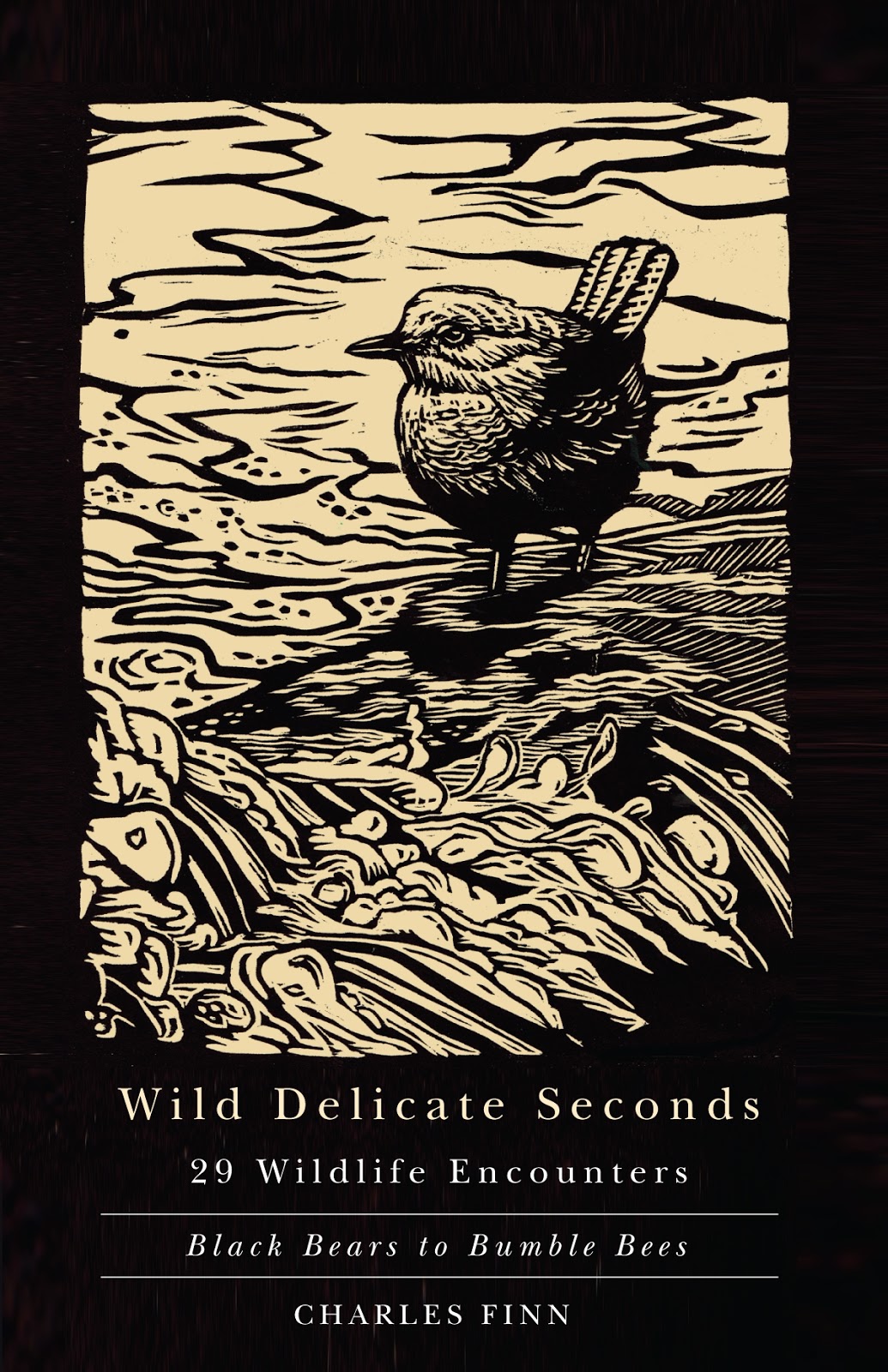
Charles Finn's lyrical meditation on his encounters with wildlife is simply a beautiful book--both in its physical design and in the way Finn spins his words on the page.  As the publisher's blurb for Wild Delicate Seconds tells us, "There are no maulings or fantastic escapes in Finn's narratives—only stillness and attentiveness to beauty. With profundity, humor, and compassion, Finn pays homage to the creatures we share our world with—from black bears to bumble bees, mountain lions to muskrats—and, in doing so, touches on what it means to be human."  Author Robert Michael Pyle had this to say about the book:
I don’t know when I have felt more captive to a suite of animal associations than I do in reading Wild Delicate Seconds. I think of Ernest Thompson Seton, both Adolf and Olaus Murie, and all of the Craigheads, written with the elegant concision of Penelope Fitzgerald and the wild whimsy of Tom Robbins. But this is Charles Finn, all by himself, except for the company of 29 memorable creatures—all the more memorable for his gem-like accounts of intimate meetings in the wild. Finn’s mastery of simile, his deep, deep attention to others around him, and his humility in the presence of his evolutionary peers make this a fine book, one I shall read over and over, give away again and again, and return to when I am lonely.
In case you didn't catch it earlier here at the blog, you should go read Charles' "My First Time" account of how that exquisite cover design came into being.  Also, for those of you in Butte and western Montana, a heads up alert that Charles and I will be doing a reading at the Butte-Silver Bow Library in the coming months.  I'll post the exact date and time at the events page on my website once we work out the details.

If you'd like a chance at winning a copy of both The Coldest Night and Wild Delicate Seconds, all you have to do is email your name and mailing address to thequiveringpen@gmail.com

UPDATE: I have extra copies of Wild Delicate Seconds and a paperback copy of The Coldest Night, so this week there will be two winners: one person will win a hardcover of The Coldest Night and Wild Delicate Seconds, and another person will win the paperback of The Coldest Night along with a copy of Wild Delicate Seconds.

Put FRIDAY FREEBIE in the e-mail subject line.  One entry per person, please.  Despite its name, the Friday Freebie runs all week long and remains open to entries until midnight on March 14—at which time I'll draw the winning name.  I'll announce the lucky reader on March 15.  If you'd like to join the mailing list for the once-a-week Quivering Pen newsletter, simply add the words "Sign me up for the newsletter" in the body of your email.  Your email address and other personal information will never be sold or given to a third party (except in those instances where the publisher requires a mailing address for sending Friday Freebie winners copies of the book).

Want to double your odds of winning?  Get an extra entry in the contest by posting a link to this webpage on your blog, your Facebook wall or by tweeting it on Twitter.  Once you've done any of those things, send me an additional e-mail saying "I've shared" and I'll put your name in the hat twice.


Thursday, March 7, 2013

Great Beginnings: Godforsaken Idaho by Shawn Vestal


You can tell a lot about a story by the way it shakes your hand.  Does it have the metacarpal-crushing vigor of a football linebacker, or the limp-fish laxity of a shy visitor?  Those first sentences--the handshake of fiction--of a story will either pull you in or push you away, depending on the intensity and freshness of their language.

In the case of Shawn Vestal's stories in Godforsaken Idaho, I was grabbed and squeezed by the first grip of words.

The book will be officially released at the beginning of April, but I was lucky to get an advance copy in the mail yesterday.  As soon as I ripped open the mailing envelope and Vestal's book spilled out into my hands, my heart did a series of gymnastic vaults and I think I even let loose with a "Yesss!"  I don't know Vestal personally, but he and I have bumped into each other on social media once or twice and Godforsaken Idaho was on my radar.  I set the book aside so I could make dinner, which led to a night of TV watching with my wife, which led to a drowsy climb upstairs two hours later where I fell into bed and promptly fell asleep.

This morning--as with most mornings--I wasn't sure what I'd write about here on the blog, so to kill some time, I picked up Vestal's book again, and turned to the first page.

Howdy-do!  The handshake pumped my arm like I was an oil derrick.

I should say "handshakes" plural because I didn't stop with that first paragraph of the first story but kept flipping through the pages, reading the opening paragraphs to all of the stories.  Suddenly, I knew exactly what I'd blog about this morning.  Sure, I could have saved Godforsaken Idaho for the next edition of Front Porch Books, but my excitement over what I read would have completely taken over the blog post and that wouldn't be fair to the other books I chose to highlight.  So, I decided to give Vestal his own day.

I should add that I didn't read any of these nine stories beyond the opening lines you see below, so for all I know the rest of the words could totally suck, could turn out to be nothing but limp, moist fingers pulling weakly out of our first handshake.  But I really don't think they will.  Not with great beginnings like these.

The food is excellent.  The lines are never long.  There’s nothing to do with your hands.  These are the first things I tell my son.  Then we don’t talk again for something like two hundred years.
      --"The First Several Hundred Years Following My Death"

I never wanted to be a criminal until I was one.  And then, for a while, I couldn't imagine wanting to be anything else.
      --"About as Fast as This Car Will Go"

Gina said, "I'd love to stab you to death with an icepick.  Like four hundred times."  She feigned delicate stabs.  "Or a hat pin."  We were driving from Jackson to Rupert, Idaho, where her parents lived.  An eight-hour drive.  She'd already come up with: suffocation in a vat of excrement; poisoning with lye in cake frosting; crucifixion with rusty nails; and countless variations involving the mutilation of my genitals.
      --"Families Are Forever!"

This starts in the hot pool, around my fourth vodka cran, when she comes in slapping the poolside with her flip-flops, looking like someone you see getting out of a car on TV.  Huge sunglasses with tan lenses.  Pressed blond hair and bronze skin.  Her thin, golden legs emerging from a denim skirt that looked expensively worn out.  I believe firmly in watching such a woman.  The other men in the hot pool, the ones under the supervision of their own women, were trying not to.  She stepped out of that skirt and bent over, ass up like an autumn doe, a taut, aqua patch of swimsuit summoning the eye.  It was four in the afternoon, and something started flopping inside me like a fish on a riverbank.
      --"Pocket Dog"

For most of my life I couldn't have found Idaho on a map.  I had no picture of the place in my mind, nothing like a California beach or a Texas oil field.  Potato trees, is what I thought on the drive out.  Rows and rows of potato trees.  I was a stupid child, well into adulthood.  So I find myself in Idaho, and it turns out that potatoes grow underground, and there aren't any up here in the northern part of the state anyway.  People here hate it if you even mention potatoes.  I feel that way now, too.
      --"Godforsaken Idaho"

They materialized with the first snow.  That was how Bradshaw would always remember it.  He was standing at the living-room window, listening to Cheryl shush the baby, when he saw specks fluttering like ash against a smoky sky, then caught sight of someone on his front step, though he hadn't noticed anyone coming up the walk.  He could see about an inch of a man's left side at the window's border--an arm in a dark suit and boyish hand holding a book bound in black leather.  He knew instantly that there was another suit and another leather-bound volume out there, a companion to complete the pair: missionaries.
      --"Winter Elders"

Then I awoke.  Sea the color of stone curled away in every direction, tucking itself beneath a bright mist that blotted out the sky.  A tinge of lilac bleeding into the frosty air.  A rocking, a lulling.  Was this the celestial kingdom?  I had believed I was dying into God’s glory.  Now I was seeing through someone else’s eyes, and could but hope this was a passage, a way there.  The ashen sea rocked on.  I stared into the haze, longing to see it open upon a wide shore, a sacred light, the heavenly host.
      --"Opposition in All Things"

Sara Miller wanted to know what would happen if she said no.  Just that: No.  The thought terrified and thrilled her.  Could she say it?  Could he hear it?  Ever since they'd left Nauvoo, she feared her father had lost touch with the will of the Lord.  Now she was counting his sins again, as they stood in the dirt yard, as she watched him push the planer along the plank, watched the chapped top of his head, the white points of his raw knuckles.  Tan curls rose and fell to the earth.  His pride, she told herself.  His anger.  She held the plank.  He doesn't keep the Word of Wisdom.  The sun broke from the horizon, and the valley flowered between the mountain spines.  All Zion was golden, Sara thought, and wasn't her father a part of that?  She felt enclosed by the ambiguous messages of the Lord.
      --"Gulls"

February 27, 1825
      A new report regarding treasure.
      Josaiah Stowell heard from his cousin in Damascus the story of the Mink Gang, road agents some decades back believed to have buried coins and bills in a strongbox along our valley road, the spoils of a famed spree of robberies.  Stowell's cousin is a former sheriff, and the report confirms, in some respects, other tales of which I have written here.  The stories gather and gather.  They are becoming harder to discredit.  Elizabeth used to scoff at the notion--"Treasure," she would huff, lovely with indignation.  "You men would do anything to avoid honest labor."
      --"Diviner"


Wednesday, March 6, 2013

And the Oscar (contest) goes to...


Congratulations to Sharon Borrege, the winner of the annual Quivering Pen Academy Awards Prediction Contest.  Sharon was one of two entrants to correctly predict an impressive 21 out of the 24 winners of this year's Oscars (both names were then entered into a blind drawing).  She'll soon be enjoying her prize package of the books Les Miserables, Argo, Life of Pi, and The Hobbit.

Overall, Quivering Pen readers did a good job of predicting this year's Academy Award winners.  Here are the percentages of the voting results from the respondents to the poll:

Best Picture: Argo (78%)
Best Actor: Daniel Day-Lewis for Lincoln (96%)
Best Actress: Jennifer Lawrence for Silver Linings Playbook (70%) 
Best Supporting Actor: Tommy Lee Jones for Lincoln (49%)
     Actual Winner:  Christoph Waltz for Django Unchained (10%)
Best Supporting Actress: Anne Hathaway for Les Miserables (93%)
Best Director: Steven Spielberg for Lincoln (75%)
     Actual Winner: Ang Lee for Life of Pi (13%)
Best Original Screenplay: Quentin Tarantino for Django Unchained (45%)
Best Adapted Screenplay: Chris Terrio for Argo (62%)
Best Animated Feature: Wreck-It Ralph (49%)
     Actual Winner: Brave (44%)
Best Foreign Language Film: Amour (93%)
Best Original Score: Life of Pi (74%)
Best Original Song: "Skyfall" from Skyfall (91%)
Best Production Design: Les Miserable (36%)
     Actual Winner:  Lincoln (12%)
Best Cinematography: Life of Pi (90%) 
Best Costume Design: Anna Karenina (79%)
Best Documentary Feature: Searching for Sugar Man (79%)
Best Documentary Short: Open Heart (52%)
     Actual Winner: Innocente (29%)
Best Film Editing: Argo (84%)
Best Makeup and Hairstyling: The Hobbit (63%)
     Actual Winner: Les Miserables (36%)
Best Animated Short Film: Paperman (75%)
Best Live Action Short Film: Curfew (61%)
Best Sound Editing: Zero Dark Thirty (44%), which tied with Skyfall (14%)
Best Sound Mixing: Les Miserables (83%)
Best Visual Effects: Life of Pi (91%)


Tuesday, March 5, 2013

Trailer Park Tuesday: The Chalice by Nancy Bilyeau


Welcome to Trailer Park Tuesday, a showcase of new book trailers and, in a few cases, previews of book-related movies.  Unless their last name is Grisham or King, authors will probably never see their trailers on the big screen at the local cineplex.  And that's a shame because a lot of hard work goes into producing these short marriages between book and video.  So, if you like what you see, please spread the word and help these videos go viral.


Today marks the publication date of Nancy Bilyeau's new novel The Chalice, a sequel to last year's historical thriller The Crown, and I'm pleased to bring you her new blood-soaked trailer (almost exactly a year to the day I featured The Crown's trailer).  It's hard to keep your pulse rate down while watching this 90-second video.  It moves quickly through a series of haunting images: an ancient graveyard, a sky full of wheeling ravens, a flash of skull superimposed over King Henry VIII's face, a single drop of blood splashing into a pool of red.  Chilling and thrilling.  On her website, Nancy writes, "Think Day of the Jackal meets The Tudors."  I haven't had the chance to read The Chalice, but the trailer does a good job setting the mood for the story in which former novice Joanna Stafford continues her fight against corruption in Tudor-era England.  This time, she uncovers a plot against King Henry while she's trying to unravel the puzzle of a prophecy about her own life.  Her quest for the truth leads her on a journey into the heart of darkness where, I'm guessing, blood will be spilled. 


Monday, March 4, 2013

Memo From Fobbit Headquarters


Here are a few scraps of miscellany which might be of interest to Fobbit fans:

1.  Bookplates: I now have a couple dozen bookplates (pictured above) which I'm happy to sign and mail to those readers who were unable to get an in-person signature at any of the readings or other events on the Fobbit book tour last Fall.  Just drop me a line if you'd like one of these puppies signed (either personalized or just an autograph) and sent your way.


2.  Tournament of Books: The results of the pre-tournament play-in have been announced and Billy Lynn's Long Halftime Walk effectively TKO'ed Fobbit and The Yellow Birds.  Kevin Powers and I will be bandaging our cuts, nursing a whiskey at the bar, and cheering on Ben Fountain as he goes forward in The Morning News' literary death match.  Go, Ben!  Go, Billy!


3.  Upcoming events:  I've added a few new bookstore and festival appearances to the calendar, including readings at Auntie's Bookstore in Spokane, Washington (March 19 at 7 pm) and Rediscovered Books (May 10 at 7:30 pm) in Boise, Idaho.  I'll also be at the Los Angeles Times Festival of Books on April 20 (exact time and place to be determined).  Sadly, due to the Los Angeles Times Book Awards ceremony, I've had to cancel my panel with Ben Fountain at the Arkansas Literary Festival (which was scheduled for that same weekend)--but the good news is, we've rescheduled that joint appearance in Little Rock for June 20.  Stay tuned for more details.


My First Time: Charles Finn


My First Time is a regular feature in which writers talk about virgin experiences in their writing and publishing careers, ranging from their first rejection to the moment of holding their first published book in their hands.  Today’s guest is Charles Finn, editor of High Desert Journal and author of Wild Delicate Seconds: 29 Wildlife Encounters which Gretel Ehrlich, author of The Solace of Open Spaces, called “an exquisite read, full of small surprises with big heartbeats.  Finn’s stories are warbler-sized.  They cut through the air of the mind like flames.”  Finn’s essays and poetry have appeared in The Sun, Northern Lights, Wild Earth, Silk Road, Open Spaces, High Country News, Writers on the Range, Big Sky Journal, Montana Quarterly, Montana Magazine and many other places.  Before joining High Desert Journal, he taught English as a foreign language for three years in Hiroshima, Japan; hid out in the woods of British Columbia for ten; and spent five years in Montana, much of it in an 8 x 12 cabin of his own making with no running water or electricity.  A self-taught woodworker and proponent of “living little” he began A Room of One's Own building “microhomes,” one-room wood cabins constructed entirely out of reclaimed lumber and materials he salvaged from old barns and buildings.  Click here to visit his website. 

My First Book Cover

Long before I had a manuscript to submit, I dreamed about my first book, and, most deliciously, what its cover might be.  Lingering over titles in stores, I’d make mental notes on the covers I liked.  Not surprisingly, I was always drawn to the quieter, less brash ones: details of famous paintings, or mood-evoking photographs.  From the 1970s through the 2000s, I thought I could see an evolution in cover art, a maturing you might say, and with a marketer’s eye, I plotted my course.  From very early on, I understood the importance a cover could make, how it could draw a potential reader in or turn them away, and how a good cover evoked what lay inside.  I’d also read wonderful accounts of authors from big publishing companies seeing their books for the first time and the joy they felt holding the honest-to-goodness thing in their hands.  I’d also read about writers who were crushed at that same moment, disappointed to the point of tears.

How utterly depressing that must be, I thought, to have an ugly cover, to have slaved so hard, created a thing of such wondrous beauty, only to have it wrapped in an ugly skin.

In 2002 I moved to Missoula, Montana.  One of the first people I met was artist Claire Emery, and from the moment I saw Claire’s work, I knew it was a perfect fit for the collection of wildlife essays I was working on.  Claire was teaching nature journaling at the time, and just beginning to branch out into woodblock carvings.  Her work had a quietness I liked, a gentleness that corresponded well to what I was trying to do with the written word.  Very early on, I showed Claire drafts of my essays and we began talking about a possible collaboration.  Years later, when the happy news came that my manuscript Wild Delicate Seconds: 29 Wildlife Encounters was accepted by Oregon State University Press, I immediately floated Claire’s name as a possible cover artist, going so far as to suggest she do 29 interior illustrations as well, one for the title page of each chapter.

Although Claire was contracted to do the cover, 29 interior images would prove too expensive for OSU to fund, and I certainly didn’t have the resources to pay Claire even after a generous and discounted offer.  For a time I searched for images in the public domain, but couldn’t come up with enough that were in a similar vein, and gave up.  It was a depressing time, as bit by bit, I was seeing my dream slip away (I’d wanted uncut pages too, but no dice) and then OSU press surprised me with black-and-white silhouettes on each title page when they sent the page proofs.

Hmmm… How to respond?  The silhouettes were good, but not great: the bumblebee looked like a fly had been squashed between the pages, and to any birder, the osprey was obviously not an osprey.  The images were also static, all of them placed in the exact center of the page.  In a near state of panic, and with a knot in my stomach, I contacted the Press and their designer.  Oh what a relief!  What a surprise!  I was expecting pushback, but the designer was more than willing to work with me and was open to my suggestions.  Bouncing emails back and forth, we soon moved the animals to different positions on the page.  Suddenly, a butterfly fluttered in the top right corner, flying squirrels zig-zagged across the page, the fixed osprey perched on the O in its name, and deer, elk, and bison browsed along the page bottom.  Things were looking up.


At the same time as the book was being walked through its steps at OSU Press, Claire was sending me drafts of her ideas.  She had settled on an image of an American Water Ouzel, more commonly known as a “dipper.”  She experimented with different shadings and colorings, and I watched water being added and then a stone, mid-stream, to be perched on.  I trusted her implicitly, and had nothing to say except I loved it.  I only hoped the Press did too.

For years I’d wondered what I’d do if my book—my baby—was born with an ugly cover.  I remember fantasizing how I would storm out of my publisher’s office, the torn pages of my contract fluttering to the carpet behind me.  Back then, such juvenile daydreams, which ironically (or maybe naturally) drifted into even more ludicrous dreams of rehearsing Pulitzer Prize-winning acceptance speeches, were a staple of my procrastination-filled days.

Luckily, for everyone involved, there were no tantrums: the cover was a hit—both at the Press and when it hit the book stores.  In fact, everywhere I went to read, and in my email inbox on a regular basis, were comments and compliments on how attractive it was.  I have even had bookstore owners tell me they’ve observed people being pulled to it, how it stands out from so many other covers that it makes people curious as to what the book is about.  And isn’t that exactly the job of any cover?!  To get the reader to pick the book up.  Because of the cover, I’m told (and I believe it to be true) copies of Wild Delicate Seconds were sold.

It is hard to express my gratitude to OSU Press for allowing me the amount of input and decision-making power they did.  It is an example of the benefits of working with a small, independent publisher.  They sent any number of mock-ups and asked for my opinion.  Thinking back, I don’t know if I had veto power when it came to the cover, I never asked, but they bent over backwards to accommodate me and my tastes.  I listened to them, and they listened to me, and just like it is supposed to be, everybody came away feeling happy, good, and proud of what they’d done.

Finally, of course, this is also a thank you to Claire, for her gorgeous work.  It is an honor to have my words wrapped by her art.  And despite the fact that the cliche “you can't judge a book by its cover”  is true, I would like to think, at least in the case of Wild Delicate Seconds, that you can.


Sunday, March 3, 2013

Sunday Sentence: Useless Landscape by D. A. Powell


Simply put, the best sentence(s) I've read this past week, presented to you out of context and without commentary.


Because I have no sense
                         and I like the way it sounds:
           if I was to buy me a little place,
I'd buy me some bottomland.

      --First stanza of "The Price of Funk in Funkytown" from Useless Landscape, or A Guide for Boys: Poems by D. A. Powell


Saturday, March 2, 2013

Soup and Salad: Covering Fahrenheit 451, More covers at The Casual Optimist, Ayana Mathis and the "Aha! Moment," Retiring writers, Delayed reviews, Heavy-breathing reviews, Adam Braver's new project, 100 years of bestsellers, Paperback pride, First drafts


On today's menu:


1.  Congratulations to Matthew Owen who won a contest, sponsored by Simon & Schuster and the American Library Association’s Office for Intellectual Freedom, to design a new cover for Ray Bradbury's Fahrenheit 451.  Owen's concept (seen above) is simple and brilliant and is sure to draw new readers to the special 60th anniversary printing of Bradbury's classic.  I suspect those who already own Fahrenheit 451 will also buy a copy just to have this beautiful art on their shelves.


2.  Speaking of outstanding design, if you aren't already a subscriber to The Casual Optimist blog, you should start now.  I always look forward to visiting the site for a full course of smart conversation about eye candy--like the British cover design for Laurent Binet's novel HHhH (which, if you'll recall, was reviewed here at The Quivering Pen by Sam Thomas not too long ago).


3.  At The Millions, Matthew Bourne describes how, in his research for an article for Poets & Writers magazine, he visited the "sun-struck jewel box" office of literary agent Ellen Levine to talk about her "Aha! Moment"--that is, "the moment the light went on for [her] about a particular manuscript, the moment when [she] thought, I have to do this project."
As we sat down to discuss the page in question, midway into the first chapter of a first novel by an unknown African-American writer living in Brooklyn, Levine described the writer’s command of language and storytelling craft, but when she reached a key passage in the scene, in which a young mother is about to lose her twin babies to pneumonia, Levine’s voice caught. When I looked up, her eyes had misted over. If you interview a lot of people, you develop a radar for when people are selling and when they are not, and in this case Ellen Levine was not selling. She was genuinely moved by this scene in an unpublished book by a writer nobody had ever heard of. I left her office that day thinking: Something really, really good is going to happen to that book. Sure enough, eight months later, I read that the book Levine and I had been discussing that day, The Twelve Tribes of Hattie by Ayana Mathis, had been published in December, six weeks ahead of schedule, and had been picked by Oprah Winfrey for her newly rebooted Book Club.
Bourne goes on to talk about what we've come to know as the Oprah Fairy Tale Effect: "the sudden reversal of fortune experienced by those lucky few Oprah authors. The poor wretched scribe....toiling away in obscurity in the backwaters of American literary culture until one day the phone rings, and — Oh, my God! — 'Hi, this is Oprah.'"


4. Elsewhere at The Millions, Bill Morris ponders the question "Can writers retire?"  The abrupt end (and in some cases only a pause) of some writers' careers are called into question, including those of Alice Munro, E. M. Forester, J. D. Salinger, Roberto Bolano and Phillip Roth, the latest writer to hang up his pen.


5.  On any given day, you'll find me writhing in agony over the fact that I'm not reviewing books as soon as I finish reading them.  I have every good intention of sitting down and opining about a book as soon as I turn the last page.  Alas, time and circumstance conspire against me, and I often end up not posting a review here at the blog.  In fact, at this very moment, I have at least five novels begging for my attention, even though enough time has elapsed to turn their details into fuzzy mush.  Regrets, I've had a few.  That's why I was happy to see Rena Rossner write a review of Jessica Keener's debut novel Night Swim....one year after the fact:
I read the book in nearly one sitting – I could not put it down. At the time, I really wanted to write a review of the book, but life got hectic, as it tends to do, and I never got around to it. When I saw Jessica post recently on Facebook that she was celebrating her book’s 1-year anniversary with a 50-state Skype book-club blog tour, I realized that even though I read the book a year ago, so many things still stuck in my mind. And that made me think, wouldn’t that make a great blog post? To talk about a book one year later and specifically highlight the things that stayed with you. What higher compliment to pay an author than to be able to say: “I still remember…”
As an author, I think this is a wonderful way to pay tribute to a book, talking about the specific details which still float sharp and bright on the surface of that fuzzy mush we call memory.


6.  Sometimes, like with Rossner's blog post, reviewers can pull me in with their heavy-breathing earnestness.  At Three Guys One Book, Joseph Rakowski did just that as he opened his review of Mark SaFranko's novel No Strings with this:
Have you ever shot a potato gun, held a Roman candle firework, or lit a propane grill? Then you’ve had the feeling. That feeling right before you light it, the feeling that something is about to go terribly wrong. Well, that point never came during SaFranko’s latest novel No Strings. It built, and built, and almost blew up, but it didn’t. It worked perfectly, just like it was supposed to. The potato shot a mile, the Roman candle did its Jack Kerouac thing, and the grill is fired up and ready to cook.  I was in the tub when I finished reading No Strings…note pad balanced on the soap bar rack. My plan to finish the book, dry off, get ready for the day, and write the review. I am currently dripping wet, sitting at my desk, wiping droplets of wet soap slime from my elbows as I type.
How could I possibly resist Rakowski's eagerness to sell me on the book?  I couldn't--I went right out and bought it.


7.  As readers of this blog know, I'm a big fan of Adam Braver's novels (like Misfit and Mr. Lincoln's Wars), so when Adam wrote to me telling of his latest project, I was intrigued.  He told me in the email that The Madrid Conversations was a special project he and co-author Molly Gessford worked to bring to print: "It's all been a labor of love that needs a little more love."  Subtitled "Normando Hernández González: Persecuted, Imprisoned, Exiled," the book is a transcript of interviews Braver and Gessford conducted with Gonzalez, who was among seventy-five Cuban journalists arrested in the "Black Spring," then were tried and sentenced to Cuba's harshest prisons.  I haven't had a chance to read The Madrid Conversations, but I wanted to mention it here as something worth your attention.  By the way, Braver said he's taking no money for the book--all proceeds go to Gonzalez himself.


8.  My hat is off to blogger Matt Kahn who recently announced he would review every book to reach the No. 1 spot on the Publishers Weekly annual bestsellers list, starting in 1913.  That's right, Kahn is going to subject himself to 100 years of dubious-quality literature--from Winston Churchill to E. L. James.  God give him strength on his journey.


9.  I'll never forget the moment I first learned Fobbit had been accepted for publication by Grove/Atlantic.  The good news: Fobbit was going to be published!  (cue the bombs bursting in mid-chest)  The bad news: it would be published in trade paperback rather than hardcover.  (cue the sound of fizzled fireworks)  Ah, but was that really bad news?  I'll admit the idea of forsaking hardcover publication gave me a moment's blink of disappointment.  But only for a moment because I had seen plenty of "trade paper originals" pass across my reviewer's desk from respectable publishers who gave them just as much attention and love as their sexier "grown-up" hardcover siblings.  It wasn't long before I came to be proud of my TPO status and couldn't imagine Fobbit launching in any other format (though in one month's time it will indeed be published in hardcover in the UK by Harvill-Secker.  Re-ignite the fireworks!!).  So that's why I was interested to read this article in the Virginia Quarterly Review: "Oh Format, Where Art Thou?" in which Kathleen Schmidt reassures us that softcover is nothing to be ashamed of:
[W]hat is an author to do when the choice is to be published in trade paperback or e-book, but not hardcover? For some, the choice is complex because being published in hardcover (falsely) assigns a certain amount of stature to said author. In the past, a hardcover was considered a calling card for an author while a trade paperback was akin to a napkin on which you’d scribble your number. Times have changed, as has the consumer. In other words, the format that sells is the right format for the book.

10.  It's always fun to take the backs off of writers and examine the way the gears whir and click.  At The Millions, Edan Lepucki gathers the thoughts of other authors on first drafts, shitty and otherwise.  Jennifer Egan, Emily St. John Mandel, Emma Straub, Ben Fountain, Antoine Wilson, and others let us inside The Process.


Friday, March 1, 2013

Friday Freebie: This Close by Jessica Francis Kane


Congratulations to Rhonda Lomazow, winner of last week's Friday Freebie: Flimsy Little Plastic Miracles by Ron Currie Jr. and The Burn Palace by Stephen Dobyns.

This week's book giveaway is This Close: Stories by Jessica Francis Kane from Graywolf Press.  This new book by the author of The Report hits bookstores on Tuesday, joining a ripe bumper crop of short story collections this spring. Here's just a taste of what you'll find in these dozen stories:
A recent college graduate living in New York City finds himself in a strangely entangled friendship with his dry cleaner and her son. An older woman, irritated with her wealthy young neighbor's yard "improvements," offers a corner of her lawn to a Croatian immigrant who wants a vegetable garden. A daughter accompanies her father to Israel, where, seeing a new side of him away from her mother, she makes an unusual bargain.
And here are a couple of my favorite opening paragraphs from This Close:
Their first morning in London, a Monday, Sarah looked out the window and saw a squirrel eating from a woman's hand. Their hotel, the Royal Lancaster, stood on the north edge of Hyde Park. It was the middle of February, off-season, the only way they could afford to come, and the reason, Sarah believed, that they'd been given a room on such a high floor with windows facing south. These rooms went for much more in the summer, she was sure. They had a beautiful view over the Italian fountains at the top of the Serpentine and the park stretching away to the left and right. The landscape looked as though it had been drawn overnight in wet ink, the grass a moist dark green, the bare trees blackened by rain. Even the woman kneeling down to the squirrel was wearing a slick yellow raincoat that looked shiny and fresh.
      --from "Evidence of Old Repairs" 
Six weeks after his college roommate died, Ben thought he saw him in London: the square jaw and pale skin, the round eyes and devilish grin. Ben followed the man for half a block, but it was only a stranger in the crowd on Oxford Street. In the weeks that followed, Ben saw lots of people who reminded him of Mike Leary. It seemed the city was suddenly populated with dozens of men who shared his fondness for gray parkas, cheap tight jeans, baseball caps and bargain boots.
      --from "Double Take"

If you'd like a chance at winning a copy of This Close, all you have to do is email your name and mailing address to thequiveringpen@gmail.com

Put FRIDAY FREEBIE in the e-mail subject line.  One entry per person, please.  Despite its name, the Friday Freebie runs all week long and remains open to entries until midnight on March 7—at which time I'll draw the winning name.  I'll announce the lucky reader on March 8.  If you'd like to join the mailing list for the once-a-week Quivering Pen newsletter, simply add the words "Sign me up for the newsletter" in the body of your email.  Your email address and other personal information will never be sold or given to a third party (except in those instances where the publisher requires a mailing address for sending Friday Freebie winners copies of the book).

Want to double your odds of winning?  Get an extra entry in the contest by posting a link to this webpage on your blog, your Facebook wall or by tweeting it on Twitter.  Once you've done any of those things, send me an additional e-mail saying "I've shared" and I'll put your name in the hat twice.


Thursday, February 28, 2013

A Sense of Place: Keith McCafferty and The Gray Ghost Murders


One of the chief things which keeps writers lying in bed awake at night staring at the blank ceiling is the fear they didn't get it right--in this case, "it" meaning setting.  There's nothing worse than writing that Pat's King of Steaks is on the south side of Philadelphia's Passyunk Avenue, when readers in the City of Brotherly Love will immediately point out that it's Geno's Steaks on the south side of that intersection; Pat's is on the north.    (At least, I think I have that right; never having actually stood between those rival cheesesteak joints, I'm having a moment of doubt which is gnawing at me like a dog on a bone--See what I mean?)

To geographically-savvy readers, one wrong detail of landscape can jar them right off the page, deflating the author's credibility.

Mystery writer Keith McCafferty had this kind of paranoia when he was looking at the final page proofs of his second novel, The Gray Ghost Murders, which were due back to his publisher in two days.  Those of us attending his reading at The Country Bookshelf in Bozeman, Montana last night got to hear the story about this last-minute panic.


The opening pages of McCafferty's mystery novel open on the real-life Sphinx Mountain near Ennis, Montana, a distinct fortress of rock rising 10,876 feet off the floor of the Madison Valley.  In The Gray Ghost Murders, a body is discovered in a shallow grave along the steep slopes of the Sphinx.  When local sheriff Martha Ettinger and her team investigate, they find a sow grizzly has been dining on the remains. McCafferty needed to make sure he was painting a good picture of the surrounding forests and clearings in order to maintain the mood of the scene.

"I'd climbed that mountain and walked that very ground," said McCafferty, a long-time Montana resident and Field & Stream contributor who'd often fished the ribbon of river beneath the gaze of the Sphinx.  "But it had been twenty years since I'd been up there.  And yet, here I was, describing it in detail on the page.  I knew if I got one thing wrong, Madison Valley readers would be the first ones to point it out.  It wouldn't matter to the grandmother living in Indiana, but it would definitely be important to someone living in Ennis."

McCafferty had a problem: he was out of time.  The pages were due back to his publisher in two days and nothing could be changed on the page after that.  It was late spring.  Snow was clinging to the side of the mountain.  Bears were coming out of hibernation.  But McCafferty knew he had to Get It Right.

And so he climbed the Sphinx, drinking in the details as he walked.

"I wasn't even a quarter of a mile from the trailhead when I heard this loud chuff off to my left."  It was a grizzly giving him a warning.  The bear was hungry after hibernating all winter.  McCafferty kept walking, but now all his muscles and nerves were on full alert.

"Newspaper headlines were flashing before my eyes: MONTANA MYSTERY WRITER EATEN BY GRIZZLY WHILE RESEARCHING NOVEL.  What a way for me to end up," McCafferty told us.

"At least it would give a boost to your book sales," someone in the audience cracked.

McCafferty laughed.  "That's probably very true."

Fortunately, the next thing McCafferty heard was the snap and crackle of underbrush....as the grizzly moved away from him.  Our intrepid author continued his ascent along the Sphinx, got what he needed, came down the mountain safely, and returned to his manuscript with fresh details in his head.

And that's one way to meet a publisher's deadline.

A few minutes later the team reached the elevation where the slope flattened into a bench, a half acre of scattered trees and conglomerate boulders that were cordoned off with marking tape.  All eyes immediately sought the backpack that Jarrett had suspended from the limb of a Douglas fir tree the day before yesterday.  In it were the two plastic evidence bags, one containing the rib cage and skull that the bear had excavated, along with tatters of rotted clothing and the few odd bones that had been strewn across the bench, the other a jellied mass of dark tissue and organ matter.  Doc Hanson had been in favor of packing the remains down in the Air Mercy flight for examination at the lab, but Ettinger had been adamant about studying the crime scene, if indeed a crime had been committed, with the evidence intact.  Hanson's objection, that a bear had already disrupted the scene, fell on deaf ears.

Sphinx Mountain

Wednesday, February 27, 2013

Web of Horror: Revenge by Yoko Ogawa


Revenge: Eleven Dark Tales
By Yoko Ogawa
Picador
Guest review by Sam Thomas

In her delightfully disturbing collection of short stories, Revenge (appropriately subtitled Eleven Dark Tales), Yoko Ogawa explores the paper-thin border separating our unremarkable daily existence and the all-too-human demons that threaten us at every turn.  The chapter titles themselves blur this boundary, as the first story “Afternoon at the Bakery” is only marginally less disturbing than “Welcome to the Museum of Torture.”  On virtually every page, Ogawa’s characters confront death.  Parents, children, husbands, wives and lovers, all meet grisly ends.

Rather than telling eleven discrete stories, Ogawa interweaves the lives of her characters, as individuals from one story appear in another, whether as narrator, antagonist, or corpse.  It soon becomes clear that Ogawa’s characters are connected not just to their own personal horror, but to a web of horrors enmeshing those around them.  The effect of this is profoundly unsettling, for in Ogawa’s world, terror is not consigned to a particularly nasty town, or even a single, psychotic individual.  Rather it permeates the world, simply waiting for the opportunity – which is never long in coming – to break into the open and wreak havoc on all in its path.

Perhaps the most unsettling thing about Ogawa’s characters is the cavalier manner in which they invite those around them, even complete strangers, to share in their horrors.  Whether it is a woman’s casual confession of murder, or a gardener who ushers her neighbors into a strange kind of cannibalism, Ogawa’s characters refuse to suffer in solitude.  Horror doesn’t love company – it demands it.  Even more disturbing is the fact that Ogawa’s characters accept these invitations as if they are no new thing.  After the narrator in “Afternoon at the Bakery” tells a stranger that she hoped to purchase a cake for her dead son, she notes, “There was no sign of sympathy or surprise or even embarrassment on [the stranger’s] face...‘Well,’ she said, ‘then it is lucky you chose this bakery.  There are no better pastries anywhere; your son will be pleased.’”  It is as if the characters fully expect the border between the quotidian and the horrible to be breached at any moment, and are thus unsurprised when it happens.

While most horror and suspense stories (Ogawa’s are both) hope to surprise the reader, it is clear that Ogawa also wants to disturb.  She does this by conventional means of murder and mayhem, but she also refuses to let the reader get comfortable with her narrators.  Despite the fact that all the stories are told in the first person, the narrators reveal their true nature with excruciating deliberation.  Ogawa is in no hurry to tell you whether the narrator is male or female, young or old, or – most disconcertingly – humane or homicidal.  When one of Ogawa’s characters offers you his hand, you’d better check the other for a knife.

To be clear, this is not a typical horror collection, for while much blood is promised, very little is spilled on the page.  However, the pervasive threat of violence and death, coupled with Ogawa’s occasional forays into the surreal and supernatural, leave me at a loss for a better word to describe these stories.  They are disturbing to be sure, but if you are in the mood for a brief trip into the dark, you could do far worse than Revenge.


Sam Thomas is the author of The Midwife's Tale, a historical thriller recently published by Minotaur Books.  He has a PhD in history with a focus on Reformation England and currently teaches at a secondary school near Cleveland, Ohio.