Showing posts with label Jonathan Franzen. Show all posts

Monday, March 25, 2019

Front Porch Books: March 2019 edition


Front Porch Books is a monthly tally of new and forthcoming booksmainly advance review copies (aka “uncorrected proofs” and “galleys”)I’ve received from publishers. Cover art and opening lines may change before the book is finally released. I should also mention that, in nearly every case, I haven’t had a chance to read these books, but they’re definitely going in the to-be-read pile.


The World Doesn’t Require You
by Rion Amilcar Scott
(Liveright)

Jacket Copy:  Deftly spinning genres of his feverish literary invention, Rion Amilcar Scott creates his very own Yoknapatawpha County with fictional Cross River, Maryland. Established by the leaders of America’s only successful slave revolt, the town still evokes the fierce rhythms of its founding. Among its residents are David Sherman, a struggling musician who just happens to be God’s last son; Tyrone, a ruthless PhD candidate, whose dissertation about a childhood game ignites mayhem in the neighboring, once-segregated town of Port Yooga; and Jim, an all-too-obedient robot who serves his Master. Culminating with an explosive novella, these haunting stories of the denizens of Cross River serve to explore larger themes of religion, violence, and love―all told with sly humor and a dash of magical realism. Shattering rigid literary boundaries, Scott is “a necessary voice in American literature” (PEN Award citation), a writer whose storytelling gifts the world very much requires.

Opening Lines:  God is from Cross River, everyone knows that. He was tall, lanky; wore dirty brown clothes and walked with a limp he tried to disguise as a bop. His chin held a messy salt-and-pepper beard that extended to his Adam’s apple. Always clutching a mango in His hand. Used to live on the Southside, down under the bridge, near the water. Now there is a nice little sidewalk and flowers and a bike trail that leads into Port Yooga. Back then there was just mud and weeds, and He’d sit there barefooted, speaking softly, preaching His word. At one time He had one hundred, maybe two hundred—some say up to five hundred or even a thousand—people listening to Him. But the time I’m talking about, He’d sit with only one or two folks. Always with a mango, except during Easter time, when He’d pass out jellybeans to get people to stop and listen.
       He lived on the banks of the Cross River until one day, He filled His pockets with stones and walked into the water and sank like a crazy poet. He wasn’t insane. It was all part of God’s plan. Last time He was crucified, this time drowned.

Blurbworthiness:  “In the midst of a renaissance of African American fiction, Rion Amilcar Scott’s stories stand at the forefront of what’s possible in this vanguard. Funny, sad, and always moving, these stories explore what it means to call a place like America home when it treats you with indifference or terror. The people in these stories are unforgettable, their lives recognizable, their voices, as written by Scott, wholly original.”  (Kaitlyn Greenidge, author of We Love You, Charlie Freeman)



White Flights: Race, Fiction, and the American Imagination
by Jess Row
(Graywolf Press)

Jacket Copy:  White Flights is a meditation on whiteness in American fiction and culture from the end of the civil rights movement to the present. At the heart of the book, Jess Row ties “white flight”—the movement of white Americans into segregated communities, whether in suburbs or newly gentrified downtowns—to white writers setting their stories in isolated or emotionally insulated landscapes, from the mountains of Idaho in Marilynne Robinson’s Housekeeping to the claustrophobic households in Jonathan Franzen’s The Corrections. Row uses brilliant close readings of work from well-known writers such as Don DeLillo, Annie Dillard, Richard Ford, and David Foster Wallace to examine the ways these and other writers have sought imaginative space for themselves at the expense of engaging with race. White Flights aims to move fiction to a more inclusive place, and Row looks beyond criticism to consider writing as a reparative act. What would it mean, he asks, if writers used fiction “to approach each other again”? Row turns to the work of James Baldwin, Dorothy Allison, and James Alan McPherson to discuss interracial love in fiction, while also examining his own family heritage as a way to interrogate his position. A moving and provocative book that includes music, film, and literature in its arguments, White Flights is an essential work of cultural and literary criticism.

Opening Lines:  These essays are about race in the imaginative life of Americans from the end of the civil rights era to the present. They’re about fiction in the proper sense of the wordnovels, short stories, film, playsand also the larger, boundaryless, improper sense, in which our collective life is a series of overlapping fictions, fantasies, dream states. They’re about the ways fiction in the first sense reflects and sustains the fictions of the second.
       Because it couldn’t be otherwisebecause I couldn’t write it any other waythis is also a book about the dimensions and complications of my own racial identity, and particularly about my life as a white writer, and how I learned, without consciously learning it, to represent whiteness and identify with whiteness, while at the same time believing I was practicing something called “imaginative freedom.” I’m trying to undertake what Wayne Koestenbaum calls autoethnographya way of writing that should never take itself entirely seriously. Because whiteness is a category that is both laughable and lethal. Writing about race as a white man means I have to move beyond the understanding of what words like “sincerity,” “earnestness,” and “dignity” mean. The worst thing a book like this could be is polite.

Blurbworthiness:  “These are brilliant, sweeping, intimate delights―and afterward, you may never read the same way again.” (Alexander Chee, author of How to Write an Autobiographical Novel)


What the Women Do
by Adam Braver
(Outpost19)

Jacket Copy:  In What The Women Do, three trailblazing women face private decisions that redirect their lives—and also shape history. In these powerful novellas, Adam Braver imagines life-changing encounters away from the spotlight, hidden inflection points that capture how these remarkable groundbreakers engaged the world around them. When Eleanor Roosevelt rushes to her son’s hospital bedside, she’s stopped short by Miss Ethel duPont, his fiancĂ©e and the embodiment of everything she’s always resisted. In the crush of World War II, Kay Summersby lives and works alongside General Eisenhower, building a loving domestic sanctuary that’s dismantled in victory and that shadows the life she later builds for and by herself. And in a small shop in Reykjavik, Bobbie Gentry, the reclusive 70’s pop star, fights to preserve her anonymity. Or maybe it’s her doppelgänger: her refusal to engage with an ambitious reporter recasts the entire prospect of knowing these women’s lives at all.

Opening Lines:  Outside of the private hospital room in Phillips House, before she’s even seen her son, Eleanor Roosevelt, the First Lady of the United States, listens to Dr. Tobey, an Ear, Nose, & Throat man, try to explain what he believes is happening inside her son’s body. Because she’s hardly had any sleep, having just arrived in Boston on the 12:45 AM Owl out of Grand Central Station, it takes all her will to focus on the details.

Blurbworthiness:  “I’ve loved Adam Braver’s work for many years. What The Women Do is one of his finest books yet. These novellas offer radically different takes on the lives of three women about whom we know much less than we sometimes like to think. Braver’s bravura narration—stealthy and startling—confirms my long-held opinion that he’s one of the best fiction writers in the country. One of the best artists, period.”  (Steve Yarbrough, author of The Unmade World)


We Were Killers Once
by Becky Masterman
(Minotaur)

Jacket Copy:  In 1959, a family of four were brutally murdered in Holcomb, Kansas. Perry Smith and Dick Hickok were convicted and executed for the crime, and the murders and their investigation and solution became the subject of Truman Capote’s masterpiece, In Cold Blood. But what if there was a third killer, who remained unknown? What if there was another family, also murdered, who crossed paths with this band of killers, though their murder remains unsolved? And what if Dick Hickok left a written confession, explaining everything? Retired FBI agent Brigid Quinn and her husband Carlo, a former priest and university professor, are trying to enjoy each other in this new stage in their lives. But a memento from Carlo’s days as a prison chaplain—a handwritten document hidden away undetected in a box of Carlo’s old things—has become a target for a man on the run from his past. Jerry Beaufort has just been released from prison after decades behind bars, and though he’d like to get on with living the rest of his life, he knows that somewhere there is a written record of the time he spent with two killers in 1959. Following the path of this letter will bring Jerry into contact with the last person he’ll see as a threat: Brigid Quinn.

Opening Lines:  Little Brigid Theresa Quinn, with a Band-Aid on my knobby knee from jumping out of a banyan tree on a dare, and a ponytail of red hair that should have been washed four days ago—I’m only six years old when I first hear about the murder of the Walker family on December 19, 1959. Though the decades pass, and I have witnessed even greater horrors than were described that night, I still can’t see a Christmas tree without feeling the crime scene, the tree with its ornaments, the glittery packages, the bodies in the living room.


All the Water in the World
by Karen Raney
(Scribner)

Jacket Copy:  Maddy is sixteen. Smart, funny, and profound, she has loyal friends, a mother with whom she’s unusually close, a father she’s never met, devoted grandparents, and a crush on a boy named Jack. Maddy also has cancer. Living in the shadow of uncertainty, she is forced to grow up fast. All the Water in the World is the story of a family doing its best when faced with the worst. Told in the alternating voices of Maddy and her mother, Eve, the narrative moves between the family’s lake house in Pennsylvania; their home in Washington, DC; and London, where Maddy’s father, Antonio, lives. Hungry for experience, Maddy seeks out her first romantic relationship, finds solace in music and art, and tracks down Antonio. She continually tests the depths and limits of her closeness with her mother, while Eve has to come to terms with the daughter she only partly knows, in a world she can’t control.

Opening Lines:  A lake is a black hole for sound. The wind, the crack of a hammer, the cries of birds and children weave a rim of noise around the water, making its silence more profound. When a turtle or fish breaks the surface, the sound appears to come from within. Maddy, who is a natural philosopher, would want to know whether it really is sound, or just the possibility of sound, that issues from such breaches. I mention Maddy because to have a child is to have a twofold mind. No thought or action belongs to me alone. This holds true more than ever now.

Blurbworthiness:  “An extraordinary achievement for a first novel: tender, heartfelt and heart-breaking.”  (Francis Spufford, author of Golden Hill)


Ducks, Newburyport
by Lucy Ellmann
(Biblioasis)

Jacket Copy:  Peeling apple after apple for the tartes tatin she bakes for local restaurants, an Ohio mother wonders how to exist in a world of distraction and fake facts, besieged by a tweet-happy president and trigger-happy neighbors, and all of them oblivious to what Dupont has dumped into the rivers and what’s happening at the factory farm down the interstate―not to mention what was done to the land’s first inhabitants. A torrent of consciousness, narrated in a single sentence by a woman whose wandering thoughts are as comfortably familiar as they are heart-rending in their honesty, Ducks, Newburyport is a fearless indictment of our contemporary moment.

Opening Lines: When you are all sinew, struggle and solitude, your young – being soft, plump, vulnerable – may remind you of prey. The damp furry closeness in the crowded den sometimes gave her an over-warm sensation akin to nausea, or boredom. Snaking her long limbs as far as space permitted, she longed to be out on her winding path, ranging wide in search of deer. In her dreams she slaughtered whole herds. She sought that first firm clasp on a stag’s neck, the swift parting of its hide, her mouth filling at last with what was hot and wet and necessary.

(To read the start of that book-length sentence, which begins “The fact that the raccoons are now banging an empty yoghurt carton around on the driveway...,” visit this page at Biblioasis)

Blurbworthiness:  “Perhaps the most ambitious novel of 2019, a contemporary Molly Bloom soliloquy, a paginated lioness, a corrective, a challenge, a ‘Moby-dick of the kitchen’ in weird but sorta true ways.” (Josh Cook, Porter Square Books)


The Turn of the Key
by Ruth Ware
(Scout Press)

Jacket Copy:  When she stumbles across the ad, she’s looking for something else completely. But it seems like too good an opportunity to miss—a live-in nannying post, with a staggeringly generous salary. And when Rowan Caine arrives at Heatherbrae House, she is smitten—by the luxurious “smart” home fitted out with all modern conveniences, by the beautiful Scottish Highlands, and by this picture-perfect family. What she doesn’t know is that she’s stepping into a nightmare—one that will end with a child dead and herself in prison awaiting trial for murder. Writing to her lawyer from prison, she struggles to explain the unravelling events that led to her incarceration. It wasn’t just the constant surveillance from the cameras installed around the house, or the malfunctioning technology that woke the household with booming music, or turned the lights off at the worst possible time. It wasn’t just the girls, who turned out to be a far cry from the immaculately behaved model children she met at her interview. It wasn’t even the way she was left alone for weeks at a time, with no adults around apart from the enigmatic handyman, Jack Grant. It was everything. She knows she’s made mistakes. She admits that she lied to obtain the post, and that her behavior toward the children wasn’t always ideal. She’s not innocent, by any means. But, she maintains, she’s not guilty—at least not of murder. Which means someone else is. Full of spellbinding menace and told in Ruth Ware’s signature suspenseful style, The Turn of the Key is an unputdownable thriller from the Agatha Christie of our time.

Opening Lines:
                                                                                      3rd September 2017
Dear Mr. Wrexham,
I know you don’t know me but please please, please you have to help me


Three Flames
by Alan Lightman
(Counterpoint)

Jacket Copy:  The stories of one Cambodian family are intricately braided together in Alan Lightman’s haunting Three Flames, his first work of fiction in six years. Three Flames portrays the struggles of a Cambodian farming family against the extreme patriarchal attitudes of their society and the cruel and dictatorial father, set against a rural community that is slowly being exposed to the modern world and its values. A mother must fight against memories of her father’s death at the hands of the Khmer Rouge, and her powerful desire for revenge. A daughter is married off at sixteen to a wandering husband and his domineering aunt; another daughter is sent to the city to work in the factories to settle her father’s gambling debt. A son dreams of marrying the most beautiful girl of the village and escaping the life of a farmer. And the youngest daughter bravely challenges her father so she can stay in school and strive for a better future. A vivid story of revenge and forgiveness, of a culture smothering the dreams of freedom, and of tradition against courage, Three Flames grows directly from Lightman’s work as the founder of the Harpswell Foundation, a nonprofit organization whose mission is to advance a new generation of female leaders in Cambodia and all of Southeast Asia.

Opening Lines:  Ryna had just finished putting a quarter kilo of pork and a half dozen rambutan into her burlap shopping bag, wondering if her husband would scold her for spending too much, when she saw the man who had murdered her father.

Blurbworthiness:  “Lyrical and poignant, Three Flames weaves the stories of three generations of a poor, Cambodian farming family as they struggle to survive and hold on to their humanity. Each family member, like a flickering flame, lights the hopes and dreams of the others, offering courage in the face of shattering heartbreaks and tragedies. Beautifully written and told with great compassion, Alan Lightman's novel gives readers a family that is rich in stories, history, and heart, proving in the end that love shines even in the midst of great darkness.”  (Loung Ung, author of First They Killed My Father)


Machine
by Susan Steinberg
(Graywolf Press)

Jacket Copy:  Susan Steinberg’s first novel, Machine, is a dazzling and innovative leap forward for a writer whose most recent collection of short stories, Spectacle, gained her a rapturous following. Machine revolves around a group of teenagers―both locals and wealthy out-of-towners―during a single summer at the shore. Steinberg captures the pressures and demands of this world in a voice that effortlessly slides from collective to singular, as one girl recounts a night on which another girl drowned. Hoping to assuage her guilt and evade a similar fate, she pieces together the details of this tragedy, as well as the breakdown of her own family, and learns that no one, not even she, is blameless. A daring stylist, Steinberg contrasts semicolon-studded sentences with short lines that race down the page. This restless approach gains focus and power through a sharply drawn narrative that ferociously interrogates gender, class, privilege, and the disintegration of identity in the shadow of trauma. Machine is the kind of novel―relentless and bold―that only Susan Steinberg could have written.

Opening Lines:  the water is deeper than it looks; and we’re not the worst swimmers, but it’s dark; we tend not to swim at night; no, we tend not to swim at night with guys; we all knew of the girl who drowned; she sank like a stone, they said; she was showing off that night, they said;

Blurbworthiness:  “Otherworldly, and every-other-line sublime, Machine reads like the text messages Laura Palmer might send back from the Black Lodge. It’s a timely reminder of why our culture remains haunted by dead girls, and of the different ways we find to drown them.”  (Bennett Sims, author of A Questionable Shape)


Wednesday, February 20, 2019

Front Porch Books: February 2019 edition


Front Porch Books is a monthly tally of new and forthcoming booksmainly advance review copies (aka “uncorrected proofs” and “galleys”)I’ve received from publishers. Cover art and opening lines may change before the book is finally released. I should also mention that, in nearly every case, I haven’t had a chance to read these books, but they’re definitely going in the to-be-read pile.


The Cassandra
by Sharma Shields
(Henry Holt)

Jacket Copy:  Mildred Groves is an unusual young woman. Gifted and cursed with the ability to see the future, Mildred runs away from home to take a secretary position at the Hanford Research Center in the early 1940s. Hanford, a massive construction camp on the banks of the Columbia River in remote South Central Washington, exists to test and manufacture a mysterious product that will aid the war effort. Only the top generals and scientists know that this product is processed plutonium, for use in the first atomic bombs. Mildred is delighted, at first, to be part of something larger than herself after a lifetime spent as an outsider. But her new life takes a dark turn when she starts to have prophetic dreams about what will become of humankind if the project is successful. As the men she works for come closer to achieving their goals, her visions intensify to a nightmarish pitch, and she eventually risks everything to question those in power, putting her own physical and mental health in jeopardy. Inspired by the classic Greek myth, this 20th century reimagining of Cassandra’s story is based on a real WWII compound that the author researched meticulously. A timely novel about patriarchy and militancy, The Cassandra uses both legend and history to look deep into man’s capacity for destruction, and the resolve and compassion it takes to challenge the powerful.

Opening Lines:  I was at the mercy of the man behind the desk. I needed him to see my future as clearly as I saw it. He held four pink digits aloft, ring finger belted by a fat gold band, and listed off the qualities of the ideal working woman.
       “Chaste. Willing. Smart. Silent.”
       I swallowed his words, coaxed them into my bloodstream, my bones. I crossed my ankles and pinned my knees together, morphing into the exemplary she.
       The man eyed me with prideful ownership. “Frankly, Miss Groves, you’re the finest typist we’ve interviewed. Your speed and efficiency are commendable.”
       I opened up my shoulders, smiling. “They named me Star Pupil at Omak Secretarial.”
       “You’re not a bad-looking girl, you know that?”
       “Thank you. How kind of you.”
       “A little large. Plumper than some. But a nice enough face.” The man smoothed open the file on his desk. “Good husband stock at Hanford, Miss Groves. Plenty of men to choose from.”
       In my lap my hands shook like tender newborn mice. Such sweet, dumb hands. Calm down, you wild darlings. I focused on the man’s sunburnt face. It reminded me of a worm’s face, sleek, thin-lipped, blunt. He was handsome in a wormish way, or wormish in a handsome way. If I squinted just a little, his head melted into a pink oval smudge.

Blurbworthiness:  “The Cassandra feels powerfully―chillingly―relevant to our own political moment, even as it unfolds against the bleak splendor of the 1940s American West. It’s a harrowing story, beautifully told, of patriarchy and violence intertwining to make a combustible monster; and of the woman who speaks the truth about this monster, only to be dismissed as unhinged.” (Leni Zumas, author of Red Clocks)


Dawson’s Fall
by Roxana Robinson
(Farrar, Straus and Giroux)

Jacket Copy:  In Dawson’s Fall, a novel based on the lives of Roxana Robinson’s great-grandparents, we see America at its most fragile, fraught, and malleable. Set in 1889, in Charleston, South Carolina, Robinson’s tale weaves her family’s journal entries and letters with a novelist’s narrative grace, and spans the life of her tragic hero, Frank Dawson, as he attempts to navigate the country’s new political, social, and moral landscape. Dawson, a man of fierce opinions, came to this country as a young Englishman to fight for the Confederacy in a war he understood as a conflict over states’ rights. He later became the editor of the Charleston News and Courier, finding a platform of real influence in the editorial column and emerging as a voice of the New South. With his wife and two children, he tried to lead a life that adhered to his staunch principles: equal rights, rule of law, and nonviolence, unswayed by the caprices of popular opinion. But he couldn’t control the political whims of his readers. As he wrangled diligently in his columns with questions of citizenship, equality, justice, and slavery, his newspaper rapidly lost readership, and he was plagued by financial worries. Nor could Dawson control the whims of the heart: his Swiss governess became embroiled in a tense affair with a drunkard doctor, which threatened to stain his family’s reputation. In the end, Dawson—a man in many ways representative of the country at this time—was felled by the very violence he vehemently opposed.

Opening Lines:  He wakes as he is falling.
       He feels himself plunging into space, a great wheeling emptiness below. He’s been on the edge of a cliff, grappling with a man trying to shoot him. Dawson grabs him, wrestling for the gun, but he wrenches away, pulling Dawson off-balance. The man presses the gun against Dawson’s chest; he hears the great enveloping sound of the shot. Then he feels the sickening shift beneath his feet as he loses his grip on the world.

Blurbworthiness:  “Acclaimed writer Roxana Robinson delves into her own family history as she sets her sights on the Civil War at its very heart, South Carolina, with spectacular results. Like Charles Frazier’s Cold Mountain, her own Dawson’s Fall will be a revelation to many readers in its profound and nuanced depiction of Southerners’ widely varied feelings about the Civil War and its aftermath. The past springs brilliantly to life in this tragic and compelling story, as accurate and fully realized a depiction of daily life and the extraordinary events of this time as has ever been written.”  (Lee Smith, author of Dimestore: A Writer’s Life)


The Vagabonds
by Jeff Guinn
(Simon and Schuster)

Jacket Copy:  The Vagabonds is the fascinating story of two American giants—Henry Ford and Thomas Edison—whose annual summer sojourns introduced the road trip to our culture and made the automobile an essential part of modern life, even as their own relationship altered dramatically. In 1914 Henry Ford and naturalist John Burroughs visited Thomas Edison in Florida and toured the Everglades. The following year Ford, Edison, and tire maker Harvey Firestone joined together on a summer camping trip and decided to call themselves the Vagabonds. They would continue their summer road trips until 1925, when they announced that their fame made it too difficult for them to carry on. Although the Vagabonds traveled with an entourage of chefs, butlers, and others, this elite fraternity also had a serious purpose: to examine the conditions of America’s roadways and improve the practicality of automobile travel. Cars were unreliable and the roads were even worse. But newspaper coverage of these trips was extensive, and as cars and roads improved, the summer trip by automobile soon became a desired element of American life. In The Vagabonds Jeff Guinn shares the story of this pivotal moment in American history. But he also examines the important relationship between the older Edison and the younger Ford, who once worked for the famous inventor. The road trips made the automobile ubiquitous and magnified Ford’s reputation, even as Edison’s diminished. The automobile had come of age and it would transform the American landscape, the American economy, and the American way of life. Guinn brings to life this seminal moment when a new industry created a watershed cultural shift and a famous businessman became a prominent political figure. The Vagabonds is a wonderful story of two American giants and the transformation of the country.

Opening Lines:  Bad weather plagued much of Michigan during the late summer of 1923. Unseasonably cool temperatures combined with near-constant rain, trapping residents indoors and tamping down what had been, for the last fifteen years or so, an ever-increasing influx of tourists eager to enjoy the state’s bracing mix of sprawling woodlands, arching hills, and sparkling lakes.


Temper CA
by Paul Skenazy
(Miami University Press)

Jacket Copy:  Joy Temper grew up wandering the woods of Temper, CA, a Gold Rush town her family helped establish in the 1840s. When she returns to Temper for her grandfather’s funeral, she discovers that the stories she’s long traded on about her hippie upbringing have little to do with reality. Her struggles to face who she once was, and what she now desires, force her to confront family secrets and long-suppressed memories in a novella both familial and romantic, contemporary and historical.

Opening Lines:  It was July—not the skin-scorching July I knew as a child growing up in Temper but the overcast chill of San Francisco summer mornings. I was at my kitchen table feasting on my usual Saturday morning breakfast of self-loathing, wondering why I needed to drink myself into a hangover every weekend Angie was away. Dad’s call was a relief.
       “Joy, your grandpa died last night.”

Blurbworthiness:  “Paul Skenazy’s fiction misbehaves. It swerves, it revisits ground and digs deeper, it confounds expectations. He has the gift of creating characters who are sympathetic not in spite of their prickliness but because of it, and of depicting human bonds that are all the tenser for being so strong.” (Jonathan Franzen, author of Freedom)


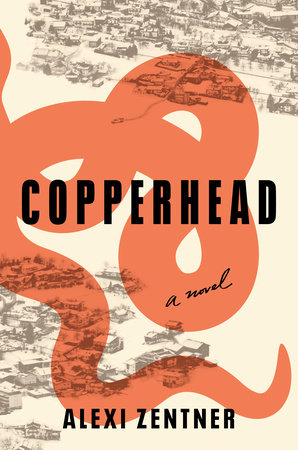
Copperhead
by Alexi Zentner
(Viking)

Jacket Copy:  All Jessup wants is to enjoy his senior year at Cortaca High and get a scholarship to attend college. It doesn’t seem impossible. He’s a standout varsity football player. A good student. He works at the local movie theater to help his mother make ends meet. But it’s hard to live a normal life when everybody in town knows that your stepfather is a white supremacist—a white supremacist who was involved in a violent encounter with two young black college students. And who is about to be released from prison. But his stepfather, David John, also saved Jessup’s family from imploding, rescuing his mother and giving Jessup and his siblings a safe home for the first time. David John’s release from prison sets off a chain of events that will forever define Jessup’s entry into adulthood, dragging him into the swirling currents of irreconcilable ideologies, crushing loyalties, and unshakeable guilt. Told with unflinching honesty and a ferocious gaze directed at contemporary America’s darkest corners, Copperhead vibrates with the energy released by football tackles and car crashes. Alexi Zenter unspools the story of boys who think they’re men of the entrenched thinking that supports a split-second decision; and asks whether hatred, bigotry, and violence can ever be unlearned.

Opening Lines:  He spins the wheel hard, angry. He cannot pull away from the house fast enough. The truck lurches forward. A bee-stung horse. Snow and ice spit out from under the wheels, like a curse from a teacher’s mouth, like buckshot scattering through the air and bloodying the breast of a duck flushed from the water. The back end of the pickup, light and bouncy, skids wide and loose.
       When it happens, he feels the sound of the impact as much as he hears it: like a soda can crushed by a stomped foot. But it’s two distinct sounds: the heavy thud of the boot and the gossamer crinkle of metal folding on itself.

Blurbworthiness:  “Rendered in sparse, impressionistic prose, Copperhead is an incredibly ambitious undertaking, even for a writer of Zentner’s prodigious gifts—not just another bold stylistic reinvention, but a deeply personal and unflinching interrogation of the battle between self and history from a writer who never shies from unnerving his readers or wrenching our sympathies or forcing us to reckon with the quotidian nature of society’s most horrific impulses in ways we would prefer never to imagine.”  (TĂ©a Obreht, author of The Tiger’s Wife)


Like Lions
by Brian Panowich
(Minotaur Books)

Jacket Copy:  Brian Panowich burst onto the crime fiction scene in 2015, winning awards and accolades from readers and critics alike for his smoldering debut, Bull Mountain. Now with Like Lions, he cements his place as one of the outstanding new voices in crime fiction. Clayton Burroughs is a small-town Georgia sheriff, a new father, and, improbably, the heir apparent of Bull Mountain’s most notorious criminal family. As he tries to juggle fatherhood, his job and his recovery from being shot in the confrontation that killed his two criminally-inclined brothers last year, he’s doing all he can just to survive. Yet after years of carefully toeing the line between his life in law enforcement and his family, he finally has to make a choice. When a rival organization makes a first foray into Burroughs territory, leaving a trail of bodies and a whiff of fear in its wake, Clayton is pulled back into the life he so desperately wants to leave behind. Revenge is a powerful force, and the vacuum left by his brothers’ deaths has left them all vulnerable. With his wife and child in danger, and the way of life in Bull Mountain under siege for everyone, Clayton will need to find a way to bury the bloody legacy of his past once and for all.

Opening Lines:  Annette memorized every board in the floor. It had taken her months to get the pattern right. She knew which slats creaked and moaned when she stepped on them, so she was careful to keep her bare feet only on the few that were nailed down tight. Those particular strips of seasoned oak had become her partners in crime. She’d let them become her friends. She trusted them not to betray her. She couldn’t say the same about anyone or anything else. Still, she was cautious, because this was her first attempt to navigate the route in the dark. She counted to ten every time she eased her weight down on each of them, and stepped in a slow-motion zigzag pattern down the main hall of the house.

Blurbworthiness:  “If Elmore Leonard and Flannery O’Connor had a love child who grew up reading William Faulkner, pulp fiction, and a Shakespearean tragedy or two, he’d write like Brian Panowich. His characters are knotty, tangled people who try and fail and frustrate yet keep going, fueled by something as bone deep as family or fear, or both…You’re in for a hell of a ride.” (Christopher Swann, author of Shadow of the Lions)


The Paper Wasp
by Lauren Acampora
(Grove Press)

Jacket Copy:  In small-town Michigan, Abby Graven leads a solitary life. Once a bright student on the cusp of a promising art career, she now languishes in her childhood home, trudging to and from her job as a supermarket cashier. Each day she is taunted from the magazine racks by the success of her former best friend Elise, a rising Hollywood starlet whose life in pictures Abby obsessively scrapbooks. At night Abby escapes through the films of her favorite director, Auguste Perren, a cult figure known for his creative institute the Rhizome. Inspired by Perren, Abby draws fantastical storyboards based on her often premonitory dreams, a visionary gift she keeps hidden. When Abby encounters Elise again at their high school reunion, she is surprised and warmed that Elise still considers her not only a friend but a brilliant storyteller and true artist. Elise’s unexpected faith in Abby reignites in her a dormant hunger, and when Elise offhandedly tells Abby to look her up if she’s ever in LA, Abby soon arrives on her doorstep. There, Abby discovers that although Elise is flourishing professionally, behind her glossy magazine veneer she is lonely and disillusioned. Ever the supportive friend, Abby becomes enmeshed in Elise’s world, even as she guards her own dark secret and burning desire for greatness. As she edges closer to Elise, the Rhizome, and her own artistic ambitions, the dynamic shifts between the two friends—until Abby can see only one way to grasp the future that awaits her.

Opening Lines:  I wore red capris on the plane. After I’d resolved to go to you, I couldn’t imagine wearing anything else. The red made me feel bold, like a matador.

Blurbworthiness:  “The Paper Wasp was a crazy joy ride of a novel; a bold and joyous take on female friendship, outsider ambition and the secret powers of loners. It gives us a heroine who is selfish, weird, manipulative, and sometimes just plain nasty, and makes us root for her with all our selfish, weird, manipulative, and nasty hearts. I loved every second of it.”  (Sandra Newman, author of The Heavens)


The Sun on My Head
by Geovani Martins
(Farrar, Straus and Giroux)

Jacket Copy:  In The Sun on My Head, Geovani Martins recounts the experiences of boys growing up in the favelas of Rio de Janeiro in the early years of the twenty-first century. Drawing on his childhood and adolescence, Martins uses the rhythms and slang of his neighborhood dialect to capture the texture of life in the slums, where every day is shadowed by a ubiquitous drug culture, the constant threat of the police, and the confines of poverty, violence, and racial oppression. And yet these are also stories of friendship, romance, and momentary relief, as in “RolĂ©zim,” where a group of teenagers head to the beach. Other stories, all uncompromising in their realism and yet diverse in narrative form, explore the changes that occur when militarized police occupy the favelas in the lead-up to the World Cup, the cycles of violence in the narcotics trade, and the feelings of invisibility that define the realities of so many in Rio’s underclass.

Opening Lines:  Woke up blowtorches blazing. For real, not even nine a.m. and my crib was like melting. Couldn’t even see the rising damp in the living room, everything dry. Only the stains left: the saint, the gun, the dinosaur. Clear it was gonna be one of those days when you walking ’round and the sky’s all fogged up, things shiftin’ about you like hallucinating. Check it, even the breeze from the fan was hot, like the devil’s fuggy breath.


The Grand Dark
by Richard Kadrey
(Harper)

Jacket Copy:   From the bestselling author of the Sandman Slim series, a lush, dark, stand-alone fantasy built off the insurgent tradition of China Mieville and M. John Harrison—a subversive tale that immerses us in a world where the extremes of bleakness and beauty exist together in dangerous harmony in a city on the edge of civility and chaos. The Great War is over. The city of Lower Proszawa celebrates the peace with a decadence and carefree spirit as intense as the war’s horrifying despair. But this newfound hedonism—drugs and sex and endless parties—distracts from strange realities of everyday life: Intelligent automata taking jobs. Genetically engineered creatures that serve as pets and beasts of war. A theater where gruesome murders happen twice a day. And a new plague that even the ceaseless euphoria can’t mask. Unlike others who live strictly for fun, Largo is an addict with ambitions. A bike messenger who grew up in the slums, he knows the city’s streets and its secrets intimately. His life seems set. He has a beautiful girlfriend, drugs, a chance at a promotion—and maybe, an opportunity for complete transformation: a contact among the elite who will set him on the course to lift himself up out of the streets. But dreams can be a dangerous thing in a city whose mood is turning dark and inward. Others have a vision of life very different from Largo’s, and they will use any methods to secure control. And in behind it all, beyond the frivolity and chaos, the threat of new war always looms.

Opening Lines:  The Great War was over, but everyone knew another war was coming and it drove the city a little mad.


Dreadful Young Ladies and Other Stories
by Kelly Barnhill
(Algonquin Books)

Jacket Copy:  When Mrs. Sorensen’s husband dies, she rekindles a long-dormant love with an unsuitable mate in “Mrs. Sorensen and the Sasquatch.” In “Open the Door and the Light Pours Through,” a young man wrestles with grief and his sexuality in an exchange of letters with his faraway beloved. “Dreadful Young Ladies” demonstrates the strength and power—known and unknown—of the imagination. In “Notes on the Untimely Death of Ronia Drake,” a witch is haunted by the deadly repercussions of a spell. “The Insect and the Astronomer” upends expectations about good and bad, knowledge and ignorance, love and longing. The World Fantasy Award–winning novella “The Unlicensed Magician” introduces the secret magical life of an invisible girl once left for dead—with thematic echoes of Barnhill’s Newbery Medal–winning novel, The Girl Who Drank the Moon.

Opening Lines:  The day she buried her husband—a good man, by all accounts, though shy, not given to drink or foolishness; not one for speeding tickets or illegal parking or cheating on his taxes; not one for carousing at the county fair, or tomcatting with the other men from the glass factory; which is to say, he was utterly unknown in town: a cipher; a cold, blank space—Agnes Sorensen arrived at the front steps of Our Lady of the Snows. The priest was waiting for her at the open door. The air was sweet and wet with autumn rot, and though it had rained earlier, the day was starting to brighten, and would surely be lovely in an hour or two. Mrs. Sorensen greeted the priest with a sad smile. She wore a smart black hat, sensible black shoes, and a black silk shirt belted into a slim crepe skirt. Two little white mice peeked out of her left breast pocket—two tiny shocks of fur with pink, quivering noses and red, red tongues.

Blurbworthiness:  “The eight short stories and one novella in Barnhill’s collection are haunting and beautifully told...Each story is written in intensely poetic language that can exult or disturb, sometimes within the same sentence, and evokes a dreamlike, enchanted mood that lingers in the reader’s mind. These tales are made to be reread and savored.”  (Publishers Weekly)


Tuesday, February 23, 2016

Trailer Park Tuesday: Welcome Thieves by Sean Beaudoin


Welcome to Trailer Park Tuesday, a showcase of new book trailers and, in a few cases, previews of book-related movies.


Chuck Norris poetry, John Cheever lunchboxes, and...FRANZEN BRAN® cereal. They’re all part of the trailer for Welcome Thieves, the new short story collection by Sean Beaudoin, a founder of The Weeklings website. With a double-eye wink* to Zach Galifianakis’ celebrated Between Two Ferns, the Welcome Thieves trailer gives us “Between Two Franzens” as host Jimmy Goodwin interviews Beaudoin with lightning-quick repartee:

     “Where do you get the ideas for your short stories?”
     “Walgreens.”
     “Who is your earliest influence?”
     “Caligula.”

And so on and so forth. Sponsored by Franzen Bran (a company which, I assume, also makes Freedom Flakes), the trailer zips along with some very funny moments (and only a couple that don’t quite stick the landing). If Beaudoin’s stories have this kind of panache and wit, then we’re in for a very delicious treat indeed. Milk, bowl and spoon not included.

*aka, a blink


Thursday, September 10, 2015

Front Porch Books: September 2015 Edition


Front Porch Books is a monthly tally of books--mainly advance review copies (aka "uncorrected proofs" and "galleys")--I've received from publishers, but also sprinkled with packages from Book Mooch, independent bookstores, Amazon and other sources.  Because my dear friends, Mr. FedEx and Mrs. UPS, leave them with a doorbell-and-dash method of delivery, I call them my Front Porch Books.  In this digital age, ARCs are also beamed to the doorstep of my Kindle via NetGalley and Edelweiss.  Note: most of these books won't be released for another 2-6 months; I'm here to pique your interest and stock your wish lists.  Cover art and opening lines may change before the book is finally released.  I should also note that, in nearly every case, I haven't had a chance to read these books.  I'm just as excited as you are to dive into these pages.

I begin today with a trio of novels coming in early 2016 from the new imprint Lee Boudreaux Books. I’m especially interested in these releases because the namesake of the Little, Brown imprint has edited and/or acquired some of the best manuscripts in recent memory, including Fourth of July Creek by Smith Henderson, Billy Lynn’s Long Halftime Walk by Ben Fountain, The Sisters Brothers by Patrick deWitt and many others. These first three to roll off the Lee Boudreaux presses promise to carry on that fine legacy.

Your Heart Is a Muscle the Size of a Fist
by Sunil Yapa

Jacket Copy:  The Flamethrowers meets Let the Great World Spin in this debut novel set amid the heated conflict of Seattle’s 1999 WTO protests. On a rainy, cold day in November, young Victor—a boyish, scrappy world traveler who’s run away from home—sets out to sell marijuana to the 50,000 anti-globalization protestors gathered in the streets. It quickly becomes clear that the throng determined to shut the city down—from environmentalists to teamsters to anarchists—are testing the patience of the police, and what started as a peaceful protest is threatening to erupt into violence. Over the course of one life-altering afternoon, the lives of seven people will change forever: foremost among them police chief Bishop, the estranged father Victor hasn’t seen in three years, two protestors struggling to stay true to their non-violent principles as the day descends into chaos, two police officers in the street, and the coolly elegant financial minister from Sri Lanka whose life, as well as his country’s fate, hinges on getting through the angry crowd, out of jail, and to his meeting with the president of the United States. In this raw and breathtaking novel, Yapa marries a deep rage with a deep humanity, and in doing so casts an unflinching eye on the nature and limits of compassion.

Opening Lines:  The match struck and sputtered. Victor tried again. He put match head to phosphate strip with the gentle pressure of one long finger and the thing sparked and caught and for the briefest of moments he held a yellow flame. Victor—curled into himself like a question mark, a joint hanging from his mouth; Victor with his hair natural and braided, two thick braids and a red bandanna folded and knotted to hold them back; Victor—with his dark eyes and his thin shoulders and his cafecito con leche skin, a pair of classic Air Jordans on his oversized feet, the leather so white it glowed—imagine him as you will because he hardly knew how to see himself.

Blurbworthiness:  “There is nothing to say about Sunil Yapa’s debut novel that its wonderful title doesn’t already promise—its heart beats and bleeds on every page, in prose so raw it feels built of muscle and tissue and sinew and sweat. This book is delightfully, forcefully alive, and I feel more alive for having read it.”  (Eleanor Henderson, author of Ten Thousand Saints)


Tender
by Belinda McKeon

Jacket Copy:  When they meet in Dublin in the late nineties, Catherine and James become close as two friends can be. She is a sheltered college student, he an adventurous, charismatic young artist. In a city brimming with possibilities, he spurs her to take life on with gusto. But as Catherine opens herself to new experiences, James’ life becomes a prison; as changed as the new Ireland may be, it is still not a place in which he feels able to truly be himself. Catherine, grateful to James and worried for him, desperately wants to help-—but as time moves on, and as life begins to take the friends in different directions, she discovers that there is a perilously fine line between helping someone and hurting them further. When crisis hits, Catherine , walled off by a truth he feels unable to share. When crisis hits, Catherine finds herself at the mercy of feelings she cannot control, leading her to jeopardize all she holds dear. By turns exhilarating and devastating, Tender is a dazzling exploration of human relationships, of the lies we tell ourselves and the lies we are taught to tell. It is the story of first love and lost innocence, of discovery and betrayal. A tense high-wire act with keen psychological insights, this daring novel confirms McKeon as a major voice in contemporary fiction, belonging alongside the masterful Edna O’Brien and Anne Enright.

Opening Lines:  Dreams fled away, and something about a bedroom, and some­thing about a garden, seen through an open window; and a windfall, something about a windfall—a line which made Catherine see apples, bruising and shrivelling and rotting into the ground. Windfall-sweetened soil; that was it. And, the flank of an animal, rubbing against a bedroom wall—though that could not be right, could it? But it was in there somewhere, she knew it was; something of it had bobbed up in her con­sciousness.
      She was on the lawn in front of James’s house, a wool blanket beneath her, one arm thrown over her eyes to do the job of the sunglasses she had not thought to bring. It was so hot. It was such a proper summer’s day.

Blurbworthiness:  “Tender rises above every other book on the shelf for its language alone; the beauty of each sentence will break your heart. But the story, full of the pleasures and terrors and betrayals of youth, will do that anyway. There is no way around it: you will weep. Spectacular.”  (Andrew Sean Greer, author of The Story of a Marriage)


As Close to Us as Breathing
by Elizabeth Poliner

Jacket Copy:  In 1948, a small stretch of the Woodmont, Connecticut shoreline, affectionately named “Bagel Beach,” has long been a summer destination for Jewish families. Here sisters Ada, Vivie, and Bec assemble at their beloved family cottage, with children in tow and weekend-only husbands who arrive each Friday in time for the Sabbath meal. During the weekdays, freedom reigns. Ada, the family beauty, relaxes and grows more playful, unimpeded by her rule-driven, religious husband. Vivie, once terribly wronged by her sister, is now the family diplomat and an increasingly inventive chef. Unmarried Bec finds herself forced to choose between the family-centric life she’s always known and a passion-filled life with the married man with whom she’s had a secret years-long affair. But when a terrible accident occurs on the sisters’ watch, a summer of hope and self-discovery transforms into a lifetime of atonement and loss for members of this close-knit clan. Seen through the eyes of Molly, who was twelve years old when she witnessed the accident, this is the story of a tragedy and its aftermath, of expanding lives painfully collapsed. Can Molly, decades after the event, draw from her aunt Bec's hard-won wisdom and free herself from the burden that destroyed so many others? Elizabeth Poliner is a masterful storyteller, a brilliant observer of human nature, and in As Close to Us as Breathing she has created an unforgettable meditation on grief, guilt, and the boundaries of identity and love.

Opening Lines:  The summer of 1948 my brother Davy was killed in an accident with a man who would have given his life rather than have it happen.

Blurbworthiness:  “Vivid, complex, and beautifully written, Elizabeth Poliner’s novel, As Close to Us as Breathing, brims with characters who leave an indelible impression on the mind and heart. This moving story of the way one unforgettable family struggles with love and loss shows an uncommon depth of human understanding. Elizabeth Poliner is a wonderful talent and she should be read widely, and again and again.”  (Edward P. Jones, author of The Known World)


Silence and Song
by Melanie Rae Thon
(FC2)

Reading Melanie Rae Thon’s fiction and poetry is like floating in amniotic fluid while watching the birth of nebulae—Technicolor splashing across your face—and listening to harp music whispering from another world. I want to get lost in this latest book—two novellas joined by a poem—and never return.

Jacket Copy:  Immigrants lost in the blistering expanse of the Sonoran Desert, problem bears, bats pollinating saguaros, a Good Samaritan filling tanks at emergency water stations, and the terrified runaway boy who shoots him pierce the heart and mind of Rosana Derais. “Vanishings,” the first story in Silence and Song, is a love letter, a prayer to these strangers whose lives penetrate and transform Rosana’s own sorrow. In “Translations,” the prose poem connecting the two longer fictions, child refugees at a multilingual literacy center in Salt Lake City discover the merciful “translation” of dance and pantomime. The convergence of two disparate events—a random murder in Seattle and the nuclear accident at Chernobyl—catalyze the startling, eruptive form of the concluding piece,“requiem: home: and the rain, after.” Narrated in first person by the killer’s sister and plural first person by the “liquidators” who come to the Evacuation Zone to bury entire villages poisoned by radioactive fallout, “requiem” navigates the immediate trauma of murder and environmental disaster; personal and global devastation; and the remarkable recovery of the miraculously diverse more-than-human world.

Blurbworthiness:  “Melanie Rae Thon belts out her stories in a tone and style reminiscent of classic blues singers....The reader is swept along not only by her remarkable characterizations, but also by the taut, magic current of her prose, which carries an exhilarating rhythmic punch.” (New York Times Book Review)

Opening Lines:  My brother kneels in the back of the Chrysler. Leo Derais, eleven years old: he’s skipped three grades: this fall he’ll start high school.
     He’s just made the most astonishing discovery, has seen the evidence and understands at last how time moves at different speeds in both directions.


Mendocino Fire: Stories
by Elizabeth Tallent
(Harper)

My Fall reading schedule is peppered with big, meaty novels like City on Fire by Garth Risk Hallberg, Purity by Jonathan Franzen and Avenue of Mysteries by John Irving. Tucked in among those tomes, however, I’d like to sneak in a little short-story refreshment like Elizabeth Tallent’s latest collection whose stories lure me with titles like “Mystery Son,” “Eros 101” and “Mystery Caller.”

Jacket Copy:  The triumphant, long-awaited return of a writer of remarkable gifts: in this collection of richly imagined stories—her first new work in twenty years—the master of short fiction delivers a diverse suite of stories about men and women confronting their vulnerabilities in times of transition and challenge. Beginning in the 1980s, Elizabeth Tallent’s work, appeared in some of our most prestigious literary publications, including The New Yorker, Esquire, and Harper’s. Marked by its quiet power and emotional nuance, her fiction garnered widespread praise. Now, at long last, Tallent returns with a new collection of diverse, thematically linked, and deeply powerful stories that confirm her enduring gift for capturing relationships at their moment of transformation: marriages breaking apart, people haunted by memories of old love and reaching haltingly toward new futures. Mendocino Fire explore moments of fracture and fragmentation; it limns the wilderness of our inner psyche and brilliantly evokes the electric tension of deep emotion. In these pages, Tallent explores expectations met and thwarted, and our never-ending quest to avoid being alone. With this breathtaking collection, she cements her rightful place in the literary pantheon beside her contemporaries Lorrie Moore, Ann Beattie, and Louise Erdrich. Visceral and surprising, profound yet elemental, Mendocino Fire is a welcome visit with a wise and familiar friend.

Blurbworthiness:  “Elizabeth Tallent is, and always has been, a vivid, meticulous, and astutely inviting writer. These new stories vitally tell us how things are for us, in the most acute and memorable ways. Her ear is perfect; her gaze searing and unmistakable.”  (Richard Ford)

Opening Lines:  Among the son’s bright fucking ideas, that last summer they worked together, was the notion that since there was good money in sport fishing they ought to start taking out parties of tourists. Shug could savor a rank cigar, resting up his bad shoulder while doctors and lawyers baited hooks, and when a senator failed to reel in a big Chinook Shug could grin around the last skunky inch and salt the wound with “Wave bye-bye to your wallhanger, son.”


True False
by Miles Klee
(O/R Books)

As a fan of Miles Klee’s story in the Watchlist anthology, I’m pumped to read this new collection of short stories—most of them very short in length—but, I assume, long and deep when it comes to thematic concerns. I’m a fan of short-shorts. Every now and then, I need a succession of quick, stinging barbs to the brain. Browsing through True False, I can tell already that Klee will deliver the jabs and jazz.

Jacket Copy:  Miles Klee’s first book Ivyland was variously hailed as “sharply intelligent” (Publishers Weekly) and “harsh, spastic” (Justin Taylor): we like to think of True False as intelligently spastic, or sharply harsh—disquieting and funny. A collection of stories that range from the very short to the merely short, these forty-four tales evoke extraordinary scenes in an understated manner that’s marked Klee one of today’s most intriguing writers. From the apocalyptic to the utopic, from a haunted office building to a suburban pool that may be alive, a day in the mind of a demi-god Pythagoras to a secret race to develop artificial love, True False captures a fractured reality more real than our own.

Blurbworthiness:  “Miles Klee is a fresh genius of the American literary sentence, and his every paragraph is aburst with nervous, agitative exactitudes. So much gets itself zanily and definitively rendered in the crackle of his ultravivid prose that True False is not just a joltingly original collection but the essential record of the inner terrors of our hyperurban era.” (Gary Lutz, author of Stories in the Worst Way)

Opening Lines:  The last known speakers of American English were garbagemen.  (from “Dead Languages,” the first story in the collection)


Bad Sex
by Clancy Martin
(Tyrant Books)

Last month, I talked to you about Married Sex. Now, I’d like to have a word about Bad Sex. Bad Sex and Good Writing. Clancy Martin’s new novel is slim, composed of very short chapters (most only a few pages long), and the kind of writing that’s as electric as French-kissing a lamp socket. You’ll sizzle your way through this book quickly, and feel good about yourself afterwards.

Jacket Copy:  “I drink, I hurt myself and the people around me, and then I write.” Brett is in Central America, away from her husband, when she begins a love affair with his friend, Eduard. Tragedy and comedy are properly joined at the hip in this loosely autobiographical book about infidelity, drinking, and the postponing of repercussions under the sun. Though coming undone is something we all try to avoid, Clancy Martin reminds us that going off the rails is sometimes a part of the ride.

Opening Lines:  One of us had to watch our hotel in Tulum during the storm, so I was flying into Cancun International then renting a car. The hurricane had closed all of the airports on the coast, and my flight was delayed, and then cancelled.

Blurbworthiness:  “Bad Sex is like a diamond, cut clean, dangerously sharp, brutally hard and yet paradoxically beautiful, ruthlessly honing in on the plight of a woman caught in the throes of alcoholism, desire, marriage and adultery. Like Camus in The Stranger, Martin digs into the philosophical through precise narrative, exposing the big questions for the reader to answer.”  (David Means, author of Assorted Fire Events)


Old Silk Road
by Brandon Caro
(Post Hill Press)

As a writer of war fiction, I inevitably read a lot of war fiction. This past reading year has seen a lot of great novels pass before my eyes: The Valley by John Renehan, I’d Walk with My Friends If I Could Find Them by Jesse Goolsby, and A Hard And Heavy Thing by Matthew J. Hefti among them. Now along comes a fresh and promising novel set in Afghanistan by an equally fresh and promising writer who also happens to be a war veteran. I can’t wait to deploy my imagination into the world of war and madness, as written by former Navy corpsman Brandon Caro.

Jacket Copy:  Old Silk Road is a prescient, powerful novel of the Afghan war by someone who’s been there. Norman “Doc” Rodgers suspects he won’t make it out of this one alive. He’s a young combat medic in Afghanistan, eager to avenge his father’s death in the World Trade Center, and make sense of a new world that feels like it’s fallen to pieces. Haunted by hallucinatory encounters, his only solace is a barely concealed addiction to the precious opiates he’s supposed to dole out sparingly to those beyond aid. In this tautly-plotted debut novel, Brandon Caro, a veteran who served in Afghanistan, tells the story of a soldier’s undoing in raw, incendiary, hypnotic prose that forces us to ask ourselves about what we know about the futility of war–and what other outcome we can expect?

Opening Lines:  The sun shone hard and the wind billowed in from the west the day I first killed a man.

Blurbworthiness:  “In our era of yellow ribbon patriotism and collective detachment from America’s brushfire wars, Brandon Caro’s Old Silk Road should serve as an IV of truth for any citizen still trying to give a damn. In tight, gritty prose, Caro taps into deep emotional veins the way only fiction allows for, and his drug-addled anti-hero Doc is as distinct a protagonist I’ve yet come across in post-9/11 war literature. Care about the consequences of America’s foreign adventures? Read this novel.” (Matt Gallagher, author of Kaboom)


A Free State
by Tom Piazza
(Harper)

I love a good chase novel. And when it’s wrapped in the complexities of racial issues, identity and our national shame of slavery, that makes it all the more attractive. Tom Piazza’s new novel is a book to run toward, not flee.

Jacket Copy:  The author of City of Refuge returns with a startling and powerful novel of race, violence, and identity set on the eve of the Civil War. The year is 1855. Blackface minstrelsy is the most popular form of entertainment in a nation about to be torn apart by the battle over slavery. Henry Sims, a fugitive slave and a brilliant musician, has escaped to Philadelphia, where he earns money living by his wits and performing on the street. He is befriended by James Douglass, leader of a popular minstrel troupe struggling to compete with dozens of similar ensembles, who imagines that Henry’s skill and magnetism might restore his troupe’s sagging fortunes. The problem is that black and white performers are not allowed to appear together onstage. Together, the two concoct a masquerade to protect Henry’s identity, and Henry creates a sensation in his first appearances with the troupe. Yet even as their plan begins to reverse the troupe’s decline, a brutal slave hunter named Tull Burton has been employed by Henry’s former master to track down the runaway and retrieve him, by any means necessary. Bursting with narrative tension and unforgettable characters, shot through with unexpected turns and insight, A Free State is a thrilling reimagining of the American story by a novelist at the height of his powers.

Opening Lines:  City haze shot through with morning sun. Buildings razed, buildings rising, dust drifting off the dirt streets drying in the morning air. Clank of carts on cobblestones, barrels unloaded, the men shouting, the mist burning off the river.

Blurbworthiness:  “Once I’d begun reading A Free State, I couldn’t leave my chair. It combines bite-your-nails tension with deeply felt evocations of the brutalities of slavery, the perplexities of racial masquerading and the transcendent joys of making music. At the end (Piazza) executes a swerve so bold, it’ll take your breath away.”  (David Gates, author of A Hand Reached Down to Guide Me)


Lay Down Your Weary Tune
by W. B. Belcher
(Other Press)

Just like that waterlogged wool cap snagged out of the river in the opening sentence of Lay Down Your Weary Tune,  I was hooked right from the start with W. B. Belcher’s opening lines (see below). I’m intrigued and entranced and can’t wait to read more.

Jacket Copy:  In this debut novel, a ghostwriter of the memoirs of a reclusive folk music icon—part Woody Guthrie, part Bob Dylan—attempts to glean fact from fiction, only to discover the deeper he digs into the musician’s past, the more his own past rises to the surface. Despite his fame, Eli Page is a riddle wrapped in a myth, inside decades of mask-making. His past is so shrouded in gossip and half-truths that no one knows who he is behind the act. Jack Wyeth, a budding writer, joins Eli in Galesville, a small town on the border of New York and Vermont, only to learn that the musician’s mind is failing. As he scrambles to uncover the truth, Jack is forced to confront his own past, his own hang-ups, and his own fears. At the same time, he falls for a local artist who has secrets of her own, he becomes linked to a town controversy, and he struggles to let go of his childhood idols and bridge the divide between myth and reality. Set against a folk Americana aesthetic, Lay Down Your Weary Tune is an emotionally charged exploration of myth-making, desire, and regret, and the inescapable bond between the past and present.

Opening Lines:  When little Sammy Sweet fished a waterlogged wool cap out of the river, Trooper Mark Calvin, of the New York State Police, said it was “definitive” proof that Eli had drowned. Case closed. Time to get on with our lives. But three days later, in the hollow behind the paper mill, Sammy snagged Eli’s bruised leather satchel from the murmuring backwash. A half a mile upstream from Eli’s last known location, the discovery was fodder for a new round of conspiracy theories, conjectures, and what-if scenarios. To further infuriate the investigators, the bag’s limp, deformed body wore a small bullet hole just above its clasp. Members of the trolling media, busybodies, and Galesville’s newfound tourists all voiced the same question from the same village sidewalks and gas pumps and bar stools: “What the hell happened to Eli Page?”

Blurbworthiness:  “As beautiful and artfully constructed as an old guitar, Lay Down Your Weary Tune feels both familiar and wholly original. William Belcher’s debut is a highly readable wonder.”  (James Scott, author of The Kept)


The History of Great Things
by Elizabeth Crane
(Harper Perennial)

I really shouldn’t have to do much more than whisper these words in your ear: “Elizabeth Crane has a new novel coming out.” That should be enough to get you all twitterpated, enough to make you run and mark your calendar for April 5, 2016, enough to send you back to your bookshelf to read (or re-read) Crane’s previous books (We Only Know So Much, When the Messenger Is Hot and You Must Be This Happy to Enter) before this new one arrives. But if, for some reason, that’s not enough, read on for further proselytizing, arm-twisting, and brow-beating. The History of Great Things is coming, and it’s the one to put on top of your 2016 must-read list.

Jacket Copy:  A witty and irresistible story of a mother and daughter regarding each other through the looking glass of time, grief, and forgiveness. In two beautifully counterpoised narratives, two women—mother and daughter—try to make sense of their own lives by revisiting what they know about each other. The History of Great Things tells the entwined stories of Lois, a daughter of the Depression Midwest who came to New York to transform herself into an opera star, and her daughter, Elizabeth, an aspiring writer who came of age in the 1970s and ’80s in the forbidding shadow of her often-absent, always larger-than-life mother. In a tour de force of storytelling and human empathy, Elizabeth chronicles the events of her mother’s life, and in turn Lois recounts her daughter’s story—pulling back the curtain on lifelong secrets, challenging and interrupting each other, defending their own behavior, brandishing or swallowing their pride, and, ultimately, coming to understand each other in a way that feels both extraordinary and universal. The History of Great Things is a novel about a mother and daughter who are intimately connected and not connected enough; it will make readers laugh and cry and wonder how we become the adults we always knew we should—even if we’re not always adults our parents understand.

Opening Lines: You’re late. Two weeks, forty-one hours late, nine pounds, ten ounces. That’s a lot. That’s like a bowling ball coming out of me.
      —I’ve heard this part before, Mom.
      —Just let me have my say and then you can have yours.
      —Fine.
      So you’re a giant bowling ball coming out of me. If bowling balls were square. It hurts like a bitch. Honestly. No one mentioned this detail to me in advance. I may as well be pushing out a full-grown adult. Wearing a tweed pantsuit. Think about that. That’s what they should tell kids in sex ed. Not that sex ed exists now, because it doesn’t. Sex exists. Not ed.


Studies in the Hereafter
by Sean Bernard
(Red Hen Press)

C’mon, admit it: you’re obsessed with death. Or, to be more exact, you have a healthy curiosity about “life after death.” Does it exist? Will it be cotton-candy clouds or fire and brimstone? Will we romp with our dogs, take long walks with our loved ones, eat pickles on our ice cream without a trace of guilt? Will Warren Beatty serenade us with a saxophone? Sean Bernard’s new novel Studies in the Hereafter may not have all the answers, but he’s certainly got some interesting questions. This is one book I want to read before I die.

Jacket Copy:  A disillusioned office bureaucrat in the afterlife has come to realize that maybe heaven isn’t all it’s cracked up to be. Bored by the endless routine of work, golf, and vegan food, he finds his one saving grace in his Field Studies: detailed reports he compiles on the living in order to determine their best fit in his world. While working on his 62nd Field Study, he begins to fall for Tetty, a detached Basque-American beauty living in Nevada, while struggling to understand what she sees in Carmelo, a clumsy scholar obsessed with the elusive Basque culture. When people start going missing from heaven for no apparent reason, the narrator learns that Field Study 62 may hold the key to explaining the disappearances.

Opening Lines:  I’m just a bureaucrat. I live an ordinary life—if you can even call it a “life.”
      Maybe that sounds bad. Personally, when I hear other people say they live ordinary lives, I imagine days of dull routine, the waking up to alarm, the showering, the coffee, the dead-eyed commute to work, the sitting at desk and compiling reports and trying to lower a work-stack that will never end. Middling lunches. Hollow office gossip. Reading too-familiar human interest stories. More gossip. Home. Dinner. Television. Bed. Lather. Rinse. Repeat.
      When I hear people say their lives are like this, are “ordinary,” I pity them a bit. Because after all isn’t existence our only chance to touch the trembling mysteries of the soul and the universe and etc?
      Then I remember—oh, that’s my life, too.

Blurbworthiness:  “A novel that makes us laugh while breaking our hearts; that is thought-provoking as it entertains; that is profoundly new, even while looking askance at old assumptions. Herein are vegan angels, time-hopping dead bureaucrats, and a love story for the ages. Quite simply: this novel is a joy." (Christopher Coake, author of We’re in Trouble)