Showing posts with label Raymond Carver. Show all posts

Wednesday, November 27, 2019

Where the Books Went


The books had become a burden.

That’s not a sentence I would ever have dreamed of writing when I was younger. “Younger” meaning eighteen months ago. Until recently, I went around saying things like “There’s no such thing as too many books, only too little time in which to read them.” I declared I would measure my coffin according to the number of volumes I could squeeze inside its piney confines. Part with my books? You might as well cut my arm off with a rusty saw.

And yet, the timbers of my Craftsman home in Butte, Montana groaned under the weight of paper and ink. The shelves lining the walls of my basement had long since been filled, and over-filled—like a corpulent guest at Thanksgiving dinner who, after the turkey and the stuffing and the sweet potatoes and the cranberry sauce and the gravy, greedily cuts just One More Slice of Pumpkin Pie. With whipped cream.

The books were every-frickin-where in the 4,000-square-foot house: there were piles in the bathroom, stacks in the breakfast nook, and a haphazard litter of titles to be shelved weighing down the polished-wood bar in the basement. My collection, which had been built and curated over the past thirty years of my life, was out of control. It was the literary version of The Trouble with Tribbles.


Books came into the house, but none went out. I was saturated and oversaturated. By my estimate, and according to my Library Thing catalog, my shelves were stuffed with more than 13,000 books. The real “trouble,” of course was the fact that I could not stop buying books. I am, I guess, part magpie: I cannot resist a new, shiny object. I was a bookaholic in much the same way that many people struggle with grape and grain; I had to start avoiding bookstores like twelve-steppers vow never to step foot inside a bar again. As an author who frequently goes on book tours, this was impossible. But I tried to control myself. I tried, I really tried.

And failed.

It was a slowly-dawning awareness, but eventually, I reached—and passed—my breaking point. Long ago, I had crossed the line when I had more books than I could possibly read in my lifetime (in truth, more books than the most secluded hermit could ever read). A speed-reading course wouldn’t even make a difference. The tipping point came when my wife and I made the decision to put the house on the market and move into smaller quarters. The original plan was to live in our new 25-foot RV. We would travel the country and Live Small. We’ve since tapped the brakes on that idea—not entirely ruling it out, but not committing to that miniaturized lifestyle, either. (Plus, the house in Butte still hasn’t sold, so we’re biding our time here in Montana for now.) We had an estate sale and sold more than 80 percent of our worldly goods; we’re now living in this oversized house with just a sofa, a bed, two nightstands, and just a few sticks of furniture. Our three cats spend their days chasing dust bunnies and listening to the echoes of their meows bounce off the bare hardwood floors. (And no, before you ask, we’re not marching to the beat of Marie Kondo and all those decluttering books which currently clutter the aisles of bookstores; this is a long-brewing, personal decision which has nothing to do with popular trends.)

Everything, from the camcorder bought in 2010 to the massive antique wardrobe in the upstairs bedroom, was sold. If my wife could part with her pewter salt-and-pepper shaker collection, I knew I, too, needed to make my own hard sacrifices. The books had to go. But where?

For the past year, I had been carting fat bookbags to Second Edition Books in Butte where the owner, Ann, bought somewhere around 1,000 books (and God bless her for her generosity and patience with my bi-weekly trips into her store where I continually ask, like a scratched record, “Can you take any more off my hands?”).

But off-loading at the used bookstore was just one slice of the Thanksgiving-feast pie. After separating out the ones I wanted to keep—

[Oh, excuse me, did you think I would get rid of all the books? If so, you obviously don’t know me. It was an emotionally-difficult culling process, but I picked and I chose, I sorted and set aside, I boxed and then unboxed and re-boxed indecisively. Eventually, I preserved about 1,000 of my most treasured volumes. I kept all of the Flannery O’Connor; ditto with Dickens, Hemingway, Richard Brautigan, Lewis Nordan (you can have my Nordan collection when you pry it from my cold, dead fingers) and Raymond Carver, along with a handful of my favorite living authors—though I won’t name names to avoid any hurt feelings from someone who didn’t make the cut. I saved my Dell mapbacks collection and my Big Littles. I held on to a small shelf of beloved children’s books. I kept my Penguin Classics and all my Library of America volumes.]

The survivors of the Great Book Culling of 2019
I carried The Keepers to an upstairs bedroom and though they lined an entire wall, removing them from the basement only made a minor dent in the overall collection. How, and where, could I possibly unload a lifetime’s worth of books? The answer came in the most unexpected of ways.

My friend Christine Martin, board director of the local non-profit organization The Root and Bloom Collective, was at my house in late summer to buy several of my bookcases (the ones which had been recently emptied of their contents) and, knowing of my book “burden,” she looked at the rows and rows of spines and said, “You know, we might be interested in buying some of these from you...”

“We?” I said.

“The Root and Bloom. We’re in the early stages of building our own library and some of these books would make a good start for what we want to do.”

“Some?” I said, teasingly (but also seriously). “What about all? Would you be willing to take all of them?”

“Oh.” She stared at the two hundred tons of paper, ink and glue. “Well....Let me talk to our board and directors and see what they say.”

*     *     *

They said yes.

And so, the next week Christine returned with empty boxes and a few volunteers from the Root and Bloom to help pack what she later estimated were 180 boxes. “No one had to go to the gym that week,” she told the local TV news station.

For several days, the basement of my house was noisy with the rumble of heavy books dropping into cardboard boxes and the shrieks of packing tape sealing the flaps. Christine and her small army, the Book Brigade, arrived early each day and spent hours pulling, sorting, and cramming. I popped in on my lunch hour to check on their progress and I always went away feeling a little bad: my burden had become their burden. The sheer number of books was overwhelming and I felt sorry for the Book Brigade and their sweat-damp faces and sore muscles.


But eventually, everything was boxed up and carted off. I felt only relief.

That soon turned to joy when Christine told me of her plans for the books: “These will be the start of a new library we’re establishing at the Jacobs House. We’re going to call it the Edwin C. Dobb Memorial Peace Library.”

I had to turn away for a minute. Suddenly, there was a lump in my throat and tears in my eyes.

*     *    *

Before his all-too-soon death this past July, Ed Dobb was one of the best word-slingers to ever come out of Butte, Montana. His articles about the troubled history of this copper-mining town, “Pennies From Hell” and “Dirty Old Town,” are revered as masterpieces of journalism; they’re the yardstick against which everything else written about Butte is measured. Ed was also the co-producer of the terrific documentary film Butte, America. The blood that flowed through Ed’s veins was the color of pennies.

Ed emailed me out of the blue one day in 2010, one year after I’d moved to the Mining City and shortly after my interview with Tom McGuane appeared in New West magazine. The subject line of the email was “Comparing Pens” and it opened like this:
Hey, David, I enjoyed your interview with McGuane in New West. Also noted with delight that you’re living in Butte. Clearly you’re mad....What sort of unspeakable crimes would condemn you to such a desolate place?....Doubtless you’ve now heard the old joke: One of the best things about living in Butte is that Montana is close by. I think how a person responds to the quirky, often forbidding island ruin of Butte says a lot about a person’s character and sensibility.
I leaned closer to my laptop screen. I’d found a kindred spirit, someone who removed his rose-colored glasses before sweeping his eyes across the scraped and scarred landscape of this town. Ed loved Butte, but he also understood its complexities: the ugly and the lovely.

Ed sent me more essays to read, including this one about cold-water swimming which began:
Although I had been swimming on and off since moving from southwest Montana back to San Francisco in mid-January, my new season officially started on April 17th, the day I turned 60. It was a bright afternoon, the sun partially obscured by high thin clouds, gusts churning the surface of Aquatic Park, a manmade cove bounded by curved piers on the waterfront. That’s where I swim, along with others whose notion of a swell time is plying chilly San Francisco Bay while wearing nothing but a cap and a Speedo. And chilly it was that day—water about 55 degrees, or 30 degrees cooler than the average municipal pool. Whatever pleasures await the cold-water sea swimmer—and they are incomparable, even, at times, transcendent—reaching them entails a certain amount of discomfort. Every swim begins with a double leap—the physical act of plunging into the water, the mental act of deliberately submitting to pain.
Going back over that article now, half a year after Ed died at 69 of complications from a heart condition, I read it as metaphor. Ed was writing about swimming, yes; but—and I hope he’ll forgive me for stretching his words—he could easily have been writing about the process of shedding my beloved books: the icy shock of the decision to rid myself of what I’d once held so dear, deliberately subjecting myself to the pain of loss.

But now, as Christine told me of Root and Bloom’s plan for the books, I realized it wasn’t loss and grief I should be feeling, but happiness and comfort. My 30-year library would have a new life and find new readers and, best of all, it would carry my friend’s name and legacy with it into the future. I couldn’t have planned a better fate for the books.

*     *    *

Two months after the last box was packed and carried out the front door, I paid my books—my former books—a visit at the Jacobs House. Many of them were still in their cartons, stacked like a small mountain range in the middle of the floor; but enough had made their way onto the shelves—my old bookcases—for me to browse. I tilted my head and ran my eyes across the familiar spines. “Hello, old friends,” I whispered. “It’s good to see you again.”

I restrained myself: I did not shake the shelves and sweep the books into my arms and carry them out the door. Instead I felt a pang of guilt for holding them in a miser’s grip for all those years, knowing I could never read even a fraction of the collection—no, not even a snowflake on the tip of the iceberg’s worth—before I died. Now, other visitors to the Edwin C. Dobb Memorial Peace Library would have the chance to read what I built and saved over the decades.

I went back to Ed Dobb’s article on swimming in the icy waters near Alcatraz and his words took on fresh meaning:
How long it takes for the body’s internal heat to counteract the penetrating cold varies widely, depending on several factors—metabolism, conditioning, overall acclimation, how hard one swims. But whether the interim is measured in seconds or minutes, a kind of alchemy is at work, converting the forbidding into the ecstatic. What makes the shift possible is conviction, the belief that eventually the sting will recede, the shock replaced by something that cannot be experienced anywhere else.
What I once feared most—losing my books—had been converted to joy. A new refrain ran through my head: It is better to share than to hoard.

I was at peace with my loss.

Ed Dobb swimming toward Alcatraz

Thursday, November 24, 2016

Giving Thanks for Books


At this uncertain and unsteady Thanksgiving, I am grateful for many things: family, health, a stable job, and the food I’m about to eat in T-minus two hours. Somewhere on that list, though, are the thousands of books which line my basement walls. They are my comfort, my inspiration, and my escape hatch (down which I frequently find myself sliding these days). Where would we be without the music of words?

Bookish recently asked several authors (including yours truly) to name the one book for which they’re thankful. I could have plucked any number of books from my shelf. I mean, just a casual perusal yields this harvest of books which have comforted, inspired, etc. over the years: A Good Man is Hard to Find by Flannery O’Connor, The Collected Stories of Raymond Carver, Rabbit, Run by John Updike, Jimmy Corrigan by Chris Ware, Rock Springs by Richard Ford, Catch-22 by Joseph Heller, The Executioner’s Song by Norman Mailer, and The Things They Carried by Tim O’Brien. I could go on and on, but Bookish demanded a single book and so I tried to narrow it down as best I could. My response:
Just one book? Impossible. Narrowing it down to just one shelf of my nearly 40 shelves? Next to impossible. Maybe I could pick just one author out of the dozens who’ve held sway over my imagination for 50 years? Doable, but still difficult. Okay, okay, okay… (takes deep breath, stares long and hard at his library) I’ll choose… David Copperfield by Charles Dickens. I could have easily picked ten others from my Dickens shelf (one of the longest in my library), but I’ll settle on this bursting-at-the-seams bildungsroman about a thinly-disguised C.D. as D.C. who makes his way from abused waif to accomplished author over the course of three inches of pressed and bound pages. I am particularly thankful for Dickens’ masterful marriage of plot and character whose happy union always sharpens both my imagination and my pen—never more so than in the personages of Betsey Trotwood, Steerforth, all the Peggotties, Mr. Micawber, Dora, David and, oh, the shudder-worthy Uriah Heep. David Copperfield is a triumph! And God bless us, everyone! Oh wait, that’s from another favorite of mine.


What books are on your most-thankful list? Let me know in the comments section below.


Tuesday, October 25, 2016

Trailer Park Tuesday: The Deep Code by Charley Henley


Welcome to Trailer Park Tuesday, a showcase of new book trailers and, in a few cases, previews of book-related movies.


One of the things I like most about the trailer for Charley Henley’s short story collection, The Deep Code, is its arty, independent film qualities. Stark, spare, a little surreal, it unspools like something from a Hollywood lens of the 1970s. Robert Altman, Terrence Malick, and Hal Ashby spring to mind, maybe even David Lynch (the video is from “Lost Highway Films LLC”perhaps a nod to the director’s 1997 film?). The title story of the collection is also set in the era of long, slow pans and sun-haze cinematography:
First time I ever met Stanley, my mother and I had pulled off the Interstate at a truck stop west of Missoula. We’d been living at this commune over in the Okanogan Valley, in Washington State. But then my mother wore out her welcome with the hippies, and we were back on the road again. It was three days to Ohio, and she said she needed a cold can of Hamm’s and a Vick’s nasal inhaler. This was in 1979. In those days such inhalers came with a ragged amphetamine in them. She’d cut the top off of the plastic. Then shove the little cotton swab down into a beer. Said she could drive all night like that. But then coming out of the store, she spied this little trucker bar up the road. Said she needed to get her mind right for the drive. So, we went back inside, where she bought me a Savage Sword of Conan and a meat stick. Then she dropped me off at the Gremlin. “Lock the doors,” she said. “And don’t talk to strangers.”
Those opening lines of “The Deep Code” hint at Raymond Carver and Richard Ford: the grim nostalgia of the lower-middle class. That tone seeps through in the excerpt Henley narrates at the beginning of the trailer, the opening lines of the book’s final story “Cerrito Blanco,” a conversation between a father and daughter about her mother (who is serving time in jail after having shot her husband):
“You’re never going to see that woman,” he said.
“She apologized,” said Tessa.
“Your mother shot me,” he said.
“Grandmother said you deserved it.”
A good book deserves a good trailer, and Henley’s The Deep Code gets it with this haunting short film. I’m ready to grab a six-pack of Hamm’s and some meat sticks, then hit the road with these stories of “desperation and perseverance.”


Thursday, June 9, 2016

Front Porch Books: June 2016 edition


Front Porch Books is a monthly tally of booksmainly advance review copies (aka “uncorrected proofs” and “galleys”)I’ve received from publishers, but also sprinkled with packages from Book Mooch, independent bookstores, Amazon and other sources. Because my dear friends, Mr. FedEx and Mrs. UPS, leave them with a doorbell-and-dash method of delivery, I call them my Front Porch Books. In this digital age, ARCs are also beamed to the doorstep of my Kindle via NetGalley and Edelweiss. Note: many of these books won’t be released for another 2-6 months; I’m here to pique your interest and stock your wish lists. Cover art and opening lines may change before the book is finally released. I should also mention that, in nearly every case, I haven’t had a chance to read these books.


A Tree or a Person or a Wall
by Matt Bell
(Soho Press)

Let the bells ring! There’s a new Matt Bell book in town (or will be when the marvelously-titled A Tree or a Person or a Wall is released in September). I look forward to the release of new work by the author of Scrapper and In the House Upon the Dirt Between the Lake and the Woods with all the fervor of the devout listening for cathedral bells on a Sunday morning calling them to worship. To stretch this metaphor to its end, let me just say this collection of short fiction is the answer to our prayers.

Jacket Copy:  A Tree or a Person or a Wall gives us Matt Bell at his most inventive and uncanny: parents and children, murderers and monsters, wild renditions of the past, and acute takes on the present, all of which build to a virtuoso reimagining of our world. A 19th-century minister builds an elaborate motor that will bring about the Second Coming. A man with rough hands locks a boy in a room with an albino ape. An apocalyptic army falls under a veil of forgetfulness. The story of Red Riding Hood is run through a potentially endless series of iterations. A father invents an elaborate, consuming game for his hospitalized son. Indexes, maps, a checkered shirt buried beneath a blanket of snow: they are scattered through these pages as clues to mysteries that may never be solved, lingering evidence of the violence and unknowability of the world. A Tree or a Person or a Wall brings together Bell’s previously published shorter fiction—the story collection How They Were Found and the acclaimed novella Cataclysm Baby—along with seven dark and disturbing new stories, to create a collection of singular power.

Opening Lines:  Even before the man with rough hands brought the boy to the locked room, even then there was always already the albino ape sitting on the chair beside the nightstand, waiting for the man and the boy to come.


Compartment No. 6
by Rosa Liksom
(Graywolf Press)

How about some chilly Russian literature for your summer reading? Rosa Liksom’s highly-acclaimed novel looks like it will be just the ticket. From the outside at least, Compartment No. 6 looks like it will marry the snowy vistas of Doctor Zhivago with Chekhovian intimacy on the relationship between two strangers in a train compartment. Liksom’s book, which is making its American debut in a translation by Lola Rogers, was previously published in 2011 in Finland and won the Finlandia Prize.

Jacket Copy:  In the waning years of the Soviet Union, a sad young Finnish woman boards a train in Moscow. Bound for Mongolia, she’s trying to put as much space as possible between her and a broken relationship. Wanting to be alone, she chooses an empty compartmentNo. 6.but her solitude is soon shattered by the arrival of a fellow passenger: Vadim Nikolayevich Ivanov, a grizzled, opinionated, foul-mouthed former soldier. Vadim fills the compartment with his long and colorful stories, recounting in lurid detail his sexual conquests and violent fights. There is a hint of menace in the air, but initially the woman is not so much scared of or shocked by him as she is repulsed. She stands up to him, throwing a boot at his head. But though Vadim may be crude, he isn’t cruel, and he shares with her the sausage and black bread and tea he’s brought for the journey, coaxing the girl out of her silent gloom. As their train cuts slowly across thousands of miles of a wintry Russia, where “everything is in motion, snow, water, air, trees, clouds, wind, cities, villages, people and thoughts,” a grudging kind of companionship grows between the two inhabitants of compartment No. 6. When they finally arrive in Ulan Bator, a series of starlit and sinister encounters bring Rosa Liksom’s incantatory Compartment No. 6 to its powerful conclusion.

Opening Lines:  Moscow hunkered down into a dry, frozen March evening, sheltering itself from the touch of an icy sun setting red. The girl boarded the last sleeping car at the tail end of the train, found her cabincompartment number sixand took a deep breath. There were four bunks, the higher two folded against the wall above. There was a small table between the beds with a white tablecloth and a faded pink paper carnation in a plastic vase. The shelf at the head of the beds was full of large, clumsily tied parcels. She shoved the unprepossessing old suitcase that Zahar had given her into the metal storage space under the hard, narrow bunk and threw her small backpack on the bed. When the station bell rang for the first time she went to stand at the window in the passageway. She breathed in the smell of the train: iron, coal dust, smells left by dozens of cities and thousands of people. Travelers and the people with them pushed past her, lugging bags and packages. She touched the cold window and looked at the platform. This train would take her to villages of exiles, across the open and closed cities of Siberia to the capital of Mongolia, Ulan Bator.
     When the station bell rang the second time she saw a muscular, cauliflower-eared man in a black working-man’s quilted jacket and a white ermine hat and with him a beautiful, dark-haired woman and her teenage son, keeping close to his mother. The woman and the boy said goodbye to the man and walked arm in arm back towards the station. The man stared at the ground, turned his back to the icy wind, pinched a Belamorka, lifted it to his lips and lit it, smoked greedily for a moment, stubbed the cigarette out on the sole of his shoe, and stood there, shivering. When the station bell rang for the third time, he jumped on the train. The girl watched him walk towards the back of the car with swinging steps and hoped he wasn’t coming to her cabin. She hoped in vain.

Blurbworthiness:  “This unlikely couple...accompany one another across the plains as if progressing through a film by Andrei Tarkovsky.”  (Svenska Dagbladet)


The Loved Ones
by Sonya Chung
(Relegation Books)

As a long-time admirer of Sonya Chung’s whip-smart editorial work at The Millions and Bloom, I was happy to see the front-porch arrival of her new novel, The Loved Ones. I have not had the chance to read beyond the first few pages, but I have the sneaking suspicion that The Loved Ones, due to hit bookstores in October, is bookstore-vigil, be-first-in-line, and call-in-sick-to-work worthy. Read on to see why you should put the novel at the top of your must-read list...

Jacket Copy:  In this masterful novel of inheritance and loss, Sonya Chung (Long for This World) proves herself a worthy heir to Marguerite Duras, Hwang Sun-won, and James Salter. Spanning generations and divergent cultures, The Loved Ones maps the intimate politics of unlikely attractions, illicit love, and costly reconciliations. Charles Lee, the young African American patriarch of a biracial family, seeks to remedy his fatherless childhood in Washington, DC, by making an honorable choice when his chance arrives. Years later in the mid-1980s, uneasy and stymied in his marriage to Alice, he finds a connection with Hannah Lee, the teenage Korean American caregiver whose parents’ transgressive flight from tradition and war has left them shrouded in a cloud of secrets and muted passion. A shocking and senseless death will test every familial bond and force all who are touched by the tragedy to reexamine who their loved ones truly arethe very meaning of the words. Haunting, elliptical, and powerful, The Loved Ones deconstructs the world we think we know and shows us the one we inhabit.

Opening Lines:  The boy was six, the girl nine. Their father, Charles Frederick Douglass Lee, was himself one of five children; each had looked after the next while Charles’s mother worked night shifts and his grandmother worked days at the same corner store owned by a cousin. He’d come up fine and didn’t believe in babysitters. It was his wife, Alice, who insisted the girl was not old enough to be left alone with the boy. “What if there’s an emergency,” Alice Lee said to Charles. She often made statements in the form of questions. She said “emergency” in a near whisper.

Blurbworthiness:  “Sonya Chung’s prose is elegant, sparse, and heartbreaking in a way that reminds one of Elena Ferrante or Clarice Lispector. In this novel of two very different but interconnected families both named Lee, she tells the story of love against the twin inheritances of shame and grief. This book is a complication of the immigrant narrative in a way that is long overdue and necessary. A gorgeous and important second novel.”  (Nayomi Munaweera, author of What Lies Between Us)


Half Wild
by Robin MacArthur
(Ecco)

After reading Jodi Paloni’s wonderful They Could Live With Themselvesshort stories set in VermontI find myself jonesing for more literature about the Green Mountain State. Robin MacArthur’s Half Wild looks All Great. I can’t wait to start exploring the terrain populated by her characters. Reviewers have compared her style to Raymond Carver, Annie Proulx, Flannery O’Connor and Eudora Weltyhigh praise indeedso that seals the deal for me.

Jacket Copy:  A powerfully authentic new literary voice debuts with stories that carve out a distinctive vision of the wildness and beauty of rural Vermont. Spanning nearly forty years, the stories in Robin MacArthur’s formidable debut give voice to the hopes, dreams, hungers, and fears of a diverse cast of Vermonters—adolescent girls, aging hippies, hardscrabble farmers, disconnected women, and solitary men. Straddling the border between civilization and the wild, they all struggle to make sense of their loneliness and longings in the stark and often isolating enclaves they call home—golden fields and white-veiled woods, dilapidated farmhouses and makeshift trailers, icy rivers and still lakes rouse the imagination, tether the heart, and inhabit the soul. In “Creek Dippers,” a teenage girl vows to escape the fate that has trapped her eccentric, rough-living mother. “Maggie in the Trees” explores the aftershocks of a man who surrenders to his passion for a wild, damaged woman—his longtime friend’s partner. In “God’s Country,” an elderly woman is unexpectedly reminded of a forbidden youthful passion and the chance she did not take. Returning to her childhood house when her mother falls ill, a daughter grapples with her own sense of belonging in “The Women Where I’m From.” In striking prose powerful in its clarity and purity, MacArthur effortlessly renders characters cleaved to the land that has defined them—men and women, young and old, whose lives are inextricably intertwined with one another and tied to the fierce and beautiful natural world that surrounds them.

Opening Lines:  “You want to jump in the creek?” my mother asks. It’s a Tuesday night in late July and we’re on the porch drinking Myers’s rum doused with lemonade. She’s wearing cut-off cargo pants and a Grateful Dead T-shirt full of holes; her cracked toenails are the chartreuse of limes.
     “No,” I say, to which she snorts and throws her cigarette butt into the wet grass, where it hisses before losing its flame. Mist rises from the field. Baby grasshoppers pop. Clouds drift.
     I don’t want to go down to the creek with my mom. Nor do I want to be living here at sixteen in this deciduous/coniferous northeastern no-man’s-land of Vicksburg where we were both born, forty square miles of intersecting roads, intersecting streams, failing farms, and rocky ledge.
     Populated by ghosts and animals and lonely women. Frickin' heaven, my mom calls these woods.

Blurbworthiness:  “MacArthur writes with the ear of a musician and a classic, pure command of the short story form, like a dispatch from Eudora Welty in the great north woods.”  (Megan Mayhew Bergman, author of Almost Famous Women)


Froelich's Ladder
by Jamie Duclos-Yourdon
(Forest Avenue Press)

I can say, without hesitation, that Froelich’s Ladder is the most unusual book to come across my desk this past month. Too few novels these days involve ladders (not to mention the world’s fourth-tallest ladder!) and there’s certainly a lack of Confederate Army assassins, general store magnates and “unfortunately-named” girls named Lotsee in our contemporary literature. There is, indeed, a lot to see in this novel set in the fog-shrouded Pacific Northwest.

Jacket Copy:  Froelich nurses a decades-old family grudge from his permanent perch atop a giant ladder in this nineteenth century madcap adventure novel. When he disappears suddenly, his nephew embarks on a rain-soaked adventure across the Pacific Northwest landscape to find him, accompanied by an ornery girl with a most unfortunate name. In their encounters with Confederate assassins, European expatriates, and a general store magnate, this fairytale twist on the American dream explores the conflicts between loyalty and ambition and our need for human connection, even at the highest rungs.

Opening Lines:  It was November 1851 when Harald and Froelich arrived in Oregon Country. Disembarking at Fort Astoria, they journeyed inland by foot, hiking over the Cascades in a gale that swept off the ocean like an enormous push broom.

Blurbworthiness:  “From the first page to the last, Froelich’s Ladder brims with color, intrigue, and verve. At once a fantastical, madcap adventure and a poignant meditation on independence and solitude, it’s the kind of book that captivates you quickly and whisks you high into the atmosphere. I was in thrall to the surreal Oregon landscape, populated by tycoons and grifters, cross-dressers and hungry clouds. This debut is clever, irreverent, and ultimately unforgettable.”  (Leslie Parry, author of Church of Marvels)


The Girl in Green
by Derek B. Miller
(Houghton Mifflin Harcourt)

Wars are never fully left behind on the battlefield, are they? They’re carried home like burrs in a soldier’s clothing. And they prick and scrape the skin for years and years and years. In Derek B. Miller’s new novel, a soldier and a journalist each witness a terrible attack during Operation Desert Storm and carry those burr-like images with them long after they return home....until another war comes along and they finally have to confront their feelings about what they saw. As an author of a novel about Operation Iraqi Freedom, I get a steady flood of war literature cascading across my desk each month. The Girl in Green has managed to rise above the tidethanks to the tantalizing story and the promise of the opening lines on the first pageand I’ve put it near the top of my summer-reading pile.

Jacket Copy:  From the author of Norwegian by Night, The Girl in Green is a novel about two men on a misbegotten quest to save the girl they failed to save decades before. In 1991, near Checkpoint Zulu, one hundred miles from the Kuwaiti border, Thomas Benton meets Arwood Hobbes. Benton is a British journalist who reports from war zones in part to avoid his lackluster marriage and a daughter he loves but cannot connect with; Arwood is a midwestern American private who might be an insufferable ignoramus, or might be a genuine lunatic with a death wishit’s hard to tell. Desert Storm is over, peace has been declared, but as they argue about whether it makes sense to cross the nearest border in search of an ice cream, they become embroiled in a horrific attack in which a young local girl in a green dress is killed as they are trying to protect her. The two men walk away into their respective lives. But something has cracked for them both. Twenty-two years later, in another place, in another war, they meet again and are offered an unlikely opportunity to redeem themselves when that same girl in green is found alive and in need of salvation. Or is she?

Opening Lines:  Arwood Hobbes was bored. Not regular bored. Not your casual, rainy-day, Cat in the Hat-style bored that arrives with the wet, leaving you with nothing to do. It wasn’t post-fun or pre-excitement bored, either. It was, somehow, different. It felt rare and deliberate, entire and complete, industrial and inescapable. It was the kind of bored that had you backstroking in the green mist of eternity wondering about the big questions without searching for answers. And it wasn’t in short supply, either, because it was being dispensed like candy on Halloween to Arwood and others like him at Checkpoint Zulu at the rim of the Euphrates Valley, in the heart of Iraq, by the world’s largest contractor of boredom: the United States Army.
     How long had he been bored? How long was he destined to be bored? Arwood couldn’t even muster the motivation to care as he melted over his machine gun under the hot, hot sun that was pressing down on the sandy sand around him without a raindrop in sight and no one offering to cheer him up.
     The M60 machine gun was the perfect height for leaning on. It was probably the perfect height for firing, too, but Arwood had no proof of that because he hadn’t fired the gun since qualifying on it, and there was nothing to aim at because everything was far away, apart from a camel; and while he did point the gun at the camel for a while, it ultimately seemed a mean thing to do, so he stopped. That was eons ago. Nothing fun like that had happened since. Even the camel had gone away.


Faithful
by Alice Hoffman
(Simon and Schuster)

I’ll round out this month’s list of Most-Highly-Anticipated Books with the happy news that Alice Hoffman has a new novel on the horizon. Faithful will arrive in bookstores in November. And legions of the faithful shouted, “Amen!”

Jacket Copy:  From the New York Times bestselling author of The Marriage of Opposites and The Dovekeepers comes a soul-searching story about a young woman struggling to redefine herself and the power of love, family, and fate. Growing up on Long Island, Shelby Richmond is an ordinary girl until one night an extraordinary tragedy changes her fate. Her best friend’s future is destroyed in an accident, while Shelby walks away with the burden of guilt. What happens when a life is turned inside out? When love is something so distant it may as well be a star in the sky? Faithful is the story of a survivor, filled with emotion—from dark suffering to true happiness—a moving portrait of a young woman finding her way in the modern world. A fan of Chinese food, dogs, bookstores, and men she should stay away from, Shelby has to fight her way back to her own future. In New York City she finds a circle of lost and found souls—including an angel who’s been watching over her ever since that fateful icy night.

Opening Lines:  In February, when the snow comes down hard, little globes of light are left along Route 110, on the side of the road that slopes off when a driver least expects it. The lights are candles set inside paper bags, surrounded by sand, and they burn past midnight. They shouldn’t last for that amount of time, but that’s part of the miracle. On the second anniversary of the accident, a gang of boys creep out their windows and gather at two in the morning to see if Helene’s mother, Diana Boyd, drives along the road replacing each melting pool of wax with a fresh candle. They’re hoping to reveal a con in process and dispel the myth of a miracle, but after keeping watch for a while the boys all flee. In the early morning hours, safe in their beds, they wonder how much of the world can never be understood or explained.


Wednesday, May 25, 2016

The Truth About Raymond Carver


Raymond Carver (left) with his brother James

James Carver would like to set the record straight.

Over the years, his brother Raymond’s life has been distorted by those who’d like to hitch a ride on the famous writer’s coattails. “Everyone seems to have an agenda when writing about my brother,” James writes in a personal remembrance published at Electric Literature today, on what would have been Raymond Carver’s 78th birthday had he not died (much too early) in 1988. The essay, which has the Carveresque boiled-down title of “Reflections on Raymond Carver and My Family,” is an earnest, simply-told collection of family memories and includes several never-published photos of the Carver family (which Electric Literature has allowed me to reprint here, along with a brief excerpt below).

Though it’s unclear why younger brother James feels the sudden urge to purge the record of myths and lies, he casts a wide net when it comes to finding the source of rumors, including pointing a finger at Ray himself: “Ray embellished his childhood in interviews as well as in writings. He misrepresented facts, making our home life seem worse than it was. Perhaps he wanted to make his climb to fame appear more remarkable, or perhaps alcohol abuse clouded his memory.” James also blames John Updike for helping to taint the legacy by saying (at Carver’s memorial service, of all places) that Raymond grew up in a house of abuse and alcoholism. “Updike innocently picked that information up from others,” James writes. “This is how incorrect information perpetuates itself. If a lie is told often enough, it becomes the truth.”

He would probably be the first to admit he regrets the way he treated his sibling at times. In Carol Sklenicka’s biography (which James says is “the only serious and credible one written so far”), she describes the time when, shortly after Ray’s first wife Maryann kicked him out of their house, he turned to his younger brother for help:
Ray tried to live in an apartment by himself and hated it. Then he asked his brother, James, if he could stay in his Santa Clara apartment while James and his wife were on vacation. Concerned that Ray’s drinking, smoking, and partying might lead to damage at their home, James and Norma declined Ray’s request. Ray took it hard. He told his friends, “My brother forsook me, he forsook me”—lingering over the biblical phrase as much as he did over the wound. From their mother, James later learned that Ray never forgave him. He would come to regret putting “material possessions before my love for my brother.”

The Electric Literature essay seeks to mend some of those broken bridges and it can be quite moving at times, serving as a sort of eulogy—one which James perhaps wishes he could have delivered at his brother’s funeral. Instead, we can be grateful to Electric Literature for allowing us all to share in these small, good moments from a family’s history.

Here is just one of those memories from the time the Carvers lived in Washington state. To read the rest at Electric Literature, click the link at the end...


In Yakima, we had the best years of our family’s life. Our decline began in 1956, the year our father quit the Cascade Lumber Company in Yakima. He had been there for fifteen years or more, never missing a day’s work. Up until that moment, dad always paid his bills on time and provided his family with a good living. He was responsible, working since he was fourteen or fifteen years old and supporting his parents when they needed his help. Our family was living in a nice bungalow on Summitview Avenue, the better side of Yakima. We were settled, happy and doing well. Then dad’s brother Fred, who had been an institution at Cascade, was fired.

Our father quit Cascade and accepted a job as a saw filer with his brother, Fred, in Chester, California. That move started the decline of the Carver family, a slow insidious unraveling that cost all of us almost everything. Dad’s health began to deteriorate when he got blood poisoning from a saw while working for the Collins Pines Lumber Company in Chester. It caused our mother grief and hardship, forcing her to work full time to support the family when my father became too ill to work. It greatly affected my life, as I was in and out of many schools, with no roots, no friends and no permanency. I had wanted to attend the University of Washington, in Seattle and had taken all necessary preparatory courses in high school. If we hadn’t moved to California, I most likely would have graduated from the University of Washington, with my father’s help, and lived in Seattle. The move also affected Ray and Maryann’s life together for many years into the future. If Dad had not left Yakima, he might have been able to have helped them financially; maybe their lives wouldn’t have been such a painful financial struggle for all those years; it may even have averted Ray’s alcoholism.

Ray and I lost our beloved father in Crescent City, California, in June of 1967. Dad was working as a saw filer for Simpson Timber Company. The night of his death, he ate a big dinner and went to bed early. He didn’t wake up the next morning. Mom found him cold and blue. The doctor was called. Dad’s heart had failed; he was pronounced dead and taken to the local morgue. Fortunately, I was with my mother, between college semesters. We were both in a state of shock. We immediately called Maryann in Sacramento. She called Ray, who was in Iowa, enrolled in the university to work on his master’s degree. He withdrew from school and came to Crescent City. After arrangements were made, we all followed the hearse back to Yakima. It was our father’s last journey.

Click here to read the rest at Electric Literature


Friday, March 4, 2016

Jigsaw Lives: Chris Ware Builds Stories


My bags were packed. Into my suitcase, I’d neatly arranged the folded flags of shirts, squares of underwear, my shaving kit, my slippers, a corkscrew for an emergency bottle of wine, and a clump of white socks which, with their balled cuffs and trailing streamers of feet, looked like sperm swimming upstream. I was ready for a week-long business trip during which I’d work hard for eight hours of the day then retreat to the bland sterility of a hotel room where I’d eat a lonely salad, call my wife, take a bath, and wonder if it was time for that emergency bottle of pinot noir.

One thing remained: choosing the stack of books—always too large and over-ambitious—which I’d bring along with me on the trip. I stuffed a bookbag with Dashiell Hammett novels, a biography of the actress Jean Arthur, two poetry collections, four literary journals (Tin House, Ecotone, etc.), a Hardy Boys mystery, and A Little Life (which is awfully thick for a book with the word “little” in its title). I was almost ready. Only one book remained, but it was too big to fit in the bookbag, so I balanced it on top of my suitcase while I started loading my other bags in the car.

On one trip back inside, I found my wife standing in the hallway, staring at the book on top of the suitcase. “What is that, a puzzle?”

“No, honey. It’s not a puzzle. It’s a book which I’ve been meaning to read ever since I bought it at Powell’s three years ago when I was there giving a reading for the Fire and Forget anthology and I don’t know why I’ve been putting off reading it for so long but I figured now would be the best time to read it, sitting in my boring, depressing hotel room, reading a graphic-novel-in-parts about equally lonely and depressed people and I can’t friggin’ wait because I have a feeling it will be one of the best books I read all year.”

That wasn’t actually my answer. All I told my wife was, “No, that’s a book called Building Stories by Chris Ware.”

Like I said (in my head), I don’t know why I’ve put off reading Building Stories. Was I waiting for the rainy day? Did I want to save Building Stories for later, like it was a much-anticipated delectable dessert? Was I worried about having to spread out the box’s contents all over the breakfast nook table and read it in full view of my wife? Not that she’d care, but I wanted my time with Chris Ware to be intimate, solitary, and free from distraction. A hotel room would be perfect.

And now, as I sit here at the end of the week, it has been the ideal homogeneous environment in which to finally explore the lives in Building Stories’ apartments. When I’m reading Ware, I am deep-sea diving into his world and nothing—not the lure of the internet, not the slippery crunch of lettuce from my sad little salad, not even a phone call from my wife (forgive me, honey)—can pull me from that inky universe.


The packaging is indeed shaped like a puzzle box, but instead of holding 1,000 interlocking jigsaw pieces, the reader is greeted with pamphlets, posters, and books (one which resembles a “Little Golden Book” which most of us read as children). When I put out the call on social media a week ago asking, “Where should I start?” the nearly-universal answer was “Anywhere.” It’s true, there’s no “right” order in which to read Building Stories...but being a man of honed habits, obsessive compulsion and an ongoing habit of creating To Do Lists (updated and rearranged daily), I decided to take the materials in the order in which they were stacked inside the box. When I was finished with one piece, I carefully laid it inside the open box top so that I could easily reassemble it into its original shape. I sometimes wonder if the hotel maids took a glance at the dissected book and started browsing Ware’s apartment building as they were vacuuming my room’s carpet.


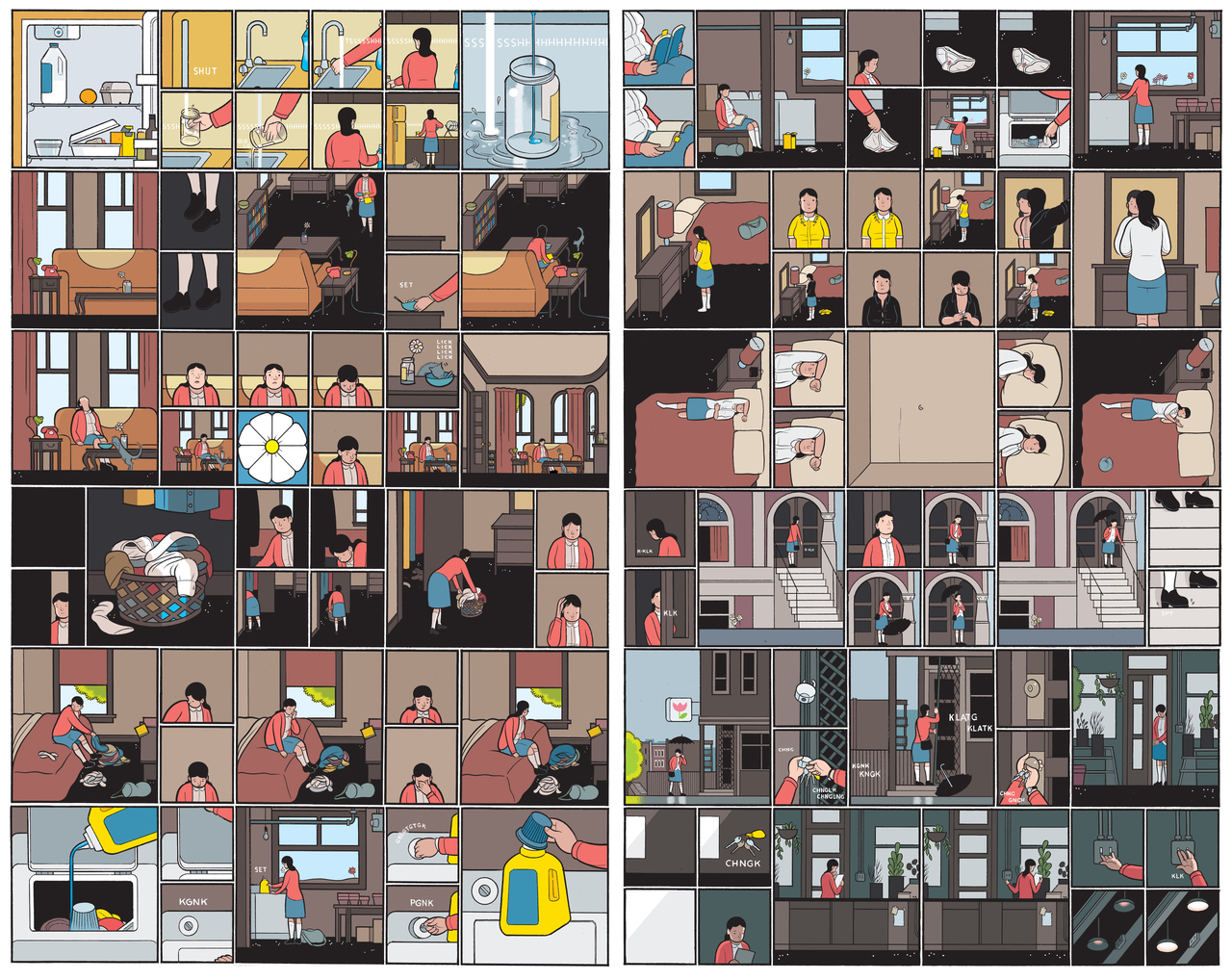
I’m not quite through Building Stories and I’m still processing what it all means, so this won’t be a full, legitimate review, but I can tell you that it will turn out to be among the best books I read this year (if not the best). Inside this box, not much happens, but at the same time everything happens. Ware distills a life experience down to the confines of a single panel. The thickness of a line, the subtle hint of a new color, a shift in point-of-view can bring about a shock of emotion. Entire two-page spreads like the one above are devoted to silence, and yet each panel speaks a thousand words.


Ware doesn’t just build a story, he makes you feel the lives of his characters—in this case, a single woman with one leg who runs a flower shop, wonders if she’ll ever be fulfilled in life, bathes in regret, eavesdrops on her neighbors, reluctantly goes out to dinners with her friends, spends hours lying in bed staring at the ceiling, navigates the choppy waters of conversations with her mother, hates herself in every self-doubting moment, and loves her cat much too deeply. We also meet some of the noisy neighbors (a husband who may or may not be abusive), a widowed plumber who comes to fix the woman’s toilet (and it turns out he used to live in her very apartment), and the elderly landlady who herself has a very rich backstory. Occasionally, Ware includes a cutaway of the apartment building and when we hear from the hundred-year-old house, its thought-bubbles are some of the most heartbreaking of the entire book.


All in all, Building Stories is a visual feast, an engaging series of linked short stories, and one of the deepest emotional experiences you’re bound to have this year.

But, like I said, this is only a midway-through-the-book review. I’m still processing its many facets.

I thought I’d also take this opportunity to share three of my earlier reviews of Ware’s other books as part of my ongoing quest to make sure everyone on this planet has read Chris Ware at least once. Jesus had his twelve apostles, Chris Ware has me. These reviews were written many years ago for other websites (including January Magazine) and, frankly, they’re dated, occasionally redundant and not my finest hour of literary criticism (not that any of my hours of criticism could properly be called “fine”), but from them I hope you get a sense of my enthusiasm for Ware’s work. Here then, are my reviews (in order of how much I liked them) of Quimby the Mouse, The Acme Novelty Library, and Jimmy Corrigan, the Smartest Kid on Earth.

*     *     *
Chris Ware can do as much with a few lines of ink and delicately-colored shading that writers like Raymond Carver or John Updike can in a few hundred words.

Ware, a graphic novelist whose Fantagraphic books include Jimmy Corrigan, the Smartest Kid on Earth and The Acme Novelty Library, is a masterful genius at describing heartbreak, anger and anguish—especially the kind you find in Updike’s suburbia territory. In the tight confines of his pastel-colored panels (vulgarly called “cartoons”), he captures a universe of pain, drawing us in with the kind of emotions with which we can all identify.

In his newest book, Quimby the Mouse, the titular rodent experiences typical teenage anxiety when he sits up in bed one morning and says, “Oh gross. Today’s the day I have to give that speech in class. It makes my wiener feel funny...My stomach hurts, I bet I really am sick.” Later, sitting at his school desk, he grumbles, “If I’d barfed, I could’ve stayed home.”

In another sequence, a juvenile Quimby discovers he has super-powers, which enable him to fly, turn his arms to rubber and shrink down to “insect size.” He uses his powers to escape the every-adolescent’s-nightmare game of dodge ball, play hooky, and peer into the girls’ locker room. In the end, though, he’s still saddled with living the life of a worrisome, hormonal boy.

Quimby the Mouse is full of these quick, brilliant peeks at human nature. Some episodes are titled, “Empty Stomach,” “I’ll Do Anything, Just Please Let Me Stay,” and “I Am a Sickness That Infects My Friends.”

The “quick peeks” might be the book’s only shortcoming—the oversized volume (11-by-14 inches) is little more than a scrapbook of Ware’s existential doodlings. Brilliant as they are, these bits of miscellany never add up to the kind of narrative flow we found in Jimmy Corrigan where we suffer through all of Jimmy’s ups and downs as he reunites with his long-lost father. Quimby, by contrast, is all over the place, a wondrous jumble of what Ware calls “Self-Conscious Text Pages, Advertisements, and Space-Filling Nonsense.” The mind boggles and the eyes cross as we strain to take it all in. [Ed.: The same could be said for Building Stories, but I guess I got used to it.]

Ware of course, knows this and even labels one page “Incomprehensible Cartoon Strips.” Quimby the Mouse won’t be everyone’s slice of cheese. The panels are laid out in such a way that it’s hard to follow the flow and we often wonder if Ware’s train of thought has jumped the tracks. Eventually, by staring at the page long enough, we’re able to absorb a sense of the abstract emotions Ware is driving at: the loneliness, the regret, the mortality, the you-can-try-and-go-home-again-but-it’ll-never-be-the-same feelings that well up in most of us around the time we hit age 35. [Ed.: Or 52.]

I guess you could say Quimby the Mouse is a journey of the senses, a maze-like trip into the self-conscious subconscious. The most appealing, and accessible, portions of the book are when Ware draws his mouse during that turbulent, transitional period of adolescence, back when we thought life had definite answers (“When I was really young, I asked my mom why all old movies were in black and white. She said that back then, everything was in black and white. I took her really literally, and until I was six or seven, I thought color was some weird modern invention.”).


At other times in the book, Ware draws Quimby as a two-headed mouse—either a pair of Siamese twins or a dual personality. One half of Quimby is always imagining the other half meets with a violent end: decapitation, deflation (like a balloon-head), starvation, and so on. The episodes, bizarre and full of black-and-white cartoon blood, aren’t the book’s strongest moments, but they do serve to remind us that Ware is a tortured soul struggling to understand the all-too-real world outside his hand-drawn boxes. Just like the rest of us.

*     *     *

Those of you who have been holding your breath waiting for Chris Ware’s next great graphic novel can release at least a tiny puff of oxygen. He’s back in fine fettle with a new volume of contemporary angst in the signature pen-and-pastel world he’s created over the years.

While The ACME Novelty Library #16 may not be as full and complete as Ware’s earlier masterpiece from 2000, Jimmy Corrigan, the Smartest Kid on Earth, it’s at least a satisfying hors d’oeuvre to snack on until the main meal arrives. If nothing else, it’s more tantalizing and thought-provoking than the majority of contemporary novels out there, graphic or otherwise.

In the time since Jimmy Corrigan came out, Ware hasn’t released very much new material. Instead, Fantagraphics Books has been issuing collections of his Acme Novelty Library compendiums from the series of the 1990s, which include short vignettes about baby boomers mulling over their troubled childhoods, short gag strips, and complex, intricately-worded advertisements which graphically and textually resemble pages from the Sears and Roebuck catalogs of the early 20th century.

This is all well and good, but what die-hard fans really long for is something meaty like Jimmy Corrigan, a deep probe into worlds normally described by the likes of Raymond Carver or John Updike. In an earlier review, I wrote that the 380-page book contains vivid passages of “pain, desire, hope, humiliation and the sweet surprise of forgiveness and reconciliation.”

Though smaller in scope and page-length, The Acme Novelty Library No. 16 follows similar suit. The graphic novel is more like a novella with a couple of short stories.

The main narrative follows Rusty Brown, a fat grade-schooler with a halo of orange hair, and his terminally-depressed father, Woody Brown, a schoolteacher who is “sleeping through his life” in Omaha, Nebraska.

On the surface, nothing much “happens" in “Rusty Brown”—the kid and his father go to school where they are separately picked on by bullies and plagued by suicidal thoughts. But scratch beneath the pastel exterior of Ware’s world and you’ll find a universe of raw emotion. This is literature in its finest hour. I just wish the hour weren’t so short.

Running simultaneously with Rusty’s story, along the bottom of the page we see Alice White and her little brother Chalky getting ready for their first day at a new school which turns out to be the one where Woody and Rusty are already having their bad days. Eventually, the lives of the characters intersect and nearly connect. The rest of their story will have to wait for the full-length version of “Rusty Brown,” I suppose.

The Acme Novelty Library No. 16 also contains a one-page episode of a stick-figure version of Ware himself babysitting his daughter while fretting over whether or not readers will appreciate his metaphors and allusions.

And, oh yeah, there’s a brief treatise on the life cycle of snowflakes. This is a mixed stew of ingredients, but Ware brings everything to a full, delicious simmer.

The final pages are further proof of Ware’s talent as he illustrates the lives of tenants in an apartment building. The entire section is done with nothing more than cutaway diagrams and wordless panels showing the residents going about their daily routines. [Ed.: Obviously, a preview of Building Stories.]  And yet, his pictures really are worth a thousand words. There are few better chroniclers of contemporary American life than Chris Ware.

*     *     *

The only thing separating Chris Ware from William Faulkner is the fact that Ware draws his characters with ink and uses little balloons for dialogue to tell his story of one dysfunctional family’s sound and fury.

To the best of my knowledge, Mr. Yoknapatawpha never drew a comic strip; but if he had, the results surely would have been as powerful as what’s on the 380 pages of Ware’s Jimmy Corrigan: The Smartest Kid on Earth.


Actually, the term “comic book” cheapens Ware’s magnificent artistry. Calling Jimmy Corrigan a comic strip reduces it to the dime digests of our childhood. This is about as far from Archie and Jughead as you can get. Some people call Ware and other artists like Art Spiegelman (Maus) and Ben Katchor (Julius Knipl, Real Estate Photographer) “graphic novelists.” That’s fine, but when it comes to something as profound as Jimmy Corrigan, I think I prefer the term “illustrated novel.”

As you hold this volume of “comic strips” in your hand for the first time, you may not realize it, but you’ve got something as deep and genuinely moving as anything you’ll find in the words of John Updike, Raymond Carver [Ed.: Him again?!] or any other contemporary scribe bound by the rigid, old-fashioned black-and-white prison of text. The story here is complex and multi-layered in ways that “traditional” American literature often aspires to (and just as often fails). Once you step inside Jimmy’s pastel world, don’t be surprised if you have a hard time finding your way out again. In fact, this book is the kind that can’t be adequately described (though I’ll try). It must be experienced.

So, let’s start with the experience...The hardcover edition of Jimmy Corrigan has the strangest and cleverest dust jacket I’ve ever seen—it looks like the aftermath of a horrible paper-folding accident at the bindery. Unfold it and you’ll discover a collage of seemingly-random panels showing what looks like a family tree of sorts, a doctor’s report of a patient (“36-year-old male who has arrived with acute muscular sprain to right foot following a fall”) and instructions for making paper dolls. You can read the microscopic text now if you like (“With the many recent technological breakthroughs in pictorial linguistics [as exemplified by airline safety cards, battery diagrams and feminine protection directions], such heretofore-dormant skills of Comic Strip Apprehension [or CSA] are being reawakened in the adult mind,” etc.), but you’ll really appreciate it when you return after finishing what’s inside. (By the way, Ware’s tiny-print writing is as smart and funny as anything you’d find in Dave Eggers’ copyright page disclaimers).

Look on the front cover, lower right corner, and you’ll find these words: “A bold experiment in reader tolerance, disguised as a gaily-colored illustrated romance in which TINY PICTURES seem to COME ALIVE, DANCE, SING and WEEP.” Dancing, singing and weeping—yep, that’s what I was doing by the end of my Jimmy Corrigan experience. Well okay, I’m not exactly what you’d call a “weeping man,” but if I was, then I’d be a sobbing wreck by the end of the book. In these 380 pages, you’ll find pain, desire, hope, humiliation and the sweet surprise of forgiveness and reconciliation. Ware’s satiric tone on the dustjacket and inside covers is a bit misleading—there’s nothing riotously funny about the pathetic, boring life of Jimmy Corrigan. Sure, there are moments of great humor, but overall this is the serious stuff of the most intense Oprah show you can imagine.

Ware knowingly juxtaposes the soul-scraping agony of Jimmy’s family history with the “gaily-colored illustrations” and while it took me some time to adjust to the fact that this is not a “Sunday funnies” yuk-it-up, I was soon immersed in Jimmy’s world.

And here’s what you’ll find in Jimmy’s world…


The book tells the tale of three generations of Corrigans—all of them named James: James Reed Corrigan (b. 1883), who is beaten and neglected by his father, a crippled, bitter Civil War veteran; James William Corrigan (b. 1921), a Marine vet, bartender and deadbeat dad; and our “hero,” Jimmy (b. 1941), a virginal Chicago office worker who is terrified of women. Jimmy is a therapist’s dream come true: he’s painfully shy, tongue-tied, full of neuroses and has a set of “mother issues” that would make Norman Bates look like a patsy. Jimmy lives by himself, talks to his mother every day on the phone whether he wants to or not (he usually doesn’t), eats Cap’n Crunch for breakfast and either picks his nose or bites his nails (it’s hard to tell from Ware’s depiction). He rarely speaks in complete sentences; most of his word balloons are filled with just the nervous “Ha ha” or “Uh.”

One day, he gets a letter in the mail which begins “Dear Son, I think it’s about time we fellas get to know each other, what do you say?” Jimmy’s life turns into a Tilt-o-Whirl. He hasn’t seen his father since he was 6, and his vague memories get the man confused with, alternately, Superman or a serial killer. Eventually, the two men do meet and the story turns into an excruciating inward journey toward healing wounds. As they work through their issues, Ware delves back into the Corrigan family history and we witness 9-year-old James I’s rough childhood which has a glorious and heartbreaking climax at the 1893 Chicago Columbian Exposition.

[Note: Jimmy Corrigan is not for young eyes—profanity, sex and lots of toilet-sitting all have a place in the narrative.]

The tale unfolds like a surreal Walter Mitty, only this time Jimmy’s daydreams are filled with lurid images of cruelty and humiliation. In one sequence, he imagines he has a son, a gigantic Superman shows up and plucks their house out of the neighborhood, his son is killed, he realizes he’s on a theater stage and then there’s some business about a horse he must kill. Symbolism abounds as Ware gives subtle weight to the simplest objects: a peach, a crutch and most especially the Columbian Exposition, a fair which was designed in honor of the 500th anniversary of Christopher Columbus’ arrival in the New World. The exposition celebrated where America had come from and looked ahead to where it was going; and the same goes for the Corrigans—though Jimmy has absolutely no idea what’s ahead on his perilously icy road.

Visually, Ware is at the opposite end of the spectrum from R. Crumb. Ware’s panels are light, airy and simple while Crumb’s are thick and heavy (though Ware and Crumb do explore the same themes of dysfunction). In Jimmy Corrigan, you might be reminded of the “clear line” artistry you see in The Adventures of Tin-Tin. Jimmy III, in fact, reminds me a bit of Henry, the bulbous-headed comic strip kid who never said a word—except, of course, Jimmy’s an older version of Henry, one with jowls and a Prozac prescription.

Ware, whose work has appeared in Raw magazine and was previously collected by Fantagraphic Books in a series called The ACME Novelty Library, is an artist of the highest caliber, using simple lines and muted colors to present a world that leaps off the page. At one point, James I is on his way to see the Columbian Exposition for the first time, but he wonders whether this is just another of his father’s broken promises. These worries are cramped into tiny, postage-stamp-sized panels. Then suddenly there’s a bird’s-eye view of the palatial exposition grounds filling the entire next page. To call it “breathtaking” is a gross understatement.

Another thing I liked about Jimmy Corrigan was the use of sound effects. Ware shows he’s really listened to the world around him and he transcribes that music onto the page. Here, for instance, is the sound of a man nervously playing with the pop top of a soda can: pk pk pk; or, turning on a faucet: tsssssh; or inserting a set of keys into the door: chngle chng. Details like these set Jimmy Corrigan apart from anything else you’ll read this year.

My one and only quibble with the novel is that it’s sometimes hard to follow the flow of the action. Ware crowds your vision with panels of varying sizes, occasionally guiding you with arrows, but there are times when I got them out of sequence and had to backtrack to the start of the page. But that’s such a minor quibble in the face of the big picture. There is far too much beauty at stake here—both visually and textually—to be nitpicking.

Ah yes, the text—another quality of Ware’s to admire. Every so often, especially in the 1890s story, the panels are scripted with a narration composed of obsolete language. Just listen to some of the poetry Ware employs:
on this humid morning, [the city] shimmers with the smell of cattle, chocolate and garbage
and, when James I, anticipating another beating from his father, is sitting alone on the back porch with his head on his knees:
A distant roll of thunder and cooling breeze bearing the slur of neighborhood voices emerging from the stale house heat. Crickets, fireflies…all ruined by a stomach-turning sense of dread. It makes his toes hurt (and the familiar sniff of his own kneecaps which always precedes any punishment). SOMETIMES if he pushes on his eyeballs hard enough he sees pictures—red splotches and patterns of purple green sparkles, silvery smears.
Now you see what I mean about Faulkner?

It’s rare that literature as deep and moving as this comes along and I hope that by now I’ve convinced you to at least consider running out to your neighborhood Books-R-Us to hunt down Jimmy Corrigan. In the space of three panels, Ware is able to convey what some novelists struggle to describe in entire books: the heartbreak, the struggle and, finally, the glimmer of hope in our dark, dull lives.