Showing posts with label William Faulkner. Show all posts
Monday, March 25, 2019
Day Jobs and All-the-Time Writers
For nearly all my working life, I’ve held jobs that were not, shall we say, dedicated to the study or creation of art. And so, I constantly felt a disconnect between what I do with my hands and what’s going on in my head. That’s the beauty of the so-called day job: you can turn a wrench, or flip a burger, or type a mundane report with those hands while your novel’s plot churns and thickens in your head. William Faulkner, after all, wrote As I Lay Dying in between shoveling loads of coal at the University of Mississippi power plant.
Since graduating with a bachelor’s degree in English from the University of Oregon, I have worked various jobs—some of them simultaneously—while also making time to write (and publish) a long parade of short stories, poems, essays, and two novels (Fobbit and Brave Deeds). A sampling of my resume: cook, soldier, newspaper editor, manager of a boat-and-RV storage yard, public affairs specialist, school janitor, journalist, video store clerk, tutor in a remedial writing program at a community college, and pizza-delivery driver.
I know a thing or three about day jobs.
And so, when Wendy J. Fox (If the Ice Had Held) invited me to be on a panel called Don’t Quit Your Day Job at this year’s annual conference of the Association of Writers & Writing Programs (AWP), I immediately knew what I needed to do: put in for leave from my day job.
I embark on the road trip tomorrow, armed with a few good audiobooks. I’m looking forward to this year’s conference in Portland and three days of intense focus on the creative writing arts: not something I normally get back in my windowless, fluorescent-lit office.
To hear more about day jobs and creativity, please come to the AWP panel Don’t Quit Your Day Job – Writers Outside of Academia, where I’ll be joined by these fine, fellow laboring writers: Wendy J. Fox, Daniel Olivas, Yuvi Zalkow, and Teow Lim Goh. Our panel is first thing on the first day—9 a.m., Thursday, March 28 in Room A106 of the Oregon Convention Center.
Can’t make it to AWP, but still want to talk about Writers With Day Jobs? Feel free to leave a comment below!
Labels:
Domestic Life,
The Writing Habit,
William Faulkner
Monday, March 6, 2017
My First Time: David Joy
My First Time is a regular feature in which writers talk about virgin experiences in their writing and publishing careers, ranging from their first rejection to the moment of holding their first published book in their hands. Today’s guest is David Joy, author of the new novel The Weight of This World. His first novel, Where All Light Tends to Go, debuted to great acclaim and was named an Edgar Award finalist for Best First Novel. His stories and creative nonfiction have appeared in Drafthorse, Smoky Mountain Living, Wilderness House Literary Review, Pisgah Review, and Flycatcher, and he is also the author of the memoir Growing Gills: A Fly Fisherman’s Journey. He lives in Waynesville, North Carolina.
This Caravan Rolls On
January 1 was my deadline and I already knew I was going to miss it because who the hell gets anything done over the holidays. Nevertheless, I was doing everything I could to finish up my second novel. It was three days before Christmas and my editor sent me an email with some kind of warning in the subject line about the first trade review coming in for my debut and needless to say it wasn’t good.
The general rule of thumb is that thin-skinned folks won’t last long in this industry. You hear that all the time coming up. A hundred rejections to a single acceptance, and that’s if you’re lucky. What I can tell you is that it’s one thing to persist through a mountain of form rejections and another altogether to sign a book deal with a Big Five publishing house, get shoved onto the biggest stage in the world, and stand there bound and gagged while folks hurl rocks at your head like Shirley Jackson’s “The Lottery.” That may be a bit hyperbolic but the reality is that I’d prefer to have rocks chucked at my head. Sticks and stones I can deal with. Broken bones aren’t new to me.
That first review was absolutely debilitating. I had nothing else to go on. The novel wasn’t even out yet. I didn’t have past success to lean against. That was it. I was days away from deadline on my second manuscript and I had no clue what happened if you missed deadline. All I knew was this: my first novel sucked ass and if that book sucked ass then that probably meant the next one was going to suck ass and so what the hell was I doing anyways? Suddenly everything I was working on seemed like an absolute waste of time.
Here’s the thing, looking back, that book didn’t suck ass. Matter of fact, a whole lot of people loved it. Where All Light Tends To Go was an Edgar finalist for first novel, was hailed “Remarkable!” by the New York Times, and was longlisted for one of the richest and most prestigious literary awards in the world. The reality is that I should’ve known that then. One of my literary heroes, Daniel Woodrell, had already praised the book. But for whatever reason we tend to hand the megaphone to the one asshole telling us we suck when the rest of the coliseum is cheering us on.
Artists tend to be a pretty self-deprecating lot. “You’re your own worst critic,” as they say, and for the most part they’re right. Sure, there are some artists with egos that have gravitational fields, writers who think they’re the next Walt Whitman or Emily Dickinson. We all know them, and we know they’re assholes. But most of us tend to be pretty introverted. A lot of us suffer from depression and anxiety, and some, like me, drink a little more than we should. So it makes sense why we hand the megaphone to the naysayers. It’s because they confirm our own worst fears. We start to believe we suck. There’s a person screaming we suck. 1+1=2. And so I guess they’re probably right.
Lucky for me, I had good friends who had already been down that road and who are a hell of a lot smarter than I am who were able to pick me up out of the ditch. In the back of my second novel, The Weight Of This World, the book I wound up finishing not long after deadline, there’s a cryptic acknowledgement that reads, “To Ace and George for pouring me a drink when I was lying in the mud.”
I reached out to two friends and here’s the advice that got me through the woods. First I reached out to New York Times bestselling author Ace Atkins who asked simply: “When’s the last time you bought a book because of something you read in that magazine?” to which I answered, “Never.” The other person I reached out to is one of the finest short story writers in America, a fellow by the name of George Singleton. George explained that it was like driving down a dirt road and you come upon a little run-down singlewide trailer and as you pass all of these little yappy dogs come piling out of the yard, racing around your car barking, biting at your tires. He asked whether you stop or keep going then answered his own question by telling me, “The little dogs will always be barking but this caravan rolls on.” It’s that same sort of Teddy Roosevelt idea of “the man in the arena,” but like all Southern writers, George said it better.
I guess the reason I’m writing this is because I’ve been at this game long enough now to know for a fact that I’m not alone. Not long after that first book came out, a dear friend of mine had a memoir come out from another Big Five publisher, and I remember one day she called me almost in tears because of a review she’d read on Amazon. In a lot of ways her memoir is about motherhood and so when this person attacked the book they really just wound up explaining why they thought my friend was a shitty mother. It’s easy to understand why that would hit home, but here’s how it played out.
While we’re talking on the phone I jump online on my laptop and look at the review she’s talking about and sure enough it’s bad. But then I double-clicked the reviewer’s avatar and was invited inside a museum of one star reviews. “Swiss Army Knife: One star, plastic toothpick broke off between my molars”; “Tube socks: One star, elastic wore out because of large calves”; “Hair dye: One star, my widow’s peak is still lipstick red”; “Flip flops: One star, toe-thong doesn’t hold on foot that lost big toe to cotton gin.”
My friend’s memoir was brilliant. It truly was. She’s one of the most talented writers I know and that book wound up becoming a New York Times bestseller, despite what the Swiss Army Knife lady might’ve thought. We have to be very careful who we hand the megaphone. They may very well spend most of their time reviewing toilet paper and hemorrhoid cream (those two being quite literally what I found when I double-clicked the account).
Here’s what I’m getting at. Everyone likes different things and that’s perfectly okay. What one person thinks is brilliant, another might believe is the dumbest thing they’ve ever read. That’s what makes the world go ’round and lucky for us we live in a time of extraordinary options. Some people don’t like livermush or fried bologna sandwiches. That’s great. I think they’re idiots.
Right now, head over to Goodreads, look up your favorite book of all time, and read the one-star reviews. William Faulkner’s As I Lay Dying has 5,969 one-star reviews at the time I’m writing this, and it’ll probably surpass 6,000 by the time this essay publishes. The other day I was giving five stars to a book I absolutely loved and while I was doing that I could see a one-star review that started, “This book needed and editor.”
The Weight Of This World hits shelves on March 7 and I know right now that some people are going to love it, some people are going to hate it, and the vast majority of people will go on living their lives without ever knowing anything about me or the book I wrote. That’s okay. Deep down, I know the book’s good and so none of that other stuff really matters. I can’t do a thing about it anyways.
But when that old feeling comes and I start to doubt myself, something that’ll inevitably happen, I’ll remember what George said about those dogs. I’ll remember the toilet paper lady and I’ll pray that she found a remedy for those hemorrhoids. I’ll head over to Goodreads and read one-star reviews of The Holy Bible, a book that one critic noted had an “inconsistent narrative; main character seems fickle,” and I’ll laugh till I feel better.
Author photo by Ashley T. Evans
Labels:
George Singleton,
My First Time,
William Faulkner
Thursday, November 3, 2016
All the Hungry Possibilities: Elizabeth J. Church’s Library
Reader: Elizabeth J. Church
Location: Los Alamos, NM
Collection Size: est. 6,000
The one book I’d run back into a burning building to rescue: This question violates the Eighth Amendment prohibition against cruel and unusual punishment. But okay, since you INSIST–my Riverside Shakespeare (and it weighs a ton).
Favorite book from childhood: Beautiful Joe by Marshall Saunders
Guilty pleasure book: Valley of the Dolls by Jacqueline Susann
Each time I’ve moved over the years, friends have accused me of mislabeling boxes. “No one can have this many books!” they’ve moaned. But there’s been no deception on my part. I really do own–and love and adore and need–that many books. This obsession, this indefatigable love, will preclude my ever taking off in a tear-drop trailer–unless I lug a second trailer full of books in my wake.
It began with my mother reading to me and my brothers from The Illustrated Treasury of Children’s Literature (1955). We memorized traditional verses about Little Miss Muffet and Diddle Diddle Dumpling, and we played patty-cake while chanting. The book was so loved that my mother in later years had to repair the binding. Ever a product of the Great Depression, she used what was at hand: duct tape.
I progressed to Hans Christian Andersen and the Brothers Grimm. I bought my own Nancy Drew books with my allowance (the books cost $1.00, but with an allowance of 25 cents per week, 10 cents of which had to go to a church offering, that took a long while to earn). My mother had grown up poor, unable to own her own books, but from my father’s childhood library I had glorious old copies of Freckles, A Girl of the Limberlost, several volumes of the Bobbsey Twins, and Black Beauty.
I devoured all the classics: Jane Eyre, Wuthering Heights, and the exquisite Mr. Dickens. I had to be told to go outside and play, to “go get some fresh air”–which meant I hid a book beneath my clothing, went outside, and read.
In high school, I was fortunate enough to have an English teacher who saw my hunger and set about to feed it with consistently nutritional meals. She designed an individual study course for me (then an unheard of approach to teaching). She called it “Great Books.” I was allowed to suggest titles, and she filled in the gaps with F. Scott Fitzgerald, Hemingway, and T. S. Eliot, among others. The two of us would then sit and discuss what I’d read. In retrospect, I think she might have enjoyed our conversations nearly as much as I did, as I recognize what a delight it is to find a young mind eager for books and ideas, someone who is discovering the power, the beauty of words, and the compelling nature of shared stories.
In undergraduate school, I majored in English and minored in French–and I read (slowly, often stumbling) Flaubert, Gide, Zola, Balzac and others in their original French. I found Faulkner, whose darkness spoke most directly to me. Joan Didion, The Killer Angels by Michael Shaara, and All the King’s Men by Robert Penn Warren. I shouted with joy while reading the poetry of Shakespeare, and I put on the highest pedestal Milton’s Paradise Lost. With one generous professor, I sat cross-legged on his office floor and along with him nearly wept over the full-blown roses of Keats, Shelley, and Byron.
Over the ensuing years, all of those volumes have accompanied me from apartment to apartment, home to home. I always dreamt of having a physical, personal library like the ones in Jane Eyre or other such novels. Finally, I gave myself that, and I had bookshelves built to surround my bed. I put fiction around my head, non-fiction facing me on the opposite wall.
It was sheer heaven to see the tentative morning light bless the volumes, and at night to think of all the books I’d consumed, as well as all of the hungry possibilities that still awaited me.
I practiced law for many decades, but in the wake of my husband’s premature death I chose to walk away and instead do what I’d always wanted to do: write books of my own. To do that, I had to give up my home–and that precious library–for a smaller, more affordable house. “Smaller” meant that I also had to give up books. I cut my collection in less than half–an excruciating debridement that at times sliced into bone, even marrow. And yet, once I moved into my cozy new home, I discovered I had to give up even more books just to be able to fit the rest of my life into the house, which was half the size of my previous home.
Two years later, I find myself hunting for books that I thought I’d kept but instead reluctantly let leave me–and I am gradually repurchasing those that I realize I simply don’t want to be without. The library is still divided into fiction and non-fiction. And yes, there are towers of to-be-read books (always a reassuring sight to this hoarder). Both sets of shelves include sections on Vietnam, which is an abiding fascination to me. They are the men of my generation, the men who have populated my life and whom I’ve loved: Robert Olen Butler’s A Good Scent from a Strange Mountain and the unsurpassed The Things They Carried by Tim O’Brien. Most harrowing–and excruciatingly intimate–is Dear America: Letters Home from Vietnam, a compilation of letters written by soldiers and POWs.
For the most part, my library is arranged by “Where will one of this width and size fit?” But I also have shelves that represent the Civil War, Transcendentalism, psychology and philosophy, and my current Olympian Gods of Fiction–such as Colm Toibin and Colum McCann, Faulkner, Fitzgerald, Jean Rhys, D. H. Lawrence, and Michael Cox.
With the publication of my novel, The Atomic Weight of Love, I made one change to my library. I was able, at long last, to fulfill the most constant wish of my life: that I could see my name on a binding and place it next to whomever I chose. I’ll let you find where Atomic resides this week (she moves about in uncanny ways).
Elizabeth J. Church’s debut novel, The Atomic Weight of Love, was a long time coming–it was published when she’d reached age sixty. Atomic was recently released in the United Kingdom, and it comes out in paperback from Algonquin Books in the U.S. in March 2017. Her second novel, Map of Venus, is slated for publication in the spring of 2018. Elizabeth left the practice of law to pursue her lifelong dream of writing, and she has never–for a moment–regretted that decision.
My Library is an intimate look at personal book collections. Readers are encouraged to send high-resolution photos of their home libraries or bookshelves, along with a description of particular shelving challenges, quirks in sorting (alphabetically? by color?), number of books in the collection, and particular titles which are in the To-Be-Read pile. Email thequiveringpen@gmail.com for more information.
Thursday, June 2, 2016
The Days of Our Lives
“How we spend our days is, of course, how we spend our lives.”
That’s the guiding quote by Annie Dillard at the Catching Days blog, run by Cynthia Newberry Martin. The blog is built on a simple, beautiful concept: that by describing the activities of one particular day, writers will reveal deeper truths about themselves. Combined, the micro events of our lives add up to the macro pattern of our biographies. I’ve long been an admirer of what Cynthia is doing at Catching Days, and so when she invited me to contribute to the How We Spend Our Days feature, I couldn’t say “yes” fast enough.
The day I chose to write about—Friday, May 27—was typical in many respects: I rose early, wrote for a couple of hours, went to work at the Day Job, came home to make dinner, and spent the evening watching TV with my wife. I talked about my cat, the treadmill in my basement, a particularly tasty pork roast, and my favorite coffee mug:
I am weird about my coffee mugs. Whatever I choose for the day greatly influences my mood. Nearly all of my mugs are book-themed: there’s the Banned Books mug, the “Read Harder” mug from Book Riot, the mug with Charles Dickens’ bearded mug looking out at me, and the mug I bought when I visited the Library of Congress, which has a quote from Thomas Jefferson (“I cannot live without books.”). But when I want to have a serious, crack-the-knuckles-and-get-down-to-it kind of writing day, I choose my William Faulkner mug. This is the one I’ve owned for the longest time (more than a decade at this point) and though there’s a worrisome hairline fracture along the top of the handle, it has somehow survived the near-droppings and over-caffeinated hard set-downs. I love this mug with the kind of affection people usually reserve for their pets. I can’t explain my romance with this ceramic cup except to say I think it’s because I like drinking out of William Faulkner’s head. Somehow, I’ve taken the notion that my coffee will be infused with his linguistic talent. Poppycock, of course…but try telling that to my heart.The details of my “caught day,” however, were selective out of necessity. When I sat down to write the essay, I realized there were so many—too many—other things that happened to me on May 27 that I would leave the maximum allotted word length in the dust long before I even reached 9 a.m. So, I had to pick and choose what to include.
I pick Faulkner today. I’m on deadline to turn in a short story commissioned for a new anthology in five days. It is not going well. The editors need a completed draft of a story between 3,000 and 6,000 words. Five days before it’s due, I have 853 limp, aimless words that stubbornly keep bashing their heads against a concrete wall. I don’t have writer’s block—I can write plenty of words, goddammit—I have story block. This narrative doesn’t know what it wants to be when it grows up. I am depending on coffee from William Faulkner’s head to help me figure out this story’s identity.
A partial list of what you won’t read about at Cynthia’s blog: my choice of clothes for the day, my impatience when I got stuck behind slow drivers on my way to work here in Butte, Montana, commentary about all the interesting things I read that day (from online articles to the novel currently on my nightstand), the hour-long phone call with my editor to discuss my new novel, the snacks I munched on at work, the “conversations” I had with my cat (which involve tongue-clicks on my part and a cocked head on his), the way the house smelled of slow-cooked pork roast when I came home, and all the things my wife and I said to each other in the hours between “Good morning” and “Good night.” Nor did I mention the fact that May 27 was my birthday, and all that milestone implies (appreciation for all the Facebook messages balanced with the omnipresent gloom of mortality). There just wasn’t enough room to catch all of my day. And that’s probably a good thing because you would have been bored to tears if I’d somehow been able to catalogue 17 hours of activities. So, I just gave you a few glittering chips hewn from the day.
Here are highlights from some other authors who told Catching Days how they spent their hours:
I manage to get offline and work from 9:30 to 1 pm. I don’t mean steady work. I mean little bursts of fifteen or twenty minutes when I’m actually with the characters, present in the room you might say. I have no idea if the story’s any good or not. That all comes later. I just have to show up and keep my heroine moving through the world and see if she can get herself into some kind of honest trouble.
~Steve Almond
Our new home—for living, for my family—contains no place for me to write. So way back in September I bought an old camper-trailer, a 1959 Dalton, and put it down on the creek. Ever since, I’ve been trying to find time to get it in shape: run a line for the propane to the stove, build a rack for the solar panels, wire them to the batteries, fix the busted windows, build some bench seats, install a desk, jack the whole thing up on blocks. Now, a week before the New Year, there’s still a gas leak somewhere and the solar panels aren’t giving me a charge, but god it felt good to sit down, open my computer, pour some coffee into my mug, stare out the hoar-frosted window for a second, listen to the shushing of the creek, and start.
~Josh Weil
After my run, I pour a cup of tea, sit down with my laptop, and put on my headphones. I’m currently having a love affair with a Portland band called Fort Union. One of their songs, “That Part of Me,” was on repeat so much during the early chapters that I decided to name a place in the book after the band. I understand that other writers can’t listen to music with lyrics while they write, but I like it. I like hearing the rhythm of the words set to music while I write, and music can evoke atmosphere with the tiniest gestures: a change in key, an unusual harmony, the lilt of a singer’s voice, a cello behind the guitars, hand-clapping. It’s something I think about when I’m trying to translate the story I see and feel in my head into words on the page.
~Alexis M. Smith
I have seventy things to do, but one overrides them all: the copyedits of my new novel are due in three days. This is my last chance to incorporate any changes (beyond fixing typos) into the manuscript. I need to go over it with a fine-tooth comb and even change a last few major things for my editor. The novel is ninety thousand words long. I’m on page twelve. That’s twelve, as in one ten and two units. As in, three hundred pages away from the end.
~Rebecca Makkai
Labels:
Butte,
Domestic Life,
Josh Weil,
The Writing Habit,
William Faulkner
Friday, March 4, 2016
Jigsaw Lives: Chris Ware Builds Stories
My bags were packed. Into my suitcase, I’d neatly arranged the folded flags of shirts, squares of underwear, my shaving kit, my slippers, a corkscrew for an emergency bottle of wine, and a clump of white socks which, with their balled cuffs and trailing streamers of feet, looked like sperm swimming upstream. I was ready for a week-long business trip during which I’d work hard for eight hours of the day then retreat to the bland sterility of a hotel room where I’d eat a lonely salad, call my wife, take a bath, and wonder if it was time for that emergency bottle of pinot noir.
One thing remained: choosing the stack of books—always too large and over-ambitious—which I’d bring along with me on the trip. I stuffed a bookbag with Dashiell Hammett novels, a biography of the actress Jean Arthur, two poetry collections, four literary journals (Tin House, Ecotone, etc.), a Hardy Boys mystery, and A Little Life (which is awfully thick for a book with the word “little” in its title). I was almost ready. Only one book remained, but it was too big to fit in the bookbag, so I balanced it on top of my suitcase while I started loading my other bags in the car.
On one trip back inside, I found my wife standing in the hallway, staring at the book on top of the suitcase. “What is that, a puzzle?”
“No, honey. It’s not a puzzle. It’s a book which I’ve been meaning to read ever since I bought it at Powell’s three years ago when I was there giving a reading for the Fire and Forget anthology and I don’t know why I’ve been putting off reading it for so long but I figured now would be the best time to read it, sitting in my boring, depressing hotel room, reading a graphic-novel-in-parts about equally lonely and depressed people and I can’t friggin’ wait because I have a feeling it will be one of the best books I read all year.”
That wasn’t actually my answer. All I told my wife was, “No, that’s a book called Building Stories by Chris Ware.”
Like I said (in my head), I don’t know why I’ve put off reading Building Stories. Was I waiting for the rainy day? Did I want to save Building Stories for later, like it was a much-anticipated delectable dessert? Was I worried about having to spread out the box’s contents all over the breakfast nook table and read it in full view of my wife? Not that she’d care, but I wanted my time with Chris Ware to be intimate, solitary, and free from distraction. A hotel room would be perfect.
And now, as I sit here at the end of the week, it has been the ideal homogeneous environment in which to finally explore the lives in Building Stories’ apartments. When I’m reading Ware, I am deep-sea diving into his world and nothing—not the lure of the internet, not the slippery crunch of lettuce from my sad little salad, not even a phone call from my wife (forgive me, honey)—can pull me from that inky universe.
The packaging is indeed shaped like a puzzle box, but instead of holding 1,000 interlocking jigsaw pieces, the reader is greeted with pamphlets, posters, and books (one which resembles a “Little Golden Book” which most of us read as children). When I put out the call on social media a week ago asking, “Where should I start?” the nearly-universal answer was “Anywhere.” It’s true, there’s no “right” order in which to read Building Stories...but being a man of honed habits, obsessive compulsion and an ongoing habit of creating To Do Lists (updated and rearranged daily), I decided to take the materials in the order in which they were stacked inside the box. When I was finished with one piece, I carefully laid it inside the open box top so that I could easily reassemble it into its original shape. I sometimes wonder if the hotel maids took a glance at the dissected book and started browsing Ware’s apartment building as they were vacuuming my room’s carpet.
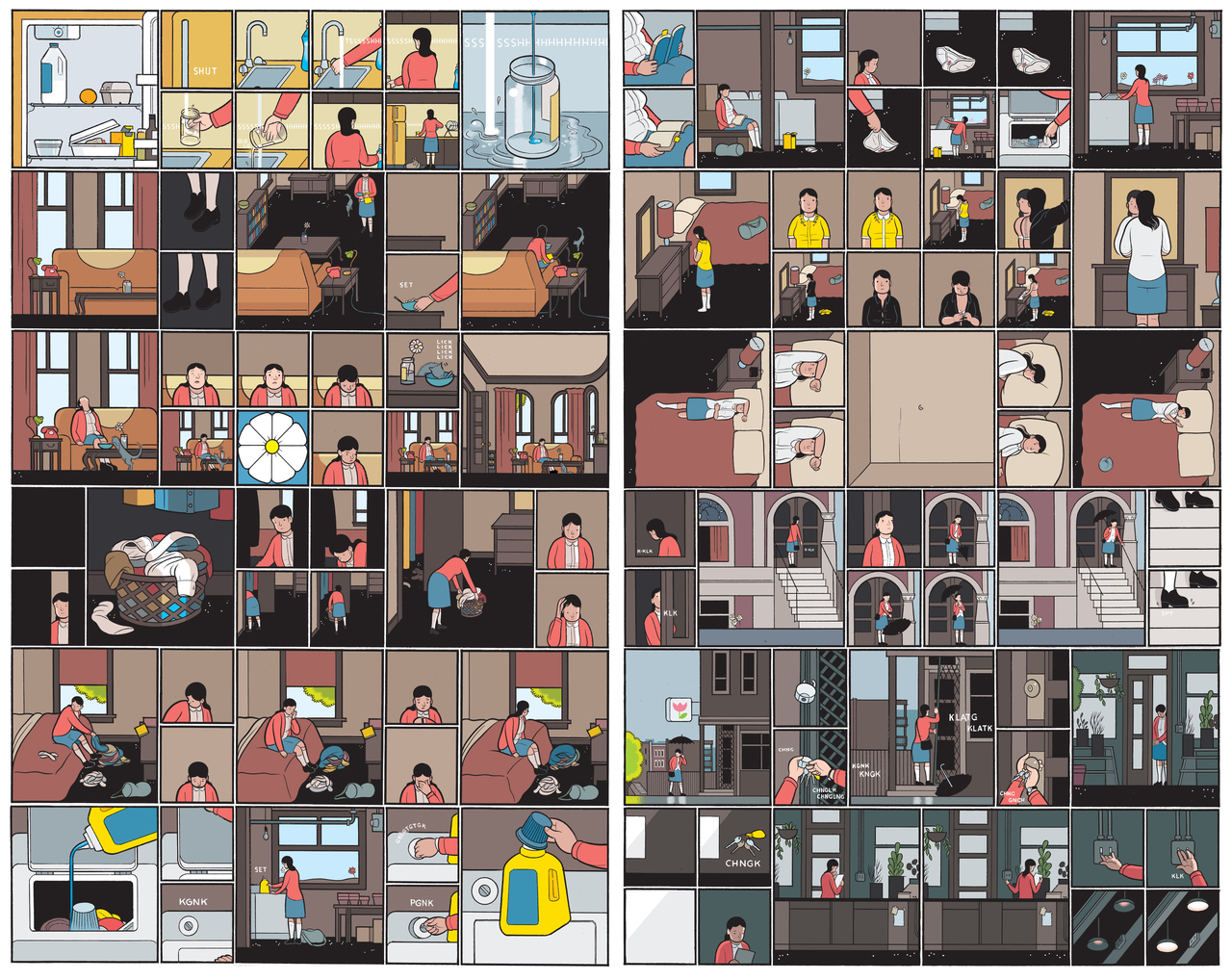
I’m not quite through Building Stories and I’m still processing what it all means, so this won’t be a full, legitimate review, but I can tell you that it will turn out to be among the best books I read this year (if not the best). Inside this box, not much happens, but at the same time everything happens. Ware distills a life experience down to the confines of a single panel. The thickness of a line, the subtle hint of a new color, a shift in point-of-view can bring about a shock of emotion. Entire two-page spreads like the one above are devoted to silence, and yet each panel speaks a thousand words.
Ware doesn’t just build a story, he makes you feel the lives of his characters—in this case, a single woman with one leg who runs a flower shop, wonders if she’ll ever be fulfilled in life, bathes in regret, eavesdrops on her neighbors, reluctantly goes out to dinners with her friends, spends hours lying in bed staring at the ceiling, navigates the choppy waters of conversations with her mother, hates herself in every self-doubting moment, and loves her cat much too deeply. We also meet some of the noisy neighbors (a husband who may or may not be abusive), a widowed plumber who comes to fix the woman’s toilet (and it turns out he used to live in her very apartment), and the elderly landlady who herself has a very rich backstory. Occasionally, Ware includes a cutaway of the apartment building and when we hear from the hundred-year-old house, its thought-bubbles are some of the most heartbreaking of the entire book.
All in all, Building Stories is a visual feast, an engaging series of linked short stories, and one of the deepest emotional experiences you’re bound to have this year.
But, like I said, this is only a midway-through-the-book review. I’m still processing its many facets.
I thought I’d also take this opportunity to share three of my earlier reviews of Ware’s other books as part of my ongoing quest to make sure everyone on this planet has read Chris Ware at least once. Jesus had his twelve apostles, Chris Ware has me. These reviews were written many years ago for other websites (including January Magazine) and, frankly, they’re dated, occasionally redundant and not my finest hour of literary criticism (not that any of my hours of criticism could properly be called “fine”), but from them I hope you get a sense of my enthusiasm for Ware’s work. Here then, are my reviews (in order of how much I liked them) of Quimby the Mouse, The Acme Novelty Library, and Jimmy Corrigan, the Smartest Kid on Earth.
* * *
Chris Ware can do as much with a few lines of ink and delicately-colored shading that writers like Raymond Carver or John Updike can in a few hundred words.
Ware, a graphic novelist whose Fantagraphic books include Jimmy Corrigan, the Smartest Kid on Earth and The Acme Novelty Library, is a masterful genius at describing heartbreak, anger and anguish—especially the kind you find in Updike’s suburbia territory. In the tight confines of his pastel-colored panels (vulgarly called “cartoons”), he captures a universe of pain, drawing us in with the kind of emotions with which we can all identify.
In his newest book, Quimby the Mouse, the titular rodent experiences typical teenage anxiety when he sits up in bed one morning and says, “Oh gross. Today’s the day I have to give that speech in class. It makes my wiener feel funny...My stomach hurts, I bet I really am sick.” Later, sitting at his school desk, he grumbles, “If I’d barfed, I could’ve stayed home.”
In another sequence, a juvenile Quimby discovers he has super-powers, which enable him to fly, turn his arms to rubber and shrink down to “insect size.” He uses his powers to escape the every-adolescent’s-nightmare game of dodge ball, play hooky, and peer into the girls’ locker room. In the end, though, he’s still saddled with living the life of a worrisome, hormonal boy.
Quimby the Mouse is full of these quick, brilliant peeks at human nature. Some episodes are titled, “Empty Stomach,” “I’ll Do Anything, Just Please Let Me Stay,” and “I Am a Sickness That Infects My Friends.”
The “quick peeks” might be the book’s only shortcoming—the oversized volume (11-by-14 inches) is little more than a scrapbook of Ware’s existential doodlings. Brilliant as they are, these bits of miscellany never add up to the kind of narrative flow we found in Jimmy Corrigan where we suffer through all of Jimmy’s ups and downs as he reunites with his long-lost father. Quimby, by contrast, is all over the place, a wondrous jumble of what Ware calls “Self-Conscious Text Pages, Advertisements, and Space-Filling Nonsense.” The mind boggles and the eyes cross as we strain to take it all in. [Ed.: The same could be said for Building Stories, but I guess I got used to it.]
Ware of course, knows this and even labels one page “Incomprehensible Cartoon Strips.” Quimby the Mouse won’t be everyone’s slice of cheese. The panels are laid out in such a way that it’s hard to follow the flow and we often wonder if Ware’s train of thought has jumped the tracks. Eventually, by staring at the page long enough, we’re able to absorb a sense of the abstract emotions Ware is driving at: the loneliness, the regret, the mortality, the you-can-try-and-go-home-again-but-it’ll-never-be-the-same feelings that well up in most of us around the time we hit age 35. [Ed.: Or 52.]
I guess you could say Quimby the Mouse is a journey of the senses, a maze-like trip into the self-conscious subconscious. The most appealing, and accessible, portions of the book are when Ware draws his mouse during that turbulent, transitional period of adolescence, back when we thought life had definite answers (“When I was really young, I asked my mom why all old movies were in black and white. She said that back then, everything was in black and white. I took her really literally, and until I was six or seven, I thought color was some weird modern invention.”).
At other times in the book, Ware draws Quimby as a two-headed mouse—either a pair of Siamese twins or a dual personality. One half of Quimby is always imagining the other half meets with a violent end: decapitation, deflation (like a balloon-head), starvation, and so on. The episodes, bizarre and full of black-and-white cartoon blood, aren’t the book’s strongest moments, but they do serve to remind us that Ware is a tortured soul struggling to understand the all-too-real world outside his hand-drawn boxes. Just like the rest of us.
* * *
Those of you who have been holding your breath waiting for Chris Ware’s next great graphic novel can release at least a tiny puff of oxygen. He’s back in fine fettle with a new volume of contemporary angst in the signature pen-and-pastel world he’s created over the years.
While The ACME Novelty Library #16 may not be as full and complete as Ware’s earlier masterpiece from 2000, Jimmy Corrigan, the Smartest Kid on Earth, it’s at least a satisfying hors d’oeuvre to snack on until the main meal arrives. If nothing else, it’s more tantalizing and thought-provoking than the majority of contemporary novels out there, graphic or otherwise.
In the time since Jimmy Corrigan came out, Ware hasn’t released very much new material. Instead, Fantagraphics Books has been issuing collections of his Acme Novelty Library compendiums from the series of the 1990s, which include short vignettes about baby boomers mulling over their troubled childhoods, short gag strips, and complex, intricately-worded advertisements which graphically and textually resemble pages from the Sears and Roebuck catalogs of the early 20th century.
This is all well and good, but what die-hard fans really long for is something meaty like Jimmy Corrigan, a deep probe into worlds normally described by the likes of Raymond Carver or John Updike. In an earlier review, I wrote that the 380-page book contains vivid passages of “pain, desire, hope, humiliation and the sweet surprise of forgiveness and reconciliation.”
Though smaller in scope and page-length, The Acme Novelty Library No. 16 follows similar suit. The graphic novel is more like a novella with a couple of short stories.
The main narrative follows Rusty Brown, a fat grade-schooler with a halo of orange hair, and his terminally-depressed father, Woody Brown, a schoolteacher who is “sleeping through his life” in Omaha, Nebraska.
On the surface, nothing much “happens" in “Rusty Brown”—the kid and his father go to school where they are separately picked on by bullies and plagued by suicidal thoughts. But scratch beneath the pastel exterior of Ware’s world and you’ll find a universe of raw emotion. This is literature in its finest hour. I just wish the hour weren’t so short.
Running simultaneously with Rusty’s story, along the bottom of the page we see Alice White and her little brother Chalky getting ready for their first day at a new school which turns out to be the one where Woody and Rusty are already having their bad days. Eventually, the lives of the characters intersect and nearly connect. The rest of their story will have to wait for the full-length version of “Rusty Brown,” I suppose.
The Acme Novelty Library No. 16 also contains a one-page episode of a stick-figure version of Ware himself babysitting his daughter while fretting over whether or not readers will appreciate his metaphors and allusions.
And, oh yeah, there’s a brief treatise on the life cycle of snowflakes. This is a mixed stew of ingredients, but Ware brings everything to a full, delicious simmer.
The final pages are further proof of Ware’s talent as he illustrates the lives of tenants in an apartment building. The entire section is done with nothing more than cutaway diagrams and wordless panels showing the residents going about their daily routines. [Ed.: Obviously, a preview of Building Stories.] And yet, his pictures really are worth a thousand words. There are few better chroniclers of contemporary American life than Chris Ware.
* * *
The only thing separating Chris Ware from William Faulkner is the fact that Ware draws his characters with ink and uses little balloons for dialogue to tell his story of one dysfunctional family’s sound and fury.
To the best of my knowledge, Mr. Yoknapatawpha never drew a comic strip; but if he had, the results surely would have been as powerful as what’s on the 380 pages of Ware’s Jimmy Corrigan: The Smartest Kid on Earth.
Actually, the term “comic book” cheapens Ware’s magnificent artistry. Calling Jimmy Corrigan a comic strip reduces it to the dime digests of our childhood. This is about as far from Archie and Jughead as you can get. Some people call Ware and other artists like Art Spiegelman (Maus) and Ben Katchor (Julius Knipl, Real Estate Photographer) “graphic novelists.” That’s fine, but when it comes to something as profound as Jimmy Corrigan, I think I prefer the term “illustrated novel.”
As you hold this volume of “comic strips” in your hand for the first time, you may not realize it, but you’ve got something as deep and genuinely moving as anything you’ll find in the words of John Updike, Raymond Carver [Ed.: Him again?!] or any other contemporary scribe bound by the rigid, old-fashioned black-and-white prison of text. The story here is complex and multi-layered in ways that “traditional” American literature often aspires to (and just as often fails). Once you step inside Jimmy’s pastel world, don’t be surprised if you have a hard time finding your way out again. In fact, this book is the kind that can’t be adequately described (though I’ll try). It must be experienced.
So, let’s start with the experience...The hardcover edition of Jimmy Corrigan has the strangest and cleverest dust jacket I’ve ever seen—it looks like the aftermath of a horrible paper-folding accident at the bindery. Unfold it and you’ll discover a collage of seemingly-random panels showing what looks like a family tree of sorts, a doctor’s report of a patient (“36-year-old male who has arrived with acute muscular sprain to right foot following a fall”) and instructions for making paper dolls. You can read the microscopic text now if you like (“With the many recent technological breakthroughs in pictorial linguistics [as exemplified by airline safety cards, battery diagrams and feminine protection directions], such heretofore-dormant skills of Comic Strip Apprehension [or CSA] are being reawakened in the adult mind,” etc.), but you’ll really appreciate it when you return after finishing what’s inside. (By the way, Ware’s tiny-print writing is as smart and funny as anything you’d find in Dave Eggers’ copyright page disclaimers).
Look on the front cover, lower right corner, and you’ll find these words: “A bold experiment in reader tolerance, disguised as a gaily-colored illustrated romance in which TINY PICTURES seem to COME ALIVE, DANCE, SING and WEEP.” Dancing, singing and weeping—yep, that’s what I was doing by the end of my Jimmy Corrigan experience. Well okay, I’m not exactly what you’d call a “weeping man,” but if I was, then I’d be a sobbing wreck by the end of the book. In these 380 pages, you’ll find pain, desire, hope, humiliation and the sweet surprise of forgiveness and reconciliation. Ware’s satiric tone on the dustjacket and inside covers is a bit misleading—there’s nothing riotously funny about the pathetic, boring life of Jimmy Corrigan. Sure, there are moments of great humor, but overall this is the serious stuff of the most intense Oprah show you can imagine.
Ware knowingly juxtaposes the soul-scraping agony of Jimmy’s family history with the “gaily-colored illustrations” and while it took me some time to adjust to the fact that this is not a “Sunday funnies” yuk-it-up, I was soon immersed in Jimmy’s world.
And here’s what you’ll find in Jimmy’s world…
The book tells the tale of three generations of Corrigans—all of them named James: James Reed Corrigan (b. 1883), who is beaten and neglected by his father, a crippled, bitter Civil War veteran; James William Corrigan (b. 1921), a Marine vet, bartender and deadbeat dad; and our “hero,” Jimmy (b. 1941), a virginal Chicago office worker who is terrified of women. Jimmy is a therapist’s dream come true: he’s painfully shy, tongue-tied, full of neuroses and has a set of “mother issues” that would make Norman Bates look like a patsy. Jimmy lives by himself, talks to his mother every day on the phone whether he wants to or not (he usually doesn’t), eats Cap’n Crunch for breakfast and either picks his nose or bites his nails (it’s hard to tell from Ware’s depiction). He rarely speaks in complete sentences; most of his word balloons are filled with just the nervous “Ha ha” or “Uh.”
One day, he gets a letter in the mail which begins “Dear Son, I think it’s about time we fellas get to know each other, what do you say?” Jimmy’s life turns into a Tilt-o-Whirl. He hasn’t seen his father since he was 6, and his vague memories get the man confused with, alternately, Superman or a serial killer. Eventually, the two men do meet and the story turns into an excruciating inward journey toward healing wounds. As they work through their issues, Ware delves back into the Corrigan family history and we witness 9-year-old James I’s rough childhood which has a glorious and heartbreaking climax at the 1893 Chicago Columbian Exposition.
[Note: Jimmy Corrigan is not for young eyes—profanity, sex and lots of toilet-sitting all have a place in the narrative.]
The tale unfolds like a surreal Walter Mitty, only this time Jimmy’s daydreams are filled with lurid images of cruelty and humiliation. In one sequence, he imagines he has a son, a gigantic Superman shows up and plucks their house out of the neighborhood, his son is killed, he realizes he’s on a theater stage and then there’s some business about a horse he must kill. Symbolism abounds as Ware gives subtle weight to the simplest objects: a peach, a crutch and most especially the Columbian Exposition, a fair which was designed in honor of the 500th anniversary of Christopher Columbus’ arrival in the New World. The exposition celebrated where America had come from and looked ahead to where it was going; and the same goes for the Corrigans—though Jimmy has absolutely no idea what’s ahead on his perilously icy road.
Visually, Ware is at the opposite end of the spectrum from R. Crumb. Ware’s panels are light, airy and simple while Crumb’s are thick and heavy (though Ware and Crumb do explore the same themes of dysfunction). In Jimmy Corrigan, you might be reminded of the “clear line” artistry you see in The Adventures of Tin-Tin. Jimmy III, in fact, reminds me a bit of Henry, the bulbous-headed comic strip kid who never said a word—except, of course, Jimmy’s an older version of Henry, one with jowls and a Prozac prescription.
Ware, whose work has appeared in Raw magazine and was previously collected by Fantagraphic Books in a series called The ACME Novelty Library, is an artist of the highest caliber, using simple lines and muted colors to present a world that leaps off the page. At one point, James I is on his way to see the Columbian Exposition for the first time, but he wonders whether this is just another of his father’s broken promises. These worries are cramped into tiny, postage-stamp-sized panels. Then suddenly there’s a bird’s-eye view of the palatial exposition grounds filling the entire next page. To call it “breathtaking” is a gross understatement.
Another thing I liked about Jimmy Corrigan was the use of sound effects. Ware shows he’s really listened to the world around him and he transcribes that music onto the page. Here, for instance, is the sound of a man nervously playing with the pop top of a soda can: pk pk pk; or, turning on a faucet: tsssssh; or inserting a set of keys into the door: chngle chng. Details like these set Jimmy Corrigan apart from anything else you’ll read this year.
My one and only quibble with the novel is that it’s sometimes hard to follow the flow of the action. Ware crowds your vision with panels of varying sizes, occasionally guiding you with arrows, but there are times when I got them out of sequence and had to backtrack to the start of the page. But that’s such a minor quibble in the face of the big picture. There is far too much beauty at stake here—both visually and textually—to be nitpicking.
Ah yes, the text—another quality of Ware’s to admire. Every so often, especially in the 1890s story, the panels are scripted with a narration composed of obsolete language. Just listen to some of the poetry Ware employs:
on this humid morning, [the city] shimmers with the smell of cattle, chocolate and garbageand, when James I, anticipating another beating from his father, is sitting alone on the back porch with his head on his knees:
A distant roll of thunder and cooling breeze bearing the slur of neighborhood voices emerging from the stale house heat. Crickets, fireflies…all ruined by a stomach-turning sense of dread. It makes his toes hurt (and the familiar sniff of his own kneecaps which always precedes any punishment). SOMETIMES if he pushes on his eyeballs hard enough he sees pictures—red splotches and patterns of purple green sparkles, silvery smears.Now you see what I mean about Faulkner?
It’s rare that literature as deep and moving as this comes along and I hope that by now I’ve convinced you to at least consider running out to your neighborhood Books-R-Us to hunt down Jimmy Corrigan. In the space of three panels, Ware is able to convey what some novelists struggle to describe in entire books: the heartbreak, the struggle and, finally, the glimmer of hope in our dark, dull lives.
Labels:
Chris Ware,
John Updike,
Raymond Carver,
reviews,
William Faulkner
Monday, July 7, 2014
My First Time: Angela Pneuman
My First Time is a regular feature in which writers talk about virgin experiences in their writing and publishing careers, ranging from their first rejection to the moment of holding their first published book in their hands. Today’s guest is Angela Pneuman, author of the just-released Lay It On My Heart. This debut novel tells the story of one unforgettable month in a Kentucky girl’s thirteenth year. Julie Orringer, author of The Invisible Bridge, said Lay It On My Heart “evokes the genius of Angela Pneuman's canonical progenitors: Flannery O’Connor, Katherine Anne Porter, Walker Percy...a gorgeous, riveting, and unforgettable book.” Angela was raised in Kentucky, is a former Stegner Fellow and teaches fiction writing at Stanford University. Her short story collection Home Remedies was hailed by the San Francisco Chronicle as “call[ing] to mind Alice Munro.”
My First Rejection
I went to a tiny college in my hometown in Kentucky. It wasn’t officially a Bible college, and it was officially accredited, but it was very, very religious, very Southern evangelical Protestant. Put it this way—when I matriculated in 1988 girls still had to wear skirts to class and RAs carried rulers to make sure the skirts stayed within one inch of the knee. In 1988. For their part, boys had to wear collared shirts. Don’t even mention dancing, or drinking, or smoking—even though back then this college was surrounded by fields of tobacco.
This college did, however, have an enthusiastic poetry professor and poet in her own right. She taught all the creative writing classes—two, if memory serves: Writing Poetry and Writing Fiction. In Writing Fiction, which I took senior year, I had my first exposure to Best American Short Stories—the 1991 edition, which I read cover to cover in 24 hours. Those writers: Lorrie Moore, Kate Braverman, Alice Munro, Robert Olen Butler, Charles Baxter—I’d never heard of them, and I headed right to the University of Kentucky library with a list of names, determined to read everything each of them had ever written. Love at first sight, and I’m still pretty much a devotee.
I never took Writing Poetry. Three handsome guys did, however, boys I’d known since before kindergarten, boys whose houses I’d spent lots of time in. Let’s call them Matthew, Mark and John in the spirit of the New Testament, which was big at my school. These three were on the fringe of the college as I was, by then, questioning the faith we’d all grown up with. At some point we realized we all loved to read, a fact we guarded jealously from each other like disaster survivors with a secret stash of canned goods. Or maybe that’s just me. You know what they say—when you assume you know what others are thinking you reveal what you’re thinking, instead. I remember one of them telling me how much he loved William Faulkner and I, who had puzzled my way through The Sound and the Fury once, then promptly reread it again, loving every word, sniffed diffidently and said something to the effect of “Faulkner’s okay. I can see why you’d like him.” And then I probably made sure I had, mysteriously, somewhere else to go.
However anyone else felt about it, I can say for sure that I felt possessive about reading. My heart fell a little every time I realized a book I’d loved had already been loved by another. Even by one of these three handsome boys whom I’d been wanting to impress since their voices dropped, at about 15.
So then they all took Writing Poetry together, formed our college literary review, and became its editorial board. A poetry writing group—a workshop—started to meet every week or so, with one of the three always at the helm. I pored over their poems. They were so, so good. How did they know those nature details? How did they know when to break off a line—just right there in the middle of a sentence like that?
After attending the group a couple times, I worked up the courage to submit my own poetry. Let me say, here, that I did not love poetry. Not yet. I loved fiction, and I loved writing in general, in my early way, and I loved all three of these boys, and I wanted to write something they would love, and they loved poetry. They must have been kind about my poem, because I don’t remember otherwise. I was probably too nervous to hear anything that was actually said.
Then submissions for the literary review came around, and I did not submit. In fact, I brought another poem to the group for discussion, and when asked if I planned to submit—there was a deadline—I said that nothing I had was ready. It’s a good, honest line I still use. “Cool,” one of them probably said.
Then, in the College Post Office, I opened my box and found a typed rejection slip. Strip, really. Sliced by a paper cutter. “We regret that we can’t use…blah blah blah name of my poem.” Signed Matthew, Mark and John.
I was crushed. Then I was mad. Then I worked hard to find some significance. One of them was mad at me? One of them considered my great work a threat and wanted to take me down? One of them liked me? I saw these last two possibilities as hopeful stretches, even at the time.
It was a mistake, of course. Nothing more. But nearly ten years later I started sending out work for real, and got plenty of rejections from folks who’d never met me, some in the little strips, others with some encouragement, and I have kept them all in a folder with the original college rejection taped on the outside. And Matthew, Mark and John are still friends of mine, kindred spirits still, even if we only see each other on Facebook. They “like” me with great, supportive regularity and I like them right back.
Friday, October 25, 2013
Friday Freebie: An Unbridled Giveaway
Congratulations to A. W. McKinnon, winner of last week's Friday Freebie: The Hunter and Other Stories by Dashiell Hammett.
This week's book giveaway is one of the most unique and personally gratifying Friday Freebies I've ever posted in The Quivering Pen's three-year history. A couple of months ago, I was contacted by Greg Michalson, co-publisher (along with Fred Ramey) of Unbridled Books. Greg said he was going through some old boxes of Unbridled books and came across some titles which he thought deserved more recognition. Would I be interested in offering them up as Friday Freebie giveaways?
Would I? I think I said "Yes" so fast, the "s" got there before the "y." I've been a fan of Unbridled Books since its inception in 2003. In fact, I was even a devotee of its precursor, BlueHen Books, the short-lived Putnam imprint which Ramey and Michalson also co-founded. If I went out to my front porch and discovered a package with the Unbridled logo--the flying mane and galloping forelegs of a horse--then I knew there was an unqualified literary treat waiting for me inside. I've never been disappointed by an Unbridled Books book. That's not something I can say of every publisher.
When Greg's box of books arrived, it was like Christmas in September at my house. Actually, I was celebrating your Christmas since these titles will be going out to a few lucky Quivering Pen readers. It's my unbridled delight to pass these works of fiction on to other readers. I asked Greg to talk a little bit about the books he sent:
One unexpected pleasure of recently going back through some boxes of books after I moved my office over the summer was the chance to revisit memories from some wonderful novels that have meant a great deal to me. As I was doing this, it occurred to me, yet again, that over the years Fred Ramey and I have published a number of Western titles that deserve some further attention unless and before they’re forgotten. I continue to think of them as some of the best books I ever published. At least a few of them are or should be considered classics. I wrote a couple of short blog posts a while back about the nature of Western fiction that also got me thinking about this group.
I’ve often said in describing what we do that Unbridled Books is a regional publisher, just not from any one region. There are so many different ways that this statement is true, even though we’re a small press with a national footprint and aspirations to being a part of the national conversation—if there is such a thing anymore. Our authors and their books certainly have universal appeal and deserve national recognition.
But one simple way this is true is with the books that grow from a particular landscape or culture and that help us understand our heritage and define who we’ve become today. And in fact, the literature of the West of course has embodied the American spirit, identity and dream.
In the best fiction, cultural identity is often inseparably tied up in sense of place. We’re shaped by where we come from and where we’re going as much as by what we want, and why, and what we’re willing to give up to get it. That cultural identity is one of the main differences between, say, Garcia Marquez’s brand of real maravillosa and the decadence or decay of Faulkner’s Yoknapatawpha County. And why the fresh promise of the New World and the rootlessness of Westward expansion gave rise to the oh so American penchant for continually reinventing oneself.
With all this in mind, I’ve invited David Abrams to give away copies from my personal stash of some of my favorite books and authors, hoping to bring them at least in some small way together with another appreciative audience of readers who might have missed them before. Many are from Unbridled Books, but some go back to earlier times with BlueHen and MacMurray & Beck.
These novels are filled with the stories and people of the Western United States. Each of them seems to take the reader on a ride to places he or she might never expect, connecting with characters who have helped define some part of what it means to be who we are as a culture today. They’ll touch both your heart and your mind, offering the pleasure and intimate enrichment of the very best reading experiences. Or at least, this is the effect they’ve had on me.
Here, then, is the list:
Rick Collignon’s classic The Journal of Antonio Montoya, the novel which begins his amazing Guadalupe saga, set in Guadalupe, New Mexico. If you haven’t read the Guadalupe saga, you’re simply missing a group of novels that make up an important piece of America’s western literature, one that’s comic and tragic at once, delightful, surprising and revelatory. The characters you’ll come to know through these novels will live with you for a long time to come.
Lloyd Zimpel’s A Season of Fire and Ice, from the heartlands of the harsh 1880s Dakota Territories, a morality tale of survival and destiny told in the convincing language of a patriarch’s journal. This is a moving personal journey filled with humor and tenacity, family loyalty, defiance and despair, an almost biblical story of self-revelation with an over-arching spiritual reach. It offers a portrait of who we have always been in America and what we’ve learned to value as a people.
Debra Earling’s Perma Red, set in the 1940s on the Flathead Indian Reservation in Montana, in which a reckless and stubborn young girl sets her life down a desperate but unforgettable path. This is a breathtaking, love-crossed saga of the West, about a young woman coming of age under perilous circumstances, against a classic, frightening clash of cultures. I’ve never read anything quite like it.
If you haven’t read these, you must. And you’re in for a treat. Right alongside them are:
M. Allen Cunningham’s The Green Age of Asher Witherow, which was a #1 Booksense pick back in the day, set in the coal mines north of San Francisco in the 1860s-70s. It’s a rich, gothic tale of a young soul coming of age during the explosive boom and bust years of a little remembered immigrant coal mining town in 19th-century California.
Cathryn Alpert’s Rocket City, a classic road novel with one of the first great dwarf characters, with one of the all-time greatest opening lines ever.
And perhaps surprisingly (surprising only because she’s from Ohio), Nancy Zafris’ Lucky Strike, a novel full of heart that follows a young widow and her two children into the canyon country of Utah in 1954 where thousands of self-styled prospectors, encouraged or deluded by government pamphlets, have caught uranium fever and descended upon the desert landscape, determined to reinvent themselves.
Also William Cobb’s The Bird Saviors, set in Western Colorado in some very near future, it captures a haunting vision of the new West in which a young and remarkable unwed mother must find her way during a time of climate change, economic turmoil, virus fears, fundamentalist cults and illegal immigrant hardship. Cobb’s is a story of defiance and anger mixed with compassion and unexpected love, of resilience and personal survival, and surprising hope.
John Addiego’s Tears of the Mountain chronicles a single day in one man’s life—July 4, 1876—along with a series of flashbacks that all lead up to an eventful Centennial Independence Day celebration in Sonoma, California.
David Allan Cates’ dark (sometimes darkly comic) and almost hallucinatory period masterpiece of re-invention and horrific manifest destiny, Freeman Walker.
Definitely Mattox Roesch’s Sometimes We’re Always Real Same-Same, if you count Alaska’s Eskimo community as the West, with a transplanted teenage gangbanger from LA. This one was named by Library Journal as the best adult novel of its year for young adult readers. Basically, a book for everyone of all ages.
And the stunningly lyrical epic tale by Michael Pritchett, The Melancholy Fate of Capt. Lewis, which delivers as intimately imagined a version of the grand adventure that was the Lewis & Clark expedition as you’ll ever read.
* * *
Here's how the giveaway will work: I have one copy of each of the books to give away to contestants. I'll draw four names out of the hat. One person will win four of the books, one person will win three books, and two people will win two books. If you have a preference for which of the Unbridled titles you'd like to win, mention that in your email; I can't guarantee those will actually be the books I select for you, but I'll do my best to match demand with supply. Otherwise, I'll just randomly select your prize-package books. Trust me when I say there is not a bad apple in this bunch.
If you'd like a chance at winning the Unbridled Books prize package, simply email your name and mailing address to
Put FRIDAY FREEBIE in the e-mail subject line. One entry per person, please. Despite its name, the Friday Freebie runs all week long and remains open to entries until midnight on Oct. 31, at which time I'll draw the winning name. I'll announce the lucky reader on Nov. 1. If you'd like to join the mailing list for the once-a-week newsletter, simply add the words "Sign me up for the newsletter" in the body of your email. Your email address and other personal information will never be sold or given to a third party (except in those instances where the publisher requires a mailing address for sending Friday Freebie winners copies of the book).
Want to double your odds of winning? Get an extra entry in the contest by posting a link to this webpage on your blog, your Facebook wall or by tweeting it on Twitter. Once you've done any of those things, send me an additional e-mail saying "I've shared" and I'll put your name in the hat twice.
Subscribe to:
Posts (Atom)