Monday, May 23, 2011

My First Time: Laura Harrington

My First Time is a regular feature in which writers talk about virgin experiences in their writing and publishing careers, ranging from their first rejection to the moment of holding their first published book in their hands.  Today's guest is Laura Harrington whose debut novel, Alice Bliss (Pamela Dorman Books), arrives in bookstores next week.  The novel's titular character is a fifteen-year-old girl learning to cope with the absence of her father, a soldier in the U.S. Army Reserves who has just deployed to Iraq.  Harrington's plays, musicals and operas have been widely produced in the U.S., Canada, and abroad.  She is a two-time winner of the Massachusetts Cultural Council Award in playwriting and a two-time winner of the Clauder Competition for best new play in New England for Mercy and Hallowed Ground.  Much of her work is inspired by her fascination with history and her commitment to work that explores the human cost of war, from the Civil War (Hallowed Ground) to World War I (The Book of Hours) and World War II (Fifteen Minutes at Midway).  Alice Bliss grew out of Harrington’s one-woman musical Alice Unwrapped, which ran off-Broadway in New York and in the Minneapolis Fringe Festival in 2009.  Harrington teaches playwriting at MIT and lives in Gloucester, Mass.  Visit her website at www.lauraharringtonbooks.com


My First Book

The day I am invited to write this guest post, my first book lands on my doorstep.  A true artifact, an actual object; it even has a little heft.  It is sitting on my kitchen table.  I circle around it, not quite believing it’s real.  It is so strange to have something tangible in my hands after years of working in the theatre where our work is so beautifully, magically ephemeral.  Even if you hold a play in your hand, you know it is only a blueprint for the theatrical experience it inspires.  But a book....a book will exist as an object and in the mind of its readers and therefore holds the potential of being both tangible and ephemeral.

The day my book launches is the day of my daughter’s graduation from college, which certainly puts things into perspective: the joy of her accomplishments, the excitement of starting out, stepping into the first days of her adult life.  And like all graduations, perhaps all watershed events in one’s life, there is as much looking backwards as looking forwards.  Thus the poignant mix of emotions we all experience: fear, elation, anxiety, joy, and anticipation.

As I hold this book with gratitude and a degree of awe, I also hold something back.  Have I been a writer for too long to fully experience this “first” in my life?  Am I superstitious?  Not yet, I hear a little voice saying, don’t get excited yet--as if my excitement could somehow impact book sales or reviewers’ reactions in a negative or positive way.  I don’t want to overburden the slender shoulders of Alice Bliss as she makes her way into the world.  As much as I wish for this book going forward (and don’t we all have these dreams of finding our audience, our readers?)  I keep reminding myself of all that has happened to bring me to this moment; all who have helped me along the way.  So, like my daughter on her upcoming graduation day, I find myself looking forward and reaching back.

Reaching back to my first mentors:  How can I leave them out when I hold my first book in my hands?  Parents and teachers and, for me, my lucky, blessed relationships with several collaborators in my theatre life: the composers who celebrated my love of language and embraced my desire to create deeply emotional work, the producers and directors who championed my work and made it happen, the performers who made my characters come alive in words and in music.  They are all a part of this book and the journey that led me to this book.

Reaching back to my family:  My husband and daughter who have done the daily work of living in the trenches with a writer, my brothers who have cheered me on with such generosity, my parents, now gone, who would have loved to sit with my book in their hands.  A book.  So different from a play.  Something we all know and recognize and revere.  Something we can hold in our hands.  Full of promise; carrying our hopes and our dreams.

Author photo by Claire Barclay

Sunday, May 22, 2011

Short Story Month Giveaway: American Masculine by Shann Ray


This week, I'm celebrating short stories with giveaways and thoughts about short fiction by participating authors.  Join me each day as I pay tribute to National Short Story Month, a movement which has snowballed since the first efforts by Larry Dark and Dan Wickett to give overdue national attention to short stories.  For details on how to enter today's contest, scroll to the bottom of this post.  For more bloggers participating in Short Story Month giveaways, be sure to visit this page at Fiction Writers Review.

Today's book is American Masculine by Shann Ray, due to hit bookstores four weeks from now.  At one point, American Masculine was subtitled "Montana Stories" and featured two sparring bison on the cover.  The buffalo still remain, but "Montana" appears to have been dropped, perhaps in an effort to make the fiction more universal.  Make no mistake, however, the Big Sky Country--both beautiful and brawling--spreads to every corner of these 10 tales, which Dave Eggers has compared to the work of Cormac McCarthy and Annie Proulx: "lyrical, prophetic, brutal, yet ultimately hopeful."  In "Three From Montana," for instance, Ray writes: "In Montana, skies run from a tilted wooden porch all the way to the horizon line, and nothing keeps back the dawn...Everyone who has ever come here, remains.  The land and the vault of sky are everything and people so insignificant they are struck by the idea that God doesn't owe them anything."  When I read lines like those, I'm gripped by the desire to get in my car, drive ten miles north of Butte and stand at the edge of Elk Park, where I lean against the hood of my Hyundai, drink the fresh-washed air of the high-elevation valley through my nostrils, and say, "Goddamn, he got it right alright."  The book's Jacket Copy says Ray writes of "washed-up basketball players, businessmen hiding addictions, and women fighting the inexplicable violence that wells up in these men.  A son struggles to accept his father’s apologies after surviving a childhood of beatings.  Two men seek empty basketball hoops on a snowy night, hoping to relive past glory.  A bull rider skips town and rides herd on an unruly mob of passengers as he searches for a thief on a train threading through Montana’s Rocky Mountains."  American Masculine is the winner of the 2010 Bakeless Prize for Fiction, chosen from at least eight other strong semi-finalists, said fiction judge Robert Boswell.  In his foreword to Ray's collection, Boswell had this to say:
The sentences in this book have such grace and muscularity that they seem more performed than written, and the author's images and events carry the nearly visceral weight of memory.  In fact, during the weeks immediately following my initial reading of American Masculine, I twice caught myself struggling with what I thought was personal recollection only to realize that it was actually an episode from one of the stories.  For example, I thought I had dreamt of a train and I was trying to describe to a friend how compelling the dreams had been when I realized that it was not a dream locomotive but the train from "The Great Divide" curling about my consciousness, nosing its way into my life, making claims on my experience.  The work has that kind of resonance.  You finish each story with the understanding that something meaningful has happened to you, and though you may not be able to specify the meaning, you understand nonetheless that you have lived through something powerful and significant.
I guess Boswell kinda liked the stories.  Find out for yourself by a) entering today's contest, b) buying the book on June 21, or c) a & b--and if you win, give one of the copies to a friend in need of an "always-eloquent contemplation of the mysteries of grace and forgiveness" (Jess Walter).


About the Author:  Born and raised in Montana, Shann Ray holds a dual MFA in poetry and fiction from the Inland Northwest Center for Writers at Eastern Washington University, a Masters in clinical psychology from Pepperdine, and a PhD in systems psychology from the University of Alberta in Canada. His stories have appeared in many top literary magazines, including McSweeney’s, StoryQuarterly, Northwest Review, Narrative, Best New Poets and William and Mary Review. Ray is the winner of the subTerrain Poetry Prize, the Crab Creek Review Fiction Award, the Pacific Northwest Inlander Short Story Contest, the Ruminate Short Story Prize, and the Creative Writing Distinguished Alumni Award from Eastern Washington University.  His work was selected as a notable story in Best American Nonrequired Reading and anthologized in The Better of McSweeney’s, Vol. 2.  For in-depth background material, excerpts, book trailers, and his blog, be sure to visit Ray's website: www.shannray.com


Five Story Collections: Five Great Fires

Rock Springs by Richard Ford
Master of dirty realism, narrative density, and clarity and depth of prose, Pulitzer Prize winner Richard Ford depicts the low-down frightfully real existence of our emptiness and how like fragile vessels we are.  We exist under the simple straightforward conception we have freedom to grow, expand, and illumine the world with color, yet we are so often bound to the gray and mundane by fate, or destiny.  As artful in its reach as Wildlife (Ford’s beautiful small book of awe-invoking portent), Rock Springs delivers.

Labors of the Heart by Claire Davis
A prose stylist extraordinaire with a light and fluid touch concerning the heart of humanity, Claire Davis exposes a vein of hidden resolve in the secret folds of her characters' interior lives.  Her discipline as an artist, enveloped by a great sense of the complexity of being human and graced by a caring hand, is a golden thread of illumination in the title story and throughout the collection.  Davis’ work, selected for Best American Short Stories and a Pushcart Prize, is rich with alienation, secrecy, the nuances of power, and the subtle ascendancy of love.

The Woman Lit by Fireflies by Jim Harrison
Prolific novelist (Legends of the Fall), screenwriter, poet (The Theory and Practice of Rivers), and short story writer, Jim Harrison embeds people in landscape and weaves through subtle narrative layering, masterful prose, and emotional import a web of intricate and compelling design.  "The Woman Lit by Fireflies," the final novella of this collection, generously explores ingenuity, freedom, and loyalty.

Lost in the City by Edward P. Jones
An artist whose prose and narrative arcs generate irresistible pull and evoke in readers a genuine sense of entire worlds, Edward P. Jones has written three books.  The first, Lost in the City, garnered the PEN/Hemingway award.  The second, The Known World, won the Pulitzer Prize.  A luminary of American letters, Jones affirms that which is humble and human, and does so with startling power.  The characters Jones writes are imbued with compassion, and the words of Martin Luther King Jr. aptly apply to Jones’ prose, a distilled language with “a heart full of grace, a soul generated by love.”

Close Range by Annie Proulx
Winner of the Pulitzer Prize for The Shipping News and known for vigorous torque-driven prose, Annie Proulx takes readers on a journey of speed and destiny in Close Range.  Her ability to uncover and dissipate the dead waters of American culture, providing a rich love of character and story in the process, is replete with momentum and artistry.  Her stories burn like bonfires in the darkness of a vast literary plain.

*     *     *

If you'd like a chance at winning a copy of American Masculine, send an email to thequiveringpen@gmail.com with "Shann Ray" in the subject line.  Please include your mailing address in the body of the email.  This contest is only open to residents of the U.S. and Canada (sorry, we can't ship to addresses with P.O. boxes).  One entry per person per book (yes, you can enter the drawings for each book during Short Story Week, but each entry must be sent separately).  The contest remains open until May 31, at which time I'll draw the winners of each day's giveaway.

Author photo by Vanessa Kay

Saturday, May 21, 2011

Short Story Month Giveaway: Binocular Vision by Edith Pearlman


This week, I'm celebrating short stories with giveaways and thoughts about short fiction by participating authors.  Join me each day as I pay tribute to National Short Story Month, a movement which has snowballed since the first efforts by Larry Dark and Dan Wickett to give overdue national attention to short stories.  For details on how to enter today's contest, scroll to the bottom of this post.  For more bloggers participating in Short Story Month giveaways, be sure to visit this page at Fiction Writers Review.

Today's book is Binocular Vision by Edith Pearlman, the acclaimed collection published earlier this year by Lookout Books, a new imprint at the University of North Carolina Wilmington.  Binocular Vision is the first title to roll off Lookout's presses and it's an important occasion--not just because it's the premiere from what looks like a promising publisher, but because it's a book by an author who has been criminally overlooked by the general reading population despite a track record of three previous award-winning short story collections.  This is Edith Pearlman's day and she's rightfully basking in the glow from Lookout's lightbulb logo.  It's true, Binocular Vision shines a light on the author's career with these "new and selected stories."  The first paragraph of Ann Patchett's introduction further illuminates:
To that great list of human mysteries which includes the construction of the pyramids and the persistent use of Styrofoam as a packing material let me add this one: why isn't Edith Pearlman famous? Of course by not having the level of recognition her work so clearly deserves, she gives those of us who love her the smug satisfaction of being in the know. Say the words Edith Pearlman to certain enlightened readers and you are instantly acknowledged as an insider, a person who understands and appreciates that which is beautiful. Still, I think that Binocular Vision: New & Selected Stories should be the book with which Edith Pearlman casts off her secret handshake status and takes up her rightful position as a national treasure. Put her stories beside those of John Updike and Alice Munro. That's where they belong.
Based on Patchett's effusive praise of Pearlman's "Self-Reliance," I turned to the back of Binocular Vision and read that story before going to any of the others.  As Patchett points out, it's a story that deepens with each re-read.  There are layers upon layers and worlds within worlds and words behind words here.  It is, in short, literary delight multiplied to the nth degree.  Pearlman begins by grounding us in the reality of an elderly cancer patient who buys a cabin beside a spring-fed pond in New Hampshire to live out her days, to the chagrin of her daughter.  Here's one of my favorite passages:
"I worry about you in the middle of nowhere," her daughter, Julie, said.  But the glinting stones of the house, its whitewashed interior, summer's greenness and winter's pale blueness seen through its deep windows, the mysterious endless brown of the peaked space above her bed...and pond and trees and loons and chipmunks...not nowhere.  Somewhere.  Herewhere.
"Self-Reliance" begins conventionally enough, but soon veers into unexpected, surreal territory.  In this way, it reminded me of Tobias Wolff's "Bullet in the Brain."  Those who have read that story about a bank robbery know what I'm talking about when I say one sentence can send the story in a completely new direction--like a spinning top bouncing off a wall.  I won't say more for fear of spoiling the undiscovered joys of an unread story, but I will say this: Pearlman's fiction will stand the test of time.  Read her.  Now.


About the Author:  Edith Pearlman has published more than 250 works of short fiction and short non-fiction in national magazines, literary journals, anthologies, and on-line publications. Her work has appeared in Best American Short Stories, The O. Henry Prize Collection, New Stories from the South, and The Pushcart Prize Collection--Best of the Small Presses.  Her first collection of stories, Vaquita, won the Drue Heinz Prize for Literature and was published by the University of Pittsburgh University Press in 1996.  Her second, Love Among The Greats (Eastern Washington University Press, 2002) won the Spokane Annual Fiction Prize.  Her third collection, How to Fall, was published by Sarabande Press in 2005 and won the Mary McCarthy Prize in Short Fiction.  Visit her website at www.edithpearlman.com


Edith Pearlman's Five Favorite Books
(Not all short stories, but I think reading any of them will be instructive and enjoyable for the short story writer)

A Better Angel by Chris Adrian
Chris Adrian burst into the world of fiction in the 1990s with stories published in small literary magazines and also in that big one The New Yorker.  The narrators of these brilliant short works share a yearning to reverse death, and an acquaintance with angels who walk the earth, often broken-winged and outlandishly dressed.  Every story presents some or many of the following: a brother who, though dead, is audible and occasionally visible; an impaired physician; a killing (sometimes murder); the comforts of substance use; illnesses, often gruesome; congenital defects; and injuries, sometimes received on the battlefield.  Had enough?  I hope not.  For this is a writer of prodigious talent who holds your heart in his hands.  (They are youthful, gloved hands: Adrian is a pediatrician of 40, and a student of divinity as well.)  Despite or because of his obsessively repeated subject matter, he is a writer of enormous charm.  And despite or because of his unlikely world-view, he is irresistible.  He sails into the inexplicable, seeking meaning; and the reader, gripped by curiosity and admiration, scrambles on-board.  He has written three novels as well as this collection; the latest is The Great Night, published this month.


Little Black Book of Stories by A. S. Byatt
A. S. Byatt has the best eye in the business--she renders the surface of things and what’s underneath with eloquent economy.  In “The Thing in the Forest,” a story in this collection, the general reader will marvel at descriptions of nature, of remembered happenings, of present emotions.  The apprentice writer--the experienced writer, too--will marvel as well, and wonder how it’s done.  How it’s done is shown in another story, “Raw Material,” which should be required reading in every writing workshop.


Our Mutual Friend by Charles Dickens
My favorite book by my favorite author.  High life in all its ridiculous hypocrisy, the Thames in all its foulness, fidelity, vengeance, a pair of scoundrels with redeeming virtues, plenty of drowned bodies and one gruesome murder; language rich and funny, glorious dialogue, passion, mania.


Deerskin by Robin McKinley
Books written for children and young adults give us much of what books written for adults try to: conflict, betrayal, faithfulness, love, adventure--and they do it without the baggage of realism; they avoid contemporary settings in favor of timeless ones; they dispense with that overvalued element motivation--as the poet Amy Clampitt says: “who knows what makes any of us do what we do?”  Deerskin is a powerful example of the genre.  There’s an unforgettable heroine and a superb dog.


Fingersmith by Sarah Waters
Just read it.

*     *     *

If you'd like a chance at winning a copy of Binocular Vision, send an email to thequiveringpen@gmail.com with "Edith Pearlman" in the subject line.  Please include your mailing address in the body of the email.  This contest is only open to residents of the U.S. and Canada (sorry, we can't ship to addresses with P.O. boxes).  One entry per person per book (yes, you can enter the drawings for each book during Short Story Week, but each entry must be sent separately).  The contest remains open until May 31, at which time I'll draw the winners of each day's giveaway.

Friday, May 20, 2011

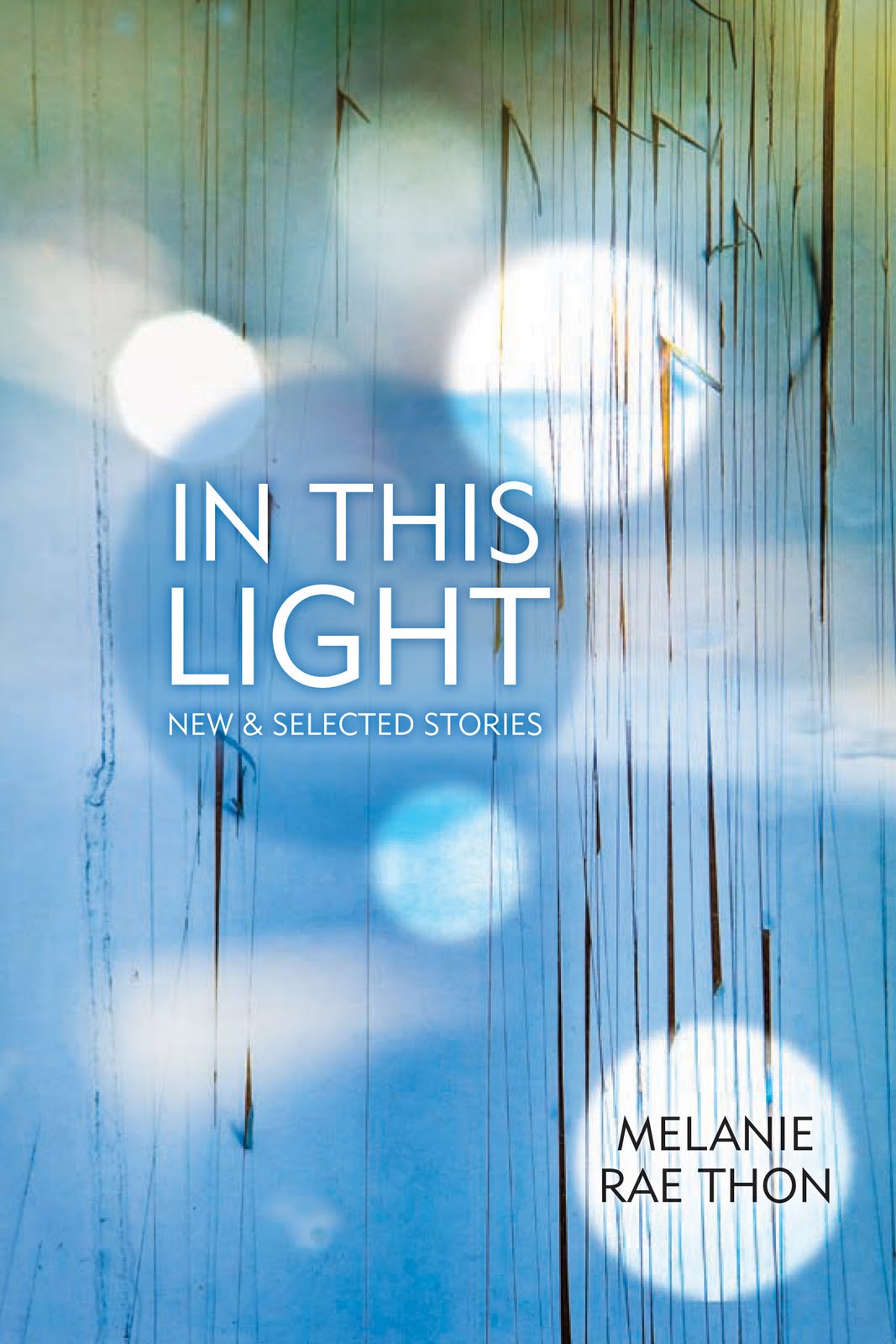
Short Story Month Giveaway: In This Light by Melanie Rae Thon


This week, I'm celebrating short stories with giveaways and thoughts about short fiction by participating authors.  Join me each day as I pay tribute to National Short Story Month, a movement which has snowballed since the first efforts by Larry Dark and Dan Wickett to give overdue national attention to short stories.  For details on how to enter today's contest, scroll to the bottom of this post.  For more bloggers participating in Short Story Month giveaways, be sure to visit this page at Fiction Writers Review.


Today's book is In This Light by Melanie Rae Thon, brought to you by the consistently-stellar Graywolf PressIn This Light gathers some of the greatest hits of Thon's previous collections, plus three new stories.  Here's the Jacket Copy:
In This Light shimmers with grace as a drunk young woman hits a Native American man on a desolate Montana road, a grieving slave murders the white child she nurses and loves, and two throwaway kids dance in the twinkling lights of a Christmas tree in a stranger’s house.  Thon’s searing prose reveals that the radiant heat inside us all is the hope and hunger for love.
In a review of the collection, High Country News had this to say about the stories:
Thon slips into the skins of her flawed, long-suffering characters with astonishing ease and authenticity. Her characters are hungry, and for more than just food. Two runaway kids break into a house one night and gorge themselves. One says, "You don't know how it hurt us to eat this way, our shriveled stomachs stretching; you don't know why we couldn't stop." Her people are loners, addicts, outcasts, misfits stuck in too-small towns and reservations. They lose fingers to frostbite and steal coats that are too thin. In one story, Thon describes a horde of runaway children who haunt the woods outside of Kalispell, Mont., as being glued together "from broken sleds and headless dolls and bits of fur and scraps of plastic. Their bones were splintered wood. Their hearts were chicken hearts. Their little hands were rubber."
At Matt Bell's blog (which, by the way, you should be reading on a daily basis--especially this month as Bell and guest reviewers analyze specific stories from print journals), Nina Schuyler digs deeper into one story from Thon's new book:
When free association is a key style technique in a story, it opens up immense possibilities, including surprise and a collage of interesting imagery. In "Tu B'Shvat," you find a beautiful young girl who drowns in the community pool, the narrator's dead mother, the holocaust, the narrator's piano-playing daughter, relatives who died in the camps, a dead deer, her father who died in the shower of her childhood home and the beautiful young girl's missionary brother living in Hermosillo. David Shields writes in Reality Hunger, "It's not the story. It's just this breathtaking world—that's the point" and that perfectly describes "Tu B'Shvat."

About the Author:  Melanie Rae Thon is the author of the novels Sweet Hearts, Meteors in August, and Iona Moon, and the story collections First, Body and Girls in the Grass.  Her work has been included in Best American Short Stories (1995, 1996), three Pushcart Prize Anthologies (2003, 2006, 2008), and O. Henry Prize Stories (2006).  She is a recipient of a Whiting Writer's Award (1997), two fellowships from the National Endowment for the Arts (1992 and 2008), a Writer's Residency from the Lannan Foundation (2005), and a fellowship from the Tanner Humanities Center (2009).  Originally from Montana, Thon now lives in Salt Lake City, where she teaches in the Creative Writing and Environmental Humanities programs at the University of Utah.


Five Reasons to Tell a Story in 2011

1.
Last Sunday, the beautiful woman on TV, the soldier home from Iraq with shrapnel still deep in her brain, said doctors gave her one chance in a hundred to wake, one in a thousand to do more than bob and babble.  And here she was, radiantly amazed, smiling sweetly.

Somebody had to be the one, she said.  Why couldn't I do it?

In a tent, in a field hospital outside Baghdad, Jodee Beddia's surgeon cut a piece of bone from her skull so her swelling brain wouldn’t kill her.  Sewed it inside my abdomen, she said.  To keep the bone alive.  So nobody would lose it.  Jodee Beddia flew home in a coma.

Now the bone is back in her head—she's stapled and sutured.  Pain, yes, always.  Like light, she says, cutting through me.  She traces a line from between her eyes, up over the crown, through both temples.  She smiles.  It's only pain, a friend if you call it that, not so bad to be awake, alive today to feel it.


2.
The chickadee comes to the feeder.  Even now, so close to twilight!  Less than half an ounce of feather and hollow bone, ten drops of blood, heart smaller than a fingernail—yet she survives all night, every night, all winter.


3.
One bright day last fall, thirteen-year-old Rosanna Rios arrived at the hospital in time to give her heart and lungs—liver, spleen, pancreas, kidneys.  In time to surrender her perfectly clear corneas and twenty-six inches of unscarred skin to save the lives, restore the sight, heal the burns of seven others.

Why should a sixty-nine-year-old man receive the heart of a child?


4.
Rescuers find one bruised baby in a field of tall grass, alive and unafraid after a tornado, this one of nine hundred lifted up and set down, everything destroyed around her.


5.
The tanager swoops tree to tree, gold and orange, black-winged, silent.  Frogs chirp at dusk, and swallows dive, catching insects.  Everything loves life: bird, child, fish, mosquito—you hear the fluttery whoosh of your own heart:

Let your body rise.
Let the wind blow through you.

You will die.  But not tonight.  Tonight the whole world is here alive inside you, everything you've loved and lost: the white horse haloed in morning light; your child; your father; violet pansies blooming under snow, the ones you found in your mother's garden.

The thrush hidden in the woods holds one shimmering note so bright and clear you think the bird will shatter—and then it does shatter: into a heart-sparking ripple of song that splits down your bones and bursts from your body.

You speak now because you too are shattered, because the heart breaks, and breaks open.  The people whose stories you hear, the miraculous beings you encounter, have fallen inside, and now, before you die, you hope to learn to love them.  Imagining their lives is the path you walk to do this.


*     *     *

If you'd like a chance at winning a copy of In This Light, send an email to thequiveringpen@gmail.com with "Melanie Rae Thon" in the subject line.  Please include your mailing address in the body of the email.  This contest is only open to residents of the U.S. and Canada (sorry, we can't ship to addresses with P.O. boxes).  One entry per person per book (yes, you can enter the drawings for each book during Short Story Week, but each entry must be sent separately).  The contest remains open until May 31, at which time I'll draw the winners of each day's giveaway.

Thursday, May 19, 2011

Short Story Month Giveaway: Love Doesn't Work by Henning Koch


This week, I'm celebrating short stories with giveaways and thoughts about short fiction by participating authors.  Join me each day as I pay tribute to National Short Story Month, a movement which has snowballed since the first efforts by Larry Dark and Dan Wickett to give overdue national attention to short stories.  For details on how to enter today's contest, scroll to the bottom of this post.  For more bloggers participating in Short Story Month giveaways, be sure to visit this page at Fiction Writers Review.


Today's book is Love Doesn't Work by Henning Koch from Dzanc Books (whose publisher is the aforementioned super-cool dude* Dan Wickett).  In this self-interview at The Nervous Breakdown, Koch talks to himself about the collection of short stories:
Why is your next book entitled Love Doesn’t Work?  Do you not believe in love?
Yes, I believe in love, it is one of the strongest forces in the world. I just don’t believe in so many of our ideas about it. Love isn’t the answer, love is the question. Did someone else say that? Either way, this seems to get closer to the truth than a bunch of roses on Valentine’s Day. As a culture we seem in love with idealism; but idealism is an easy fix and has a tendency to spill into cruelty.  The title of my book actually took its inspiration from the idea that life, and love, are subject to earthbound limitations. Humans are not gods and life is fairly short.  There is an old adage that no one is more disappointed than a lapsed idealist. I admire many idealists but some of them strike me as idiotic. What we need are not wild ideas based on misconceptions. We need intelligent, reasonable aims backed up by intention.  I am not rationalising here, I am observing. Okay?
I don't have a copy of Love Doesn't Work in front of me right now, so I can't speak for the actual content of the stories, but I appreciate writing that is at once heady and down-to-earth--which, by all appearances, seems to be the case with Koch's collection.  Here's the Jacket Copy:
     Enduring her jet-set life in Sardinia, a woman has learnt to sublimate her erotic longings caused by her husband's impotence, until a visitor offers a more immediate solution.
     A claustrophobic banker fears the destruction of his relationship when he discovers a yawning hole beneath the streets of Stockholm.
     The arrival of a gorgeous Russian piano prodigy inspires a screenwriter to look beyond his treadmill London existence.
     And while fixing a leaking toilet in the wilds of Sweden, Ingmar Bergman explains the predicament of lovers in a hostile world.
     Love Doesn't Work offers classic storytelling with profound, startling insights into human desire and its shortfalls. Inspired by the ancient Cathars, these seven tales present a vision of life as an inevitable struggle against ignorance, darkness and sexual confusion.  Devilish and playful in tone, they leave the reader with a sense of outraged satisfaction and delight.
Ingmar Bergman fixing a toilet?  Koch's Love bears looking into...


About the Author:  Henning Koch's writing started with screenplays.  Between 2002 and 2007, he worked as a translator and dramaturge for Yellow Bird Films, makers of Henning Mankell's Wallander series for television/cinema in Scandinavia, Germany and the UK.  In 2005, Koch moved to Sardinia, off the coast of Italy, where he spent three years writing the short story collection Love Doesn't Work and the novel The Maggot People (forthcoming September 2012).


A Few Words On The Short Story

When F. Scott Fitzgerald's The Great Gatsby failed to sell, he wrote to a friend, "It was too short.  Remember this.  Never write a book under 60,000 words."  Yet surely we are now beginning to realise that long books can bore the pants off us.  Does Jonathan Franzen's Freedom really need to weigh in at almost 600 pages?  Perhaps a fat book makes the consumer more willing to spend fifteen dollars, like buying a big bunch of bananas at a knock-down price?

When I pick up a short story by the very concise English novelist Penelope Fitzgerald, or one by Lydia Davis, I feel I am imbibing a concentrated essence, a spoonful of honey: something written by a person with a brain.  Short stories, as the critic Edmund Morton once wrote, have the ability to create interesting patterns rather than humdrum plots.  O. Henry, one of the most outstanding of all short story writers, was writing flash fiction before the term was even invented.  There is nothing newfangled about short fiction.  Even Baudelaire tried his hand at it.

The great virtue of short stories is that they get to the point.  Who really wants to think about a person's dental records and nail clippings--or what they did next?  Surely it is more captivating to be in the moment?  Plots are all very well, but ultimately we all die: The End.

Long-windedness should never be mistaken for profundity.

The factual distinction between long and short fiction is that one of them uses more words.  Nothing else.  But there is an undeniable difference, relating to the reader's expectations.  A novel demands investment, a dutiful toiling at the coalface night after night, fighting back tiredness to finish another page and reach the end of another chapter.  The novel is supposed to entertain and move us.  It has to be worth all that hard work.  Strange, then, that many of our best-known writers have expressed a sneaking regard for television.  The late David Foster Wallace once said that commercial entertainment and "its sheer ability to deliver pleasure in large doses…changes people's relationship to art" and then confessed that "I don't read a lot of avant-garde fiction now because it is hellaciously unfun."  Norman Mailer claimed that The Sopranos might be considered the cultural successor to the "Great American Novel."

There is a lot of confessing going on here, and so I am hoping that we are entering a new age in our reading habits.  Once we start downloading books directly into our e-readers, surely we won't care anymore if they are long and important or short and pithy?  We'll try out stories by Ellen Miller, Philip Ó Ceallaigh, Laura van den Berg and Josip Novakovich.  We'll sit down to Daphne du Maurier, whose story "The Birds" was evocative enough to unfold into one of Hitchcock's greatest films.

Roberto Bolaño, having penned the amazing 900-page novel 2666 which by all accounts is a classic work, nevertheless considered his 78-page Antwerp--a collection of prose poems and flash fiction--"the only novel that doesn't embarrass me."

Then again, I would not shorten 2666 by a single word.  In spite of its enormous length, even wordiness, I seemed to reach the end almost before I started.

Briefly: if writing has soul and wit, one does not care if it gets there in ten pages or a thousand.

*     *     *

If you'd like a chance at winning a copy of Love Doesn't Work, send an email to thequiveringpen@gmail.com with "Henning Koch" in the subject line.  Please include your mailing address in the body of the email.  This contest is only open to residents of the U.S. and Canada (sorry, we can't ship to addresses with P.O. boxes).  One entry per person per book (yes, you can enter the drawings for each book during Short Story Week, but each entry must be sent separately).  The contest remains open until May 31, at which time I'll draw the winners of each day's giveaway.

*I hope I'm not lowering his dignity by saying that, but really Dan is one of the hardest-working champions of literature you'll ever meet.