Thursday, October 24, 2013

My Library: Roxana Robinson and Her Grandfather's Bookroom


Reader:  Roxana Robinson
Location:  This house is in northwestern Connecticut.
Collection size:  I have no idea.  Three storeys of books.
The one book I'd run back into a burning building to rescue:  A Room of One’s Own by Virginia Woolf
Favorite book from childhood:  Silver Snaffles by Primrose Cummings
Guilty pleasure book:  P.G. Wodehouse, or any good English detective books.  Or anything by Tana French.

I now live in a house which was built by my grandparents.  They lived in Philadelphia, but spent the summers here in northwestern Connecticut, where my grandfather’s family had been for generations.  The house is set high on a thickly-wooded hillside, overlooking a lake.  It is right in the midst of nature, which is how my grandfather wanted it.  He was a lawyer by profession but a writer for fun.  His study was called the Bookroom.  It had a wall of floor-to-ceiling shelves, a big granite fireplace, and a private door, so he could slip out into the woods if he saw someone arrive whom he didn’t want to see.  “Oh, I’m so sorry, Sam’s not here.  He’s just stepped out,” my grandmother would say, and this would be true.  By then he would be padding down the trail, binoculars in hand, on the watch for whatever excitement nature was about to provide.

The Escape Route
Five years ago, my husband and I took over the house.  To make it habitable year-round, we had to clean it out, putting everything in storage for the renovation.  My grandfather’s writings were in the Bookroom, his nature books and adventure novels.  Also lots of other family stuffan unpublished manuscript of my grandfather’s, nestled in a red cardboard hatbox, rows of his father’s small black hand-written notebooks of journals (he was a minister) and shelves of theological tomes (my family was full of ministers).


Cleaning out the Bookroom was a challenge.  It was done during the winter, and the house had no heating then.  Dozens of old copies of Punch, which had no family connection, and stacks of St. Nicholas Magazine, where my grandfather often published stories.  Each object was opened, scanned for signatures or list of contributors, considered, and put into one of the piles: Town Jumble Sale, cousin so-and-so, ask someone, keep.  It gives me a headache to remember this, because those decisions were difficult.  Those things had been in the house since 1928, for nearly a hundred years.  Who was I to throw them out?  I still had my grandfather’s brown porkpie hat, that had hung on the hook in the hall closet my whole life.  He died in 1948.  No-one had ever moved it.  But if I didn’t move things, where was I to put my own life?  My own books?

It wasn’t only my grandfather’s books, though there were many of those: The Out-of-Doors Club, Boy Scouts in the Wilderness, The Inca Emerald, Lords of the Wild.  And there are other family members whose books stand beside his: we are writers on both sides of the family, and have been so for generations.  I haven’t read them all, though my mother had.  But I have them.  They’re on the shelves.

Since this is only a summer house, the Bookroom wasn’t my grandfather’s main library.  It’s relatively small, and even now there are only shelves on two-and-a-half sides.  Which meant that we had more books than we could fit into it.


My husband reads as much as I do, and together we have a mighty library.  So when we renovated we built new shelves all over the house: floor to ceiling in the front hall, for biography, art and gardening; floor to ceiling in my husband’s study, for opera, Wagner, Proust and watercolor artists; low shelves (under the eaves) in my study over the garage, for my own strange gathering: certain favorite novels, books I teach from, books on O’Keeffe and American art, and a conglomeration of war books, including the Marine Officer’s Handbook.

Alice Munro on display
But the Bookroom, the real library at the heart of the house, holds only fiction, which runs in strict alphabetical order up and down the two and a half sides of the room.  A desk lives against one wall, blocking access to certain shelves, and I became very unhappy when I realized that Alice Munro might have to disappear behind it.  I didn’t mind when I thought it would be Nabokov, because I’m long over Nabokov, but I will never be over Alice, and so I fudged it.  I shifted things around so that Alice stands serenely over the desk, unobstructed.  I like seeing big swathes of my favorite authors: the dark glossy backs of Trollope’s wonderful Palliser novels, and Updike’s long upright row of bright covers, near the doorway, upper right.  When my grandfather was alive, that wall had no bookshelves, only his desk, and a velvet-backed framed array of his running medals from Yale.  The bookshelves were on either end of the room.  The other walls were of a dark porous wallboard, water-stained, and riddled with ragged holes where snakes and mice and squirrels had gained illegal entry.  I remember all this, and I remember my grandfather’s rickety rustic desk, long legs and one shallow drawer, a couple of bookshelves on top of the desk.  The old soft brown blotter.


But now that earlier place has merged in my mind with the room as it is today.  It still holds much of my grandfather: the high shelf is lined with his books, about the natural world and the creatures who inhabit it, the adventures that await if you step out the back door and start down the path and into the woods.  It was my grandfather who found the deer antlers that still lie on top of the mantelpiece, cutting the air into smooth beautiful curves.  He’s still there, in many ways.  But the Bookroom also holds my own life now, and my husband’s.  His novels, dozens and dozens of them, are interspersed here with mine: it was he who introduced me to William Styron, Paul Scott, Evelyn Waugh and Proust.  It was he who gave me the big handsome dictionary that stands beneath the window.

All libraries hold the shifting, sifting contents of our minds, as we move through our lives.  The Bookroom holds a bit more than that; it seems to contain some fragmentary presence from each generation, each spouse, each year of this old house.

My grandfather’s hat rode around in the back of my car during the two years of the renovation.  Now it’s back in the hall closet.  It hangs on a hook over my husband’s tennis racket.


Roxana Robinson is the author of nine books: five novels, most recently Sparta, three collections of stories and the biography of Georgia O’Keeffe.  Her work has appeared in The Atlantic, The New Yorker and Harper’s, as well as many other publications.  She has received fellowships from the Macdowell Colony, the NEA and the Guggenheim Foundation.  She lives in New York and Connecticut.


My Library is an intimate look at personal book collections.  Readers are encouraged to send high-quality photos (minimum 150 dpi) of their home libraries or bookshelves, along with a description of particular shelving challenges, quirks in sorting (alphabetically? by color?), number of books in the collection, and particular titles which are in the To-Be-Read pile.  Email thequiveringpen@gmail.com for more information.

Author photo by David Ignaszewski

Wednesday, October 23, 2013

Sherman Alexie and James Lee Burke Murder Mediocrity in Missoula


By the time I arrived at the 14th annual Humanities Montana Festival of the Book two weeks ago, Sherman Alexie had already set the town on fire.  People kept coming up to me, wide-eyed and short of breath, asking, "Did you hear Sherman last night?"  It was all "Sherman this" and "Sherman that" everywhere I turned in Missoula.  It seemed I had missed the Event of the Year by arriving at the festival the day after the author of The Lone Ranger and Tonto Fistfight in Heaven and The Absolutely True Diary of a Part-Time Indian read to a packed house at the Wilma Theater.  My only consolation was that I'd heard Alexie give a reading in Anchorage, Alaska in 2001.  That night, he did indeed spark and crackle like the end of a live wire dancing near a puddle of gasoline.  Let's put it this way, Sherman Alexie is not shy, he's not always polite, and he's never boring.  That's why it's a good thing there were plenty of fire extinguishers on hand at the Wilma that night in Missoula.


Fellow author and festival-goer Jo Deurbrouck (Anything Worth Doing) was in the audience when Alexie set everyone's hair on fire and she was kind enough to submit this exclusive report for Quivering Pen readers.  As a bonus, she also had lunch with crime novelist James Lee Burke (The Tin Roof Blowdown, Light of the World) who's also in the business of murdering mediocrity.

*     *     *     *

I love events whose sole purpose is to offer up a smorgasbord for the mind.  If you arrive hungry, willing to taste every dish no matter how different from your usual fare, you will leave sated.  You may even leave changed.

I had this experience a couple weeks ago at Humanities Montana’s Festival of the Book, although I’m still asking myself how changed I want to be.

See, I’m a writer, and I take the craft seriously.  My last book, an adventure narrative called Anything Worth Doing, won a 2012 National Outdoor Book Award and an Idaho Book Award Honorable Mention.  But like most writers in the 21st century, I don’t believe my job ends with the creation of good books.  I interact with readers outside my books via email, snail mail, Facebook, Twitter, you name it.  I take that part of the job just as seriously.  I also enjoy it.  It’s writing after all, and when my fingers are on a keyboard I’m as comfortable as I can be in this life.

For the last year, though, I have been giving readings and talks.  That has not been comfortable.  I’m nagged by the feeling that people are giving me their time just as they do when they pick up my books, and that they have every right to expect that they’ll go home well-fed.  And I try, but what I know about is words on the page and that strange country that comes into being every time a reader’s eyes start to dance across those words.  What do I know about public speaking?  Could two skill sets be any more different?  Until I went to the Festival of the Book, I had never personally talked with a writer who disagreed when I said any of that.

At the festival, I attended many talks and readings over three bountiful, bookful days, enjoyed them all, and every minute was aware that these writers were more powerful on the page than off.  With two huge exceptions.  These authors couldn’t, at a glance, have been more different from one another.  Their single obvious commonality was that both are excellent craftsmen whose books are commercially successful.

One was Sherman Alexie, the author, most recently, of a short story collection called Blasphemy.  He read at the Wilma in downtown Missoula.  Of dozens of festival readings, panels and other events, his was by far the best attended.  The theater holds more than 1,000 and every seat was filled.  Organizers estimated that at least 300 had to be turned away at the door.

The other was James Lee Burke, an award-winning writer who has published 34 titles by my count, 20 of which are crime novels centering on a protagonist named Dave Robicheaux.  Burke has been in the business for more than four decades.  Despite the fact that tickets for this luncheon event cost $35, he also spoke to a full house, although his venue, a restaurant called The Tophat, was smaller.

Alexie put on a startling comic performance.  Bemoaning the indignities of middle age, he described the long hairs that have appeared on his chest while holding both hands at chest level, fingers outstretched and waggling.  To show why he thinks male yoga instructors are “creepy,” Alexie performed an elaborate skit that ended with him in front of the podium on his knees, miming a man who kneads the body of an imaginary student into position.


Many of Alexie’s jokes had blades in them.  These bladed jokes were usually about Native American anger at a world run by “you white people.”

Between skits and jokes, Alexie read deeply personal short stories and poetry about the pain of growing up Native American, about complicated family relationships, about love and death.  During one of these, a short story about a boy caught between racial resentment and adolescent love, Alexie enlisted the audience as backup singers.  At key moments in this raw story he signaled, and hundreds of voices solemnly intoned: “IIIIIII’d love to love you, baby.”

At The Tophat, Burke didn’t mime or deliver edgy jokes.  He didn’t play a Donna Summer song on his iPad so the audience could learn its part.

He just talked.  About his characters, whose misadventures amuse him so much that he’d interrupt himself mid-anecdote with his own laughter.  About his writing habits.  About life.  His conversation was salted with references to classics like “Davey Copperfield,” and to poetry authored by people like “Johnny Milton.”  He sounded like he was talking about friendsto friends.  Like this: “Remember Johnny Milton’s famous sonnet about awakening at dawn to a visible darkness?” as though an audience as thoughtful as this one had of course read (and could still recall) Paradise Lost.

I won’t try to guess how people felt leaving the Wilma after Alexie’s performance except that there’s no chance they were bored.  I’d bet, however, that most of us at the Tophat that day left enfolded in Burke’s generous regard.  You want this guy for your uncle.  You want to buy him a beer, lean your elbows on the bar and say, “Please, tell me a story, Mr. Burke.”  You know in advance that the story would be about decent people trying to get by in a crazy world.

Those two very different performances seem to me alike in one way: they were powerful.  What’s more, their power is too crafted to be accidental, too connected to things that make their respective books powerful.

Here’s what I think.  Each of these men has created a character, one called Sherman Alexie and the other James Lee Burke.  It’s that character who stands on stage and delivers dialogue.  As I write these words, it sounds like I’m talking about something contrived, but I’m not.  I’d bet a lot that these performances, like all good stories, are true: Alexie’s anger, that’s in him.  Burke’s generosity is in him.  What I’m suggesting is that they’ve crafted some or all of themselves into that guy, the guy who can fill the Wilma with the force of his personality, or the guy whose twinkling eyes make you beg for a story.

I don’t understand how I’ve let myself pretend that I don’t know how it’s done.  The skills of the performerher ability to evoke emotion rather than describe it; to enact a believable character and a satisfying story; to create a conduit between an idea and the minds of an audiencearen’t these also the skills of the writer?

My question is whether I want to do it.  I already edit every word I write or say, whether in a poem or lying beside my husband at night.  In order to deliver the kind of powerful performances these two men gave in Montana, I believe I would need to ask who this public self of mine should be and then edit, not just my words and stories, but me.


Photos by Ken Stolz

Tuesday, October 22, 2013

Trailer Park Tuesday: Simple Dreams by Linda Ronstadt


Welcome to Trailer Park Tuesday, a showcase of new book trailers and, in a few cases, previews of book-related movies.


Today, I thought I'd serve up something a little different for Trailer Park Tuesday.  Normally, I use this space to critique trailers of books and book-flavored films, but today's post will be something a little more autobiographical.  Those who have no interest in "David Abrams, the Teenage Years" are advised to click away now...

When Simon & Schuster sent me the link to a video promoting Linda Ronstadt's memoir, Simple Dreams, it triggered a complex chemical reaction inside me which flipped a switch on the time-traveling machine we all carry with us--that sneaky, deceptive contraption called Nostalgia.  Admittedly, I am a Man of a Certain Age and perhaps you have to be an MCA to have the same internal geyser-gush of feelings like I did watching and hearing Ms. Ronstadt in the video.  But then again, maybe not.  Maybe she speaks the universal language of harmony.  I like what she has to say on the subject at the opening of the book trailer: "I think that, inherently, music is a social form.  When people sing together, their heart rates synch up together.  So you form this incredibly intense conspiracy to commit beauty."  Nice.  I'm going to carry that phrase around with me and pull it out whenever anyone asks what I do for a living.  "I'm a conspirator committing beauty."  Watching the book trailer reminded me that Ronstadt has been in the news twice this year in headlines on the opposite ends of the emotional spectrum.  Just two months after she went public with the news that she can no longer sing because of Parkinson’s disease, she made the final nominations list for the 2014 Rock and Roll Hall of Fame.  Sadness and gladness.  The video also invited me to step into my own personal Way-Back Machine.  And now, if you'll indulge me, a personal appreciation....

*     *     *

Linda was the first.

Later, there was Rickie Lee, Emmylou and (much later) Alanis.  But Linda was the first.

In the days of my youth, when I was just a prickle-hearted teenager, I fell so hard for Linda Ronstadt’s direct-from-heaven voice that there was an audible thud when I hit the earth.  Something in my prepubescent soul made a sound like click-whirrrr-twang! when I heard that throaty, confident voice belt out It’s so easy to fall in love.  I just knew she was singing directly to me, a skinny, overly-nervous boy living in small-town Wyoming.

I went to bed each night, still skinny but somehow a little less nervous, knowing that Linda loved me.

Okay, maybe she didn’t love me (at the time, there was a certain governor out in California who had her attention), but she sure loved singing.  Her passion for music glistened on every note like drops of dew, like amber-colored honey.  Such was the purity of her pipes.  There’s no other way for me to describe her voice in its heyday than to say it sounded like a bell calling people to church.

I can remember the exact moment I fell in love with Linda Ronstadt.  I was working as a dishwasher in a mom-and-pop hamburger joint called The Happy Hound.  For years, this was the best burger experience in northwestern Wyoming…until the golden arches moved to town and sucked all the business away and Mom and Pop were sadly forced to close their doors.  Back in the kitchen, there was always the sizzle of meat patties cooked over an open grill.  Snaking its way through the flame-broiled smoke was the sound of a radio, perched just above the food prep area and always played at full volume.

One day, my hands deep in the sudsy water, I heard the sound of a lovelorn angel floating through all that grease and smoke.  I nearly dropped the dish as I heard:
I feel so bad I got a worried mind
I’m so lonesome all the time
Since I left my baby behind
On Blue Bayou.
For several bars, the voice was soft and yearning, then…then it broke out into a passionate cry of longing for her “baby and happier times” on the bayou.  My blood started sizzling like those hamburger patties.

It was, and remains to this day, one of the most melancholy—yet, hopeful—songs I’ve ever heard.  "Blue Bayou" is a wonderful display of her full range and it’s all laid perfectly over a soft country-rock backup that sounds like something from the Eagles.  Not surprisingly, she and the Eagles (and pals Emmylou Harris, Nicolette Larson and Karla Bonoff) all moved in the same musical circles at the time out there in California.  The laid-back sound those musicians produced in the 1970s and early 1980s shaped my generation.  Okay, at least it shaped me.


That day, when I got off work at the burger joint, I went right out and bought the album Simple Dreams.  The cover photo shows Miss Ronstadt sitting in front of a mirror wearing a silk negligee and showing a goodly amount of skin.  I don’t need to tell you my teen dreams were also fueled with gallons of teen hormones.

It’s difficult to talk about Linda Ronstadt’s music without also mentioning the girl-next-door sex appeal she oozed into the crevices of young minds like mine.  During her reign on the pop charts during the Carter administration, she was, I think, every boy’s cherub-cheeked, doe-eyed fantasy.  (Okay, she was my fantasy.)  My female contemporaries were no doubt drooling equal buckets over shag-haired Tiger Beaters like David Cassidy and Leif Garrett.  For me, it was a twentysomething singer who’d gotten her start with a folk group called the Stone Poneys.

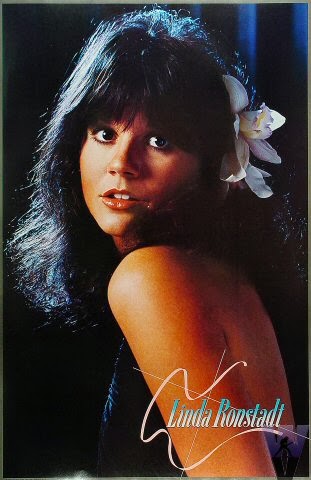
I even bought a poster for my room.  Against a midnight-blue background, Linda looked over her bared shoulder (at me!) with those doe-y, dewy, sultry eyes.  In her hair, she wore a magnolia.  At least I think it was a magnolia; time has dimmed the memory…heck, it was a white flower, of that I’m certain.

I played “Blue Bayou,” “Someone to Lay Down Beside Me” and “That’ll Be the Day” while swaying in the middle of my room and staring at that poster.  Linda stared back, a smile playing at the edges of her lips.  I dreamed of being a backup singer in her band.  Don’t laugh, please.  Like I said, I was young, a bit foolish and very much in love with her music.  I had those kind of teenage-boy dreams where you think anything is possible (making your first million by age 30, sailing a yacht on Cape Cod in the summers, singing “ooo-eeee, baby” behind Linda Ronstadt—you know, those kind of dreams).

Of course, we all know what happens: I grew up, went to college, earned a degree, settled into a comfortable routine of family man.  Life had briefs spurts of excitement marked by Casual Fridays at the office or when I took the family cat to the vet to be dewormed—you know, those kind of things.

Eventually, I outgrew Linda Ronstadt.  Or, perhaps, she outgrew me.  She continued to release albums—big-band ballads, traditional Spanish language tunes, that Fievel-the-cartoon-mouse thing—all of them fueled with her still-powerful voice, but the songs had changed.  They weren’t the assertive-yet-tender love songs that defined my youth.  Linda had gone soft—literally and figuratively—as she grew older.  I moved on to women with a harder edge: Alanis Morrisette, Liz Phair and Fiona Apple (perhaps a little too sharp-edged).

I myself got softer, duller, greyer.  Time has moved on for both of us; we float in boats farther and farther away from Blue Bayou.  But every now and then, I find myself drifting across the lines on the highway and feel the need to pull over to the side of the road when I hear a voice, aching with love, coming from my car stereo speakers: I'm going back someday, come what may....

As much as I like the grungier gals on my iPod, they can never really replace my first love: Linda Ronstadt, Queen of My Teen Dreams.


Monday, October 21, 2013

My First Time: Rochelle Jewel Shapiro


My First Time is a regular feature in which writers talk about virgin experiences in their writing and publishing careers, ranging from their first rejection to the moment of holding their first published book in their hands.  Today’s guest is Rochelle Jewel Shapiro, author of the novel Miriam the Medium, which was nominated for the Harold Ribelow Award.  Rochelle has published essays in NYT (Lives) and Newsweek.  Her second novel, Kaylee’s Ghost, was finalist in the 2013 Indie Awards.  Like the heroine of both of her novels, Rochelle is a phone psychic who also teaches writing at UCLA Extension.  Click here to visit her website.  You can also find her on Twitter and Facebook.


My First Agent

My first agent came to me though one of those cosmic quirks.

In 1985, even though I was psychic myself, I had an appointment with another psychic, a man so famous he had a seven-year waiting list.  He called the day before my appointment and told me he was giving up his practice.  I was in tears.  Then I got an image of a tombstone with his name on it.  “You’re ill,” I said, and he admitted it.  I begged him to tell me one thing about me.

“You’re going to write a novel that will be published by Simon & Schuster,” he said.

I thought he lost his powers with his illness.  Back then I wasn’t writing.  But I thanked him profusely, especially since he said he’d refer all his clients to me.  When I got off the phone, it hit me what he was going through, and I cried.

When I got back to work, my psychic readings felt like carbon dioxide going out into the atmosphere.  To keep something for myself, I started a journal of my psychic experiences.  The more I wrote, the more I began to want to write. Suddenly, those journal entries began to take shape.  Impulsively I sent an essay about the difficulty of being college-educated and being a psychic to the top place I could think of—The New York Times (Lives) column.  I was stunned when they published it.  But what was more surprising were the three interested emails from agents that followed.  “We want to see a novel,” they said.

I wish I could say I sat down and immediately wrote one, but it took seven years to write my first novel, Miriam the Medium, about a psychic and her family, and when it was done, the agents who had previously contacted me said they now had “full plates.”  I studied lists of agents online and sent my manuscript out to one.  My jaw dropped when she agreed to represent me.  A month later, she sold my novel to Simon & Schuster.  How lucky could I get? I thought.

But after the book was out, I wasn’t so lucky.  One day, I called my agent.  Her office phone was disconnected.  I went there, but the door was locked.  “She left a month ago,” the doorman told me.  Shocked, I asked, “Did she leave a forwarding address?”  “No,” he said, “but I have her cell.”  When I called and heard her voice, I was so relieved.

“I’ve been trying to reach you,” I said breathlessly.  Her voice sounded tinny, as if she were far away.  “Where are you?” I asked.

“On a bus.  I only have a minute.”

“I want to talk to you about my new novel,” I said, and then I heard her laugh.

“Oh, I’m no longer in publishing,” she said.  “I quit that rat race.”  She told me she was working for Aflac, the insurance company with the quacking duck.  And just like that, quack, quack, I had no agent.

“But I’ll still be collecting royalties on your book,” she added, and then she hung up.

When I finished my newest novel, Kaylee’s Ghost, a companion book to Miriam the Medium, I wrote queries to a slew of agents.  I was hopeful when one answered, “I adore all things psychic.  Send me the manuscript.”  But unlike my first agent who had read it in no time, she held onto it for months.  Nights I woke up in a sweat from the dream that she’d disappeared.  I began to call to check that she was still in business.  Each time her assistant got snarkier.  “She’s hard at work on her bestselling authors,” she finally snapped.

I confided my woes to a friend.  She recommended her top New York agent, Jack Scovil, a fellow so successful that he owned the agency.  He read the manuscript within ten days.

Kaylee’s Ghost is a book everyone will want to read,” he assured me.

I promised myself not to call to check up on him, but when I hadn’t heard from him for four months, I phoned and found out he had died.

At that point, I had just turned sixty-five.  I said to myself, What are you waiting for?  This was my moment, the first time I took control of my own publishing career.  Despite being unsure about self-publishing, especially after having been published by Simon & Schuster, I published the book myself on Amazon and Nook.  Some of my writer friends were supportive, others were chilly.

“Really?” one said.  “You’re actually….ahem….self-publishing?”

I tried to put her remark out of my mind, but I couldn’t help feeling I’d made a terrible mistake.

One day, on the quiet car of the Long Island Railroad where serious readers commute, I spotted four people intently reading Kaylee’s Ghost in paperback.  One laughed out loud.  Feeling my stare, she looked up at me and whispered, “This book is so good.  You should read it,” and she went right back to it.

If it wasn’t the quiet car, I would have stood up and announced, “I’m the author.”

I’m getting fan mail from everywhere, including Sweden.  Kaylee’s Ghost has gotten five-star reviews and was finalist in the Indie 2013 awards.

Agentless, I go on, grateful to all who aided and abetted me, but thrilled to be representing myself.


Sunday, October 20, 2013

Sunday Sentence: Mayakovsky's Revolver by Matthew Dickman


Simply put, the best sentence(s) I've read this past week, presented out of context and without commentary.


The subterranean elegance of shadows
and the moon like the inside of a jawbreaker
after all the color has been licked off,
all that sweet dye and sugar,
layer by layer
until only the soul of the thing is left, the hard center
that will choke you to death
if you're not careful.

"Gas Station" from Mayakovsky's Revolver by Matthew Dickman


Saturday, October 19, 2013

Baseball, Booze, and Three-Legged Dogs: Metaphor and Meaning in High and Inside by Russell Rowland


High and Inside
By Russell Rowland
Reviewed by Curtis Edmonds

It is always a bad idea to get soppy and sentimental about baseball.  You can do it, of course.  Some people live their lives that way.  But it’s not productive, and it’s not healthy, and I am saying this as a former Dr. Pepper Junior Texas Ranger.  It is perfectly okay to remember your childhood, and sitting in the bleachers, and watching Reggie Jackson and Rod Carew terrorize Rangers pitchers.  But when you do that, you have to remember the salient facts, such as the one about the old Arlington Stadium having those uncomfortable sheet-metal benches, and how, during day games in the broiling Texas sun, the outfield seats would transform into the world’s largest open-air pit barbecue.  Sometimes the past is just the past.


The picture above is one of several iconic images of the destruction of old Ebbets Field, the home of the Brooklyn Dodgers, which was destroyed to build a massive public housing complex after the Dodgers split for sunny Southern California.  I mention this for two reasons.  One is about the danger of getting sloppily sentimental about baseball teams that leave and baseball stadiums that are going to get destroyed eventually, and the other reason is that I couldn’t stop thinking of the image of the wrecking ball made up to look like a baseball while reading High and Inside by Russell Rowland.

High and Inside is neither sloppy or sentimental about baseball, which is to its credit.  The first-person narrator is Pete Hurley, a relief pitcher for the 2004 world champion Boston Red Sox, who decamps for a trailer in the vast echoing outskirts of Bozeman, Montana following what I am going to call a series of personal setbacks.  In both the narrative and the backstory, Rowland portrays Pete as a human wrecking ball, swinging this way and that, and damaging nearly everyone he comes into contact with.  Pete’s actions and reactions are fueled by alcohol and pain rather than physics, but the effect for those around him is much the same.  Almost none of the supporting characters come away unscathed by Pete’s actions—even his loving and devoted dog is missing a leg as a result of one of Pete’s benders.

Rowland writes from Pete’s perspective, and does so with clarity and grace.  He does three things that are more difficult than you might think, and does them effortlessly.  First, he takes a character that is depressed and makes him likable, and relatable.  Depression is painful, for the depressive and others around them, and it’s not always pretty, but the real problem for the writer is that depression is just so horribly consistent.  When you’re depressed, you tend to stay depressed, and having a one-note sad-sack narrator is not always compatible with quality fiction, let’s say.  And long-term depression erodes compassion, so it’s harder to stay with a character who is down all the time.  Part of what Rowland does here is to make Pete’s voice engaging, but the other thing he does is to have Pete building a house, which is something hopeful, and (quite literally) constructive.  It doesn’t do much to keep him out of trouble, but it’s a step in the right direction.

The second thing Rowland does well is to manage the long stretches of loneliness and isolation that Pete undergoes.  Rowland puts Pete alone, in a trailer, in Big Sky country, and periodically lets him stew.  This can be enervating for readers, not to mention claustrophobic, but Rowland uses flashbacks and surprise visits and other methods to break up the inaction.  Even the simple expedient of giving Pete a dog works wonders, not only in giving him something to do but giving him someone to care about.  The supporting characters, when they appear, have a depth and integrity that punctuates the narrative nicely.

The third thing that Rowland does well is to give the reader a sense of place.  Pete is a New England transplant, drawn to Montana by the promise of a peaceful retirement in an unspoiled wilderness.  He finds out that the greater Bozeman area isn’t quite as unspoiled as all that, and that at least some of the locals are a bit resentful of high-hat Easterners wandering in to town and setting themselves up in their own Walden Ponds to commune with nature.  Rowland doesn’t romanticize Montana anymore than he romanticizes baseball; his Bozeman comes complete with dive bars and audio stores and legal clinics.  But he captures local attitudes perfectly, as well as those romantic empty vistas that Pete happens to run across in the novel.

Being a conscientious reviewer, though, I have to take at least minor exception to a couple of small points and at least one large one.  I think that, perhaps, the tragedies that beset Pete Hurley and the people around him are perhaps laid on a little too thick—or that the reader is reminded of them perhaps a little too often.  (Pete ought to be able to go into some bar, somewhere, and not be reminded of the pitch that ended his baseball career every single time.)  I think that Rowland is a little too free with his metaphors; just because a character is emotionally crippled doesn’t mean that you have to give him a three-legged dog.

I have a larger problem with the ending, which is kind of pat and sort of rushed and more than a bit unsatisfying.  Worse than that, the ending feels unearned, especially when balanced against the suffering that Pete has experienced and precipitated.  Without giving anything away, I can say that I understand the philosophy of ending the book as Rowland did, but having the philosophical climax come from a character who plays no other part in the novel seems artificial and wrong.  As flawed as the ending is, though, it shows that Rowland grasps an even more important point: it is always a bad idea to get soppy and sentimental about depression and suffering.  You can do it, of course.  Some people live their lives that way.  But it’s not productive, and it’s not healthy.


Curtis Edmonds is a writer and critic living in central New Jersey.  His novel, Rain on Your Wedding Day, is available for sale at Amazon.com and other fine online shopping destinations.  You can follow him on Twitter at @Curtis_Edmonds.


Friday, October 18, 2013

Friday Freebie: The Hunter and Other Stories by Dashiell Hammett


Congratulations to Sharon Nakagawa and Christine Norris, winners of last week's Friday Freebie: If I'd Known You Were Coming by Kate Milliken.

This week's book giveaway is sure to appeal to hard-boiled mystery fans.  I've got a copy of The Hunter and Other Stories by Dashiell Hammett to put into one lucky reader's hands.  The collection--"Call this volume Hammett Unplugged," co-editor Richard Layman says in his introduction--will be published by The Mysterious Press next month and it's a beauty of a book--not just physically, but for what it represents: previously uncollected writings by one of the most influential American writers of the twentieth century.  Here's the publisher's synopsis for The Hunter and Other Stories:
This volume includes both new Hammett stories gleaned from his personal archives along with screen treatments long buried in film-industry files.  The best of Dashiell Hammett's unfamiliar treasures have been rescued from deep in these archives: screen stories, unpublished and rarely published fiction, and intriguing unfinished narratives.  Hammett is regarded as both a pioneer and master of hard-boiled detective fiction, but these dozen and half stories that explore failed romance, courage in the face of conflict, hypocrisy, and crass opportunism, show him in a different light.  The collection also includes two full-length screen treatments.  "On the Make" is the basis for the rarely seen 1935 film Mr. Dynamite, starring a corrupt detective who never misses an opportunity to take advantage of his clients rather than help them.  "The Kiss-Off" is the basis for City Streets (1931), with Sylvia Sydney and Gary Cooper caught in a romance complicated by racketeering's obligations and temptations.  Like the screen stories from Return of the Thin Man, they read as novellas--rich in both story and character.  Publication of these new volumes is due to the passion of Julie M. Rivett, Hammett's granddaughter and a well-regarded Hammett scholar, as well as Richard Layman, the author of the first full-length biography of Hammett, Shadow Man, the definitive bibliography, and other works.  Rivett and Layman are trustees for Hammett's literary estate and have co-edited two previous Hammett volumes: Selected Letters of Dashiell Hammett and Dashiell Hammett: A Daughter Remembers.  The Hunter and Other Stories will appeal to longtime Hammett fans, and introduce a new generation to one of the most influential voices in American fiction.

If you'd like a chance at winning The Hunter and Other Stories, simply email your name and mailing address to

Put FRIDAY FREEBIE in the e-mail subject line.  One entry per person, please.  Despite its name, the Friday Freebie runs all week long and remains open to entries until midnight on Oct. 24, at which time I'll draw the winning name.  I'll announce the lucky reader on Oct. 25.  If you'd like to join the mailing list for the once-a-week newsletter, simply add the words "Sign me up for the newsletter" in the body of your email.  Your email address and other personal information will never be sold or given to a third party (except in those instances where the publisher requires a mailing address for sending Friday Freebie winners copies of the book).

Want to double your odds of winning?  Get an extra entry in the contest by posting a link to this webpage on your blog, your Facebook wall or by tweeting it on Twitter.  Once you've done any of those things, send me an additional e-mail saying "I've shared" and I'll put your name in the hat twice.


Tuesday, October 15, 2013

Trailer Park Tuesday: Three Scenarios in Which Hana Sasaki Grows a Tail by Kelly Luce


Welcome to Trailer Park Tuesday, a showcase of new book trailers and, in a few cases, previews of book-related movies.


"The year we lived in Japan, the volcano at the edge of town hiccuped, covering everything in six inches of heavy, golden dust.  No one could remember anything like it.  Children poured outside to play wearing bathing suits and surgical masks.  Housewives vacuumed the street." That's the first, but not the last, of the surreal images from Kelly Luce's Three Scenarios in Which Hana Sasaki Grows a Tail we hear about--and see in animated sand--in this short video promoting the story collection.  In this trailer, we also meet a toaster which predicts how people will die, and we step into the shower with the titular Hana Sasaki as she shampoos her new tail (which is "thin, dark gray when wet, and the hair at the base rises out slightly from her back before wilting and following the curve of her bottom").  Luce's debut is being published by the new small press A Strange Object based in "keeping-it-weird" Austin, Texas.  They're dedicated to publishing "surprising, wild-hearted fiction."  Golden ash, oracular kitchen appliances, tail-sprouting girls: yep, I think Luce's stories are a perfect fit for that mission statement.  This collection of ten stories is the first (and so far, only) book published by A Strange Object.  I'm encouraging everyone to support this new publisher.  I mean, when was the last time you took a chance on a brave, young upstart?  I have a copy of Three Scenarios in Which Hana Sasaki Grows a Tail sitting high atop my ever-growing stack of To-Be-Read Books (aka Mt. NeveRest) and I'm impatient to clear enough time on my schedule to settle in with this fiction.  Until then, though, I think I'll keep a wary distance from my toaster.


Monday, October 14, 2013

My First Time: Susanna Sonnenberg


My First Time is a regular feature in which writers talk about virgin experiences in their writing and publishing careers, ranging from their first rejection to the moment of holding their first published book in their hands.  Today’s guest is Susanna Sonnenberg, author of She Matters: A Life in Friendships and Her Last Death: A Memoir.  Elizabeth Gilbert had this to say about She Matters: “Yes, I have always said that I wished somebody would write a book just exactly like this—yet you will notice that I never wrote it myself.  To be honest, I would not have had the courage to be as honest and searching as Sonnenberg has been here.  I admire her greatly for it.”  Susanna was born in London and grew up in New York.  Her essays have appeared in Elle, O, the Oprah Magazine and Parenting, among other magazines.  Click here to visit her website.  You can also find her on Facebook and on Twitter.


My First Bad Review

I only read it once.  I scrolled through the review fast—that first trumpeting sentence was hideous enough—and then fled the site, as if afraid of infection.  In fact, I was nauseated.  In a prominent paper a critic had savaged my first book, out only a few days.  The critic had savaged me, both as the subject of the memoir and its author.  I saw, in the blur of speed reading, my passionate intentions dismissed, my character ridiculed, and the events of my life questioned.

Oh, the vulnerability of this moment—the craven greed for recognition plus the naked fear.  How susceptible I was to humiliation, even as I struggled to accept that whatever happened to my book from here on out would not be within my control.  In the preceding days, lovely praise had come, and I’d been basking in a sense of gratified accomplishment.  This peace and cautious pride were shattered by the critic’s sneering vitriol, each paragraph imbued with a hateful contagion.  I’d spent two years (and a lifetime) writing the memoir.  Six months before publication, when the galley arrived from my editor, I carried it around in my arms as I had my newborn sons, proud and amazed, wishing to show off something beautiful and of my own making.  And why not?

Yet the book, published, distributed, for sale, was no longer mine.

We don’t write for the reviews.  We write because we are obsessed by some idea that needs clarity, that demands the right words, and I enjoy the craziness that is borne of this obsession.  Turning over a problem compulsively, whether of craft or theme, I am filled with purpose.  When finally I hit upon an expression that is both apt and graceful, I feel exultant, also relieved.

But life as a published writer has the inescapable component of reception.  As with everything in my life and work as a writer, avoiding negative reviews takes effort, especially in the age of such ready access.  A friend of mine, prominently published, reads neither good reviews nor bad of his books.  So he says, and I almost believe him.   Anyway, these days the reviews find you, forwarded by well-meaning friends, posted across several sites.  The only hope of avoiding them is to have no Facebook account and to resist Googling your name, disciplines that escape most of us.  Damn Amazon, too, for its blaring front-page splash of readers’ comments.  But cultivate that discipline.  To paraphrase the writer and linguist Michael Erard, none of that extremely available, often disposable, endlessly generated shit helps you write.  If anything, it muffles the resonance of your writing voice and diminishes the soul.

Writer, is the world against you?  You bet.  But we don’t need the bad review to teach us how to be humiliated.  There have always been lessons: the bully in gym class, the parent’s careless put down, the back of the line at the airport, the hidden fees from the phone company, the NSA’s blithe harvesting of our “private” information.  Yet on we go, making meaning out of the things we hold as important, exploring our passions and finding grace therein.

Go ahead, read the praise.  Writing is a lonely business which subjects you relentlessly to bitter misgivings, the voice in your head that tells you to stop, not to bother, that you’re no good.  We need all the support we can get, and praise is a perfectly respectable, if temporary, antidote.  Praise is not, however, an education.  Nor is the negative review a useful education.  The only thing the bad review does, as far as I can tell, is drive you to previously unmined levels of self-doubt, killing a writing day (or week).

After the nausea wore off, after that first book had been out on its own in the world a couple of weeks, I put that wretched review on my website alongside the others—the positive ones, the ambivalent ones, the clueless ones.   Art should provoke discussion, and discussion needs to be primed by opposing ideas.  Although the author’s mean-spirited wrath had hurt my feelings—simple as that—it didn’t alter my path, nor defeat my faith in the work itself.  Instead, the reviewer gave me a quick, cold, and essential lesson in letting go.

Recently, I was comforting a friend who received a very bad review.  I mentioned mine, and he asked who wrote it.   To my great pleasure I found that I couldn’t remember the name of that spiteful, ill-tempered bully.  I could easily look it up, but I think I won’t.

Author photo by Marion Ettlinger


Sunday, October 13, 2013

Sunday Sentence: The Impossible Lives of Greta Wells by Andrew Sean Greer


Simply put, the best sentence(s) I've read this past week, presented out of context and without commentary.


He came to me, the little boy, on tiny sheep-white socks.  He threw himself into my arms, and I was overcome by the softness of him, the scent of sour milk and jam, the slight crackle of his ironed green romper, embroidered in a wigwam pattern across the front, with its stiff white collar and sleeves so that he was Pilgrim and Indian all in one.


Friday, October 11, 2013

Friday Freebie: If I'd Known You Were Coming by Kate Milliken


Congratulations to Susan Warner, winner of last week's Friday Freebie: The Fountain of St. James Court by Sena Jeter Naslund.

This week, I have two copies of the new short story collection If I'd Known You Were Coming by Kate Milliken to put in two lucky readers' hands.  I spotlighted Milliken's fiction in the latest installment of the Front Porch Books feature (click here to read the opening lines of the collection's first story), and here's more about what you'll find between the covers of this book:
In these twelve award-winning stories, Kate Milliken unflinchingly shows us what can happen when the uninvited guest of our darkest desires comes to call.  Whether surrounded by the white noise of a Hollywood celebration or enduring a stark winter in Maine, the characters of If I’d Known You Were Coming yearn to heal old wounds with new hurts.  With a wry wit and a keen eye for emotive detail, the author of this unforgettable collection sets intersections in motion that will leave you both winded and wanting more.  In one story, a mother, driven by greed, unwittingly finds out how far her needs will push her.  A hand model surprises himself and everyone else at the birthday party of an old friend’s daughter in another.  With poetic deftness, a woman evaluates the meaning, the familial stories, that we carry with us from birth.  In a story ripped from the headlines, a woman pines for the legs her husband lost in a freak accident at a Santa Monica farmer's market.  A medical clerk, restless and alone, takes advantage of a disabled neighbor.  Kate Milliken knows the ties that bind and how tautly we will pull them.  These are stories about desire, betrayal, love, regret, and family.  Like all great fiction, If I’d Known You Were Coming possesses that uncanny ability to reveal us to ourselves.
Here's what Julie Orringer had to say about If I'd Known You Were Coming: “Kate Milliken's stories burn straight to the darkest places in our hearts, speaking aloud the thoughts we hardly dare to call our own.  In twelve flawless pieces, Milliken expertly illuminates the aftermath of abandonment; her characters, cast adrift, find themselves painfully alone, futilely seeking what was torn away long ago.  Milliken writes with merciless precision about women and men, about the old and the young, about the betrayers and betrayed.  You will stay up all night to learn the fates of these people, who will become as real to you as anyone you know.”

If you'd like a chance at winning a copy of If I'd Known You Were Coming, simply email your name and mailing address to

Put FRIDAY FREEBIE in the e-mail subject line.  One entry per person, please.  Despite its name, the Friday Freebie runs all week long and remains open to entries until midnight on Oct. 17, at which time I'll draw the winning name.  I'll announce the lucky reader on Oct. 18.  If you'd like to join the mailing list for the once-a-week newsletter, simply add the words "Sign me up for the newsletter" in the body of your email.  Your email address and other personal information will never be sold or given to a third party (except in those instances where the publisher requires a mailing address for sending Friday Freebie winners copies of the book).

Want to double your odds of winning?  Get an extra entry in the contest by posting a link to this webpage on your blog, your Facebook wall or by tweeting it on Twitter.  Once you've done any of those things, send me an additional e-mail saying "I've shared" and I'll put your name in the hat twice.