Monday, November 17, 2014

My First Time: Lee Upton


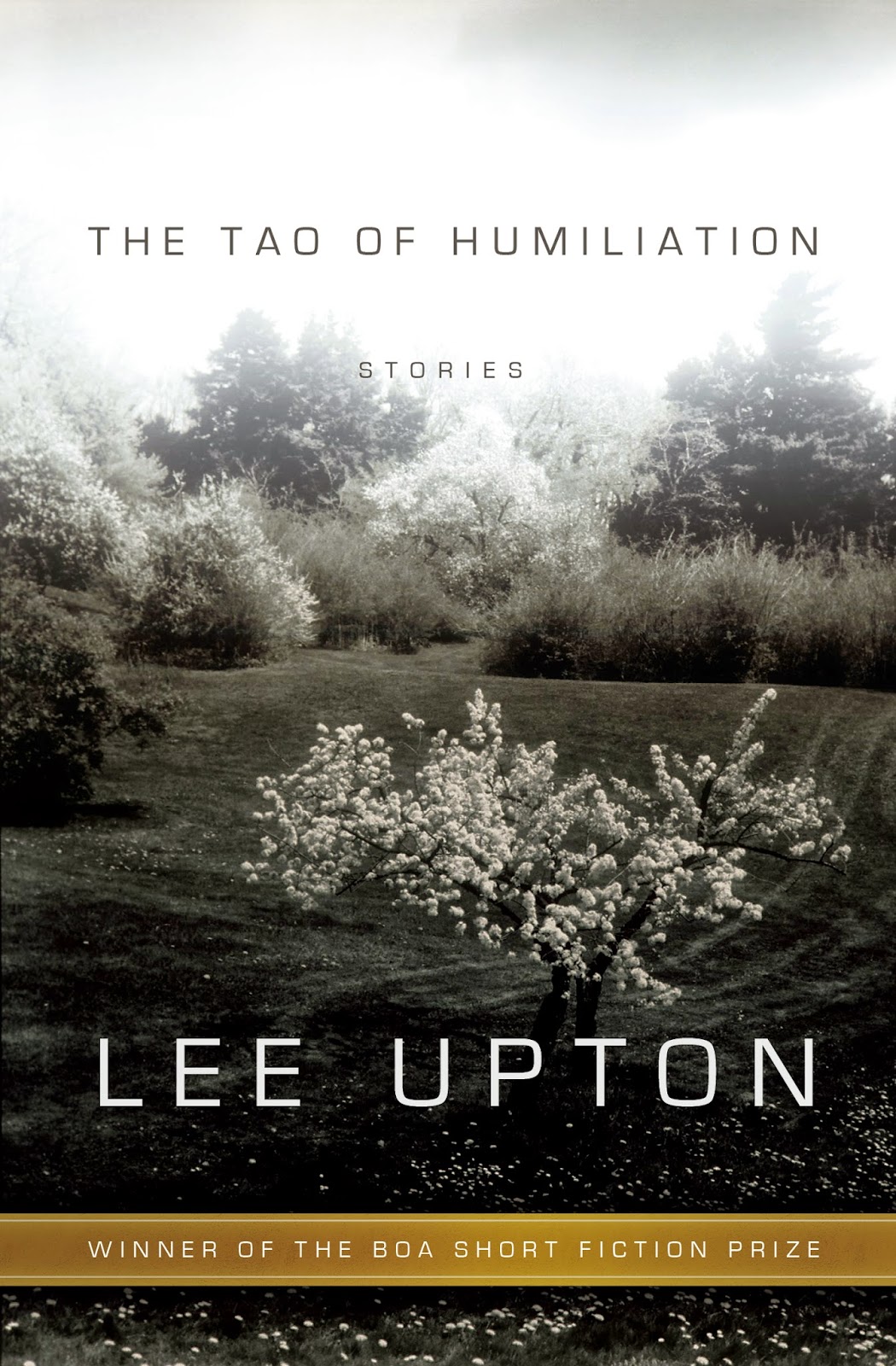
My First Time is a regular feature in which writers talk about virgin experiences in their writing and publishing careers, ranging from their first rejection to the moment of holding their first published book in their hands.  Today’s guest is Lee Upton, author of The Tao of Humiliation: Stories (BOA Editions, 2014), and a forthcoming book of poetry, Bottle the Bottles the Bottles the Bottles, this year’s recipient of the Cleveland State University Poetry Center Open Book Prize.  Her work has appeared in The Atlantic MonthlyNew Republic, American Poetry Review, Harvard Review, and DoubleTake.  She is a professor of English and the writer-in-residence at Lafayette College.

My Many First Times

The first time I published anything outside of school publications:
      I had gone to a poetry festival in Grand Rapids, Michigan.  A famous poet at the festival offered to look at poems by those in attendance.  My bus was leaving soon, and so I fought down my shyness and hurried over to him.  After reading my poems he said, without hesitation, “These could be so much worse.”
      That was all the encouragement I needed.  I rode the bus home, writing madly, in love with possibility.  And the poem I wrote on that bus became my first published poem.  It wasn’t a good poem, but that doesn’t matter now.

The first time people laughed when I read aloud something I wrote:
      The poem was called “Jesus on a Tortilla.”  This was before there were so many sightings of that sort.  I thought of the poem as a simple sequence of observations.  But the first time I read it—in a cafeteria somewhere—people laughed and kept laughing.  The poem probably isn’t funny anymore, but the laughter I heard was so unexpected that I was startled.  To be funny felt useful.  It lifted people—and lifted something from them.  Funny was helpful.

The first time I learned a book of mine would be published:
      The phone call came from a stranger.  My book was going to be published by the University of Alabama Press.  Thomas Rabbitt spoke to me for a while, explaining what the process of publication involved.  I thanked him and hung up.
      Within an hour I called him back.  It wasn’t one of those cases where I thought that maybe I had received a crank call.  I called him back because I thought I might have hallucinated his call.  When I asked him if he had actually called me, he told me not to worry about thinking I’d hallucinated the call.  He said my reaction was normal, even though it wasn’t.  I’ve always been grateful for his kindness.
      Next I called my mother.  At first I was so excited I could hardly speak.  Then I spoke.  Here’s a basic reprise of the conversation:
      Me: “Mom!  Mom!  I can’t believe it!  My book is going to be published!”
      My mother: “Good for you.  There’s a dog here and she’s in heat.  This dog is in heat.  I’m taking care of Evelyn’s dog and she’s in the garage and tearing down the garage door.  This dog is in heat.”
      And so on.  The entirety of the conversation was about that dog.  That dog in heat.

The first time I held a book I’d written:
      A box of books arrived from the publisher.  I opened the box, pulled out a freshly minted copy of my own book, and sat down on the floor, bewildered.  I knew what books were like, obviously, but somehow it seemed as if my writing—all that yearning—shouldn’t actually fit inside two covers.  I knew I was being idiotic.  Especially because it was a slim little book.  But I sat there on the floor, staring at the book, as if waiting for it to do something.  I’ve never had a similar reaction again, and while I was thankful beyond words to have a book, I was also weirdly baffled beyond words.  Could this be my book—something I could hold in my hands?  Shouldn’t the book inflate and fill the entire room?

The first time I managed to kill off a character:
      I don’t remember the first time.  For the longest time I didn’t think I could allow any character to die.  Then I looked at some of my fiction, saw I’d already done it, and realized: Oh no!  I could call this book Everybody Dies.

The first time I raised a character from the dead:
      In a long-standing version of one of my stories the main character dies.  She kept dying through many revisions—over years.  She stayed dead in a published version of the story.  But when I revised the story for inclusion in The Tao of Humiliation, I couldn’t let her die again and she doesn’t.  I think now that she never should have died and that I just had to work for a very long time to discover how to resurrect her.  That’s one of the wonderful ways in which fiction is not like life.


Sunday, November 16, 2014

Sunday Sentence: The Sasquatch Hunter's Almanac by Sharma Shields


Simply put, the best sentence(s) I’ve read this past week, presented out of context and without commentary.


It was a dreary Wednesday in early October when Eli informed Gladys that he planned to give up his flourishing podiatry practice and pursue, full-time, the region's elusive Sasquatch.

The Sasquatch Hunter's Almanac* by Sharma Shields


*Sharma Shields' debut novel will be published in early 2015.  But you should pre-order this weird, funny, totally-awesome book NOW.  That's a demand, not a request....Come on, don't make me send Bigfoot to your house to break all your fingers and eat all the food in your refrigerator....Because I will, you know....I will!  I have him on speed-dial, and he owes me a favor.  Just pre-order the book and everything will be cool.


Saturday, November 15, 2014

Soup and Salad: The Reading Habits of Authors, Finish That Book!, Joseph Heller's Long-Forgotten Musical Comedy, Is the Party Over for Amazon?, The Bad Idea Company, O-Dark-Thirty Sheds Light on Veterans, Bill Wolfe Reads Her Like an Open Book


On today's menu:

1.  Tim Horvath does it in the bathtub, Anthony Wallace did it at the beach, Judy Chicurel likes to do it on the couch at sunset, and Jon Clinch does it wherever he can.  And me?  Well....
The spot where I most frequently find myself with a book is a small, solitary spot tucked away from the bustle of human distraction. It’s a quiet Nirvana with only the occasional sound of rushing water to break the stillness. Yes, the bathroom—or water-closet, if you prefer the more refined approach—is where I get about 63 percent of my reading done. Apparently, judging by the reactions when I posted this on Facebook (“Eww!”, “I didn’t need to know this”), some people have a problem with my personal paradise. Maybe they don’t like the image of me perched on the porcelain throne, pants around my ankles, taking care of business. But I don’t want to dwell on the evacuation properties of this scenario (“waste out, words in”); I prefer to focus on why it makes the ideal reading spot.
Overshare much, Abrams?  Maybe, but you should check out the "Here I Read, There I Read" feature at Bloom anyway.


2.  I'm going to make a statement which may incense and inflame: If you don't finish reading a book, if you grow bored and abandon it midway through, if you treat books like chocolates nestled in a box and sample them with one bite before putting them back in the little brown paper cup, THEN YOU'RE WRONG.  That's the stance of Juliet Lapidos in The Atlantic, anyway:
To drop a novel after a few chapters is, then, to disregard what makes it a formal work of art rather than a heap of papers that reside in a desk drawer. Today, books and authors need all the help they can get; if you care about literature as an artistic endeavor and the people who create it, then you should do so fully. If you consider yourself a literary person, you shouldn't just embrace the intellectual cachet that starting books gives you. Starting, but not finishing, books is one step above saying, "Oh yeah, I've heard of that author."
I happen to agree with Ms. Lapidos--at least to a certain extent (I don't buy the whole "finish it for the endurance" strength training argument).  Like her, I'm a completist.  I can count on one hand the number of books I've started reading as an adult and stopped before I reached the last page (one of them, Jubilee Hitchhiker, William Hjortsberg's terrific biography of Richard Brautigan, was simply put on "pause" because it's such a massive book that I want to give it my full attention when the time is right).  Like the Atlantic article mentions, I'm probably in the minority, but so far that hasn't stopped me from not-stopping.


3.  I consider myself pretty familiar with the life of Joseph Heller, but when I stumbled across this article in Hazlitt, Penguin Random House of Canada's online magazine, I was brought up short:
In July 1962, Joseph Heller was open to any offers that came his way. Catch-22 was showing few signs of success: published nine months earlier, it was selling slowly. Heller and his family had left Manhattan behind to spend the summer on Fire Island. He was restless, worried about money, and eating enough for three. Late at night, he would sit outside on the deck of his house, waiting for something to happen. One day, something did, a thick envelope arrived with a pitch inside: would he be interested in writing the script for a new musical, Howe & Hummel? His collaborator would be a prominent composer, Harold Rome, whose latest show featured Barbra Streisand’s Broadway debut. The subject was two 19th century lawyers, William Howe and Abraham Hummel, and the scams they ran in New York. With his novel seeming more of a misfire than a blockbuster, Heller jumped at the chance.
And here's the postscript:
Howe & Hummel has never been performed. It hasn’t even been published. In the 50 years since Heller completed it, it’s never had so much as a public reading. Only two copies of the typescript survive, while more than 10 million copies of Catch-22 have been sold.
Do I smell an Off-Broadway revival?  (Or maybe just "vival" since the play was never alive in the first place.)


4.  Amazon and Hachette have apparently settled their long, muscle-straining arm-wrestling match over e-book pricing, but this article in Seattle Weekly (which came out prior to the announcement of the settlement) wonders, "Is the party over for Amazon Publishing?"  It's a long article, but well worth the read for anyone interested in the current state of publishing.


5.  If you aren't over-Amazoned after reading that, you might want to take a look at Keith Gessen's piece in Vanity Fair, in which he writes: "all the publishers feel bullied by Amazon, and Amazon, in turn, feels misunderstood."  There's a lot more to it, of course; but that seems to be the crux of the issue in which, like that spot-on illustration shows, two armies have lined up on opposite sides of the book world.  Here's another gem from Keith Gessen's article:
One of the interesting things about Amazon in its early years was the number of bad ideas it had. It was a bad idea to sell heavy home-improvement equipment on the Amazon site and charge a pittance for shipping, and it was a bad idea to consider storing merchandise in the apartments of college students living in Manhattan, so that the students could make deliveries in their neighborhoods. (The company had enough trouble worrying about theft at its warehouses; how was it going to monitor the apartments of kids?) Some people even thought that selling books was a bad idea.
And these un-tame words from literary agent Andrew "The Jackal" Wylie:
      The issues at the heart of the conflict are both margin and price, according to Wylie. Publishers have been slow to recognize the danger of percentage creep, he told me. “There was a European publisher in here recently who proudly sat on that sofa and said, ‘I’ve worked everything out with Amazon. I’ve given them 45 percent.’ I said, ‘Really?’ He said, ‘But they wanted 50 percent.’ ” The European publisher thought he had won. Wylie stared incredulously at the memory of this encounter. “He’s a moron!”
      Losing the fight over margins would be an immediate blow to the publishers’ profits, but losing control over pricing could be fatal. “If Amazon succeeds,” said Wylie, “they will lower the retail price—$9.99, $6.99, $3.99, $1.99. And instead of making $4 on your hardcover, you’ll be making 10 cents a copy on all editions. And, Keith, you will not be able to afford to write a book.… No one, unless they have inherited $50 million, will be able to afford to write a serious work of history, of poetry, of biography, a novel—anything. The stakes are Western culture.”
      Western culture I could take or leave, but the part about me sent a chill down my spine. This is not what you want to hear from your literary agent. Surely we’ll think of something, I said to Wylie, if Amazon does win?
      “You think?”
      Wylie was not in the mood for a pep talk.
      And yet he believed that the publishers had finally wised up. Not only Hachette but HarperCollins and Simon & Schuster had started negotiations with Amazon, and none of them seemed willing to agree to Amazon’s demands. Perhaps a new era was beginning. Pointing to my Kindle, Wylie asked, “What if all the publishers pulled all their books from that fucking idiot device? Then what would you read on your silly Kindle?”
      But doesn’t Amazon deserve something for building the device, for making it work?
      “If the Kindle didn’t have any books on it, guess how many Kindles would be selling,” Wylie said, putting up his fingers to indicate zero Kindles. “They want the books, and they want the publishers’ profits, too? They should get nothing. Zero.”
Gessen even takes us on a trip to Amazon's Lab126 where Kindles are routinely abused--all in the name of science and commerce:
After meeting the designers and engineers, I went down to the Kindle stress-testing lab, where various machines twisted the Kindle and dropped it and tumbled it around as if in a dryer. There was a machine that specialized in tapping the Kindle, pressing the on-and-off button thousands of times, until the Kindle couldn’t take it anymore. There was a machine that sprayed a salty mist over the Kindle, because the devices are frequently taken to the beach. All of this testing was monitored by quiet, serious people in light-blue lab coats who looked as if they had once worked for Dr. No.


6.  And now we move to a battlefield of a more traditional kind.  The latest issue of O-Dark Thirty is now out--and, not to take anything away from the contents, but that cover art alone is worth the price of admission.  O-Dark-Thirty is a quarterly literary journal by and about veterans, service members and military family members.  I haven't yet had a chance to read this latest issue, but a quick skim yields some treasures:

      I wake to the nudge of a boot in my side. It’s my turn in the gun.
~"Shadows in the Night" by Christopher Baumer

      He spoke in a monotone, as though reciting a prayer learned in childhood, and he never looked me in the eye.
      “We were in a little village outside of Al-Karmah,” he began, “about sixteen clicks northeast of Fallujah. Karmah, ha! What a dumb name. It was the most violent city in Iraq.”
~"Imagining Iraq" by Bárbara Mujica

if they wanted me
to collect a check
buy expensive
shoes wear a tie
pay taxes sleep
at night raise
a son teach
him how to be
a man if they
wanted me
to live
why did
they give me
this gun
      ~"20 to Life" by David Bublitz
Full Disclosure: O-Dark-Thirty was kind enough to publish an interview with yours truly in this issue.  If you'd like to read about my Writing Habits, you can scroll down to page 103.  But I'd highly advise making pit stops at some of the other stories, essays and poems along the way.


7.  If you haven't yet discovered Bill Wolfe's blog, Read Her Like an Open Book, you're missing some insightful and lively writing about the joys of reading.... women.  Bill is a deeper-voiced champion of literature by females and God bless him for doing that.  VIDA counts aside, I know I need to do a better job of balancing the sexes on my reading list.  Of the 83 books I've read so far in 2014, only 32 were written by women.  I generally resist "quota reading" and go where my interests take me, but after reading Bill's blog, I certainly won't lack for recommendations.  I'd suggest starting with the recent "My Favorite Books of 2014" post which includes links to reviews of books like Katey Schultz' Flashes of War:
Schultz has performed an impressive feat of imagination with Flashes of War, putting us in the shoes — and heads — of all of her characters, providing a chorus of voices telling us the various truths about the last 12 years of war. When you are finished reading these compelling and flawlessly written stories, you too will be changed.
I second that emotion, Bill!


Friday, November 14, 2014

Friday Freebie: Win a signed copy of Life Drawing by Robin Black


Congratulations to Tim Horvath, winner of last week's Friday Freebie, The Forgers by Bradford Morrow.

This week, one lucky reader will win a signed copy of Life Drawing, the debut novel from Robin Black, author of the short story collection If I Loved You, I Would Tell You This.  Some of you have probably had Robin's novel on your wish list for a long time; now is the chance to try a win a copy (and if you're name isn't drawn, I highly recommend you pony up a couple of Alexander Hamiltons to add it to your home library).  For those of you who have read it and are fiercely clinging white-knuckled to your copy, here's your chance to win a signed hardback to give away as a holiday gift.  And for those of you who have no idea what I'm talking about, read on for more reasons why Life Drawing should be near the top of your To-Be-Read pile...

In Life Drawing, her gorgeously written first novel, Robin Black unfolds a fierce, honest, and moving portrait of a woman, and of a couple’s life—the betrayals and intimacies, the needs and regrets, the secrets that sustain love and the ones that threaten to destroy it.  Augusta and Owen have moved to the country, and live a quiet, and rather solitary life, Gus as a painter, Owen as a writer.  They have left behind the city, and its associations to a troubled past, devoting their days to each other and their art.  But beneath the surface of this tranquil existence lies the heavy truth of Gus’s past betrayal, an affair that ended, but that quietly haunts Owen, Gus and their marriage.  When Alison Hemmings, a beautiful British divorcée, moves in next door, Gus, feeling lonely and isolated, finds herself drawn to Alison, and as their relationship deepens, the lives of the three neighbors become more and more tightly intertwined.  With the arrival of Alison’s daughter Nora, the emotions among them grow so intense that even the slightest misstep has the potential to do irrevocable harm to them all.  With lyrical precision and taut, suspenseful storytelling, Black steadily draws us deeper into a world filled with joys and darkness, love and sorrows, a world that becomes as real as our own.  Life Drawing is a novel as beautiful and unsparing as the human heart.

And here's some nice Blurbworthiness to topple you fence-sitters:

“In her debut novel, Black skillfully conveys the way a long-term relationship can so easily shift between love and affection and a petty tallying of old hurts and disappointments.  In addition, she delivers a hair-raising portrait of a poisonous female friendship.  Full of emotional turmoil yet subtle in its effect, this elegant novel is sure to draw in both women’s-fiction and literary-fiction fans.”
Booklist

“The simple facts—Gus’s relationship with Owen, her love affair with Bill—are, of course, not simple.  [Robin] Black is a writer of great wisdom, and illuminates, without undue emphasis, the flickering complexity of individual histories. . . . The atmosphere of their love, of this house, is one of the most powerful aspects of Black’s unsettling and compelling novel. . . . [Her] taut, elegant prose is both effective and affecting. . . . Life Drawing is at once quiet and memorable.  This makes it far from fashionable, and all the more to be applauded.  Its author pursues real and vital questions.  Astringent and wise, Black is not afraid to discomfit her readers.  This novel, like life, is uneasy: what a relief.”
—Claire Messud, The Guardian (UK)

BONUS: If you haven't already read it, you should check out Robin's contribution to the "My First Time" series here at the blog.

If you’d like a chance at winning Life Drawing, simply email your name and mailing address to

Put FRIDAY FREEBIE in the e-mail subject line.  One entry per person, please.  Despite its name, the Friday Freebie runs all week long and remains open to entries until midnight on Nov. 20, at which time I’ll draw the winning name.  I’ll announce the lucky reader on Nov. 21.  If you’d like to join the mailing list for the once-a-week newsletter, simply add the words “Sign me up for the newsletter” in the body of your email.  Your email address and other personal information will never be sold or given to a third party (except in those instances where the publisher requires a mailing address for sending Friday Freebie winners copies of the book).

Want to double your odds of winning?  Get an extra entry in the contest by posting a link to this webpage on your blog, your Facebook wall or by tweeting it on Twitter.  Once you’ve done any of those things, send me an additional e-mail saying “I’ve shared” and I’ll put your name in the hat twice.


Tuesday, November 11, 2014

Trailer Park Tuesday: The Great War by Joe Sacco


Welcome to Trailer Park Tuesday, a showcase of new book trailers and, in a few cases, previews of book-related movies.


"My name is Joe Sacco and I'm a cartoonist."  That's a strong candidate for Understatement of the Year because Sacco is much more than a "cartoonist."  As anyone who's read his masterpiece of wordless narrative The Great War knows, Sacco is a storyteller, a moralist, a historian, an artist of the highest order who has done much more than give us a 24-foot "cartoon" of combat.  The Great War is an unforgettable visual experience which will churn up a roil of emotions as you slowly move your eyes from left to right across its great length, unfolding the panels which reveal the horror and humanity of World War One's trench warfare.  In one continuous scroll of action, Sacco takes the reader through the events of a single day: July 1, 1916--the first day of the Battle of the Somme.  It was a day which "overall, turned out to be a disaster for the British," Sacco says in the book's trailer.  Ten thousand British soldiers were killed in the first hour alone.  Go back and read that sentence again: the first hour.  It didn't get much better after that, as Sacco so poignantly tells us without uttering a single word.  The Great War is printed on heavyweight accordion-fold paper and demands that you read it slowly, trying to absorb all the little details Sacco includes.  He says he wants readers to view it "as if you're looking at the world from above, somehow removed, and you're just observing what's going on without being told what's going on...and you begin to think what an amazing human endeavor war is, and you begin to think about how that's where humanity really puts its efforts."  War is something which most of us continuously fool ourselves into thinking happens to someone else Over There.  Sacco forces us to confront the consequences of what happens when we send those "someones" to war.  He raises important questions in the course of just 24 beautifully-illustrated feet of this tapestry of combat and reminds us that on July 1, 1916, some of the British soldiers didn't even make it 24 feet beyond the lip of their trench as they tried to rush the German forces on the other side of "No Man's Land."  The Great War is a graphic novel in all senses of the word; but in its grisly depictions of torn-apart men flying up from the blast of an artillery shell, the book is a sad, honest account of the cost of combat.  We cannot look away.  We should not look away.


Monday, November 10, 2014

My First Time: Kelly Jones


My First Time is a regular feature in which writers talk about virgin experiences in their writing and publishing careers, ranging from their first rejection to the moment of holding their first published book in their hands.  Today’s guest is Kelly Jones, author of Evel Knievel Jumps the Snake River Canyon...and Other Stories Close to Home, a novella and short story collection published by Ninth Avenue Press.  Kelly grew up in Twin Falls, Idaho, and attended Gonzaga University in Spokane, Washington, graduating with a degree in English and an art minor.  She is also the author of three novels: The Woman Who Heard Color (2011), a story of family loyalty, banned art, and creative freedom; The Lost Madonna (2007), set in Florence, Italy; and The Seventh Unicorn (2005), inspired by The Lady and the Unicorn Tapestries in the Cluny Museum in Paris.  A fourth novel, Lost and Found in Prague will be released in 2015.  Kelly lives in Boise, Idaho with her husband.  Click here to visit her website.

My First Giveaway

After publishing three novels with Berkley/Penguin and selling a fourth for release in January 2015, I formed my own little company to publish a small book, a novella and short story collection, Evel Knievel Jumps the Snake River Canyon...And Other Stories Close to Home.  I knew this would be a completely different experience than publishing through a large internationally-recognized corporation.  I decided to do a promotional giveaway--get the book out there, hope someone will read it and spread the word.

The e-book offer involved little effort and no cost on my part.  The second part of the promotion involved real books (old-fashioned paper) offered through Goodreads.  I had to decide how many to give away and determine the reach of the promotion.  It would be the publisher’s (that’s me) responsibility to send the books out to the “winners.”

I started out thinking maybe five books.  The U.S. postal service has a media rate to send books and I figured I could do that with limited expense.  I would open the giveaway to U.S. residents only.  Then, for some reason, I decided to do a ten-book giveaway, and then, the more I thought about it, I realized I’ve sold books around the world with more than a dozen translations of my Berkley Books (The Seventh Unicorn, The Lost Madonna, and The Woman Who Heard Color), so why not extend my reach on this one, too?  I did a little research, checking online to learn about the experiences of other writers, and determined that maybe a couple of my ten books might go to overseas readers.  The book is written in English, no translations (yet), so I knew only English-language readers would enter.

With anticipation, I opened my email from Goodreads the day after the promo ended to see a list of my winners.  To say I was shocked is an understatement.  Out of the ten books, eight would go to foreign locations!

Several years ago, I’d sent a book to Romania and, as I recalled, the postage hadn’t been ridiculously high, so I went online to set my mind at ease.  Well, postal rates have certainly increased.  For a brief moment, I thought about not sending the books at all.

I packed up one book and headed to the post office to weigh the package, recheck my calculations, make sure it could go, nicely packed, to Israel, New Zealand (two books), Peru, Saudi Arabia, Denmark, the Philippines, and Great Britain.  I also wanted to pick up any required customs declarations.

I spent the better part of a day filling out forms, signing books, bubble wrapping, packing, addressing book-sized manila envelopes with addresses that contained such descriptions as Lower Hutt and Al-Amen Neighborhood.  I started to Google some of the places I’d never heard of, looking at photos, imagining the recipients of my little book, the title story set in my hometown of Twin Falls, Idaho, hoping they would all be delighted.  Then I envisioned one of my “winners” selling the book on the street!  As a fiction writer I make up stories, and admittedly my imagination sometimes takes over as if I’m not the one steering the ship.  I wanted to have some control over this, so I pictured a big-time Hollywood producer on an exotic vacation.  He strolls by the makeshift kiosk, stops and rummages through a stack of old, used, mostly obscure books.  But my little jewel, brand new and brightly colored, stands out.  He picks it up, reads the cover, opens it.  He’s intrigued.  So he buys it, takes it back to the hotel and stays up all night reading the stories.  He loves it!  He tracks me down through my website, emails and says we need to talk.  Within days, we have a movie deal.

Okay, back to reality, I carry my stack of carefully packed books to the post office and hold up the ever-growing line while the patient postal clerk enters all of the information into his computer and processes the customs forms.  I slide my debit card through the machine and barely flinch as I’ve now prepared myself for the cost of this free giveaway.

Then, exhausted, I head to McDonald’s for a cup of coffee.  When I arrive I see that coffee is free that week and, of course, I take this as a sign, a good omen.  Free books.  Free coffee.  I just want coffee, nothing to eat, so I ask at the speaker for the drive-thru window if I have to buy something.  Normally I would feel obligated, but when the girl says, “No,” I can hear the friendly smile in her voice.  I return her smile, reply, “Thank you,” and drive through, taking my free coffee.

Would I do this type of promotional giveaway again?  We’ll see how that movie deal works out.


Sunday, November 9, 2014

Sunday Sentence: The Nixon Tapes by Douglas Brinkley and Luke Nichter


Simply put, the best sentence(s) I’ve read this past week, presented out of context and without commentary.


You should have heard, Bob, the way we worked her around.  I dropped stilettos all over her.

President Richard M. Nixon to Bob Haldeman,
referring to a meeting with Indira Gandhi
The Nixon Tapes by Douglas Brinkley and Luke Nichter 


Saturday, November 8, 2014

Dad's Dadblasted Hot Chili


What's a recipe doing on a blog about books?  As anyone who follows my Instagram account can tell you, I love to cook (and take annoying snapshots of meals).  This is the only recipe I can truly call my own, so I thought I'd share it with you here today during a brief break from book chatter.  Besides, we're approaching the deep freeze of winter and what could be better than curling up with a good book and a steaming bowl of chili?

Growing up, my three children were notoriously picky eaters and no matter what I prepared, at least one of them invariably balked and pouted.  This led to some very painful civil wars around the dinner table with both parent and child firmly entrenched in their camps.  Remind me to tell you about the Great Salisbury Steak Standoff of 1998 sometime.  One thing my beloved offspring agreed upon, however, was my home-brewed recipe for chili.  As you can see by the recipe below, the Scoville scale of this award-winning* stew can get pretty high.  Don't worry, I wasn't trying to kill my children or permanently scorch-and-scar the lining of their tender little throats.  I've adapted the ingredients and increased the pepper level as we've grown older and strengthened our intestinal fortitudes; this chili started out tame and grew its fangs over time.

That's the beauty of this dish: it's intended to be malleable to a person's individual tastes and cayenne-tolerance.  I've made this chili about four dozen times and none of the pots have ever come out tasting exactly the same.  Admittedly, there was one time where the addition of just one habanero made the difference between edible and tossing-the-whole-thing-in-the-trash-and-filling-our-mouths-with-ice-cubes.  The only thing that's been consistent--and which is essential to the success of the recipe--is the initial meat marinade.  Be sure to let the stew beef get a good soak in that sauce before you start cooking.  What you do with the peppers and spices after that is up to you; but just to be on the safe side, you might not want to operate any heavy machinery for a couple of hours after eating.

Dad's Dadblasted Hot Chili

2 lb. stew beef, cut into bite-sized chunks
2 cups teriyaki sauce
1 cup Worcestershire sauce
1/2 cup soy sauce
2 tbsp. coarse ground pepper
2 tbsp. olive oil
1 lb. ground beef
1 lb. hot Italian sausage
1 lg. onion, diced
2 lg. cans of tomato sauce (about 2 cups)
1 cup barbecue sauce (I prefer Sweet Baby Ray's Sweet 'n Spicy)
2 bottles of beer (one for the chili, one to drink while you're cooking the chili)
2 4oz. cans of chopped mild green chiles
1 15oz. can of diced tomatoes
1-2 chipotles in adobo sauce, finely chopped
3 tbsp. chili powder
1 tbsp. garlic salt
1 tbsp. onion powder
1 tbsp. smoked paprika
1 tsp. cayenne pepper
1 tsp. crushed red pepper
3 Roma tomatoes, finely diced
1 bunch of cilantro (about a cup), finely chopped
habanero peppers
jalapeno peppers
serrano peppers
1-2 15oz. can of pinto beans
1 fire extinguisher (optional)

Chop up the stew beef then place the chunks in a large bowl.  Pour in the teriyaki, Worcestershire and soy sauces until they cover the beef (if needed, add more sauce in equal portions).  Mix, then sprinkle with ground pepper and mix some more.  Cover, refrigerate for at least 4 hours.  About 3 hours before serving, heat 2 tablespoons of olive oil into a large cooking pot.  Carefully spoon marinated beef into the pot, without getting too much of the marinade in there (a little is okay).  Brown that beef, then scoop it out of the pot and set aside.  In the same pot, brown the ground beef and onions, then set those aside.  Brown the sausage, then add all the other previously-cooked meat.  Add the tomato sauce, barbecue sauce, beer, canned chiles, canned tomatoes, canned chipotles and spices.  Stir well and let it start to simmer.  Frequently taste while simultaneously sipping your beer.  This is the time when I add more spices, barbecue sauce or beer, depending on how it's turning out.  Meanwhile, chop the cilantro, tomatoes and peppers.  (The number of peppers will vary according to your internal heat level.  I usually go with 1 habanero, 3-4 serranos and 3-4 jalapenos.  But I have a steel-lined stomach, so your mileage may vary.  It's best to gradually add the peppers, tasting as you go, until your mouth is happy.)  Add the cilantro, fresh tomatoes and peppers to the pot.  Let the whole thing simmer for 60-90 minutes or until the flavors are well-acquainted.  About 30 minutes before serving, drain and rinse the beans, then throw them into the bubbling cauldron of chili.  Stir, simmer, serve.  Garnish with cheese, sour cream, or extra cilantro.  Have the fire extinguisher handy.


*1st place, 2010 Bureau of Land Management Butte (Montana) Field Office annual Chili Cook-Off; 3rd place, 2012 Bureau of Land Management Butte Field Office annual Chili Cook-Off (probably would have been 1st place again if it weren't for the fact that I almost sent one of the judges to the hospital after adding one too many jalapenos to the pot that year--lesson learned: milder is better when serving to non-family members)


Friday, November 7, 2014

Friday Freebie: The Forgers by Bradford Morrow


Congratulations to Billie Hinton, winner of last week's Friday Freebie contest: Carthage by Joyce Carol Oates and Return to Oakpine by Ron Carlson.

This week's book giveaway is The Forgers, the new novel by Bradford Morrow, who's been called "a mesmerizing storyteller who casts an irresistible spell" by Oates herself.  One lucky reader will win a new hardback copy of the book.  Read on for more information about The Forgers...

The rare book world is stunned when a reclusive collector, Adam Diehl, is found on the floor of his Montauk home: hands severed, surrounded by valuable inscribed books and original manuscripts that have been vandalized beyond repair.  Adam's sister, Meghan, and her lover, Will--a convicted if unrepentant literary forger--struggle to come to terms with the seemingly incomprehensible murder.  But when Will begins receiving threatening handwritten letters, seemingly penned by long-dead authors, but really from someone who knows secrets about Adam's death and Will's past, he understands his own life is also on the line--and attempts to forge a new beginning for himself and Meg.  In The Forgers, Morrow reveals the passion that drives collectors to the razor-sharp edge of morality, brilliantly confronting the hubris and mortal danger of rewriting history with a fraudulent pen.

If you’d like a chance at winning The Forgers, simply email your name and mailing address to

Put FRIDAY FREEBIE in the e-mail subject line.  One entry per person, please.  Despite its name, the Friday Freebie runs all week long and remains open to entries until midnight on Nov. 13, at which time I’ll draw the winning name.  I’ll announce the lucky reader on Nov. 14.  If you’d like to join the mailing list for the once-a-week newsletter, simply add the words “Sign me up for the newsletter” in the body of your email.  Your email address and other personal information will never be sold or given to a third party (except in those instances where the publisher requires a mailing address for sending Friday Freebie winners copies of the book).

Want to double your odds of winning?  Get an extra entry in the contest by posting a link to this webpage on your blog, your Facebook wall or by tweeting it on Twitter.  Once you’ve done any of those things, send me an additional e-mail saying “I’ve shared” and I’ll put your name in the hat twice.


Thursday, November 6, 2014

Front Porch Books: November 2014 edition


Front Porch Books is a monthly tally of books--mainly advance review copies (aka "uncorrected proofs" and "galleys")--I've received from publishers, but also sprinkled with packages from Book Mooch, independent bookstores, Amazon and other sources.  Because my dear friends, Mr. FedEx and Mrs. UPS, leave them with a doorbell-and-dash method of delivery, I call them my Front Porch Books.  In this digital age, ARCs are also beamed to the doorstep of my Kindle via NetGalley and Edelweiss.  Note: most of these books won't be released for another 2-6 months; I'm here to pique your interest and stock your wish lists.  Cover art and opening lines may change before the book is finally released.  I should also note that, in nearly every case, I haven't had a chance to read these books.  I'm just as excited as you are to dive into these pages.


Before He Finds Her by Michael Kardos (The Mysterious Press):  Michael Kardos comes up with some of the best plot hooks to drag me inside his thrillers.  In The Three-Day Affair, he put readers in the car with three friends who impulsively kidnap a young woman after stopping at a convenience store; and now in Before He Finds Her, he introduces us to a woman named Melanie Denison who is looking for the man who tried to murder her a decade ago.  The twist: the would-be murderer was her father.  Here's the Jacket Copy:
Everyone in the quiet Jersey Shore town of Silver Bay knows the story: on a Sunday evening in September 1991, Ramsey Miller threw a blowout block party, then murdered his beautiful wife and three-year-old daughter. But everyone is wrong. The daughter got away. Now she is nearly eighteen and tired of living in secrecy. Under the name Melanie Denison, she has spent the last fifteen years in small-town West Virginia as part of the Witness Protection Program. She has never been allowed to travel, go to a school dance, or even have internet at home. Precautions must be taken at every turn, because Ramsey Miller was never caught and might still be looking for his daughter. Yet despite strict house rules, Melanie has entered into a relationship with a young teacher at the local high school and is now ten weeks pregnant. She doesn’t want her child to live in hiding as she has had to. Defying her guardians and taking matters into her own hands, Melanie returns to Silver Bay in hopes of doing what the authorities have failed to do: find her father before he finds her. Weaving in Ramsey’s story in the three days leading up to the brutal crime, Before He Finds Her is a stirring novel about love and faith and fear—and how the most important things can become terribly distorted when we cling to them too fiercely.
Blurbworthiness: “Brilliant.  Before He Finds Her is one of the most innovative and compelling thrillers to come along in recent years.  Read the first page and kiss the next 24 hours goodbye.  Bravo!”  (Jeffery Deaver, author of The Skin Collector)


My Sunshine Away by M. O. Walsh (Putnam):  Walsh's debut novel, set in Baton Rouge in the late 1980s, comes loaded with Blurbworthiness from high-profile authors--a diverse roster which includes Anne Rice, Kathryn Stockett, Tom Franklin and this bit of praise from Darin Strauss: “Q: When is it a thrill to feel gutted?  A: When you start reading the book you hold in your hands.  M. O. Walsh’s My Sunshine Away reminds us that art can be wrenching and a delight, that pain—if examined through wit, intimacy, and wisdom—can be a salve.  This novel is great.”  Because it is Southern and because it's narrated by a fourteen-year-old boy and because it centers around a crime, there's always the temptation to dredge up a To Kill a Mockingbird comparison.  While that may be valid, I suspect My Sunshine Away will stand on its own two feet.  Walsh wastes no time in grabbing our hands and pulling us right inside the book.  Here are the Opening Lines:
      There were four suspects in the rape of Lindy Simpson, a crime that occurred directly on top of the sidewalk of Piney Creek Road, the same sidewalk our parents had once hopefully carved their initials into, years before, as residents of the first street in the Woodland Hills subdivision to have houses on each lot. It was a crime impossible during the daylight, when we neighborhood kids would have been tearing around in go-karts, coloring chalk figures on our driveways, or chasing snakes down into storm gutters. But, at night, the streets of Woodland Hills sat empty and quiet, except for the pleasure of frogs greeting the mosquitoes that rose in squadrons from the swamps behind our properties.  
      On this particular evening, however, in the dark turn beneath the first busted streetlight in the history of Piney Creek Road, a man, or perhaps a boy, stood holding a long piece of rope. He tied one end of this rope to the broken light pole next to the street and wrapped the other around his own hand. Thinking himself unseen, he then crawled into the azalea bushes beside Old Man Casemore's house, the rope lagging in shadow behind him like a tail, where he perhaps practiced, once or twice, pulling the rope taut and high across the sidewalk. And then this man, or this boy, knowing the routine of the Simpson girl, waited to hear the rattle of her banana-seated Schwinn coming around the curve.
If that wasn't enough of a fish-hook for you, just wait until you get to the concluding lines of that first chapter: “I should tell you now that I was one of the suspects.  Hear me out.  Let me explain.”


The White Van by Patrick Hoffman (Atlantic Monthly Press):  Patrick Hoffman is a private investigator who's worked in New York and San Francisco.  Patrick Hoffman is also, as it turns out, a novelist who writes sentences that land like bullets.  The White Van is his debut novel, but judging from the Opening Lines, you'd think he'd been tapping the keyboard for decades:
      The man who had been following her stepped into the bar. Emily remembered that. At the time she didn’t know he had been following her, but she remembered the way he had stepped into the bar. She remembered the door opening. She remembered him backing into the bar and closing the door. She remembered him turning to face the bar. He was big and white and dressed like someone who had a job in an office. He hesitated at the doorway and then continued in.
      Emily was sitting the back. An old Chinese man sat toward the front. There was only the bar and fifteen stools, nothing fancy. The bartender, a woman with thick makeup, seemed happy to see the new man. She greeted him with a smile. It was a Tuesday night. There were only four people in the Kum Bak Klub.
      "I'll have a whiskey," said the man, having already looked toward Emily's drink and seen something brown. There was just enough light to make out the color of it. The man had an accent of some kind. An accent and a silver watch. That was a lot. She looked him over. He seemed handsome. He was a big guy with a watch in the Tenderloin. Maybe he was here for a convention or something. He sat on his stool and sipped his drink. She sized him up.
      Emily was thirty-one years old. Her hair was pulled back tight in a ponytail; she had on tight blue jeans, men's basketball shoes, and a red 49ers jacket with gold trim and snap buttons. She was pretty, but in a beat-up way. She would have been prettier in a different life. She had on black eyeliner. Her teeth were not straight, or white. Her nails were bitten down. She had a star-shaped scar on her forehead.
Man, Hoffman really knows how to wrestle a sentence and pin it to the mat, doesn't he?  This is the pure drumbeat of noir fiction, echoing masters like Chandler and Hammett--but with the twist of putting a female at the center as our guide--at least in this first chapter.  Call her Samantha Spade.  There's a lot to love in that excerpt--especially in that last paragraph.  Look at the precise details which give us a full portrait of Emily: "pretty, but in a beat-up way;" "would have been prettier in a different life;" teeth are "not straight, or white;" and that intriguing "star-shaped scar on her forehead."  I don't know about you, but I'm eager to follow Hoffman through the next 240 pages.  Not that you need much more convincing at this point, but here's the Jacket Copy to describe what you'll find in the rest of The White Van:
At a dive bar in San Francisco's edgy Tenderloin district, drug-hustling Emily Rosario is drinking whiskey and looking for an escape from her desperate lifestyle. When she is approached by a Russian businessman, she thinks she might have found her exit. A week later--drugged, disoriented and wanted for robbery--Emily finds herself on the run for her life. When cop Leo Elias--broke, alcoholic and desperate--hears about an unsolved bank robbery, the stolen money proves too strong a temptation. Elias takes the case into his own hands, hoping to find Emily and the money before anyone else does. A sharply drawn cast of characters--dirty cops, Russian drug dealers, Chinese black-market traders, street smart Cambodians, and shady entrepreneurs--all take part in this terrifying tour through San Francisco's underbelly. Confronted with the intimate details of characters that blur the line between good and evil, and twists that surprise until the end, readers of The White Van will find their own moral code challenged by the desperate decisions the characters are forced to make.


The Lovers Set Down Their Spoons by Heather A. Slomski (University of Iowa Press):  The University of Iowa Press consistently delivers first-rate short fiction to my front porch (See Also: When Mystical Creatures Attack! by Kathleen Founds, Safe as Houses by Marie-Helene Bertino, Tell Everyone I Said Hi by Chad Simpson, and Lungs Full of Noise by Tessa Mellas).  The Lovers Set Down Their Spoons by Heather A. Slomski looks just as promising as those other winners of the Iowa Short Fiction Award and the John Simmons Short Fiction Award.  Most of the stories in this collection are very short (1-2 pages), but there are a couple (like "Neighbors" and "Before the Story Ends") which stretch their legs to longer lengths.  I particularly like the Opening Lines to the title story:
We are sitting at a table in a restaurant. The four of us. You. Me. The woman with whom you had an affair. Her boyfriend.
This sets the stage for a mealtime drama which Slomski unfurls like a play for our disquieting entertainment.  As the pairs of lovers eat their fried sage leaves and squash flan, it's like Raymond Carver is their water, serving the drinks and appetizers.  Yes, Slomski is that good.  But don't just take my word for it--check out this Blurbworthiness: "Never far from a dining table, the characters in Heather A. Slomski’s limpid and elegant debut collection are not given to melodramatics.  Civility reigns, voices are not raised, much goes unsaid.  But just beneath the sophisticated composure are longing, loss, heartbreak.  And how intensely familiar is the table itself, which made this reader suddenly understand how much of our real life takes place there.  Heather A. Slomski is truly a fresh voice on the scene, and The Lovers Set Down Their Spoons is that rare thing, a new book as innovative in its design as it is compulsively readable."  (Jaimy Gordon, author of Lord of Misrule)


The Disunited States by Vladimir Pozner (Seven Stories Press):  If you're a fan of Studs Terkel, James Agee's Let Us Now Praise Famous Men or even de Tocqueville's Democracy in America, I think Vladimir Pozner's The Disunited States would be a welcome addition to your bookshelf (if, in fact, it's not already there).  The portrait of Depression-era America, first published in 1938 in Pozner's native France, has been released in a new edition by Seven Stories Press (translated by Alison L. Strayer) with an excellent cover design showing two vagrants heading down a highway in search of their dreams...or perhaps just their next meal.  Here's the Jacket Copy:
Influential French novelist, screenwriter, pioneer in literary genre and Oscar nominee Vladimir Pozner came to the United States in the 1930s. He found the nation and its people in a state of profound material and spiritual crisis, and took it upon himself to chronicle the life of the worker, the striker, the politician, the starlet, the gangster, the everyman; to document the bitter, violent racism tearing our society asunder, the overwhelming despair permeating everyday life, and the unyielding human struggle against all that. Pozner writes about America and Americans with the searing criticism and deep compassion of an outsider who loves the country and its people far too much to render anything less than a brutally honest portrayal. Recalling Agee’s Let Us Now Praise Famous Men, Pozner shatters the rules of reportage to create a complete enduring and profound portrait.
The first chapter is a barrage of images and extracts from thirty different newspapers in America on a single day: September 21, 1936—seven years after the stock market crash of ’29, the bank runs, and the onset of the Great Depression.  In fragments separated by ellipses, the chapter sips and dips, never staying in one place too long.  Starting with a minute-by-minute account of the sun traveling across time zones, Pozner then descends from the clouds to show us the Colorado River hauling "its swollen yellow floodwaters across the plains of Texas," then starts in on the human interest stuff like: "Mrs. Johnson of Washington filed for a divorce: she drank too much one night and the next morning woke up in North Carolina, married to a Mr. Johnson."  Or this priceless scene ripped from a news story:
In a Newark hospital, a police officer approaches a nurse. "You've got a casualty who lost his nose in a car accident? Well! We found the nose stuck to the car radiator. I've brought it for you."
The chapter is very Terkel-esque and serves to set the tone for the rest of the book.  Blurbworthiness: "1936 was a hell of a year.  James Agee living with cotton tenant farmers in Alabama for what became Let Us Now Praise Famous Men.  Louis Adamic toiling away on his epic, My America.  John Dos Passos publishing The Big Money, the last in his American trilogy series.  And Vladimir Pozner working on The Disunited States.  Pozner is a missing link in this body of vital literary documentation centered around that most amazing year in American history.  But The Disunited States is not about a year or a nation frozen in time.  It speaks to us today."  (Dale Maharidge, author of And Their Children After Them)


Gutenberg's Apprentice by Alix Christie (Harper):  Intrigue!  Betrayal!  Printing Presses!  Alix Christie's debut novel takes us on a journey in the way-back machine to Germany in the mid-1400s.  Who knew a book about the "first Bible" could be so fascinating?  Apparently, Alix Christie did.  Here's the Jacket Copy:
Youthful, ambitious Peter Schoeffer is on the verge of professional success as a scribe in Paris when his foster father, the wealthy merchant and bookseller Johann Fust, summons him home to corruption- riddled, feud-plagued Mainz to meet "a most amazing man." Johann Gutenberg, a driven and caustic inventor, has devised a revolutionary--and, to some, blasphemous--method of bookmaking: a machine he calls a printing press. Fust is financing Gutenberg's workshop, and he orders Peter to become Gutenberg's apprentice. Resentful at having to abandon a prestigious career as a scribe, Peter begins his education in the "darkest art." As his skill grows, so too does his admiration for Gutenberg and his dedication to their daring venture: printing copies of the Holy Bible. But when outside forces align against them, Peter finds himself torn between two father figures--the generous Fust and the brilliant, mercurial Gutenberg, who inspires Peter to achieve his own mastery. Caught between the genius and the merchant, the old ways and the new, Peter and the men he admires must work together to prevail against overwhelming obstacles in a battle that will change history . . . and irrevocably transform them all.
Here's some Blurbworthiness for the book: "If ever there were a historical novel with up-to-the-minute resonance, this is it.  As we go through another information revolution, Christie’s novel takes us back in brilliantly-observed detail to the first–the invention of the printing press.  Her characters are engaging, the world as beautifully crafted as one of Gutenberg’s hot-metal letters, and the themes more relevant now than ever."  (Naomi Alderman, author of The Liar's Gospel)


Wednesday, November 5, 2014

The New Jungle: Blackboard by Lewis Buzbee


Blackboard: A Personal History of the Classroom
by Lewis Buzbee
Review by Lily Iona MacKenzie

Most of us who have been teaching for some time need periodic reminders of the important work we’re doing in the classroom.  It’s easy to become insensitive in our relations with our students and let our automatic pilot take over.  Since our salaries usually don’t reflect the value of what we do and the central role we play in students’ lives, it’s easy to stagnate.  Being one of those teachers, it was uplifting for me to read Blackboard: A Personal History of the Classroom by Lewis Buzbee.  A moving and thoughtful meditation on learning, the book underscores our value as teachers and the lasting impact we have on our students.

In Blackboard, Buzbee, a native Californian who currently teaches in the University of San Francisco MFA Program, revisits in memory and in actuality his history as a student.  He starts with a trip to Bagby Elementary, prompted by his daughter Maddy who wanted to see her dad’s old school.  For the rest of the book, Buzbee moves back and forth between past and present, filtering his earlier educational experiences through Maddy’s current ones.  This approach allows him to contrast the public schools of California’s golden years, when the state still “had a commitment to public education or all California students,” with the contemporary classroom.  When Buzbee was in school, he didn’t live with “metal detectors, barred windows, locked gates, and sometimes armed guards” as his daughter’s generation does.  Instead of students entering a safe space where they can experiment and explore, today’s youth study in “a locked down school [that] announce[s]…it is a dangerous place.”  It isn’t just nostalgia operating here.  Buzbee highlights our fear of violence reflected in the schools themselves because of our world’s complexities.

Despite the new moral and political complications students face today, schools still offer them the opportunity to experience valuable things they might not encounter in their daily lives.  Buzbee describes how the best schools have fully equipped labs, woodshops, “easels and paints and pottery wheels.”  He writes: “School pushes you—lures you?—into the world,” offering students many different paths to follow, from math to science to history and so much more, including typing, a skill Buzbee has put to good use as a writer.  The best schools also have teachers who care deeply about their students.  Buzbee remembers every teacher he had from kindergarten through high school, “a steady corps of teachers…who helped [him] focus on the blackboard and urged [him] to cast off into the world that waited beyond it.”

At the center of classroom learning and this book, “The blackboard is not an object that is merely stared at; the student sees beyond what’s written there, to the larger world.”  So too does Blackboard take the reader beyond the classroom and its dynamics to see how these things contribute to the larger world.  Blackboard gives us a better appreciation of the integration of learning with social and political life that is essential at all ages.  Buzbee writes: “The blackboard is not merely a convenient teaching tool; it becomes a focus for the student’s mind, both individually and for the larger class.”  It’s a lens through which we discover ourselves.

What happens in the classroom motivates us to explore beyond it, the teacher offering the impetus for those ventures.  Students are like instruments in an orchestra, making music in response to the teacher, who “commands her audience, conducts them.”  For Buzbee, it meant asking his parents for a “telescope and a microscope and a chemistry set.”  These items not only opened him to mysteries he hadn’t considered before, but also inspired his parents to join him in investigating the heavens with his new telescope.

Buzbee’s time in the classroom wasn’t always joyous.  Like most students, he often didn’t want to be there.  Acquiring knowledge includes pain as we are encouraged to push beyond our current limits: “School drags us, sometimes kicking and screaming, out of our shells” by forcing us to discover that learning is also about making mistakes and then correcting them.  He offers his own terrifying moment in fourth grade of working out an equation on the blackboard in front of the whole class.  As he says, “Not only did Miss Babb show me where I went wrong, but everyone else in the class could see my error and learn from it….On a blackboard, redemption is possible.”

After reading Buzbee’s book, none of us will see a blackboard in the same way again.  That blank space that replicates a night sky but without any constellations becomes transformed into something illuminating, an opportunity to move beyond our limitations.  Vital work goes on behind the walls of our educational institutions.  As Buzbee stresses, “School, though imperfect, is still essential,” but we need to focus more on “what happens inside the classroom, rather than what happens in legislatures and on school boards.”  If we can do that, he believes we might be able to improve not only our schools, “but the lives of the children there, and the future we all must share.”

A Canadian by birth, Lily Iona MacKenzie teaches writing part-time at the University of San Francisco.  Her poetry collection All This was published in October 2011; Fling, a novel, will be published in 2015.  Her work has been published in numerous Canadian and American venues, including Malahat Review, Tampa Review, Travelers’ Tales, Pedestal Magazine, Prairie Fire, Other Voices, Santa Clara Review, Pif Magazine, and many others.