Wednesday, January 1, 2020

My Year of Reading: Best Books of 2019


In the final year of this decade, I read my ass off. It’s true; I model a new pair of jeans for my wife (who is also named Jean, go figure) and she goes, “I don’t know....they look kinda baggy on you. What happened to that cute, tight ass I’ve come to know and love?”

“The books ate it,” I say.

Reader, it was all pleasure, little pain. Well, save for that overlong bildungsroman about a tribe of lemmings struggling for survival in nineteenth-century Lapland. That one was pure Spanish Inquisition pain. That one I tore in two and flung the various pieces across the room in disgust, after reaching page 450 and realizing I had many more lemming-cliffs to go; I returned the book, patched with duct tape, to the library with a grimace and a warning. That novel will never make any lists in any year.

In the coming days, I’ll have more to report about my big, butt-chomping 2019 reading list, but to start things off, I want to say a few words about the crème de la crème. Here then, is a list, in no particular order, of the best books published in 2019 which passed before my ever-hungry eyes. (Though, by saying “in no particular order” I will admit that the first two on the list could be considered the Best Fiction and Best Non-Fiction of my reading year, thus they get a little more ink here.) This is a very personal, particular, and possibly peculiar list with many books you might not find on other Best of 2019 lists now making their way onto the web; you’ll note some of the usual suspects aren’t on here (books like The Testaments by Margaret Atwood, or Ducks, Newburyport by Lucy Ellmann, or On Earth, We’re Briefly Gorgeous by Ocean Vuong): in those three cases, and in many others, it’s because they’re still waiting to be read by yours truly, the always-overbooked gentleman who is constantly seeking ways to make his reading days longer.

But yeah, back to the 2019 books. These are the best ones to bite my ass (in a good way) this year:

Inland
by Tea Obreht

I can unequivocally state that Inland was my most anticipated book of 2019. As a fever-addled fan of Obreht’s first novel, The Tiger’s Wife, I had built skyscraper-high expectations that this new novel, eight years after that brilliant debut, would be lyrical and engaging and as beautifully-structured as a perfect snowflake. I was not disappointed. In fact, I loved Inland so much, I went through it twice: once in hardback and once in audiobook (I’m a little less than halfway through the narration by Anna Chlumsky and Edoardo Ballerini right now and am discovering fresh gems along the way). Obreht weaves together two story strands in the novel set in the late 1800s in the Southwestern United States: that of ghost-haunted Lurie and his camel Burke (also an erstwhile member of the famed, real-life Camel Corps); and Nora, a scrappy pioneer wife and mother trying to make it through one day on her drought-dry homestead. To say more about the plot would be to destroy the joy of discovery that abounds in these pages. Rest assured, everything comes together marvelously in the end. What most impressed me about Inland was Obreht’s fine-tuned ear for dialogue and writing style of late nineteenth-century American literature. If I didn’t know any better, I could swear Obreht owned a time machine and traveled back to 1883 armed with a tape recorder. A couple of fine examples of her style from two different places in the book:
Two breads, left to rise overnight, had burst out of their pans like dancehall girls leaning over the rail. 
It struck her at some point that all life must necessarily feed on willful delusion. What else could explain the existence―and still more surprisingly, the persistence―of a place like Morton Hole, this huddle of journeyed lives strung along a thoroughfare obdurately referred to as Main Street? Would it not have been more earnest to call it Only Street?
Inland bursts its binding with great writing: the dough overflows its pan in this, my favorite fiction of 2019.


Dad’s Maybe Book
by Tim O’Brien

I hated the first Tim O’Brien book I ever read. In a review, I called his 2002 novel July, July “banal, banal.” At the time, O’Brien’s other work―most particularly The Things They Carried and Going After Cacciato―still waited for me in the near-distant future, and I did look forward to reading them despite my disappointment with July, July. None of us knew that novel about a class reunion would be the last book O’Brien would publish for 17 years. Seventeen years! In the publishing world, that even out-Tartts Donna Tartt who has spaced her three novels with “only” a decade in between publication dates. So what was Tim O’Brien doing all this time he was on hiatus from his legion of fans (myself included once I got to the Vietnam fiction)? He was busy being a father. And he was noodling around on his computer, dashing off paternal words of advice to his firstborn Timmy and then his second son Tad, neither of whom he thought he’d have much time to spend with here on earth. You see, he was 56 in 2003 when Timmy was born―right around the time I was dipping my pen in poison ink to write my review of July, July. Tad, came two years later. And so, facing the ticking clock of mortality, O’Brien set out to write a book not for us but for his sons. Maybe it will be a book, maybe it won’t, he muses. His wife Meredith assures him, “You don’t have to commit to an actual book. Just a maybe book.” And aren’t we all glad he did? The nearly two-decade wait was well worth it. Dad’s Maybe Book is one of the most delightful, inspiring, and entertaining books I read all year. At first, this new book feels like a bit of a departure for the man who wrote, in The Things They Carried, of a soldier who ties a puppy to a Claymore antipersonnel mine and squeezes the firing device. There are some of those gruesome echoes of war here, yes, but O’Brien leaves most of the grim stuff off the page and concentrates on the messages of love he wants to leave his two sons. “There was no literary impulse involved,” he writes. “There were no thoughts about making a book. My audience―if there would ever be an audience―was two little boys and no one else.” The depth of feeling in Dad’s Maybe Book is intensely intimate and we should count ourselves blessed to be able to read these notes between father and sons:
We are all locked up on death row, to be sure, but now, at age sixty-five, I've found myself trying to squeeze all I can into a rapidly shrinking allotment of days and hours. Where a younger father might tell his children he loves them sixty thousand times over a lifetime, I feel the pressure to cram those sixty thousand I-love-yous into a decade or so, just to reach my quota.
There are equally poignant observations about O’Brien’s lifelong admiration of Hemingway’s writing, coming to grips with the immorality of war, the homemade fun of family magic shows (Tim and his wife are both amateur prestidigitators) and, especially, lessons on writing....of which I’ll leave you one last gem from this book: “I write so slowly—how can I tell my kids all I want to tell them? Each of the scraps of paper on my desk seems to whisper, Tell me, put me in, don’t forget me, and yet this is only a maybe book, and I am only a maybe-writer, just as every writer was once a maybe-writer and just as every book was once a maybe book.”


Sun River
by Ben Nickol

This collection of short stories set in Idaho and Montana unfairly slipped off the radar after it was released in May of this year. I was lucky to read an advance copy of Sun River and provided the following words of praise to the publisher: Sun River is an impressive debut, driven by Nickol’s earnest concern for his characters and their well-being. It’s a good thing, too, because the people in these stories are often on the knife-edge of peril: they’re in transition, embarking on journeys, at breaking points, on icy marital roads careening toward divorce. Everywhere you turn in Sun River, hearts have skidmarks. As a reader, I found myself leaning forward in the seat, peering ahead, pressing down on the accelerator, whisking me through the pages. As the very last line of the very last story tells us, Nickol’s unforgettable characters are always “racing ahead of the storm.” I loved these stories and their heartbreaking lives.


We Love Anderson Cooper
by R. L. Maizes

Here’s another fresh collection of short stories that gripped me, hard, with its opening titular story and never let go. We Love Anderson Cooper begins with young Markus sitting on his bed thinking about his boyfriend Gavin and their first kiss (“behind the 7-Eleven six months ago, Gavin’s lips cold and tasting like raspberry Slurpee”) as he prepares for his bar mitzvah. The ensuing ceremony will be a disaster for middle-schooler Markus as he melts down in front of his family and friends, but it sets the tone for the rest Maizes’ terrific stories full of characters torn between the pangs of longing and the strictures of society.


Guts
by Raina Telgemeier

This is the fourth graphic memoir of Telgemeier’s I’ve read (after Drama, Smile and Sisters) and I once again find myself asking, “How in the world did Raina get ahold of the diary I kept in junior high and bring it to life with all its acne-riddled, headgear-binding pain and glory?” Like the author, I was a brace-faced, pathologically-shy teenager and here, in Guts, she taps into another little-discussed feature of my adolescence: my like-clockwork stomachaches (later diagnosed as a migraine stomach) which plagued me with puke for years. As I read, I was taken back to all those late nights when I hunched over the cold porcelain of the bathroom in our family home in Jackson, Wyoming. It was like I was reading my own fate and fortune in the swirl of the toilet. Telgemeier’s colorful illustrations (including Vomit Yellow-Green) perfectly complement the equally-vibrant lives of teenagers at a time when they’re so desperately trying to find their niche at school, with family, and in society at large. I can relate.


Inheritance
by Dani Shapiro

Already a fan of Shapiro’s previous books Still Writing and Hourglass, I started listening to her latest memoir, Inheritance, on audiobook soon after its release earlier this year. I was expecting a beautifully-written and intimately-personal account of the latest chapter of her life. I got that, yes, but what I wasn’t expecting was a trip full of shock and awe as Shapiro, almost on a whim, sends away for a DNA test to explore her genealogy. To say the results come as a surprise would be like saying someone shined a flashlight in the apostle Paul’s face on the road to Damascus. That one DNA test completely rocks Shapiro’s life down to its very foundation, making her question everything she knows about herself, including what she’s written in previous memoirs like Devotion and Slow Motion. Inheritance unfolds almost in real-time as we follow one of our best contemporary writers into a forensic investigation of the self.


Staff Picks
by George Singleton

That booming, crashing sound you heard coming from western Montana last February? That was me, laughing (once again) at the riotously-funny words of George Singleton. Humor on the page is a tough trick to pull off―unless the rabbit has pooped inside the hat before you pull him out; now, that is funny―but Singleton, like his spiritual god Lewis Nordan before him, knows the magic of laughter. Staff Picks is further proof that George Singleton needs to be enshrined in the National Comedy Hall of Fame...or, at the very least, given a statue in a town square somewhere, one where pigeons can alight and chuckle at all they’re planning to do to his embronzed image. All the stories in this collection are terrific, but if you only read one (and if you stop at just one story, I’ll be so mad I’ll personally come to your house and pull out your dog’s toenails with pliers) then make it the first, titular one about a “hands-on” contest to win an RV. Your laughter will echo off the hills.


Deaf Republic
by Ilya Kaminsky

The majority of my poetry reading in 2019 was devoted to the Complete Poems of e. e. cummings (begun in July and finished on the second-to-last day of the year), so I didn’t have a chance to explore many new releases. But I’m glad I made time to discover Deaf Republic, easily one of the best books of any genre to come out this year. As described at the publisher’s (Graywolf) website: “Deaf Republic opens in an occupied country in a time of political unrest. When soldiers breaking up a protest kill a deaf boy, Petya, the gunshot becomes the last thing the citizens hear—all have gone deaf, and their dissent becomes coordinated by sign language.” What follows is a remarkable fable of repression and resistance. Here are a few lines that showcase Kaminsky’s incredible talent:
In the sixth month
of a disastrous reign in the house of money

in the street of money in the city of money in the country of money,
our great country of money, we (forgive us)

lived happily during the war.
Deaf Republic is one of the most unforgettable and important books I read all year.


Daisy Jones and the Six
by Taylor Jenkins Reid

Here’s what I posted to Facebook in March:
Only 30 min into Daisy Jones and the Six and I can already tell this is going to be THE audiobook of the year. Admittedly, the novel by Taylor Jenkins Reid is clickbait for me, a boy who grew up bedroom-singing to Stevie Nicks, Linda Ronstadt, Rickie Lee Jones, Carole King, Thelma Houston, Nicolette Larson, Joan Jett, Blondie, and-and―should I go on for another two single-spaced pages? You get the idea: 70s and 80s female pop/rock/folk singers were my major jam (still are). So a novel about a rock band, led by the eponymous Daisy, told like an oral history from those who knew the once-great-now-flamed-out rockers is tailor-made for me....But the audiobook! My God, the audiobook! It has a cast of more than 20 readers (much like George Saunders’ Lincoln in the Bardo), and so far, they’re all great. But the real standout is Jennifer Beals who reads the part of Daisy. No, scratch that―she doesn’t just read the words, she BECOMES Daisy, with her burnt-out voice that sounds like she just went around licking all the ashtrays in a bar at closing time. And that’s a compliment.
I’m happy to report the remaining eight-and-a-half hours of the audiobook more than fulfilled this early promise of greatness.


The Big Impossible
by Edward J. Delaney

The Big Impossible, a collection of short stories and one novella, showcases all the qualities that make Edward J. Delaney’s writing so great: depth of feeling, a sneaky punch of wit, and beautiful sentences that soar to great heights. Delaney had me in his spell throughout the pages of this book, which took me from the chilly interior of a school shooter’s mind, to a man reviewing past lives via Google Street View, to a family in 1968 torn apart by, among other things, the sartorial choice of bellbottom pants. And if you’re someone who likes to puncture pretentious behavior at cocktail parties―especially those literary in nature―you’ll want to read the scathing and witty “Writer Party” (sample lines: Billy Collins’s success confounds them. “Billy Collins!” one shrieks, as one might shriek, “aerosol meatloaf!”).


Who Are You, Calvin Bledsoe?
by Brock Clarke

This latest novel by Brock Clarke (An Arsonist’s Guide to Writers’ Homes in New England, Exley, et al) unspools in crazy, happy fashion like a great Wes Anderson movie. It’s funny, it’s quirky, it’s laced with poignancy, and it put me under a spell for the space of 300 delicious pages. Here are the opening lines:
My mother, Nola Bledsoe, was a minister, and she named me Calvin after her favorite theologian, John Calvin. She was very serious about John Calvin, had written a famous book about him―his enduring relevance, his misunderstood legacy. My mother was highly thought of by a lot of people who thought a lot about John Calvin.
It just gets even better from there as we follow Calvin B. and his aunt Beatrice (who could also very well be named Mame) on their rollicking adventures around the globe in search of, as the title indicates, their very selves.


City of Girls
by Elizabeth Gilbert

Just as Daisy Jones and the Six transported me to the sunny vibes of the 1970s California music scene, City of Girls took me time traveling back to World War Two-era New York City and the marquee-lit theater scene. The novel follows nineteen-year-old Vivian Morris who, after being kicked out of Vassar College, is sent by her parents to Manhattan to live with her Aunt Peg (another flamboyant auntie character who brightened my reading year) who owns a midtown theater called the Lily Playhouse. Gilbert’s canvas is large (but not too large) and full of colorful character-types who feel like they tap-danced directly off the screen from movies like Stage Door and Gold Diggers of 1937 and right into our laps. I listened to the audiobook, narrated by the pitch-perfect Blair Brown, a smile on my face the whole time.


Sunday, December 29, 2019

My Year of Reading: Best #SundaySentence of 2019


How many sentences did I read in 2019? Hundreds of thousands, probably tipping over into the millions. Of all the great lines in all the great books I read this year, there is one sentence to which I’ve returned more than once: lingering over it, savoring it, tumbling it over and over in my mind like a river scurries along a stone until it is a polished pebble. It’s not high-falutin’ philosophy or even shot-through with poetic lightning; no, it’s just a simple sentence from Inland by Tea Obreht, but one that makes me smile every time my eyes rest upon it.

In the coming days, I’ll have more to say about Inland and the rest of my favorite books of 2019, but I thought I would kick off the My Year of Reading series with this micro-level moment that illustrates why it was so fun to have my nose buried in books for these past twelve months.


Two breads, left to rise overnight, had burst out of their pans like dancehall girls leaning over the rail.

Inland by Tea Obreht


Friday, December 27, 2019

Friday Freebie: The Story of a Goat by Perumal Murugan


Congratulations to Albert Bowes, winner of last week’s Friday Freebie contest: Creatures by Crissy Van Meter.

This week’s contest is for The Story of a Goat by Perumal Murugan. Here’s what Parul Seghal, writing in the New York Times, had to say about the book: “[A] parable about village life, written with breathtaking and deceptive simplicity....Murugan traces the entire life of his little goat―her despair, her small acts of heroism, her longing―with Chekhovian clarity. Each sentence in [N. Kalyan] Raman’s supple translation is modest, sculpted and clean, but behind each you sense a fund of deep wisdom about the vagaries of the rains, politics, behavior―human and animal.” Keep scrolling for more information on the book and how to enter the contest...


As the novel opens, a farmer in Tamil Nadu is watching the sun set over his village one quiet evening when a mysterious stranger, a giant man who seems more than human, appears on the horizon. He offers the farmer a black goat kid who is the runt of the litter, surely too frail to survive. The farmer and his wife take care of the young she-goat, whom they name Poonachi, and soon the little goat is bounding with joy and growing at a rate they think miraculous for such a small animal. Intoxicating passages from the goat’s perspective offer a bawdy and earthy view of what it means to be an animal and a refreshing portrayal of the natural world. But Poonachi’s life is not destined to be a rural idyll—dangers can lurk around every corner, and may sometimes come from surprising places, including a government that is supposed to protect the weak and needy. Is this little goat too humble a creature to survive such a hostile world? With allegorical resonance for contemporary society and examining hierarchies of caste and color, The Story of the Goat is a provocative but heartwarming fable from a world-class storyteller who is finally achieving recognition outside his home country.

If you’d like a chance at winning The Story of a Goat, simply e-mail your name and mailing address to


Put FRIDAY FREEBIE in the e-mail subject line. Please include your mailing address in the body of the e-mail. One entry per person, please (or, two if you share the post—see below). Despite its name, the Friday Freebie remains open to entries until midnight on Jan. 9, at which time I’ll draw the winning names. I’ll announce the lucky reader on Jan. 10. If you’d like to join the mailing list for the once-a-week newsletter, simply add the words “Sign me up for the newsletter” in the body of your email. Your e-mail address and other personal information will never be sold or given to a third party (except in those instances where the publisher requires a mailing address for sending Friday Freebie winners copies of the book). P.S. Since I’m downsizing my own book collection, I’ll occasionally toss an extra book into package. If you aren’t interested in reading the extra “Freebie,” please consider donating it to your local little free library.

Want to double your odds of winning? Get an extra entry in the contest by posting a link to this webpage on your blog, your Facebook wall or by tweeting it on Twitter. Once you’ve done any of those things, send me an additional e-mail saying “I’ve shared” and I’ll put your name in the hat twice.


Wednesday, December 25, 2019

The Ghosts of Christmas Pets


As I continue to work on my new book, a memoir whose working title is Happily, I take short, braced-for-sentimentality trips back through the journal which I’ve kept since the first days of my marriage to Jean and continued while raising our two sons Deighton and Schuyler, and our daughter Kylie. This year, I found a few apt moments featuring some of our former family pets and thought I’d share the amusing scenes with the rest of you.


For starters, there’s Ember, the most loveable and loving member of our current tribe of three cats. Here he is in a candid shot from yesterday with this year’s “Christmas Tree.” Since we’ll soon to be moving out of this grand old 4,000-square-foot Craftsman house into an apartment about one-tenth the size, we didn’t bother to unpack the Christmas ornaments or find a tree to put in the nearly-bare living room.

The cats are disappointed. What?! No sap-sticky branches to climb? No cotton-and-plastic ornaments to swat off the hooks? How dare we?!

Sorry, bud. You’ll have to settle for this tinsel-and-cardboard cone which is meant to evoke some sort of nostalgia for a Christmas circa 1971, I guess. Hate to disappoint, but 2019 will be remembered as Spartan Yuletide.

In the meantime, remember these other pets from Christmases long, long ago? Yeah, neither do I...


December 24, 1992

’Twas the night before Christmas and all through the house not a creature was stirring, not even a hamster. That’s because Jean killed it.

Let me back up. Earlier tonight, I went to a neighbor’s house. They were desperate to get rid of their hamsters because the mother had been caught eating her babies. “Yeah,” the (human) husband said, “I came downstairs one day and my stomach kinda turned. She was biting one of ’em in half.”

So, full of pity (and also a little revulsion), I brought one of the beige babies home, put it in a cage, then went upstairs while Jean went about preparing the new home, spreading wood chips and rigging up the water bottle. When I came downstairs a few minutes later, she was holding the hamster in a cupped palm, a look of horror on her face. The hamster looked like a dustball she’d just found under the sofa. “I killed it...” she said in a hoarse, broken voice. “It jumped out of my hand and went ker-splat on the floor.”

I put my arm around her. “It’s okay, hon. We’ll go back to the guy and get another one tonight.”

“I have such bad luck with pets. I always kill them off.” Jean was remembering the goldfish that flipped out of the Crayola crayon aquarium onto the carpet last summer.

We did get another hamster tonight. Again tan, but this one’s eyes are still sealed shut from its birth-blindness. We love him and pray he makes it through the night.


December 10, 1995

We bought two zebra finches for Schuyler for Christmas – a male and a female. They’re small, flighty (pardon the expression) birds, drab gray/dun brown in color. The male has a dark tan patch on his cheeks. Their beaks are like large noses–imagine a Jimmy Durante schnozzola on a little bird and you’ll get the idea. You can’t miss the finches’ beaks because they define the entire face!

Schuyler says he’s naming them David and Jean because “they look like they’re in love.”

Yeah, the awwww factor is pretty thick in the house tonight.

Laura, Jean’s friend who we bought the birds from, says they must be fed and watered daily and that we can’t turn a light on suddenly or they could die from the shock.

Elsewhere in the journal, I find a conversation I once had with a wildlife biologist: “A pine grosbeak carries the scent of a pine tree, so if you hold one in your hands, it will smell like Christmas.”

When no one is looking, I take a tiny sniff of David and Jean. They smell like dust and worry.


December 23, 2005

We’re late in setting up the Christmas tree this year. Normally, I get everyone in the Christmas spirit a week after Thanksgiving. This year, of course, I wasn’t there to be able to spread the holiday spirit. I had a good excuse: I was busy fighting the “bad guys” over in Iraq.

This was the Christmas I thought I might not live to see, given the severity of mortar attacks on any given day during my tour of duty with the U.S. Army in Baghdad. But all that was behind me now; I’d returned home to Georgia five days ago to a burst of banners and balloons from my welcoming family, and we were all starting to settle back into our normal household routines. Now, Christmas was upon us.

I drag the artificial tree out of the cobwebby crawl space in the garage and pull it up the stairs into the house. I set it up, then straighten the fake branches. Jean, Kylie and I start hanging ornaments on the branches, stopping every now and then to get misty-eyed about particular ornaments as they brought back memories.

“Hey, Mom, remember when we gave this to Schuyler? He was really into Scooby-Doo that year, wasn’t he?”

“I think we got this one during that trip to Glacier National Park, didn’t we?”

“Remember when I cross-stitched this little thing? I formed the year out of the curlicues of smoke coming from the chimney.”

Suddenly, Jean let out an ear-splitting scream. I mean, a real window-cracker that hung and hung in the air. Kylie and I nearly dropped our ornaments. “What is it, hon? What’s the matter?” I rushed over to her side.

“It’s a—it’s a—ohmigod! There! Right there!”

I look to where she’s pointing. It’s a brown lizard lying on the floor beneath the tree, panting from fright. Jean had picked him up, thinking his brown tail was part of an ornament leftover from last year. The lizard crawled across the back of her hand, whereupon she launched it into flight halfway across the room.

Eventually, I caught it and dumped it outside; the lizard slinking away through the grass, little realizing how he’d suddenly gotten a starring role in the Abrams Christmas Legends storybook.

The next morning, we’re watching the TV news and there’s a short clip about a family in Pennsylvania who brought a live tree into their living room, set it up and decorated the thick piney branches. That night, the daughter was doing homework when she noticed something moving near the top of the tree. It was an opossum, roused from his sleep deep inside the branches. Fish and Game had to come out and trap it.

“Well,” Jean said with some amount of disappointment in her voice. “The possum trumps my lizard, I guess.”

“Don’t worry,” I reassured her, “There will be other Christmases and other animals.”


Sunday, December 22, 2019

Sunday Sentence: The Complete Poems of e. e. cummings


Simply put, the best sentence(s) I’ve read this past week, presented out of context and without commentary. Note: This week, I’m bending my own rules and posting not one, but three sentences I loved from the poetry of e. e. cummings I read this week, from three different poems. Consider them my Christmas gift to you.


The moon-lit snow is falling like strange candy into the big eyes of the
little people with smiling bodies and wooden feet

hard thick feet full of toes

*     *     *


The little moon
pinks into insignificance:a grouch of sun gobbles the east

*     *     *


       Do you believe in always,the wind
said to the rain
I am too busy with
my flowers to believe,the rain answered


from The Complete Poems, 1904-1962 by e. e. cummings


Friday, December 20, 2019

Friday Freebie: Creatures by Crissy Van Meter


Congratulations to Susan Freeman, winner of last week’s Friday Freebie contest: the Big Holiday giveaway. With eleven books on their way, Susan has some great reading ahead of her.

This week’s contest is for Creatures by Crissy Van Meter. Contrary to the oft-quoted Clement C. Moore holiday poem, this Creatures is indeed stirring. Here’s what Kristen Arnett, author of Mostly Dead Things, had to say about the novel: “Creatures is the kind of beautiful book that makes you want to lick the salt from its pages. It’s so physically present you can feel the waves hit your body, smell the sea life, hear the roar of the ocean as your hair whips around your face in the breeze. Crissy Van Meter has written a book about the complexities of love and families, yes, but it’s also a careful look at intimacy through the lens of a person learning and relearning how to love the people who continually let us down. It’s inventive and surprising....It’s one of the best novels I’ve read this year.” Keep scrolling for more information on the book and how to enter the contest...


On the eve of Evangeline’s wedding, on the shore of Winter Island, a dead whale is trapped in the harbor, the groom may be lost at sea, and Evie’s mostly absent mother has shown up out of the blue. From there, in this mesmerizing, provocative debut, the narrative flows back and forth through time as Evie reckons with her complicated upbringing in this lush, wild land off the coast of Southern California. Evie grew up with her well-meaning but negligent father, surviving on the money he made dealing the island’s world-famous strain of weed, Winter Wonderland. Although her father raised her with a deep respect for the elements, the sea, and the creatures living within it, he also left her to parent herself. With wit, love, and bracing flashes of anger, Creatures probes the complexities of love and abandonment, guilt and forgiveness, betrayal and grief—and the ways in which our childhoods can threaten our ability to love if we are not brave enough to conquer the past. Lyrical, darkly funny, and ultimately cathartic, Creatures exerts a pull as strong as the tides.

If you’d like a chance at winning Creatures, simply e-mail your name and mailing address to


Put FRIDAY FREEBIE in the e-mail subject line. Please include your mailing address in the body of the e-mail. One entry per person, please (or, two if you share the post—see below). Despite its name, the Friday Freebie remains open to entries until midnight on Dec. 26, at which time I’ll draw the winning names. I’ll announce the lucky reader on Dec. 27. If you’d like to join the mailing list for the once-a-week newsletter, simply add the words “Sign me up for the newsletter” in the body of your email. Your e-mail address and other personal information will never be sold or given to a third party (except in those instances where the publisher requires a mailing address for sending Friday Freebie winners copies of the book). P.S. Since I’m downsizing my own book collection, I’ll occasionally toss an extra book into package. If you aren’t interested in reading the extra “Freebie,” please consider donating it to your local little free library.

Want to double your odds of winning? Get an extra entry in the contest by posting a link to this webpage on your blog, your Facebook wall or by tweeting it on Twitter. Once you’ve done any of those things, send me an additional e-mail saying “I’ve shared” and I’ll put your name in the hat twice.


Sunday, December 15, 2019

Sunday Sentence: The Old Nurse’s Story by Elizabeth Gaskell


Simply put, the best sentence(s) I’ve read this past week, presented out of context and without commentary.


So we went out of that great drawing room, and into another sitting room, and out of that, and then up a great flight of stairs, and along a broad gallery—which was something like a library, having books all down one side, and windows and writing-tables all down the other—till we came to our rooms, which I was not sorry to hear were just over the kitchens; for I began to think I should be lost in that wilderness of a house.

The Old Nurse’s Story by Elizabeth Gaskell


Wednesday, December 11, 2019

Writing Lessons From a Fellow Outlier: Dad’s Maybe Book by Tim O’Brien


Of all the books I read in 2019 (105 and counting, as of this writing), perhaps the one that surprised me the most was Dad’s Maybe Book by Tim O'Brien.

Don’t get me wrong: I wasn’t surprised by the quality of writing to be found in the pages of the man who gave us The Things They Carried and Going After Cacciato; nor was I startled to find a memoir about fatherhood from the man who has so beautifully described the horrors of war because ten years ago I heard Tim read from an early draft of Dad’s Maybe Book (a sweetly hilarious scene involving his son peeing into a bathroom wastebasket); nor was I shocked to find this new memoir loaded with pathos and tenderness and sentimentality that occasionally walks up to the line of overdoing it, then spits in Treacle’s face, because any reader who makes it through The Things They Carried without weeping surely carries a stone in their chest in place of a heart.

No, what really struck me afresh in Dad’s Maybe Book was how Tim O’Brien reveals himself to be a first-class writing instructor, one at whose elbow I would gladly sit with pen and notebook at the ready. I nearly wore out the highlighting feature on my Kindle marking all the paragraphs dedicated to writing advice and then jotting them down in my ongoing Commonplace Book.

At first, this new book feels like a bit of a departure for the man who wrote, in The Things They Carried, of a soldier who ties a puppy to a Claymore antipersonnel mine and squeezes the firing device. There are some of those gruesome echoes of war here, yes, but O’Brien leaves most of the grim stuff off the page and concentrates on the messages of love he wants to leave his two sons. Tim came to fatherhood late in life: he was 56 in 2003 when his first son, Timmy, was born; his second son, Tad, came two years later. And so, facing the ticking clock of mortality, he set out to write a book not for us but for his sons. Maybe it will be a book, maybe it won’t, he muses. His wife Meredith assures him, “You don’t have to commit to an actual book. Just a maybe book.”

And here’s our first lesson: write a book for your readers, not for publishing glory (or vainglory, as is often the case). Even if it’s just two readersa little boy named Timmy and his brother Tadspeak directly to them from the page, not the faceless thousands who might grab your book from a display at a Hudson Booksellers in an airport terminal between flights. Write for your Tad, your Timmy, or perhaps your dead mother who needs to hear what you could never say while she was alive.

That’s Lesson Number One, class. Are you paying attention?

Here are many more nuggets of wisdom gleaned from Dad’s Maybe Book, randomly plucked from my Commonplace Book which I am sharing with you [insert your name here], my dear friend.


I write so slowly—how can I tell my kids all I want to tell them? Each of the scraps of paper on my desk seems to whisper, “Tell me, put me in, don’t forget me,” and yet this is only a maybe book, and I am only a maybe-writer, just as every writer was once a maybe-writer and just as every book was once a maybe book.


All of us, writers more than most, are left with the cruel and taunting illusion of memory. What we call memory is failed memory. What we call memory is forgetfulness. And if memory has failed—failed so colossally, failed so apocalyptically—how can we pretend to tell the truth? Is one small fraction of the truth the truth? Memory speaks, yes. But it stutters. It speaks in ellipses.


We lose our lives as we live them. Memory is a problem. Even more of a problem, much more, is that I am also at the mercy of my abilities as a writer, and at the mercy of recalcitrant, never-quite-right nouns and verbs. I am at the mercy of the bullying word “nonfiction,” which prohibits make-believe. I am at the mercy of my endurance, and at the mercy of the demagogic rhythm of a sentence, and at the mercy of a spectacular image just off the tip of my imagination.


Among the strange and bitter ironies that have visited me over these seven decades is the certainty that I will be remembered, if I am remembered at all, as a war writer, despite my hatred for war, despite my ineptitude at war, despite my abiding shame at having participated in war, and despite the fact that I am in no way a spokesman or a “voice” for the 2.6 million American military personnel who served in Vietnam from August 1964 to May 1975. In the eyes of many Vietnam veterans—probably a majority—I’m an outlier. I don’t fit in and never did. As far as I can tell, the bulk of those who fought in Vietnam are proud of their service. I am not. They generally believe their cause was just. I do not. Many profess nostalgia about their days in uniform. I do not. Many would do it all again. I would not.


To read as a writer is to read not only with attention to artistry. It is also to read with jealousy, with ambition, with disputation, with rivalry, with fellowship, with fear, with hostility, with celebration, with humility, with proprietorial vigilance, with embarrassment, with longing, with despair, with anger, with defensiveness, with pity, and with a wolf’s steady contemplation of its next meal.


The essential object of fiction is not to explain. Explanation narrows. Explanation fixes. Explanation dissolves mystery. Explanation imposes artificial, arrogant order on human contradictions between fact and fact. The essential object of fiction is to embrace and widen and deepen all that is unknown and unknowable—who we are, why we are—and to offer us late-night company as we lie awake pondering our universal journey down the birth canal, and out into the light, and then toward the grave. In a story, explanation is like joining a magician backstage. The mysterious becomes mechanical. The miracle becomes banal. Delight vanishes. Wonder vanishes. What was once surprising, even beautiful, devolves into tired causality. One might as well be washing dishes.


Bad and mediocre stories explain too much: how the wicked witch became so completely and irreparably wicked—abused as a child, no doubt. Bad and mediocre stories tidy up the world, sorting out the human messes of serendipity and tangled motive. Who among us truly understands the plot of his own life? Do you, Tad? Do you, Timmy? Do you truly understand your own swirling, half-formed, and contradictory motives? Who recalls more than a tiny fraction of his own life—last Tuesday, for example? And if we cannot recall our lives, how can we pretend to explain our lives? It is guesswork. Scantily informed guesswork at that.


To trust a story is to trust one’s own story, not someone else’s. To trust a story is to avoid the predictable, the familiar, the wholly logical, the already written, the movie you saw last week, the bestseller you read last month, and even that classic you nearly finished back in college. To trust a story is to trust your own imagination, not the imagination of some literary predecessor.


Do not impose symbols on your work. Let symbols grow in and from your work. If you write a sentence that contains a symbol merely to insert symbolism, hit the delete key and dip your computer in Clorox.


Tuesday, December 10, 2019

Gomer Pyle, Colonel Hogan, and Other Clowns of War


I have a new essay in an anthology, Why We Write: Craft Essays on Writing War, out today from the good folks at the Military Writers Guild. I’m honored to share these pages with the likes of authors Phil Klay, Thomas E. Ricks, Carmen Gentile, Hugh Martin, Kate Germano and many others. Here’s how my essay, “War is (Funny as) Hell,” begins:

There’s nothing funny about war.

Or is there?

Out of the horrible realities of the battlefield—the losses of limb and life, the trauma of watching a friend’s life bleed away, the permanent wreckage of the soul—out of all that, is it possible to dredge up a laugh, or even a wry smile?

I think so. And what’s more, I think we need to laugh at war. Soldiers do it all the time. They laugh during combat as a way to keep themselves and their sanity alive. Dirty jokes, insults, and sarcastic comments abound in the foxhole. To those who’ve never lain prone in a fighting position, or felt the hot burn of a bullet in the air around their heads, it might seem outrageous, asinine, or insensitive. For the ones whose boots are dug into the mud, however, laughter is essential.

I grew up mocking the military. It was a case of laughing at the Army, rather than with it. For the first eight years of my life, I lived in two small cities in Pennsylvania. In 4th grade, I moved to an even smaller town in Wyoming. Any military bases were miles away—sometimes, entire states. I don’t recall ever seeing an actual person in uniform.

In truth, however, I saw them every day. They lived in black-and-white worlds, marched down grey streets, and sometimes their crispy-creased khakis were fuzzy around the edges. I’m talking, of course, about the television shows I drank down like milk back in the 1960s. In particular, I Dream of Jeannie and Gomer Pyle. These were my first role models: the wound-tight astronaut and U.S. Air Force Capt. Roger Nelson, played by Larry Hagman, who finds a genie in a bottle, and later tries to hide his wish-granting girlfriend from his superiors back at headquarters. There was also Pvt. Pyle, played by Jim Nabors, a sweet-natured and naive gas station attendant from The Andy Griffith Show’s town of Mayberry, who joins the U.S. Marines. There, he meets his nemesis, the slow-burn, veins-popping Gunnery Sgt. Vince Carter, played by Frank Sutton, who is also a member of the Wound-Tight Club.


I can still see myself sitting cross-legged in my Batman flannel pajamas on the floor in front of our family television, a floor-model Zenith ornately clad in thick oak that must have weighed as much as our family sedan. I’d sit there watching slack-jawed country bumpkin Gomer frustrate the hell out of Sgt. Carter with his slow-as-syrup drawl, “Well, golll-ly, Sarge,” and I’d laugh and laugh and laugh. Those military leaders had a stick up their asses, and it was fun watching Gomer twist the stick with his bumbling innocence.

Those shows later included M*A*S*H and Hogan’s Heroes, set in a World War II prisoner-of-war camp—a sitcom that never should have worked, but somehow did. You may think Cold War-era television was inordinately polite and patriotic, but with programs like Gomer Pyle, U.S.M.C. and Hogan’s Heroes, it was also subversive. I didn’t realize it at the time, but these shows set the stage for the way I always root for the underdog. The little guys (the privates) always got their way while the higher ranks (the officers) came off looking like fools.

When I joined the Army in 1988, I had no inkling of what military life would be like. None of my family members had ever served; my father, uncle, and grandfather—Baptist ministers, all of them—had deferments. I never played with G.I. Joe toys, I didn’t read books about war heroes, and I couldn’t even have told you the difference between Colonel Sanders and a colonel in the Army. When I entered basic training, I hoped I could pass myself off as a sweet-souled Gomer, and prayed my Sgt. Carter wouldn’t be too rough on me.

The rest of my ramblings can be found in Why We Write, available now at Amazon. For those (like me) who would prefer to purchase the book from an independent bookstore, you can do so by calling Beaverdale Books in Des Moines, Iowa (they take orders by phone only: 515-279-5400). Shipping & Handling should be around $4. I’ve been assured that Why We Write will be available at other independent bookstores in January. I’ll post an update here when that happens.


Sunday, December 8, 2019

Sunday Sentence: Say Uncle by Becky Mandelbaum


Simply put, the best sentence(s) I’ve read this past week, presented out of context and without commentary.


I once lifted a picnic table over my head to cheer up a woman who was so sad she sometimes ate nothing but cabbage and Tic Tacs for days at a time.


Cry Uncle by Becky Mandelbaum


Friday, December 6, 2019

Friday Freebie: Big Holiday Giveaway


Congratulations to Carl Scott, winner of last week’s Friday Freebie contest: The Current by Tim Johnston.


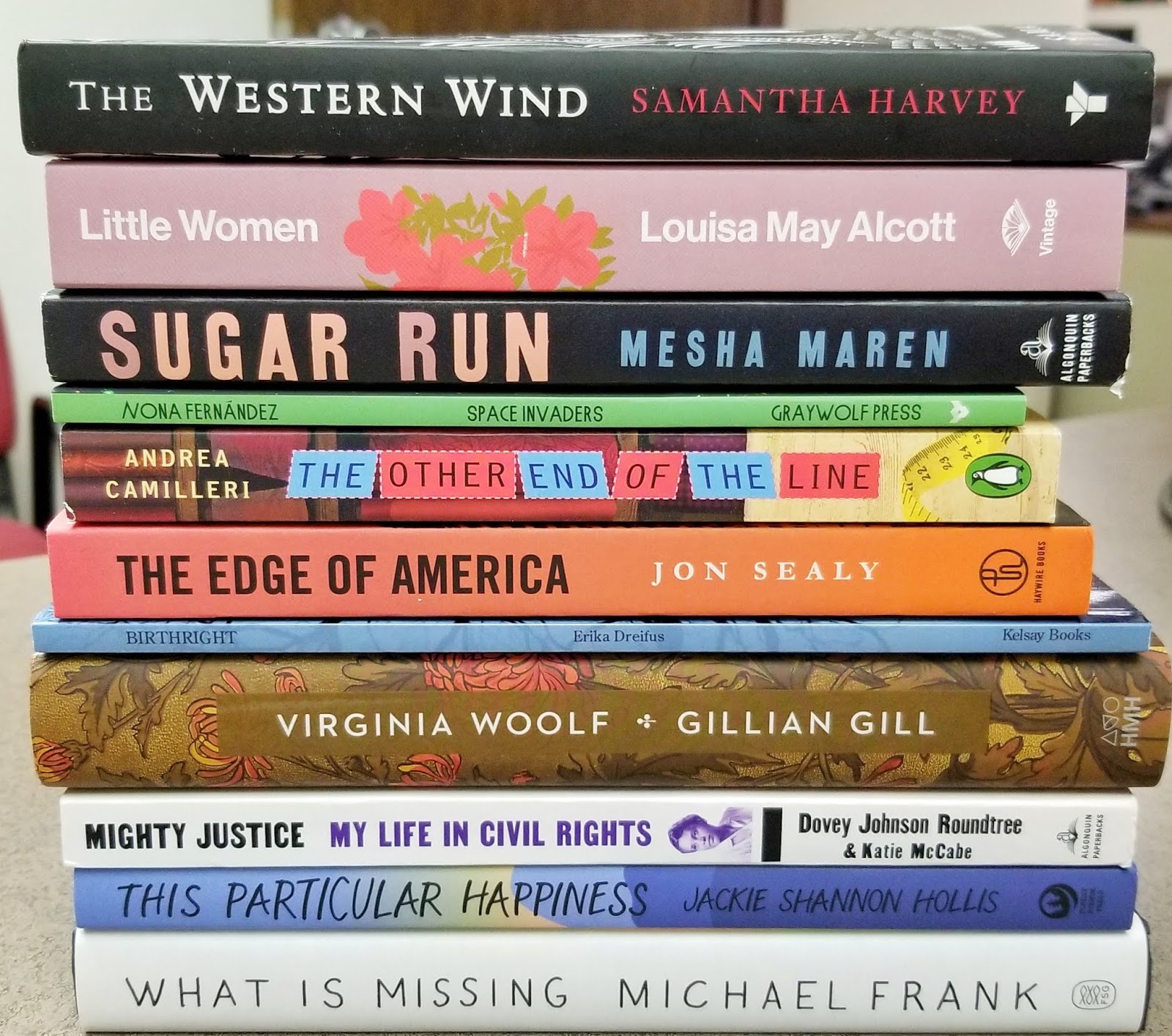
This week, I’ve donned a Santa Claus suit and put together a big, multi-book giveaway, just in time for the holidays. I have a stack of eleven books up for grabs. One lucky reader will win them all. Will it be you? Keep scrolling for more information on the book and how to enter the contest...


The Western Wind by Samantha Harvey: It’s 1491. In the small village of Oakham, its wealthiest and most industrious resident, Tom Newman, is swept away by the river during the early hours of Shrove Saturday. Was it murder, suicide, or an accident? Narrated from the perspective of local priest John Reve—patient shepherd to his wayward flock—a shadowy portrait of the community comes to light through its residents’ tortured revelations. As some of their darkest secrets are revealed, the intrigue of the unexplained death ripples through the congregation. But will Reve, a man with secrets of his own, discover what happened to Newman? And what will happen if he can’t?

Little Women by Louisa May Alcott: A Vintage Classics edition of Louisa May Alcott’s beloved and influential story of the March sisters, which is once again a major motion picture. First published in 1868, and based on Louisa May Alcott’s own unusual family, the novel brought to life some of American literature’s most spirited female characters—and this edition has a fresh new cover to match the vibrancy of these heroines. Little Women has long been one of the most enduringly beloved classics of children’s literature, as popular with adults as it is with young readers. Generations have been entranced by the adventures of the four March sisters, each with their distinct and realistic virtues and flaws: tomboyish, ambitious Jo; frail and sweet Beth; beautiful, confident Meg; and artistic, willful Amy. With their patient mother, Marmee, they survive the hardships of the Civil War and the dramas and tragedies of family life.

Sugar Run by Mesha Maren: In 1989, Jodi McCarty is seventeen years old when she’s sentenced to life in prison. When she’s released eighteen years later, she finds herself at a Greyhound bus stop, reeling from the shock of unexpected freedom but determined to chart a better course for herself. Not yet able to return to her lost home in the Appalachian Mountains, she heads south in search of someone she left behind, as a way of finally making amends. There, she meets and falls in love with Miranda, a troubled young mother living in a motel room with her children. Together they head toward what they hope will be a fresh start. But what do you do with your past—and with a town and a family that refuses to forget, or to change?

Space Invaders by Nona Fernandez: Space Invaders is the story of a group of childhood friends who, in adulthood, are preoccupied by uneasy memories and visions of their classmate Estrella González Jepsen. In their dreams, they catch glimpses of Estrella’s braids, hear echoes of her voice, and read old letters that eventually, mysteriously, stopped arriving. They recall regimented school assemblies, nationalistic class performances, and a trip to the beach. Soon it becomes clear that Estrella’s father was a ranking government officer implicated in the violent crimes of the Pinochet regime, and the question of what became of her after she left school haunts her erstwhile friends. Growing up, these friends―from her pen pal, Maldonado, to her crush, Riquelme―were old enough to sense the danger and tension that surrounded them, but were powerless in the face of it. They could control only the stories they told one another and the “ghostly green bullets” they fired in the video game they played obsessively.

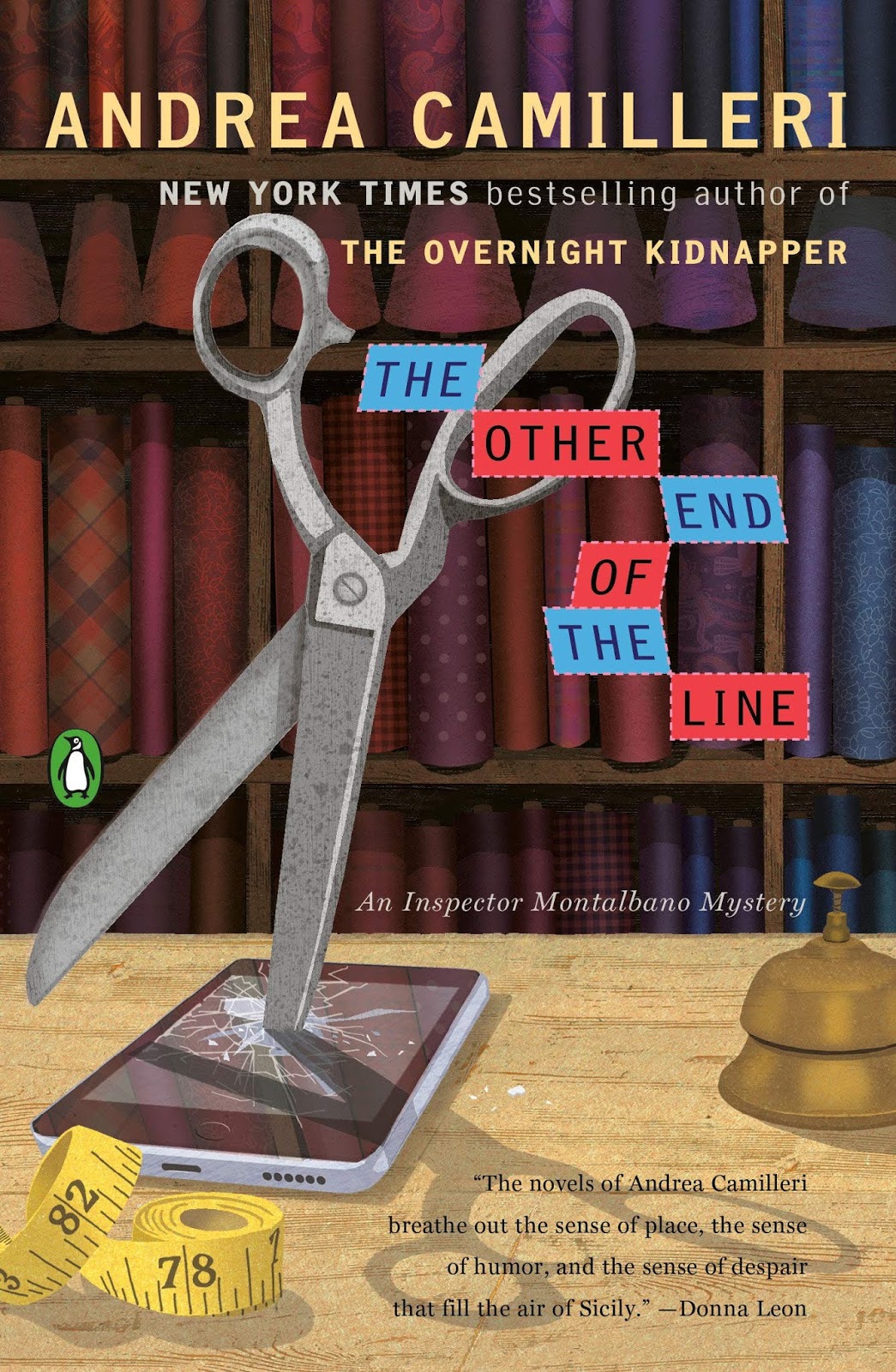
The Other End of the Line by Andrea Camilleri: A wave of refugees has arrived on the Sicilian coast, and Inspector Montalbano and his team have been stationed at port, alongside countless volunteers, to receive and assist the newcomers. Meanwhile, Livia has promised their presence at a friend’s wedding, and the inspector, agreeing to get a new suit tailored, meets the charming master seamstress Elena Biasini. But while on duty at the dock one late night, tragedy strikes, and a woman is found gruesomely murdered. Between managing the growing crowds at the landing, Montalbano delves into the world of garments, in the company of an orphaned cat, where he works to weave together the loose threads of the unsolved crimes and close the case.

The Edge of America by Jon Sealy: Bobby West is on the edge. As chief financial officer for a Miami holding company and a CIA front, he has overleveraged his business in the go-go 1980s financial culture. He turns to a deal-with-the-devil money laundering operation with a local gangster, Alexander French--a deal which quickly goes south when $3 million goes missing. Now Mr. French, a group of Cuban exiles, and an Israeli smuggler named Adriana Chekhov are all after Bobby West to pay up. With echoes of Iran-Contra and the Orwellian surveillance state, The Edge of America is a stunning thriller about greed, power, and the limits of the American dream.

Birthright (Poems) by Erika Dreifus: The poems in Birthright embody multiple legacies: genetic, historical, religious, and literary. Through the lens of one person’s experience of inheritance, the poems suggest ways in which all of us may be influenced by how we perceive and process our lives and times. Here, a poet claims what is hers as a child of her particular parents; as a grandchild of refugees from Nazi Germany; as a Jew, a woman, a Gen Xer, and a New Yorker; as a reader of the Bible and Shakespeare and Flaubert and Lucille Clifton. This poet’s birthright is as unique as her DNA. But it resonates far beyond herself.

Virginia Woolf by Gillian Gill: How did Adeline Virginia Stephen become the great writer Virginia Woolf? Acclaimed biographer Gillian Gill tells the stories of the women whose legacies—of strength, style, and creativity—shaped Woolf’s path to the radical writing that inspires so many today. Gill casts back to Woolf’s French-Anglo-Indian maternal great-grandmother Thérèse de L’Etang, an outsider to English culture whose beauty passed powerfully down the female line; and to Woolf’s aunt Anne Thackeray Ritchie, who gave Woolf her first vision of a successful female writer. Yet it was the women in her own family circle who had the most complex and lasting effect on Woolf. Her mother, Julia, and sisters Stella, Laura, and Vanessa were all, like Woolf herself, but in markedly different ways, warped by the male-dominated household they lived in. Finally, Gill shifts the lens onto the famous Bloomsbury group. This, Gill convinces, is where Woolf called upon the legacy of the women who shaped her to transform a group of men--united in their love for one another and their disregard for women--into a society in which Woolf ultimately found her freedom and her voice.

Mighty Justice: My Life in Civil Rights by Dorothy Johnson Roundtree and Katie McCabe: In Mighty Justice, trailblazing African American civil rights attorney Dovey Johnson Roundtree recounts her inspiring life story that speaks movingly and urgently to our racially troubled times. From the streets of Charlotte, North Carolina, to the segregated courtrooms of the nation’s capital; from the male stronghold of the army where she broke gender and color barriers to the pulpits of churches where women had waited for years for the right to minister—in all these places, Roundtree sought justice. At a time when African American attorneys had to leave the courthouses to use the bathroom, Roundtree took on Washington’s white legal establishment and prevailed, winning a 1955 landmark bus desegregation case that would help to dismantle the practice of “separate but equal” and shatter Jim Crow laws. Later, she led the vanguard of women ordained to the ministry in the AME Church in 1961, merging her law practice with her ministry to fight for families and children being destroyed by urban violence. Dovey Roundtree passed away in 2018 at the age of 104. Though her achievements were significant and influential, she remains largely unknown to the American public. Mighty Justice corrects the historical record.

This Particular Happiness by Jackie Shannon Hollis: Knowing where your scars come from doesn’t make them go away. When Jackie Shannon Hollis marries Bill, a man who does not want children, she joyfully commits to a childless life. But soon after the wedding, she returns to the family ranch in rural Oregon and holds her newborn niece. Jackie falls deep into baby love and longing and begins to question her decision. As she navigates the overlapping roles of wife, daughter, aunt, sister, survivor, counselor, and friend, she explores what it really means to choose a different path. This Particular Happiness delves into the messy and beautiful territory of what we keep and what we abandon to make the space for love.

What is Missing by Michael Frank: Costanza Ansaldo, a half-Italian and half-American translator, is convinced that she has made peace with her childlessness. A year after the death of her husband, an eminent writer, she returns to the pensione in Florence where she spent many happy times in her youth, and there she meets, first, Andrew Weissman, an acutely sensitive seventeen-year-old, and, soon afterward, his father, Henry Weissman, a charismatic New York physician who specializes in—as it happens—reproductive medicine. With three lives each marked by heartbreak and absence—of a child, a parent, a partner, or a clear sense of identity—What is Missing offers Costanza, Andrew, and Henry the opportunity to make themselves whole when the triangle resumes three months later in New York, where the relationships among them turn and tighten with combustive effects that cut to the core of what it means to be a father, a son, and—for Costanza—a potential mother.

If you’d like a chance at winning ALL THE BOOKS, simply e-mail your name and mailing address to


Put FRIDAY FREEBIE in the e-mail subject line. Please include your mailing address in the body of the e-mail. One entry per person, please (or, two if you share the postsee below). Despite its name, the Friday Freebie remains open to entries until midnight on Dec. 19, at which time I’ll draw the winning names. I’ll announce the lucky reader on Dec. 20. If you’d like to join the mailing list for the once-a-week newsletter, simply add the words “Sign me up for the newsletter” in the body of your email. Your e-mail address and other personal information will never be sold or given to a third party (except in those instances where the publisher requires a mailing address for sending Friday Freebie winners copies of the book). P.S. Since I’m downsizing my own book collection, I’ll occasionally toss an extra book into package. If you aren’t interested in reading the extra “Freebie,” please consider donating it to your local little free library.

Want to double your odds of winning? Get an extra entry in the contest by posting a link to this webpage on your blog, your Facebook wall or by tweeting it on Twitter. Once you’ve done any of those things, send me an additional e-mail saying “I’ve shared” and I’ll put your name in the hat twice.